Daily prompt
What’s the first impression you want to give people?
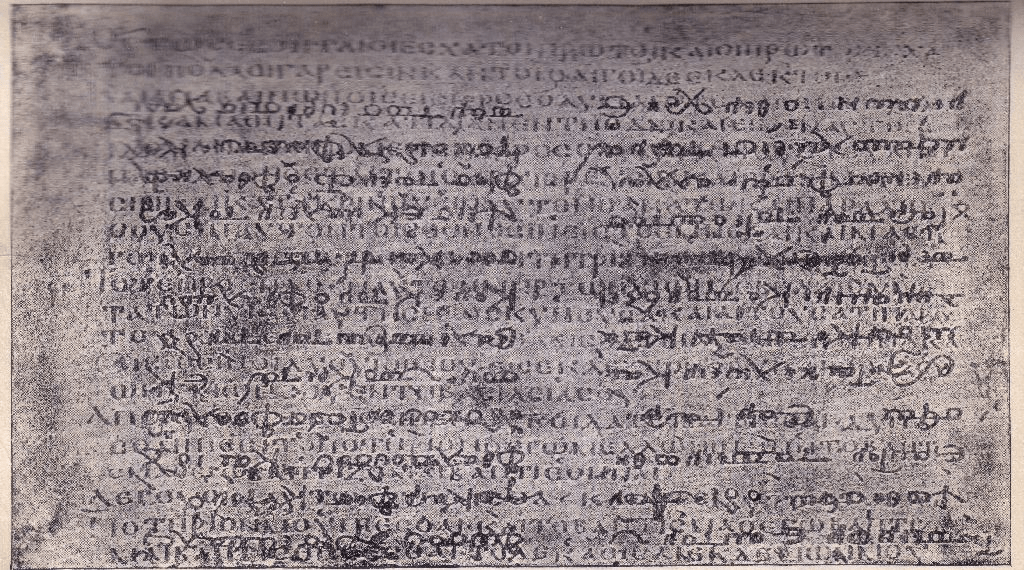
Codex ephremi (The S.S. Teacher’s Edition-The Holy Bible – Plate XXIV).Source is Public Domain, https://commons.wikimedia.org/w/index.php?curid=36972
Ancient manuscripts were written on parchment (though an even more ancient writing surface – the wax-coated tablet of stone was the origin of the idea of writing as making an impression). Parchment is usually made from animal skins and therefore writing often made an indelible impression on them. But parchment – being bought at the cost of the death of the whole animal and the staple of an ancient agrarian economy – was expensive. In order to reuse it, the text of an old written communication would be scraped off and a new text inscribed. The etymology of the word palimpsest, Wikipedia tells us (see link on the the word), actually describes that process including the scraping off:
The word palimpsest derives from Latin palimpsestus, which derives from παλίμψηστος, palímpsēstos[3] (from Ancient Greek πάλιν (pálin) ‘again’, and ψάω (psáō) ‘scrape’), a compound word that describes the process: “The original writing was scraped and washed off, the surface resmoothed, and the new literary material written on the salvaged material.”[4] The Ancient Greeks used wax-coated tablets to write on with a stylus, and to erase the writing by smoothing the wax surface and writing again. This practice was adopted by Ancient Romans, who wrote on wax-coated tablets, which were reusable; Cicero‘s use of the term palimpsest confirms such a practice.
The nearest thing to this in visual art processes is the study of old paintings for pentimenti (the plural of pentimento) – the recoverable remains on a canvas or other material of an earlier version of the painted image or part of it or even an entirely different painting that had been discarded and the painting surface re-used. The point of all this is I think that in some way ‘first impressions’, even though they may have been cut deep into material that keeps a trace of them impressed still upon it, are only recoverable by some archaeological process that is painstaking for later impressions have been drawn over them or over-painted as images or over-written as in some ancient Biblical manuscripts (see the illustration above).
The term palimpsest itself has a long history in philosophy, psychology and literature that has somewhat overwritten itself on the ancient meanings of the term. A useful article can be recovered from the internet outlining its use by Derrida and Freud by Sarah Dillon called ‘Re-inscribing De Quincey’s Palimpsest: The Significance of the Palimpsest in Contemporary Literary and Cultural Studies’ (available hopefully at that link). Freud talked about it in essay The Mystic Writing-Pad, which compares how impressions are collected and sometimes inter-related, and become dynamically interactive, by an accident of contingency or by association in the Unconscious ( the system Ucs., as he sometimes called it) as material that half-reveals (and half-conceals of course) unconscious ideas, feelings and sensations in the mind to be used in parapraxes, dreams, jokes or uncovered in analysis. Her point in part is that the revival of the term in human studies – especially in those with an interest in mental processes like memory – was Thomas De Quincey and he used i in his first drug-focused memoir, The Confessions of an English Opium-Eater. Samuel Taylor Coleridge, a close friend of De Quincey and fellow addict, referred to the term too in terms of recovering lost selves in his arcane autobiography, Biographia Literaria. Dillon cites an essay called The Palimpsest by De Quincey.
What else than a natural and mighty palimpsest is the human brain? Such a palimpsest is my brain; such a palimpsest, O reader! is yours. Everlasting layers of ideas, images and feelings, have fallen upon your brain softly as
light. Each succession has seemed to bury all that went before. And yet in reality not one has been extinguished.
Dillon shows that the use of this figurative idea bout the effect of impressions on the mind – literal deep dents recording first impressions, provided those impressions are capable of being cut deep enough, that can be recovered by some process of archaeology and may not be ever be removable permanently. Dillon writes of one such deep-cut impress of past memory in De Quincey thus:
It confirms his belief – voiced twenty-four years earlier in the passage in the Confessions that prefigures ‘The Palimpsest’ – ‘that there is no such thing as forgetting possible to the mind’ (TDQ, 69). As such, it offers the
All quotations from Sarah Dillon including De Quincy citations are from: https://research-repository.st-andrews.ac.uk/bitstream/handle/10023/3241/ReinscribingDeQuinceyDillon.pdf;sequence=1#:~:text=De%20Quincey%20was%20not%20%20the%20first%20writer,period%20of%20palimpsest%20discoveries%29%20to%20the%20present%20day.
reassurance that erasure and death, even if they appear permanent, can always be reversed – that nothing can properly and truly ‘die’. In the Suspiria, the construction of the mind as palimpsest functions specifically as one of a number of resurrective fantasies with which De Quincey attempts to secure the continued life of his sister
Elizabeth. …
Of all the ‘mysterious handwritings of grief or joy which have inscribed themselves successively upon the palimpsest of…[his] brain’ (TDQ, 146), the ‘intolerable grief’ of the loss of his sister Elizabeth haunts De Quincey most profoundly:
the deep deep tragedies of infancy, as when the child’s hands were unlinked forever from his mother’s neck, or his lips for ever from is sister’s kisses, these remain lurking below all, and these lurk to the last. Alchemy there is none of passion or disease that can scorch away these immortal impresses. (TDQ, 146)
The resurrective fantasy of the palimpsest of mind provides the assurance that Elizabeth is not dead, but sleeping.
‘Immortal impresses’ is a beautiful word and so different from the way the term impression, especially in the term ‘first impression’ is used in modern times, or at least since the days and contexts of image manipulation by one person on another to create a ‘memorable’ persona for oneself – a kind of self-advertising particularly useful in job interviews and never having much to do with the truth of how one feels or will feel and think in the job itself. The word still is about cutting deep into the consciousness of the observer, especially if they be a powerful one with gifts to give, but the means advised are often extensively superficial, to say the least. Such ‘tips’ are based on good psychological evidence of the cognitive bias to the ‘first impression’ of a person (see the link here for an example), although they ignore the equally important research on ‘recency effects’ in memory – where it is the last impression that cuts deepest, because it is still in short-term memory in the most superficial explanation of those effects but often too because it reinforces the fact that a re-evaluation of earlier impressions has been necessary and that such re-evaluations have disturbed the person let down (as they may see it, by first impressions.
Hence, ask me again what first impression do I want to give people. I think, and have always thought (but this was possible for a baby born in the 1950s as it grew up) that the pressure on ‘appearances’ is a dangerous if inescapable one. Think of Dickens’ creation of Mr and Mrs Veneering in Our Mutual Friend, whose name gives it all away. They maybe all surface but when social effects cut deep they become vulnerable and Veneering kills himself, bereft of any other deeper resource. Nevertheless Dickens still maintained a veneer himself, especially as far as his sexual and domestic life was concerned and evaded anyone getting any deeper ‘mortal impress’ of his life as he actually lived it. No-one is superior to this problem I think.
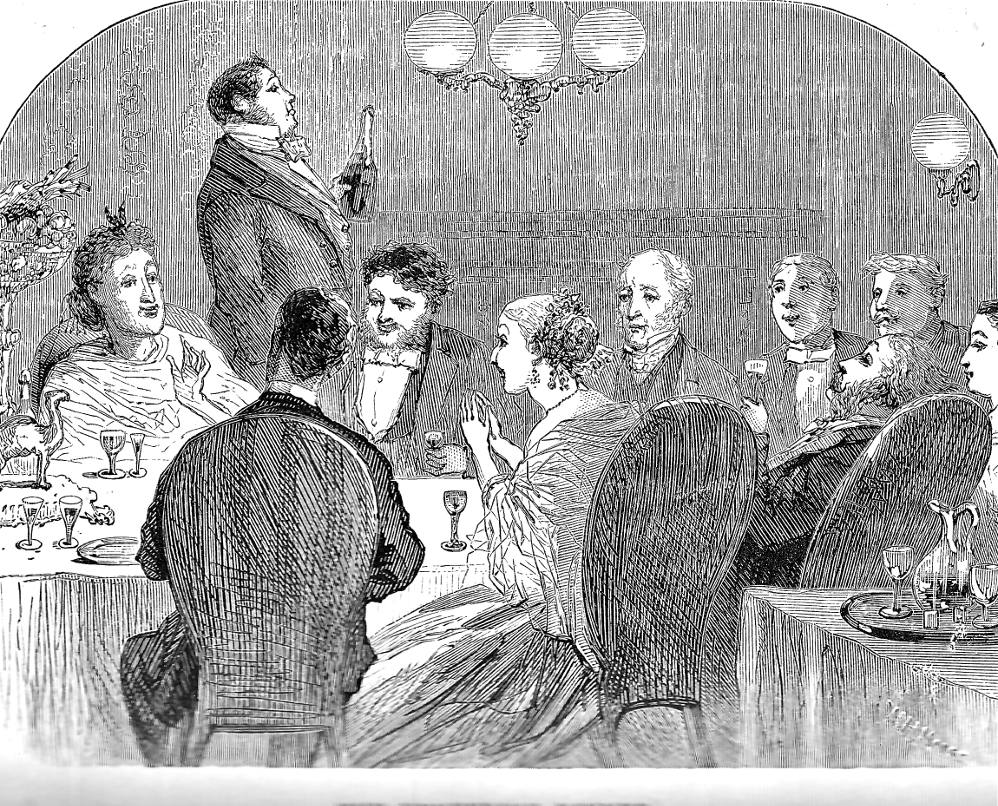
The Veneering Dinner from ‘Our Mutual Friend’ – superficial glimmer before the shadows no longer reflect light
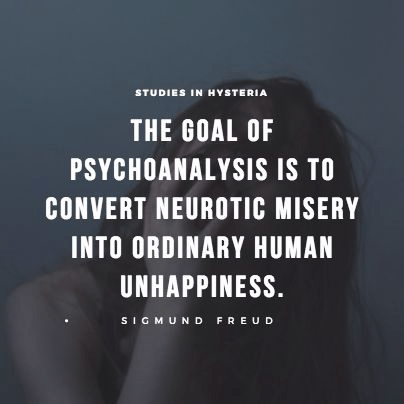
De Quincey’s use of the palimpsest to speak of the resurrection of old memories long buried is not always that of pleasant memories as any reader of the Confessions of An Opium-Eater will attest where opium opens up a portal to absolute terror, like that which must have struck Veneering before he committed suicide. For all of us, appearances of the world that affirm ‘positives’ must seem preferable (but of course veneers – ‘a thin decorative covering of fine wood applied to a coarser wood or other material’ – are never designed to look cheerless, only to be of less substance than they appear to be and to disguise a shoddy reality underlying them. However, it is difficult to not be aware that these positives remain a veneer until the problems located in the deepest layers of the psyche are reframed – and reframing is not as easy a path to positive thinking as the ‘positive psychologists’ would have us believe. Freud thought that even his greatest success as a psychotherapist could be summed up in the thought cited below, from the beginning of his career:
We fail to recognise the importance of ‘ordinary human unhappiness’ to our cost. A palimpsest subsists because it sustains multiple texts of different kinds, from different times of life and the history of a thing, and does not force them into a false coherence or a pathetically inadequate ‘closure’, for all closure is probably inadequate that does not recognise that the self and society still has a layered reality, made up of substances we need to learn to value not cover with a veneer. Mutability only looks like it is ONLY a form of decay when change is accommodated by the self, welcomed in as a new friend or one whose value we have become to disregard. In the latter event, we open our eyes to see the signs of new growth and its potential – just growth of a different nature than our past self had hitherto valued. And it may not look like the active jolly thing thing it was. It may bear the ‘mortal impresses’ as well as the ‘immortal impresses’ De Quincey talked about in a moment of sentimental recall of early family life, and cited above.
So maybe any reader of this, if it have a reader, will realise that I don’t still much care about ‘first impressions’ or impressing people with a finesses of looks I doubt I can aspire to, or ever could in my bearded youth. Depth of impress is not a matter, after all, of sequence, whatever those artificial experiments of short-term memory effects say. So maybe I must finish here.
In fact, not knowing how to finish this, I wrote a poem instead, inscribing some thought from above. Here it is, for better or worse:
Such a palimpsest is your brain, the man
said, opening his heart to receive sad
thoughts that only yesterday had shed light
on that once living love, dead not buried
yet. If the body of our love liv’d again
resurrected, so that I held again
its softer surface to that bleeding wound,
that hard of healing self would leap up new,
‘take up its bed and walk’. Layers settle
Again into that order they once had
Where unhappiness seasoned the joy,
Made it flex again; sunk back to its depths
The ‘mortal impress’ meanwhile seems for moments
That immortal type, a deep refin’d cut,
so strong its scab, it breathes with life like skin.
All my love
Steven
xxxxxx
 Steve_Bamlett_blog
very well
LikeLike