


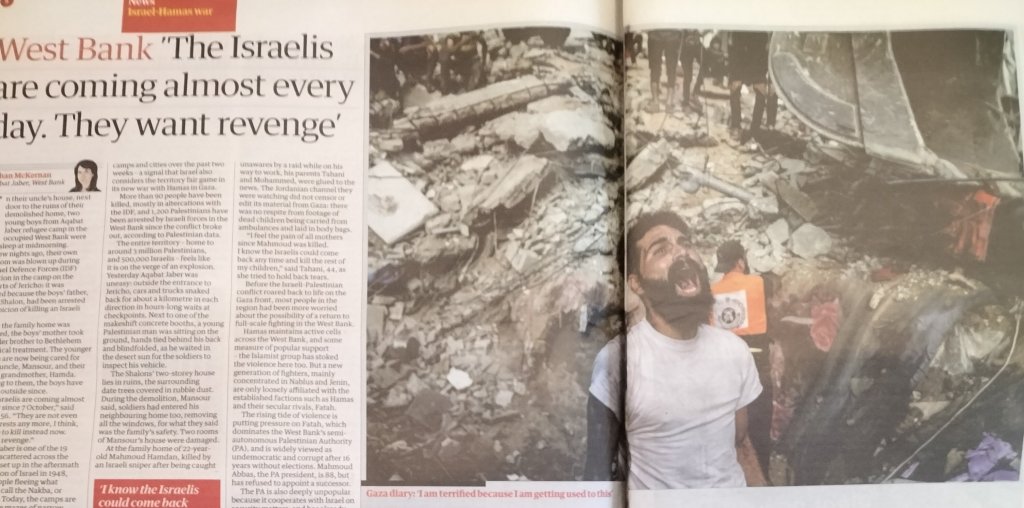
Today it was reported widely that the Israeli government has called for the resignation of the Secretary General of the United Nations (UN) for saying that, though the attacks on Israeli land and people killing an estimated 1400 were ‘appalling’ (as of course they were and more) they were not an event that happened in a historical vacuum. The UN Chief, António Guterres, went on to say, as quoted in The Guardian (Wednesday 25th October 2023, page 1), that Palestinian people had ‘seen their land steadily devoured by settlements and violence; their economy stifled; their people displaced and their homes demolished. Their hopes for a political solution to their plight have been vanishing’. The Israeli UN envoy’s response has been to question Guterres’ suitability for his role and characterise his words as ‘a justification for terrorism’.
Yet nothing that Guterres said is not evidenced from the history of the last 56 years of occupation, military control and strife. The view from Palestinian eyes is however rarely recorded, and when it is sometimes characterised as anti-Semitic (even when the issue has been even to look for a two-state solution that recognised Israel as a political fact). I rely, rightly or wrongly, on the record often from fiction that has based itself on fact from historical witness that do not get on the news programmes except those for cognoscenti. They are within sources such as Colum McMann and Isabella Hammad (I have blogged on their brilliant books Apeirogon and Enter Ghost respectively – see blogs at links on their titles).

From left: Colum McCann, Bassam Aramin and Rami Elhanan talk about ‘Apeirogon’ (Photo by Toby Tabachnick) The latter two real people here are McCann’s main ‘characters’ in the novel and both had a history in militancy on each side of a violent form of the historical struggle still continuing but were now peace campaigners. From ‘The Pittsburgh Jewish Chronicle’. Available at: https://jewishchronicle.timesofisrael.com/israeli-palestinian-conflict-explored-in-colum-mccanns-new-novel/
I cannot look long at the suffering caused by the Hamas incursion into Israel nor the present massive death toll daily inflicted by a ferocious and inflexible Israeli military response against a whole nation without pain, but infinitely less pain than those involved . Neither am I pretending to expertise on the matter. The only point I want to draw is that António Guterres was merely stating, when he spoke, the truth of the situation. That truth is that single historical events are never isolated from the long duration of the historical processes in which these events occur. They only become events isolated from history when they spark a response that pretends to be based upon that single event alone.
Some see the event in a different historical context. Many commentators have said that the Hamas murders were comparable to the ‘pogroms’ of Jewish people by forces motivated by racial hatred, but that historical context ignores a lot of other factors about the realities of inter-group experience in the Middle East. I think the point is that, though we are distant witnesses of this event (if we are geo-socially lucky), of a historical event, we barely take into account the fact that history is a cumulative and spiralling process in which events have to take their explanation or remain misunderstood. Of the current war in Gaza, ever likely to spread wider, I have now to remain silent beyond despairing that Guterres’s making of a simple point intended to nuance the approach to war and its conduct has been taken as something clearly not intended. No-one should justify terrorist murder, but if we refuse to UNDERSTAND its genesis and aetiology we will make it increasingly likely as the only response that springs from oppression that is otherwise unacknowledged.
However, the context of these thoughts turning in my head has been nothing to do with that historic conflict but with climate change. Yesterday I bought a copy of Romain Felli’s (translated by David Broder) book Climate, Capitalism and Catastrophe: The Great Adaptation (published by Verso press in 2021). I have not finished it and may report at more length because I read it to grasp more about the reasons I feel Green politics are primary in our present historical circumstances. That belief of mine is nuanced by the sense that Green politics is itself problematic and not innocent of other interests that sometimes speak through it. Though a socialist, the issue of a world at peril of extinctions has been with me since my schooling in the 1960s. Naively, I think I saw the many memories I have of supposedly historic pronouncements on the issue were never ones that happened in a vacuum that might interpret them as being less part of Green political history but of a political resistance to the means of addressing Green issues.
My last sentence would have seemed a contradictory and hard to understand sentence before I started Felli’s book but, as I read Chapter 1 and am into Chapter 2, it is clear that things that happened to the 1970s I had conceived of as steps to a recognition of the primacy of say, global warming, as a vitally significant process were perhaps not so. They were a series of events too long in duration to be called an ‘event’ suitable for this prompt question but around which crystallised a response that appeared to be be about green politics but that really addressed the security of the power structures of the status quo and interested stakeholders that sustained them.
Let’s take one idea that grew powerful first in the 1970s, for it explains the present approach of the Blairite champions in the Labour Party, scenting its time in government again (and nothing could be worse than the present UK incumbents of government). The view is that an adapted capitalism, although in truth only adapted in very minor ways and vulnerable to reversal in the short term, was the answer to national economic decline and poverty caused by social-economic differentials in its effect AND that it would also save us from ecological extinctions implicit in the phenomenon of climate change we call global warming. The talk is of sustainable growth, growth through the increased production of ‘green’ technologies dominated by the already rich West and North of the globe – growth that is a solution demanding very little change but rather ADAPTATION to a crisis. In fact in this context crisis, surprisingly, is read in this analysis, as if it were a crisis with a silver lining. That idea began in the 1970s according to Felli, in thought designed to save the structure of multi-national capitalism and its giant interests in agricultural and energy technology.
Like all ideas in our politics it is prompted by a refusal to see history as other than a series of events like changes of the personnel of government whose function is adapting to changes we cannot control. But the adaptation will not adapt the fact that the solution to all ills according to capitalism – GROWTH – is still seen as a solution even for ecological destruction. It occults the fact that growth has not only created but feeds the development of the problem of global warming. The response to green issues, of which I was aware in the 1970s was a series of significant events (world conferences and hopeful announcements (and pronouncements in hugely influential books)) of action on Green issues. However, Felli says in his book that these events were not about saving the world but were instead a strategy to remodel capitalism in the interests of its own long-term survival and with it, its belief that economic growth was still the answer to all ills. This strategy:
allows the debate on the climate crisis to be shifted away from the question of reducing greenhouse gases and towards the transformation of socio-ecological systems. in order to adapt them to a changing climate. This means a quest not to avoid change, but rather to minimise its consequences. It can even mean embracing climate change in order to draw profits from it. … The ‘great adaptation’ answers the climate crisis not by reining in the market, but by expanding it.’,
Romain Felli’s (translated by David Broder) [2021: 10] ‘Climate, Capitalism and Catastrophe: The Great Adaptation‘ London, Verso Press.
Meanwhile, what Governments did was organise ‘events’. And they still do, as instanced in the Glasgow UN Climate Change Conference of 2021, and make so that they look good and significant as EVENTS and yet achieve nothing against the forces of the historic processes they supposedly address. Moreover, the shortcomings of these events, where admitted at all, will always be blamed on economies previously not originally beneficiaries of nakedly aggressive growth based on fossil fuel reserves (such as India) .

Nothing in Labour’s programme is different from this approach. Much is now still in the air following a U-Turn on Green Investment Policy, which was still merely adaptive. What we have now is just plain management of the capitalist levers. We need that no doubt but …. (For more on that read this: https://www.bbc.co.uk/news/uk-politics-65857109). Now, we can’t afford longer subjection to Tory government if the issues are to be addressed but we need to remember that the worst outcome of all is a policy certain to doom the world to a growing number of extinctions and climatic disruptions that will sweep away some nations, impoverish others, increase migrations and make a negative result in government with a more aggressive defence of the rights of the privilege of powers-that-be. This may all be long term but perhaps not as long term as we think.
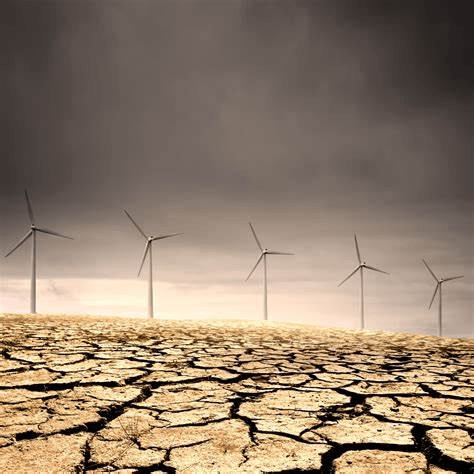
This is just some thoughts. Though the thoughts may offend some, they are not intended to do so but address the fact of not addressing the analysis of history but thinking on;y of memorable events in our lives.
With love
Steve
 Steve_Bamlett_blog