What was the hardest personal goal you’ve set for yourself?

To tell a story about giving up alcohol as a means of embracing life ought to be a humbling experience for the amount of self-congratulation for having made that choice needs the perspective of stories of people for whom this choice was both starker in its origins in their life experiences as for Ben Ashcroft, a working-class care-leaver who seized opportunities to share his stories of a broken care-system and the fragmented lives of alcohol dependency and mental distress in consequence. Likewise the experience of migration, racism and homophobia in the Canadian memoirist, Mohamed Abdulkarim Ali, or the complex path of a man of talent and skill who just got hooked on stimulation outside his own resources and began to lose them all, like Bill Clegg. Their books are illustrated below and my blog on them available from the links on their name in this paragraph.
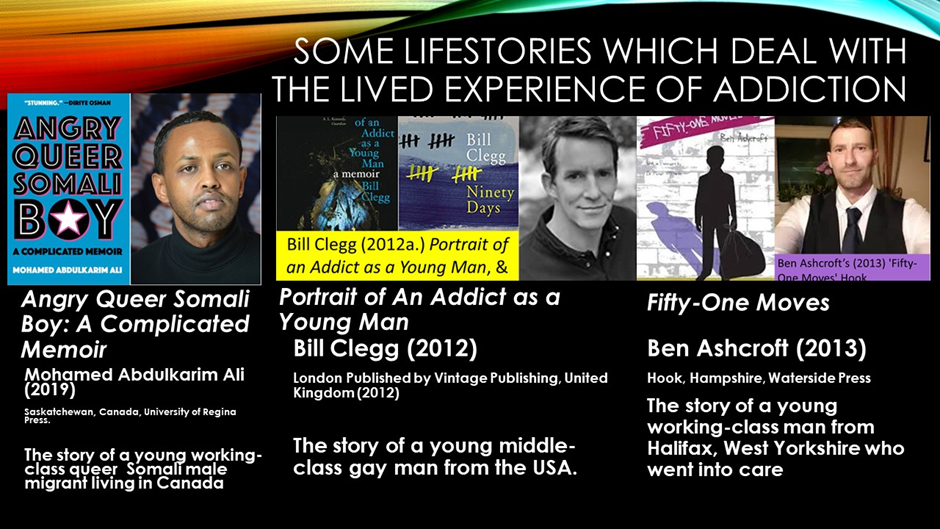
Reading these stories opens one up to the extremes with which substances can begin to represent and displace hopes, fears and turn them into a nightmare with one impoverished object – to remain cut off from all chance of knowing, feeling and even sensing what life might offer. however, in all three cases we miss the point if we see them only as stories about what we call ‘addiction’, for in all cases they are stories where the opportunity to make a choice to live, even in some cases to renounce suicide as an option, is lowered by the capture of the biochemical machinery that is the base level organisation of desire, appetite and perhaps even hope. Alcohol destabilises the role of the forces of ego-strength in the frontal cortex of the brain that mount resistance and inhibition to the easy options for pleasure(even when they are no longer easy but involve, expense, subterfuge and crime to fund that expense and hardship in the form of lost relationships, homes and the good things as well as the shackles of security. The danger of these stories is that they seem to reinforce a common myth of the exceptional nature of the stressors towards alcohol. In fact those pressure whether near to us psychologically (labelled proximal in the chart below), based in social structures outside our immediate circle (distal in the chart, because more distant in their sociopsychological operation) or larger political, economic and social themes (ultimate in the chart).
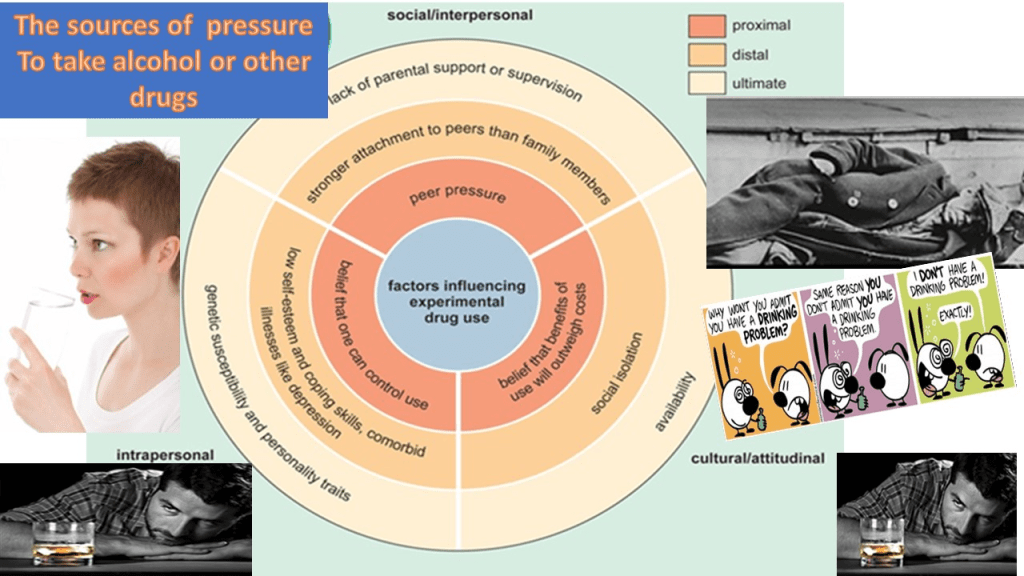
The truth that chart tries to illustrate is that alcohol or drug dependency can happen to any of us and for many is probably already in its operation of becoming a standard recourse to positive pleasure or escape from some kind of pain, sometimes because it is the only basis of our social lives. I have known many a young man who believes that they can be triggered to drink by stress but NOT by the fact that their social outlet of the first choice was sitting in a pub (where they claim to be happy with a diet Coke). So we should not think this choice occurs to people in extremis. For instance the man in the gutter or the young isolated guy staring hopelessly at a whiskey glass in the images above may be our stereotype of the perils of drink in the images above but the young woman lifting a glass of wine and looking cool and sophisticated to her friends is not, but it ought to be.
My path to drink was nearly entirely social, although aided by some experiences of exclusion ad marginalisation along the way. My father was a heavy drinker. he loved it when, as a young kid I joined him at the bar – still too short but trying to rest an arm on a bar to cause an easier leverage for my pint. At university the key social venue was a pub – even a crawl of them across London. Getting drunk made socialising so easy and you had a lot of funny stories to tell afterwards. You also had excuses for behaviour you were not ready to own yet (since I was in the process of coming out but slowly – if not cautiously – and locked about by fear). For some it was excuses for experimental behaviours (thankfully – at the time – for me for that applied to straight male peers, who sometimes wanted to try out something unknown to them). I grew into the alcohol habit. It began to seem a thing that without which life would be very dull indeed, even a night at home, so much more civilized with half-a-bottle of wine and a couple of whiskies afterwards. And then the nights out – still I still want to be the life and soul of an evening.
Giving up took time but the hardest thing I think is tackling the peculiar marriage between psychological dependency and the biochemical distortions of the interaction of the brain pathways (the mesocorticolimbic pathway regulating wanting responses and the sometimes underused inhibitory ones in the frontal cortex of the brain). If we are not far gone the latter recover fairly rapidly into a function that survives without the external inputs and these are not the source of a ‘disease’ we call addiction. But the psychological pressures, especially denial of the problem and fairly rapid mourning responses for the easy buzz resist like anything that path to recovery.
It is easy to fall for the co-dependency that people exert on others in their life to accept a drinker’s lapses and to label them an entirely physical issue over which no control is possible. The issue of control and regulation lies elsewhere and sometimes it is in resistance for harder-to-achieve pleasure – of learning for instance and expanding neural networks with a different longer-term pay off or selecting pleasures that involve at least some effort. We are all cognitive, emotional and to some extent ethical misers of a sort but come in – the waters are lovely. The waters of living and not always for oneself or how one thinks one appears to others. You rarely do – especially when drunk – look all that good.
All my love
Steve
 Steve_Bamlett_blog