Who are your favorite artists?
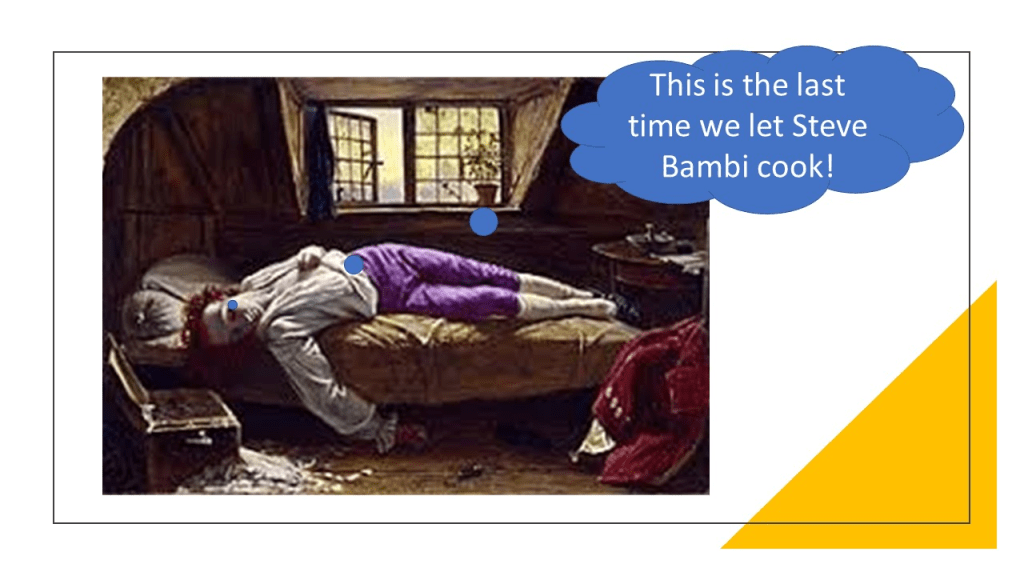
Cooking is an art in which I do not excel. This picture irrelevant to the blog, although this was once my favourite artwork. The joke was devised by my room-mates in the 1970s at university.
Art is a big part of my life and it is not as a maker of it or even aspirant to that. To me art is something that involves the bringing together of concentrated and sometimes compacted mixes of emotion and thought, together with a call out to the senses. Hence, art makes other experiences in life mean more just by abstracting them into itself. Sometimes a work of art exerts a power from the beginning, but great art leaves much more in reserve. You don’t register the magnitude of the experience until your whole being – a space where your present moment speaks to the networks of your memories and visionary anticipation. That takes time in reflection and repetition, but certainly time in reflection, which is key to the experience of true genius (a grisly and overused word) to happen.
But although I can tie that experience of greatness to the art experience, it’s more difficult for me to tie it to the individual artist, despite the fact that the artists I love, in all forms, media and representations are legion. Partly, that is because for me the response to art has to be an opening of the heart, mind and senses. To say I love one of a list of named artists, say Dickens, Shakespeare, Titian, Lucian Freud, Wagner or Prince to name examples from an infinitely longer list of names might represent a truth at some level with each of them.
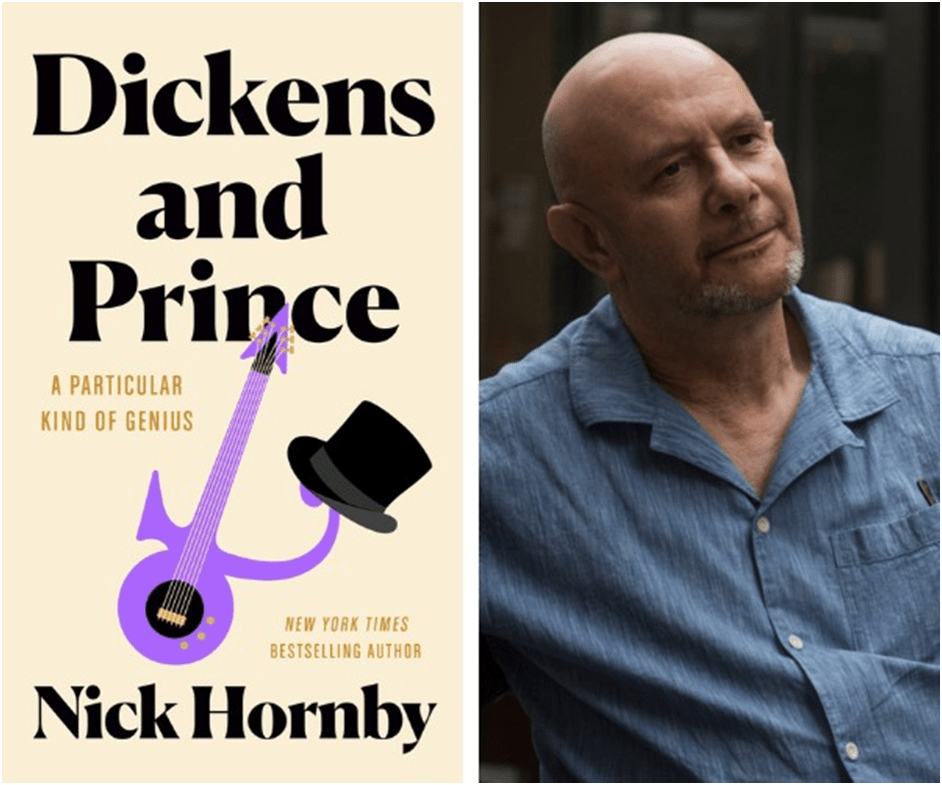
However, that kind of love of art is based on a belief that you know these artists (what their work is and does) too often in people, including me, and would, hence, tie my response to a work of art by them to the preconceptions entailed in believing I know them as artists. This can produce some wonderfully innovative criticism as in a recent book by Nick Hornby, the novelist, comparing the ‘Genius’ of Charles Dickens and Prince (see my blog thereon at this link – https://livesteven.com/2022/10/30/what-do-prince-and-dickens-have-in-common-a-blog-on-why-nick-hornby-is-right-to-look-for-the-answer-to-why-we-cling-to-the-notion-of-individual-genius-in-remarkable-comparisons-between-different-arti/). However, if we use that as our only approach to the comprehensive appreciation of art, it limits response to any artwork even if those preconceptions are as near as possible unique to me (and I doubt such a possibility) and not ones shared sometimes with a whole culture. One virtue of Nick Hornby’s book is that it does break conventional preconceptions of both Prince and Dickens. Think for instance of the damage done by various myths of what Shakespeare is, or does or means. The Tory Party frequently tries to prescribe Shakespeare teaching in schools, to use an extreme example, as a means of promoting English patriotism.
I think I can only be sure I was responding to a work of art in the long duration of its proper reception if I could be sure I was capable of thus responding to a work of art by someone whose name was hitherto unknown to me. And that has happened, though to be fair sometimes through the mediation of someone knowledgeable about the artist. My point can only be written with broad brush strokes of generalisation because there are many contradictions in the process of getting to know and respond fully to an artwork.
However, I have experienced moments when an unknown artist’s work has been encountered through an accident at first, though with digital research-enhanced reflection before it fully stunned me. I remember the first encounter, for instance, with a brief play by Kei Miller at Edinburgh, which Jed me to an enduring love and gratitude for other works, and, I have to say, the artist too now, so that I worry when a new work comes my way, lest it not revive feelings other works inspired. This isn’t though a problem I had had to face thus far (see this sample blog on a later work – a set of essays – by Kei: https://livesteven.com/2021/07/11/i-must-talk-about-my-body-as-black-and-my-body-as-male-and-my-body-as-queer-i-must-talk-about-how-our-bodies-can-variously-assume-privilege-or-victimhood-from-their-conflicting-identi/ ).

Kei Miller
But there is another reason why I resist naming an artist as a favourite experience. Among the names I’ve mentioned it is difficult to tie down sometimes exactly what makes the aesthetic experience of any one of their works so fulfilling without beginning to recognise that this experience is not one led entirely by an author – less so in film where Auteur perspectives used to insist that the glory go to one maker – a director, for instance (https://en.wikipedia.org/wiki/Auteur). Some film directors – headed possibly by Francois Truffaut, the director who was also a critic, liked this concentration on the auteur although difficult to maintain, even in Hollywood, and even in the circumstances where the auteur dominates a film as Orson Welles did Citizen Kane. But films require many strands of work to ensure their production and it is difficult to even exclude even ones that are not obviously artistic or aesthetic. Take producers whose role might be to back a work for financial backing for a film but whose influence was often much larger.
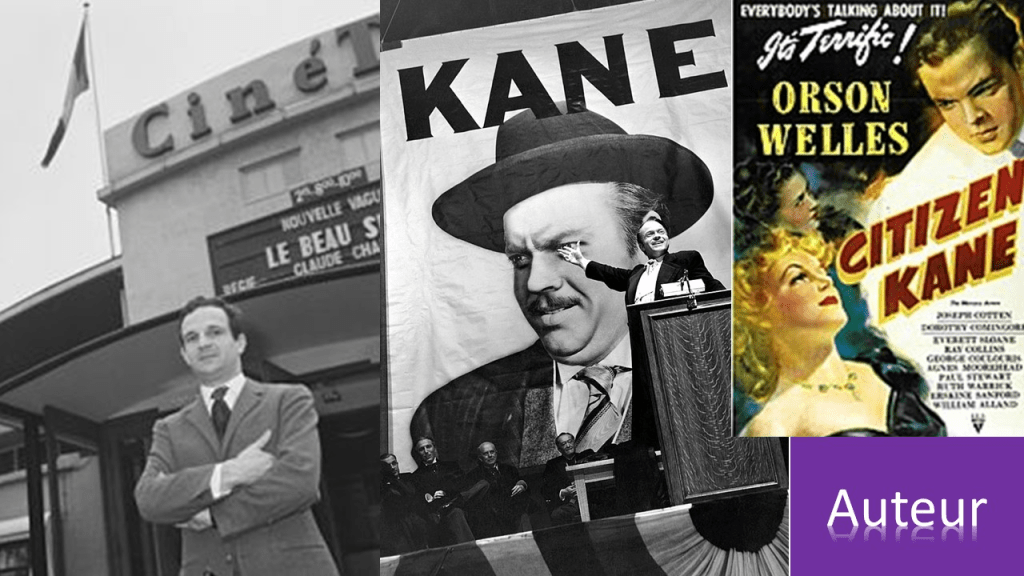
Truffaut and Welles (and Citizen Kane posing as Orson Welles)
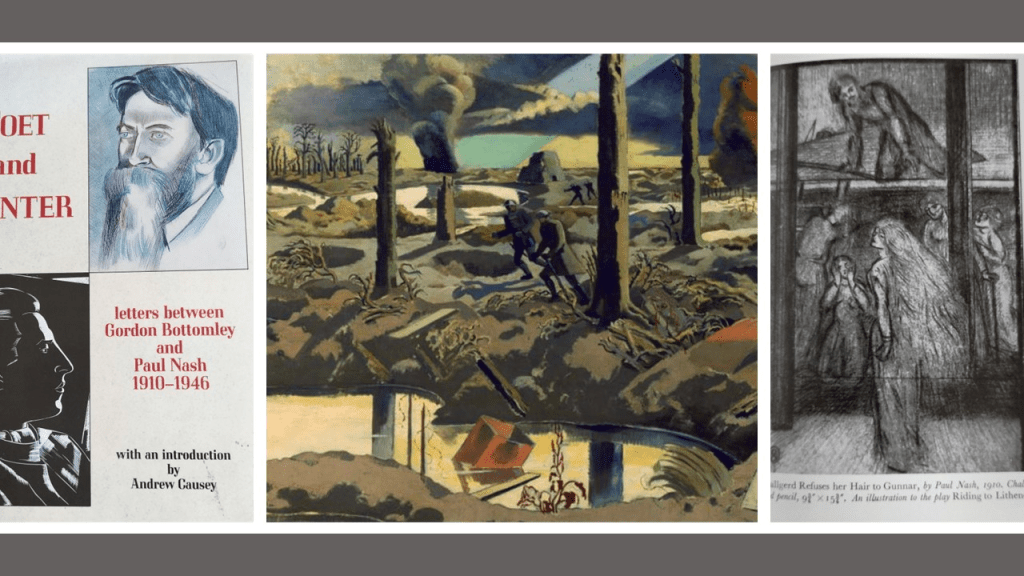
And then there are the actors and the set designers, even location finders and manipulators of location: think of the amazing work – even to the building of a lone mansion done in the Texas scenery of Giant (see my blog here -https://livesteven.com/2023/09/14/as-i-was-reading-mark-griffins-2018-all-that-heaven-allows-a-biography-of-rock-hudson-i-think-i-concluded-that-rock-hudsons-story-and-life-performance-illustrates-that-the-art-of/ ). And what of costume and make-up designers. This is as much more the case in theatre. I am currently reading the letters of a dramatic poet, Gordon Bottomley (forgotten though admired by W.B. Yeats in his day it is claimed by Charles Causey in the book’s introduction) to the Surrealist – modernist English artist, Paul Nash – whose name still causes palpitations (in me at the very least – LOL). Nash’s set designs or realisations of scenes for Bottomley’s plays are now probably rated more by his fans than the plays themselves – like King Lear’s Wife or below The Riding to Lithend – though not considered great in themselves even, unlike Nash’s war painting.
The best example of the problem I could take is a play I am going to see in York the day after tomorrow. The play is Kafka’s Metamorphosis, an adaptation by Lemn Sissay of the highly influential novella by the great modernist writer, Franz Kafka called Metamorphosis. I have blogged on this adaptation but in that blog (use this link to see the blog itself) made it clear that I am blogging on a far from complete experience of the work of art. Some effects, I point out, are totally unknown to me, such as the fate of Gregor’s corpses, in the form of the insect body to which he has metamorphosed, after his ‘disappearance’, as stated by remaining characters on the stage – his parents and sister (the Samsa family).
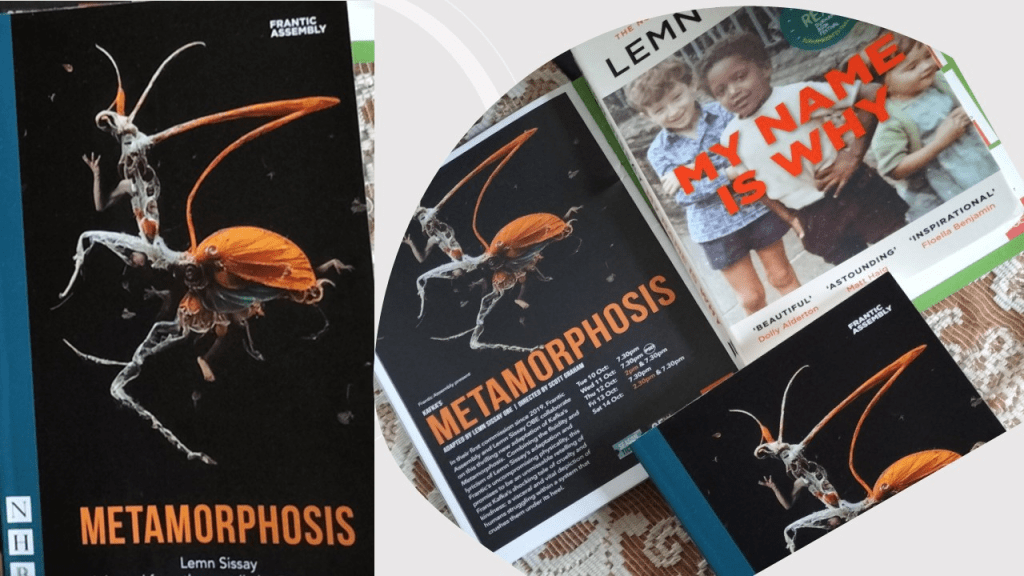
My blog praises the writing of this play and is fascinated by its link both to the translated Kafka original story, which is interpreted freely but with some debt to huge and working debts to the themes and language of the translated. Hence we deal here already with a number of artists in authorial role, or mediating it, Kafka and his translators, at least, even before we deal with Sissay’s text. Yet the text I read, with its many quotations from established translations in part is itself a product of many other working projects, not least Sissay’s memoir of being brought up in foster-care and children’s homes My Name is Why, which mediates the adaptation through that experience without claim that that the experience is an individual one – it is the fate of children brought up in care. And the text is that brought to the reader before the end of rehearsals and a provisional draft of a final text for that reason, for text changes as a result of many influences – creative and pragmatic – that stem from theatrical direction, realisation (including setting, properties, costume and make-up), actors – including the role of their ‘improvised’ improvements to the text spoken by their character, as well as the specific delivery of text as voice (with issues of accent, tone and pronunciation), gesture and movement, These factors are not only in control of each actor but the ensemble, since stage movement is always a matter of both co-operative dynamics and the proxemics of temporary placements that is relational within the ensemble of the cast and between individual cast members, to say nothing of the role of influential observers of rehearsal who are capable of changing the outcomes achieve by formal means (notably the director) or informal ones – by identifying possible audience response of a variant style, such as laughter or tears.
Hence where is the artist I venerate here. It may even be possible, for instance, to evoke Ovid as an influence that is authorial since the novella could not have been written as it is without the influence of the genre he invented in Augustan Rome in his Metamorphoses poem-narratives. Certainly Kafka matters as much as Sissay. A colleague blogger (An-Observer) has spoken of the individual artistry of individual actors in his blog today and there is certainly no denying his point, for actors achieve effects that become part of their oeuvre – certainly true of Rock Hudson, Elizabeth Taylor and James Dean in Giant. Looked at from the point of view of each of them singly, the film is part of an entirely different conception of what constitutes art for them in this aspect, as An-Observer brilliantly says, though he takes in genres about which I cannot even comment from my ignorance, such as those distinctly from the Indian sub-continent and diaspora in origin and distribution.
Here are two large reasons for not choosing either ONE or MORE examples of a favourite artist. Of course they can be questioned. Not everyone would agree that collaboration is a necessity for some art – poetry has the reputation of being considered entirely individual, and even published literary art is heavily influenced by others enough to challenge version of auteur perspective in commenting and responding to it as art. The case for arguing that all creativity is in part (a varying part and open to extremely nuanced interpretation) collaborative in nature is possible to make I think, but not here.
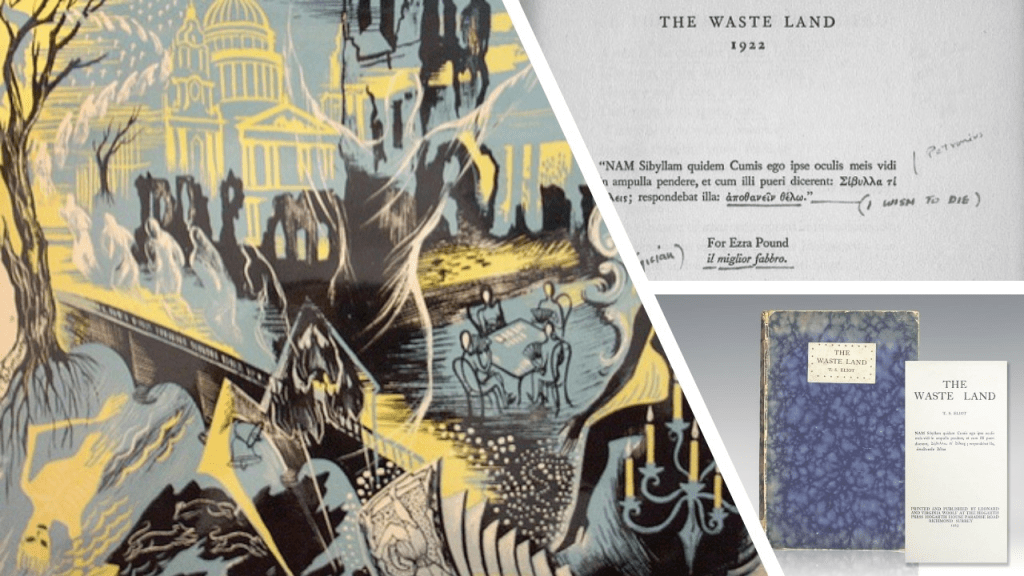
The obvious but unfair example is T.S. Eliot’s The Waste Land of 1922, dedicated by its author to il miglior fabbro (usually translated as the ‘the greater maker), his description of Ezra Pound who heavily edited (and in some part revised) the manuscript). But that example is unfair because it is so exceptional in the public history of poetry – if not – in all possibility – in its private history. A better poet to ask would be the great Andrew McMillan.
This blog has meandered, but I think, despite its meanders, it gets where I want it to be.
With love
Steve
 Steve_Bamlett_blog