What’s your favorite word?
This piece is dedicated to Heppy, who as well as being a man of his word is also wise because he knows words are links to each other and between us all. He is a hero. And a teacher. Lucky students.
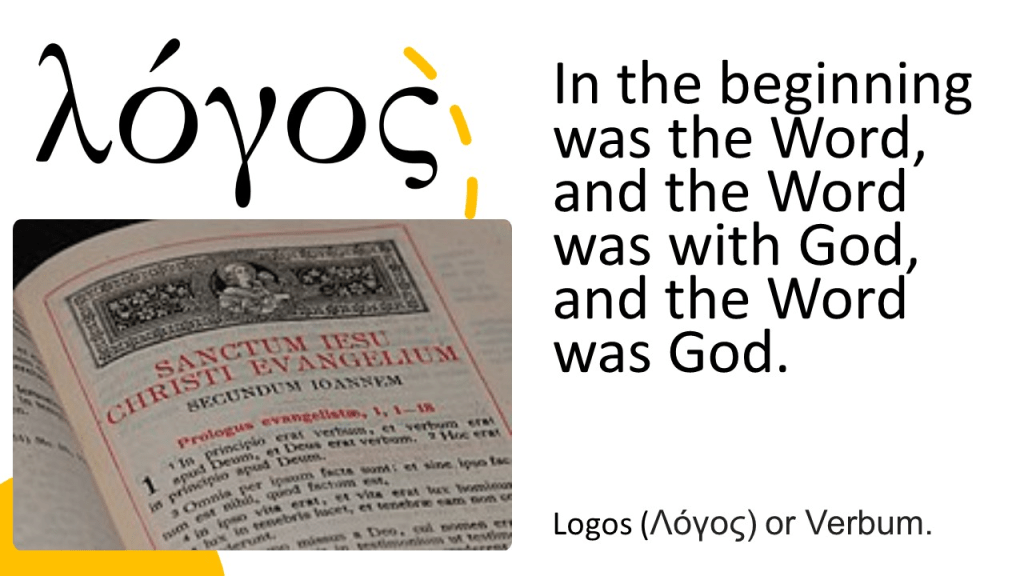
Whether we are religious or not, we live in a logocentric world (one centred on the word). The logos in Greek was ‘discourse’ or ‘reason’ and was predominant in the Socratic tradition, which became the Western and Nothern tradition (sometimes passing itself as global but actually ethnocentric too). Discourse was venerated and spiritual (or let’s say inward-looking or reflexive) in Plato’s symposia but very much about the categorisation of the outside world and the manipulation of that world in Aristotle. In the Bible, the Septuagint corralled the Jewish tradition of the word (sometimes referred to as Torah) as God’s law and metamorphosed it into the representative of Christ and /or the Holy Spirit (depending on on’e sectarian reading). It ensured that for Byzantine (Graeco-Roman) Christianity, that Christ (the Word made Flesh) was present from the very beginning of the World and ensured that Jewish Torah became seen as mainly predictive of the not yet arrived on earth first coming of Christ.
The word WORD has it all ways then, ever-present living incarnated in our very physical nature and dominant thereof, and even for the philosophy of pagans (provided you stick with hegemonic traditions and not veer to the Pre-Socratic philosophers, Pythagoras or non-Neo-Platonised mysticism) it meant everything. The more secular traditions of the seventeenth/eighteenth century Enlightenment were as logocentric as thou when it came to the colonisation of thought and the eradication of errant subjectivity.
And personally I love words – not any one word because words work in a networked associative way that systems like grammar and punctuation from the seventeenth century only attempted to control – but they are not everything I think. There is of course a lively debate about that very thing – whether things only exist in the words we give them (a debate in which the issue of the proliferation of words for snow or snowing when the climatic conditions change human experience of the environment we experience is always raised).

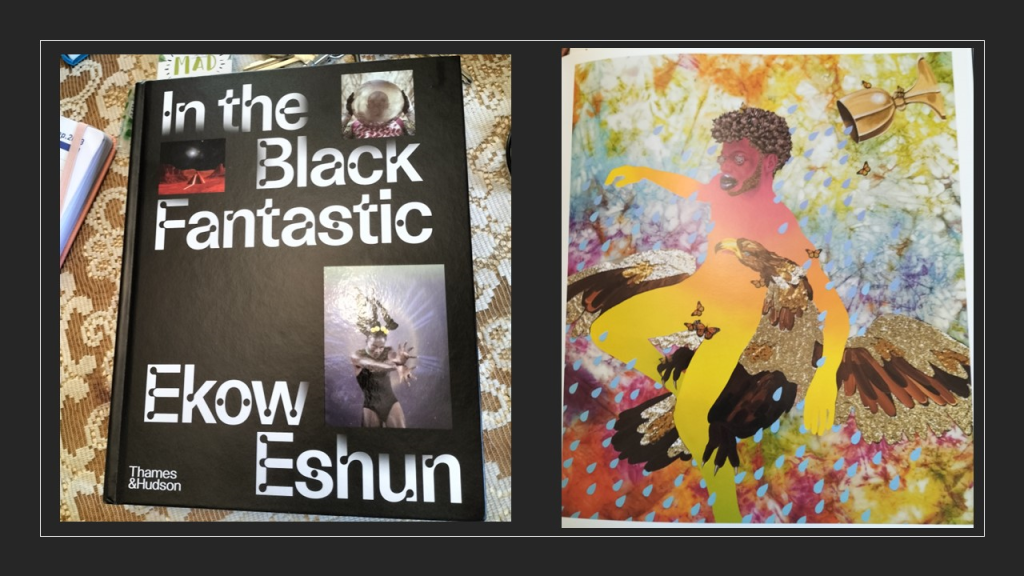
Recently I bought a tremendous book called In the Black Fantastic by Ekow Eshun and relating to an art exhibition of art that renders black experience in terms of the fantastic – not just myth but science fiction – as a means of reviving lost and marginalised Black historical traditions in their ever-changing and living forms and of working outside of the White-centric traditions that have attempted to turn those traditions and experiences into their WORDS. I found in a fascinating essay by Kameelah L. Martin Called Black Feminist Aesthetics, Conjure Feminism, and the Arts the following reference to a tradition in some ways like the theory of the Logos in the West but essentially different. Martin writes of present-day Mali where is encouraged (p. 138):
… a belief in the power of the spoken word to shift reality. That is, ‘by human utterance or through the spoken Word, human beings can invoke a kind of spiritual power. But of course, the word began with Amma or the Creator who created words by uttering three successive words’. Through the power of Nommo or the spoken word, humanity is able to create and manifest life by similar means to Amma, the Dogon high god. The sacred and the secular co-exist, and rely upon each other for the world to maintain itself: “the Word”, or the power of Nommo, does not rely solely with the Creator but also with human beings. … it is humans who have mastery of the Word.
Wherein does Nommo differ?
- First there is no immediate elision between the spoken word, the tradition which Father Walter J. Ong used to be famous for defending and wishing to rescue from history before our current desiccated academic culture banished him from literary classrooms, and gave us into the hands of the digitally created but not hegemonic word-world of the Internet and social media. The acme of the written word is THE LAW.
- Second, the Word is not colonised by God. What is made flesh in the Christian tradition is God’s word, and an amended Torah, not the power of speech (or language or communication, itself. Nommo does not belong to or identify with Amma or the Creator, it just has some similar powers. It means creation is ongoing and collaborative between the already conceived world in Amma’s mind and speech and that in the union of human voices.
- Third the word is the equivalent in a created world of human agency and the spoken word is the word of the body: what enclothes or adorns it, and what actions t uses to bring change into being. It is not conservative but preservative in the spirit of change in the interest of all.
- And, I suppose Nommo tells stories of Gods, from any tradition differently. Nommo is not created as ‘the Word’ (one Word like God’s Word) but as ‘three consecutive words’ that can only mean something in their networked associations and integrating collaborations.
Though Martin uses conjure feminist versions in art (mainly film) to illustrate her work, I wondered if the point is also made by Devan Shimoayama’s uplifting of the story of Ganymede’s abduction (The Abduction of Ganymede [2019] in In the Black Fantastic p. 109) to recreate the suffering, and perhaps the glory to come of the process of colonisation – the glory will be when the colonised become Themistocles without the American eagle and what it stands for, all signs of God – the story of the rape of Danae is in there as is the attempted rape of Psyche by Cupid. A very wonderful queer writer indeed used this for the cover of their last great novel – my blog linked here on David Santos Donaldson’s (2021) ‘Greenland: a novel’.
There is more than one word always. It always matter that it is so.
With love
Steve
 Steve_Bamlett_blog
One thought on “My favourite word is NOT ‘WORD’. Because the Word on its own is not everything but it keeps pretending it is.”