How do we travel the distance between us? Seeing the film Midwinter Break at the new Reel cinema, Bishop Auckland at 1 p.m. on Monday 30th March 2026.
Let’s pause for a moment to acknowledge that the key flashback in Midwinter Break is to a moment in which the Northern Irish troubles hit the lives of a very young middle-class (she to be a teacher, he an architect) couple and lead to their voluntary exile. There is little or no narrative force hanging specifically on this specific aspect of the flashback except for a recognition of a cause of accidental bodily hurt and a later feeling of being alienated from your homeland and put at a distance from it. Peter Bradshaw in The Guardian says, rather gnomically:
Perhaps there is something a little bit straightforward about making the Troubles a keynote moment in the past for Northern Irish characters, though for a certain generation it is plausible enough.
I am not very sure of the force of that descriptor ‘straightforward’. I agree, as I hint below that the Troubles are used to express a motive of distance from one form of identity or homeland, but otherwise they explicate only distance. As Stella, former teacher living in Glasgow asks her husband Gerry: ‘Have you thought where you wanted to be buried. In Glasgow or home’. To which Gerry says -something that suggests the pair have made Glasgow their home, but clearly one she feels to be more remote from the proximity of the Roman Catholic Church she adheres to. Nevertheless – the two actors show us a clearly hard won Northern Irish accent. I will have to ask dear friend, Paul, to check it out for me.
Bradshaw otherwise reviews Midwinter Break, Polly Findlay’s film based on a Bernard McLaverty novel, very positively but then he sees it as an exceptionally good version of a kind of genre of film that is ‘common enough ‘, which he says are about ‘ageing empty-nesters going on a bittersweet holiday and unexpectedly having to confront something about their relationship’. It is an open issue in my mind whether or not this couple actually confront ‘something about their relationship’ or only illustrate its gaps; the various distances between the people in it that sometimes they name, or misname or become frustrated about. Film rarely only tells a story plainly and, when it does it relies so much on conventions lost in narrative summaries in words. Bradshaw tells the story thus:
Gerry and Stella, played by Ciarán Hinds and Lesley Manville, are a late-middle-aged couple from Northern Ireland who left for Scotland in the 1970s, traumatised by the Troubles, and are taking a restorative midwinter break in Amsterdam. They appear perfectly happy and affectionate, but Gerry has a drinking problem and Stella feels lonely because Gerry does not share her Catholic faith. In Amsterdam, Stella is struck with epiphanic rapture at the peaceful beauty of the Begijnhof, the city’s enclosed 14th-century courtyard that historically housed unmarried Catholic women who wanted to devote themselves to God.
Stella realises that she wants nothing more than to live there as well. She can suddenly see, with pitiless clarity, how she has always hated Gerry’s genial mockery of her religion; perhaps she has always hated him, too. And she confesses to Kathy (Niamh Cusack), an Irish expatriate in the city, a terrible secret about her time in Northern Ireland that she has never told anyone. [1]
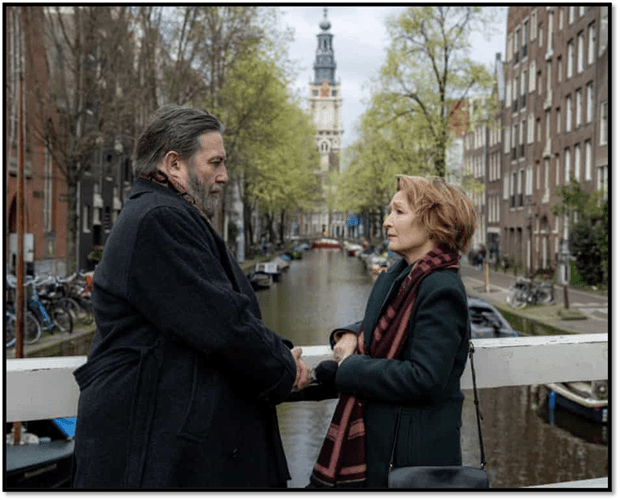
Consider, for instance the still I use in this blog to preface it. Mise en scene and cinematography tell here. Dominated by the aspirant spire of a Church, the framed still is inwardly framed by the rich houses on both of its sides. The couple stand on a bridge over the canal, with the canal itself seen as being much between them as the tree-lined streets on its banks. Dead centre are hands that do not quite touch – that don’t form a bridge of connection. And their faces are more complex interfaces yet – with yearning, certainly on Stella’s side that rhyme with her, at this point, greater openness to Gerry, with one hand ungloved and not clasped tightly and defensively as his. Gerry’s eyes reveal almost nothing of how he feels, whilst Stella’s s[peak silently if under conditions of self-suppression. I wonder if Bradshaw would see here – The Guardian uses this still – that Stella ‘can suddenly see, with pitiless clarity, how she has always hated Gerry’s genial mockery of her religion; perhaps she has always hated him, too’, if so the church is significantly placed in this scene, a bridge that constitutes instead a rupture between the pair.
But nothing in what I saw in the film shows to me that either Stella or Gerry ‘see clearly’ (and consistently) any one thing about their relationship, and this is the strength not a weakness of this film. Stella makes all kinds of emotional gestures in this film. Planning the trip in the first place seems such a gesture until it seems there might be another motive that breaks itself from the rest (that of pursuing a ‘devout life’ in an age where such lives have no straightforward model to imitate). Another is the removal of an earring in the attic of the Anne Frank House to leave in honour of the fate of the Jews in Amsterdam at the Holocaust. Just a little later, she is telling Gerry, who wants her to see her good intentions in doing it, where now, all she can see is her selfishness in the gesture – a way of making herself feel better. No one by the way does pain deeper than that that can be seen and easily understood as Lesley Manville. Thoroughly nuanced her insight really is that – a looking at a complicated vision within of conflict – which is far from pitiless. The pity is though mixed between that for her husband and the collateral damage to him from her search for a ‘devout life’, recognition of her existential isolation and sorrow for what she feels are lost loves – Gerry, her son and herself and her ‘vows’.
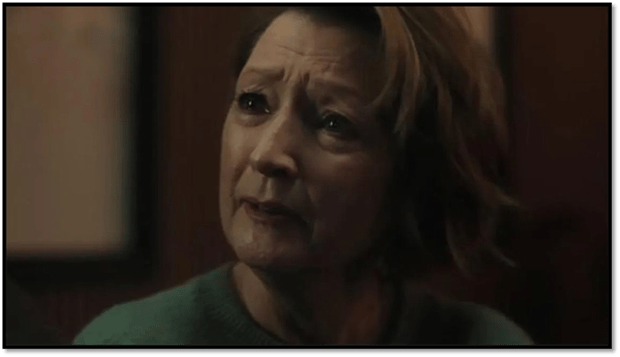
Moreover, it is not correct to see the rupture between the pair as caused, even in part by Gerry’s ‘genial mockery of her religion’, though it may seem so. Why, she asks him is ‘anything spiritual beyond your grasp’? True: Gerry will not now or in the future renounce even momentarily his disbelief in miracles or the magical action of God’s grace that really can be explained by other means. Late in the film he says that moving ‘through life with her is the only miracle’ in which he can believe, but makes it clear that it requires both love and belief too, perhaps more than some of the ‘miracles’ Stella depends upon to prove God’s grace.
Gerry is not a deep man, of course. One of his best scenes is in Amsterdam’s ‘only Irish pub’ (surely that can’t be true) where a black Irish migrant with an earring living in Amsterdam is told By Gerry that he serves a fine pint of Guinness, and in a fabulous compliment from a retired architect which the young man knows he is, says: ‘Look at the dome on that: Norman Foster eat your heart out!’ Another is a scene where Stella, suddenly sick of her monastic dreams, dons the boldest red lipstick and visits the Red Light district with Gerry, who explains how it gets its name. In pubs Gerry is at his most genial, although he takes his own bottle of Irish whiskey to supplement the pub doubles:
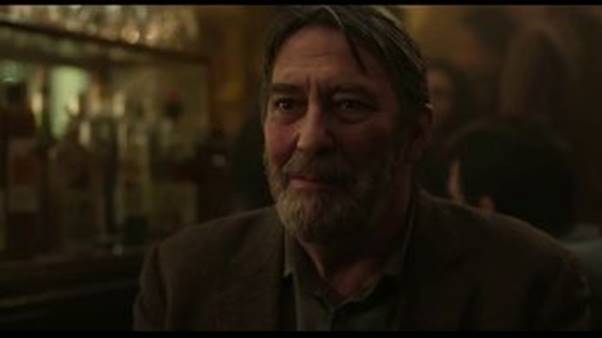
It is difficult not to like Gerry, and sometimes hard not to feel that Stella has hardened her heart to any relationship, even with the son she bargained with God about, other than to self and God, who drives a hard bargain with her if her picture of him is to believed. I believed, as I watched, that Stella’s sense that religion might be mocked goes much deeper than anything Gerry might say. That ‘secret’ she tells Kathy in the latter’s room in the Begijnhof is that when she lay feeling the blood seep from her when carrying her shopping in her late pregnancy with her son, Martin whom we never see, caught in crossfire in a kidnapping she tried to bargain with God, exchanging God’s gift of life to her son-to-be for her future sacrificial devotion of her life to Him. What are such gestures? Are they well-intentioned, like the offer of an ear-ring to mitigate the Holocaust or are they selfish too. Moreover, miracles that Stella depends on are oft hard to feel very serious about.
Take that part of the narratives that tells of Stella’s first visits, during this midwinter break with Gerry – for we are to learn that she once visited before this without Gerry and much earlier in her life, to the Begijnhof. She visits there the holy site of the Miracle Church, dedicated to Catholic understandings of the bone of contention later – especially in Reformed Protestant Holland, which contains medieval art commemorating both Holy Site and the ‘Silent Way – Stille Omgang’ (a compromise name for the Holy Way that constituted the walk to it and around it as a Holy way, or pilgrimage route)’ that was a processional to it. Here is the story told in Wikipedia:
This walk commemorates the Miracle of the Host of 16 March 1345, a Eucharistic miracle which involved a dying man vomiting upon being given the Holy Sacrament and last rites. The Host was then, due to liturgical regulations, put in the fire, but miraculously remained intact and could be retrieved from the ashes the following day. This miracle was quickly recognized by the municipality of Amsterdam and the bishop of Utrecht, and a large pilgrimage chapel, the Heilige Stede (“Holy Site”) was built where the house had stood, and the Heiligeweg (“Holy Way”) as the major pilgrimage route to it.[2]

Gerry does mock this ‘miracle’ (seeing its representations of the starry wafer ‘host’ (to Christ’s body of course) brought whole from the burning fire in the eighteenth century reproductions of the medieval story as uniquely trivial (a kind of Roman Catholic gimmickry – not unlike how the Protestant Reformers saw it) and is reprimanded by Stella because he ‘knows as well’ as she that God’s miracles come in various sizes and forms. Only a little after this, reading between the lines, Gerry says words we cannot at this point fully understand that what happened to her was not a ‘miracle’. Stella falls into a mood of great depth but indistinguishable from those that cause rifts in many relationships, whose ruptures lie deeper than the surface and not just between the persons in the relationship, but in one of them so deeply that it breaks her. Or is the ‘break’ in this work not so deep. One publicity still captured from the official trailer seems to suggest just that – that this is about a relationship that has flagged through over-exposure. With the title Midwinter Break in mind the still looks and says this, as it shows the couple facing each other with a gap or break between them over the legend: ‘A Lifetime Together’: the ‘break is in the midwinter of their joint lives.
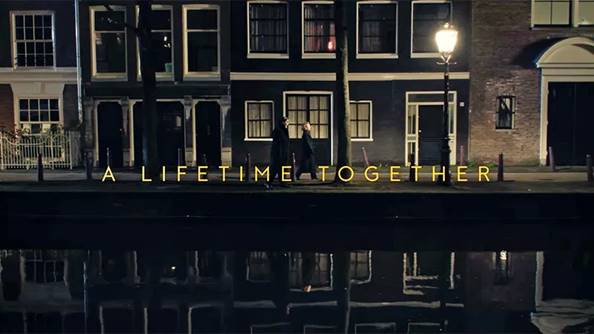
If so what Stella is facing is a kind of existential ennui and alienation that feels the pointlessness of boredom and loneliness of human life as symptom of their deficit in religious faith: so Gerry would think anyway, who calls religion the greatest ‘Deception’. Moreover, maybe there is somewhat of a similar interpretation of herself in Stella, who says towards the end of the film that she ‘only wants be close’. In that sense this seems to me an analysis of the meanings and nuances of interpersonal proximity and distance: the meanings of ‘close’ and ‘distant’ as versions that range from potentially measurable physical distance to those equivalents in human attachments of a scale of warmth against coolness/coldness or emptiness and fullness (of sound, sensation and son). This is why we get so many bed shots in which Manville and Hinds mime the variations of proximity and their emotional and other equivalences. The dominant scene is of the couple sitting at the hotel dining room table allocated to them by a window, where the window stands for cool space outside the hotel, some of which comes inside the relationship.
Others are nuanced – where proximity is required by task, as in looking together at a small-size Berlitz guidebook.
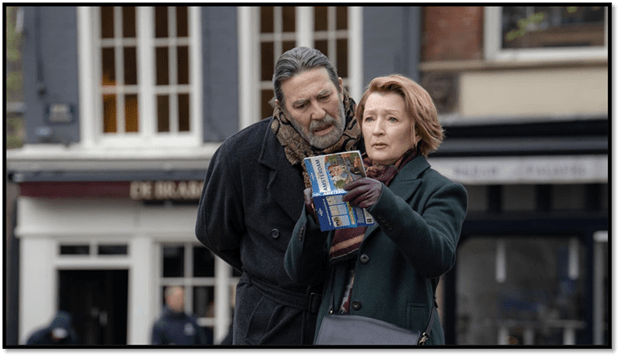
Well-acted these scenes alone can varying meanings related to co-engagement and distances (even effective co-created height distances that indicate power differential, in one or other mind. The scenes in a lift that demand proximity also vary along these dimensions – the one below, being beautifully close and almost fully attached.
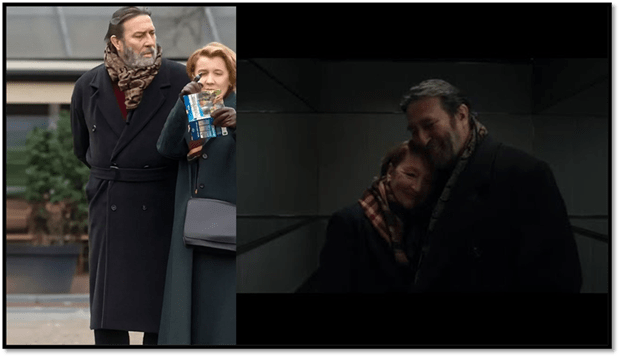
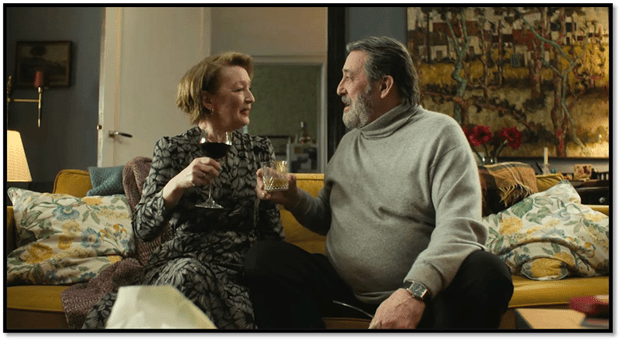
Even close – and genially social, what lies in the gap of contention is often the prompt for later dissension as the narrative gets overwhelmed by things the couple don’t say to each other, as in the drinking scene below:
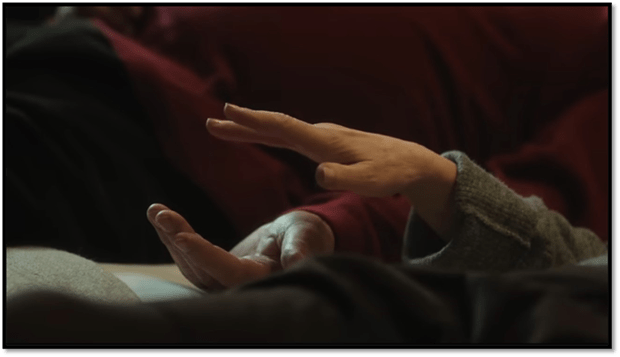
Sometimes, however hands mediate that distance – playfully as in this bed scene, where the separated digits on Stella’s hand play games of almost touching the receptive hand of her husband below, a game in which symbolically she has the power over her partner, enough to play that game with him (so different from the moments of frost in which Manville excels:
But the end of the film uses distance differently, and given the variation and nuance of proxemics in the film, it is possible to see it as selling out to a romanticised denouement. Confined to the airport at Amsterdam by a snow storm, the partners gaze out of the passenger lounge window in a position wherein the distance between them is filled with oncoming dawn. Their hands touch fully and with commitment – they see what Gerry thinks is the plane eventually arriving only for Stella to say it is a ‘shooting star’. Romantic. Yes. Fulfilling? Even more so, for it bespeaks renewal in older age, the end of night and end of winter foretold.
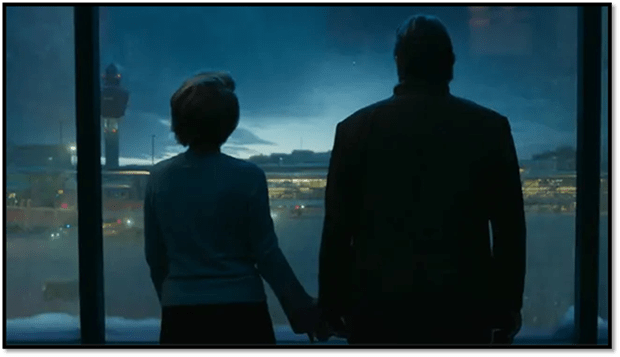
Distances often have long reach, like the scenes of boats leaving the Belfast of the Troubles and looking back in longing and relief. What’s not to like? I say this but you have to like films that move so slowly, details matter. My husband Geoff was asleep half way through. Bless him!
With love
Steven xxxxxxxxxxxx
[1] Peter Bradshaw (2026) ‘Midwinter Break review – sad, spiky and brilliantly acted portrait of rupture and rapture’ in The Guardian (Thu 19 Mar 2026 09.00 GMT) Available at: https://www.theguardian.com/film/2026/mar/19/midwinter-break-review-sad-spiky-and-brilliantly-acted-portrait-of-rupture-and-rapture?CMP=share_btn_url
[2] See Stille Omgang – Wikipedia at https://en.wikipedia.org/wiki/Stille_Omgang
 Steve_Bamlett_blog