


Most Britons do not understand the terrible responsibility of the UK for the setting up of Israel as an Apartheid state: Do films help us? A case study of the beautiful film ‘Palestine 36‘, a dramatisation of the period of the Peel Commission Report published in 1937, by Annemarie Jacir.
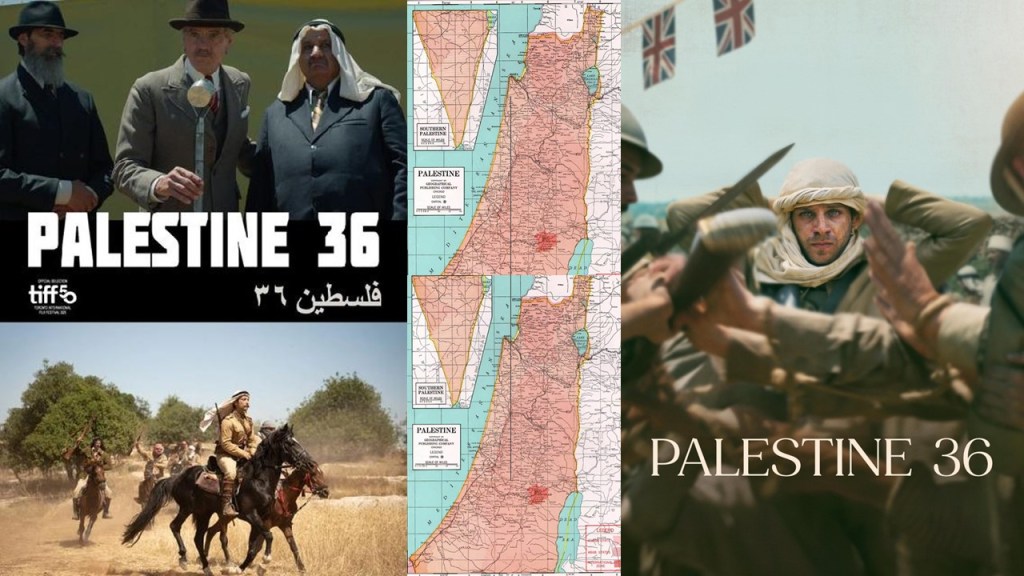
The British mandate for Palestine, a refinement of European colonialism following the Great War, was responsible for some of the worst sins of colonialism: the building of concentration camps, refined torture methodologies, and institutionalised apartheid. The Mandate, without being expreszed as colonial ownership, reflected co-operation of the colonial Europeans for their responsibilities in the collapse of the Ottoman Empire and the emergence of new realities of Arab politics in what was becoming to be known as simply the ‘Middle East’, in shame possibly at the intense competition for sovereignty over the land of the Philistines, Palestine.
Complicated by the collusion of the Western powers for their failure to address the safety of the ancient diaspora of Jews, who had permanent homes in Europe and Russia, in dressing up that failure as a belief in a return to Zion, the reconstitution of a mythical Zionist State named after the ancient Biblical name of historical myth (under the name given by God to Jacob after he wrestled with God’s Angel, Israel).
Palestine 36, released in 2025, was produced in part by the BBC and BFI. However, there had already been a recent film, from British production agents (in Michael Winterbottoms’s 2024 Soshana (see my blog on that film at this link). Whilst Soshanna is firmly situated in points of view inside Israeli nationhood-seekers (the journalist, Shoshana Borochov, in Tel Aviv, in the film and in history is and was respectively the daughter of a Russian Jewish socialist settler, from the first opposed to what he thought of fascist solutions to the setting up of Israel). The voice of Borochov (senior) was raised in the conflict between rival terrorist groups, the Haganah (of whom Shoshana is a training member carrying arms) and Irgun. These terrorist movements, later (and after the death of Soshana’s father) resolved into one force and became the origin of the current IDF.
Shoshana locates itself in the different perspectives then of the politically active and militant pre-Israeli Jews at first (those, broadly speaking, seeking a right wing apartheid resolution to statehood – Irgun – and those who looked to a multi-cultural resolution (where culture compounds ethnicity, ‘race’ and religion as well as the expressions of communal ‘truths’ in art and institutions)). Palestine 36 has only one reference to the Israeli Zionist terrorists – to the Irgun alone – and has even less coverage of Jewish terrorist incidents than Soshana has of Palestinian perspectives, except the film footage of the aftermath of the terrorist attack on the King David’s hotel by Palestinian extremists.
Whillst Soshana justifies its story by having a romantic heterosexual Anglo-British coupling at the centre of its purpose, Palestines 36 feels like a truer depiction of what was an issue of the historical politics of Anglo-European hegemony. It looks instead at the relationship of a unit of social-land (an ancient village near Al Quds / Jerusalem) to the bureaucracy that implemented the supposed right of a white Eurocentric colonial power that felt it should, and had a duty to do so, control who occupied whichever portions of land under its colonial rule.
Whilst voices have been raised at supposed historical inaccuracies in its account, that is to be expected when the very nature of how ‘history’ should be read, and in what duration, is at stake between conflicting views in an unfinished story. The mildest critique could be this embedded in the synopsis in The Los Angeles Times in a review by Robert Abele [March 27, 2026], which already has told of the national Palestinian labour strike that led into full revolt in 1936:
The split widens when a labor strike becomes an armed revolt, with Jacir gamely tracking the hardening or shifting loyalties of both her peasant and well-to-do characters. The British, represented at the top by the casually imperious High Commissioner Wauchope (a perfectly cast Jeremy Irons), are decidedly the villains here as a colonial force quick to brutalize Palestinians for speaking up for themselves. Still, by forgoing any Jewish characters when there was already a burgeoning transplanted minority — all we see is a kibbutz being erected in the far distance — seems like too careful an avoidance of contextual reality.
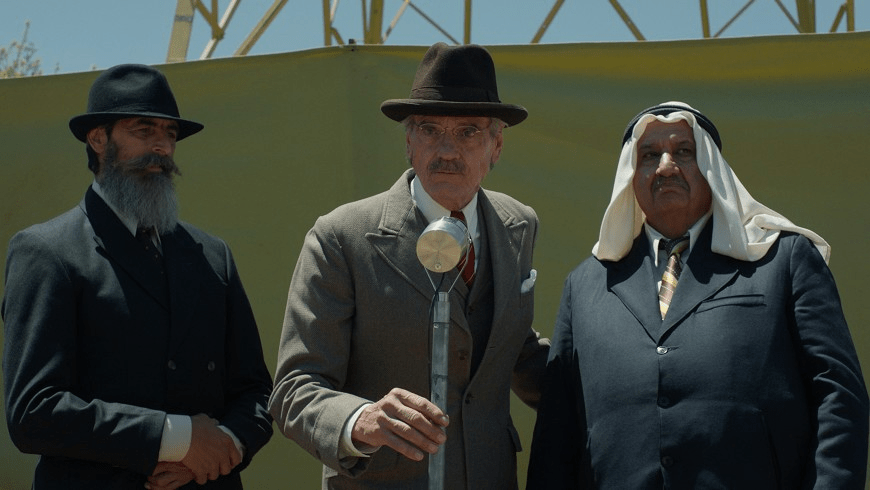
High Commissioner Wauchope (Jeremy Irons) sandwiched between the actors playing carefully chosen representatives of Palestinian Jews and Muslims.
Others speak of a simplification of the range of Palestinian views of the legitimacy of revolt against the implementation of the Balfour Declaration. Although there is no doubt these differences do in fact get stated, the statement of pro-Zionist Arab views are largely discredited, such as the those published in the Arab papers in pretence that they were by a Palestinian Arab, although actually written by the Zionist Movement. Tne film also shows the casual support of bourgeois Muslims, clearly thinking new Jewish wealth (where that existed) in Palestine was ‘good for business’.
There is, however, no romance to make the political personal in this film as in Soshana. Instead there is the story of a young Palestinian from a poor rural farming family (Salid Bakri plays Khalid) in the village at the centre of the whole story. Bakhri makes a suitable romantic lead, even if not in a love romance.

Khalid is trying to make a career in the service of the rich Palestinian family in Jerusalem who own media outlets but who must choose between family, his culture and compromise with the establishment of a partitioned land. Partition was proposed under the direction of the 1937 report of the Peel Commission (investigating the 1936 revolt) in Britain.
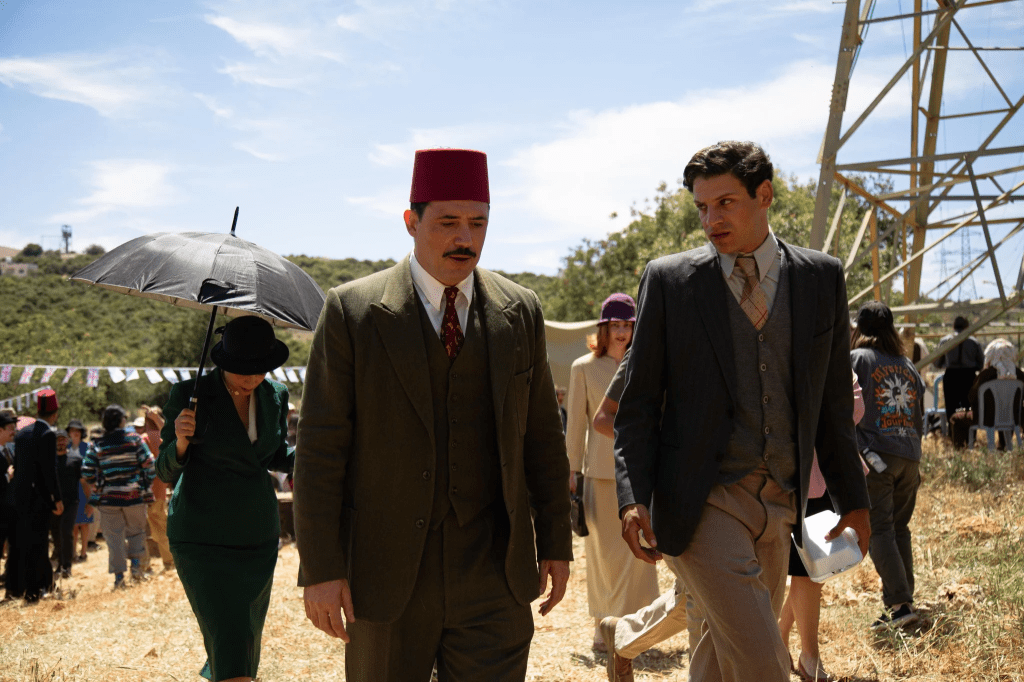
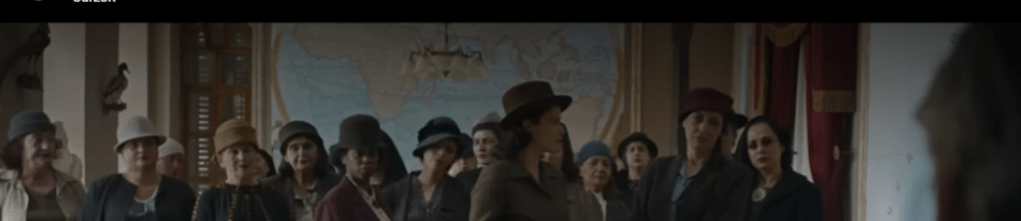
The main link between the films is the stress in each on the role of middle-class women (journalists in particular), both Jewish and Palestinian, a tonic in a debate that often represents Palestinian Arab culture as entirely misogynistic. The British are confronted in the revolt by many women looking to defend the villages:
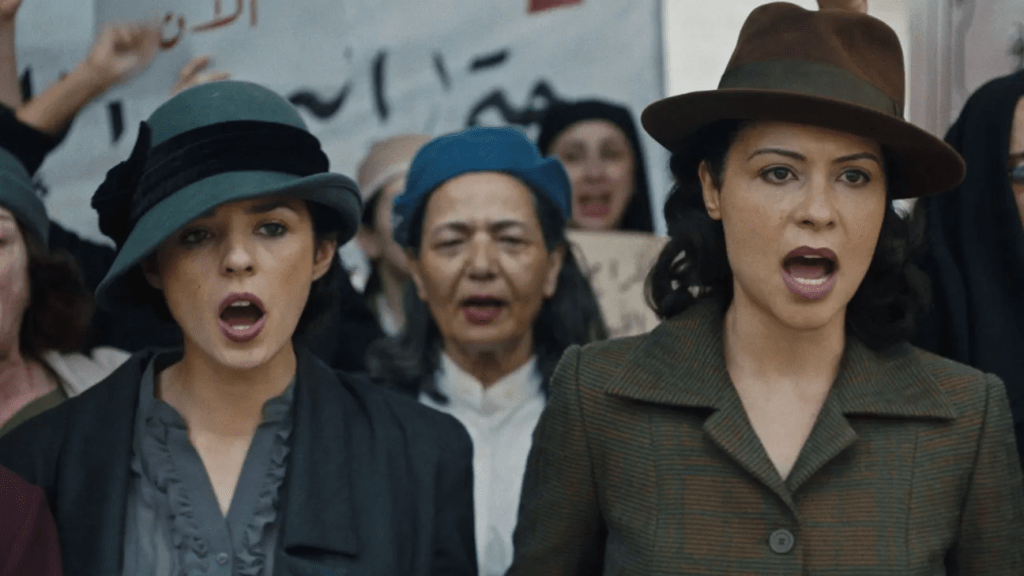
Palestine 36 focuses, in part, even before the strike and subsequent revolt, on the love of the native Palestinians of the land (that is demonstrated in the aforementioned village) and the loose means of ownership of it demanded by the Ottomans in conflict with British claims that they had the right to impose registration regulation on land, in the interests of its later apportionment to legitimate owners (or at least owners British law considered ‘legitimate’).
There is a personal side equivalent to the love story without quite being one. It concerns Afra, the youngest daughter of the family at the centre of the film and the son of the village’s Orthodox Christian priest, representing the alliance between Palestinian Christians and Muslims. The priest’s son, after the murder of his father (in punishment for owning guns – which he in fact shows to the British commander – he and others implicated are blown up in a British commissioned bus taking them to prison), becomes closely allied to the cause of Palestine revolt and shoots two English soldiers in retribution near the film’s end.
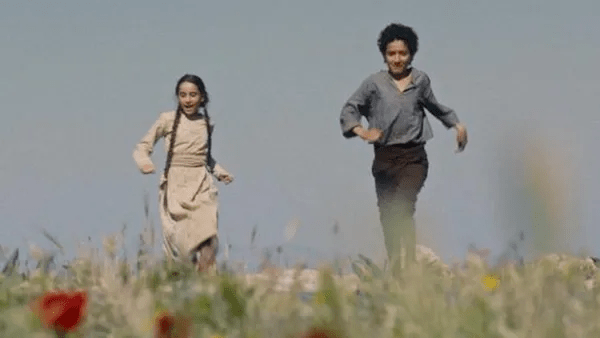
The boy does so using an Ottoman gun – a relic of the past age – which is variously over-interpreted as evidence of violent revolutionary intent, throughout the film, though hardly capable (being so antique) of having such force in reality, other than in one single killing. Donald Clarke in The Irish Times [October 31 2025] says, rather portentously – and as if this was an anachronism in modern dramatic fiction, that: ‘An ancient pistol looks to have the usual Chekhovian significance’.
The revolution otherwise is represented by ad hoc soldiers – although aided by Lebanese and other Arab forces – wearing the Arab Keffiyeh head-dress, that garment that the British banned (represented in the film) in order, they thought, to control expressions of Palestinian nationalism. That the revolt is considered as an expression of the love of native land is obvious in the stills below.
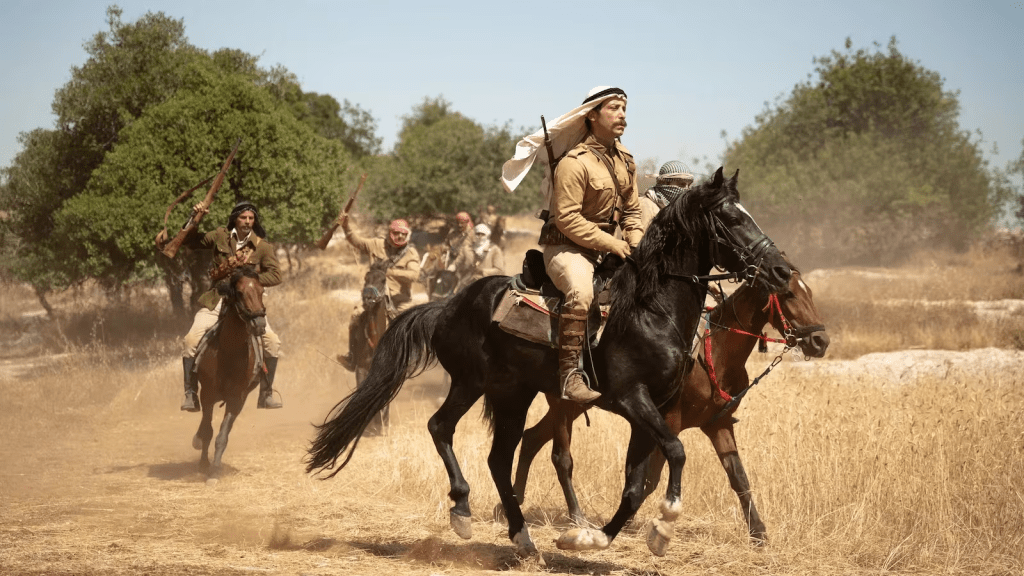
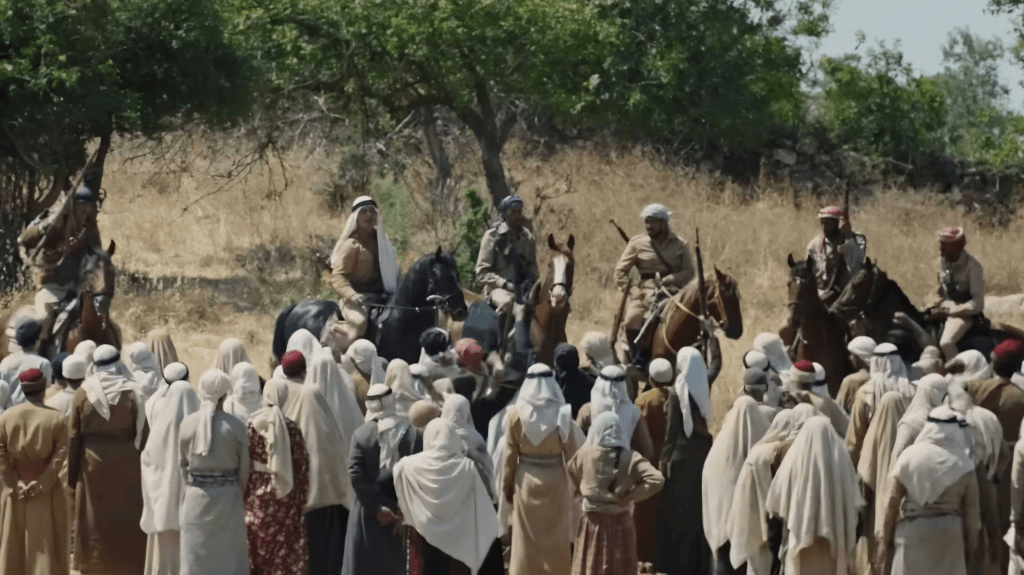
Yet the truth factor in this film is more apparent to those who have experienced British colonial rule (in Ireland for instance) and is underlined by the use of original footage that has been colourised (unlike that in Soshana) to emphasise that there is not a huge gulf between Palestine then and now). Donald Clarke puts it thus:
Palestine 36 is, however, at its best when in quasi-documentary mode. Making skilful use of colourised archive footage, the film drags up not just unavoidable pointers to the area’s current miseries, but also reminders of similar western interventions in parts as remote as Vietnam and (yes) Ireland.
In both Soshana and Palestine 36, there is an unhinged British commander set against, in mirror fashion, a naive English bureaucrat who learns the perfidy of British colonial talk and its pretence to even-handedness. The former in the later film is the more unhinged and expresses openly Zionist views:
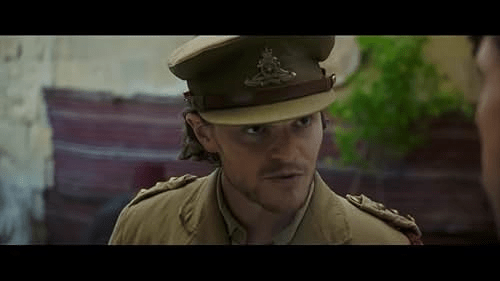
In truth, I think Palestine 36 is the greater artwork of the two films mentioned here, though both shed a light on British ignorance of British history as it is known to the world that suffered its most oppressive characteristics. Annemarie Jacir is a name to watch, certainly.

But see this film when you can. It is a Curzon DVD. Bye for now. I seethed about the injustice it revealed – but I was already aware of it. Will others? Or is the weight of British collusion in injustice represented for our age in Sir Keir Starmer more widespread than I hope (see my blog on Peter Oborne’s book Complicit: Britain’s Role in the Destruction of Gaza here at this link).
With love
Steve
 Steve_Bamlett_blog