


To tell truth, this question is one the many hoary interview questions that are prompts to elicit from their respondent a word they think makes them seem acceptable to the interviewer(s) and avoid those which can be predicted to make you seem unacceptable. Nothing is further from its purpose than to elicit truths, or even an approach to truth, about how a person sees themselves even as a potential worker. Various websites dedicated to it ask us to find a positive trait to represent us, but that nevertheless match corporate needs – such as ‘Flexible’, ‘Adaptive’ and so on.
But Christianity, like the Judaic texts it built on in the Bible that became its ‘Old Testament’ insists that human beings are united in one word that describes them all, whatever their background or religious origin. We are all sinners. St Paul makes the point in the third chapter of The Epistle to the Romans, citing Isaiah and reprimanding Roman Christians of Jewish origin that that they do not see themselves as any less ‘sinners than Gentiles who become Christians. We are all equal as ‘sinners’ seeking redemption in the Trinity of Christ: Romans 3:23 (“For all have sinned and fall short of the glory of God.” )
And then there is the Apostle John (1 John 1: 1, 5-10):
1 That which was from the beginning, which we have heard, which we have seen with our eyes, which we have looked upon, and our hands have handled, of the Word of life;
…
5 This then is the message which we have heard of him, and declare unto you, that God is light, and in him is no darkness at all.
6 If we say that we have fellowship with him, and walk in darkness, we lie, and do not the truth:
7 But if we walk in the light, as he is in the light, we have fellowship one with another, and the blood of Jesus Christ his Son cleanseth us from all sin.
8 If we say that we have no sin, we deceive ourselves, and the truth is not in us.
9 If we confess our sins, he is faithful and just to forgive us our sins, and to cleanse us from all unrighteousness.
10 If we say that we have not sinned, we make him a liar, and his word is not in us.
Now in preparation for reading Nicholas Boggs new biography of James Baldwin, I have just read afresh, Go Tell it On The Mountain, which starts as if the story of John on a significant day (his fourteenth birthday) for the main protagonist (though the story opens him out to the past stories of his family and community – notably his Father, the preacher Gabriel), John.
It strikes me that John is named after both the Apostle and the author (he of Patmos) of Revelations, not necessarily the same John but oft confused. Whether that be intended – the iconic recall of the Biblical type I mean, I cannot say with authority but there are parallels. But one feature amongst these is the identification of John as a sinner in a way that his Father rejects – often glossing the grossest of his sins, not least the abandonment of a woman who bears his child, Royal, and the child to a terrible fate, that could have been predicted, in the manner of the Pharisees that Christ so often critiqued.
Here is the early identification of himself as a sinner, recalled on the eve of the day in which he will receive the Word in a very visible drama of speaking in tongues. The passage in which the the knowledge of himself is proclaimed as a sinner has some parallels with 1 John 1. The first is the reference to hands handling things, without referring to masturbation in the Apostle proper, of course. The framing of sin in the contrast of darkness and light is also there, however, though more beautifully nuanced in Baldwin (‘the darkness of John’s sin was like the darkness of the church on Saturday evenings’).
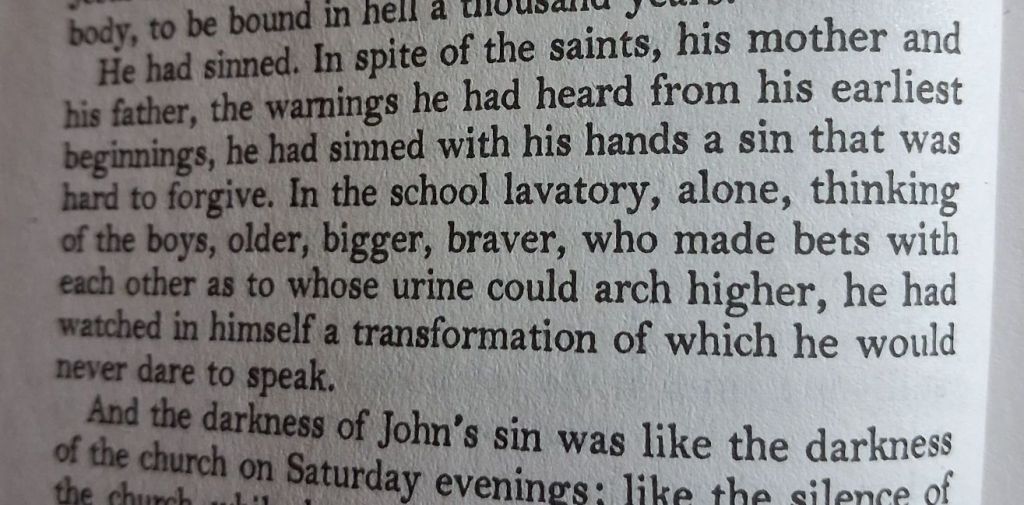
James Baldwin ‘Go Tell it in the Mountain’ Penguin Modern Classics, page 20
Teenage John’s sins are peculiarly adolescent of course, though this is the only place in the novel where masturbation is linked to John’s imagination of the competition in raising their pee highest on a wall engaged in by groups of boys who need, in order to co-engage, to display their penises to each other, and to John’s masturbatory fantasy in his imagination, as bigger than his own like their bodies and age.
John’s sins are minor but mask the true source of the darkness obscured in the book, that which links his sin to that of his Father, Gabriel, which is that both men mishandle, in terms of tne morality of the community in their novel, their seed. That is shown in Gabriel’s tortured reflections on having sex with many women as he cleans his ‘white seed’ from his ‘loins’. He has to pray afterwards, thinking:
kneeling by his cold bedside, but with the heart within him almost too sick for prayer, of Onan, who had scattered his seed in the ground rather than continue his brother’s line.
Ibid: 127
The wonder and discipline of this fine novel is totally based on the basic idea that one word can describe all people, that word being ‘sinner’, but, despite this idea, what divides people is the motivation of their sin and their ability to redeem themselves without hurting others. John, I believe, redeems himself by finding love with Elisha that neither men realised was their goal.
That’s all for now.
Love
Steven xxxxxxx
 Steve_Bamlett_blog