


I think finding yourself (when ‘it’ is lost) may be an irrelevance because it pretends that there is an undying continuous self or identity. This is a blog triggered by Jose Ando (trans by Kalau Almony 2026), ‘Jackson Alone’, London, Footnote Press.
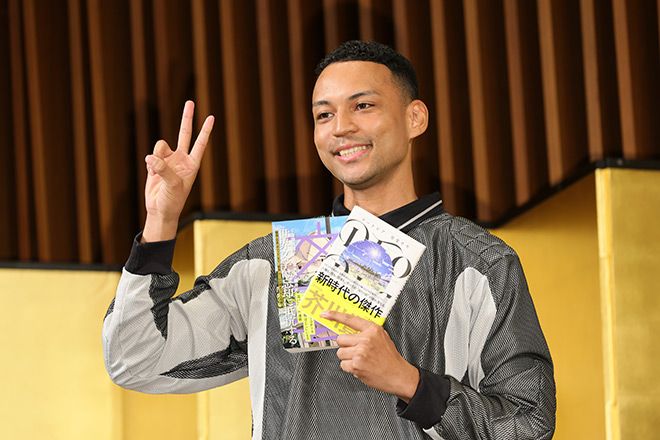
Novelist Jose Ando receives the Akutagawa Prize at an award ceremony held on Jan. 15 in Tokyo’s Chiyoda Ward. (Hikaru Uchida) from : Rising literary star Jose Ando champions minorities | The Asahi Shimbun: Breaking News, Japan News and Analysis
There is much that is ‘lost in translation’ and hence I propose the ideas here based on having just read Ando’s literary debut from 2022 (named “Jackson Hitori” in transliterated Japanese [Jackson Alone to us] very tentatively. Satoshi Yamazaki writing for The Asahi Shimbun in January 2025 has written of this novel as having ‘introduced readers to a young, mixed-race protagonist whose sexuality (is) left ambiguous’, and of it and a subsequent work that Ando has ‘consistently featured characters with mixed racial backgrounds, reflecting his own life experiences’, but has insisted, at the same time that his characters are not ‘him’.
“Writers die eventually, and times change,” Ando said, suggesting it is irrelevant how much an author’s personal life is reflected in the characters of a novel. / … / “I enjoy reading fiction, but I don’t particularly like Japanese novels,” he said. “When minority characters appear in these works, they are often portrayed as outsiders, which makes me uncomfortable.” / … / “I want to create more stories that minority audiences can enjoy without feeling marginalized,” Ando said. [1]
There is a lot that we can infer from this statement, although probably without certainty of being correct in our interpretations – but then, I tend to think that is the condition of making sense of statements about living. In the context of Western philosophical discussions of personal identity, identity has meant that which remains the same (ever unchanging) in the person over time and which might in some points of view that which, if anything, continues to be after death of each ‘person’. Ando clearly dismisses the possibility of that survival after death, and perhaps over periods of time in life too, by insisting that his fiction is not about ‘him’, a self that he can find, precisely because he hopes his writing will persist whilst accepting all writers ‘die eventually’ and thus embrace the nonentity they do not desire for their writing.
Japanese concepts of identity are often portrayed, though surely this is changing (as the link immediately above, and my blog on Bryan Washington’s last novel, Palaver, might suggest – at this link), as relational rather than, as in the ego-centred West, individual – what one ‘is’ (or my ‘this-ness’) is, in relational thinking, always filled out by relationship to others – family, community, working status, ‘race’ or nation, all of which exist by virtue of exclusion of the non-related. Hence Ando’s discomfort with ‘Japanese literature’, though this too may be changing -how would I know who cannot read Japanese, as creating ‘outsiders of those consider as a-relational (alone or all-one) and his hope to writers for those likewise marginalized.
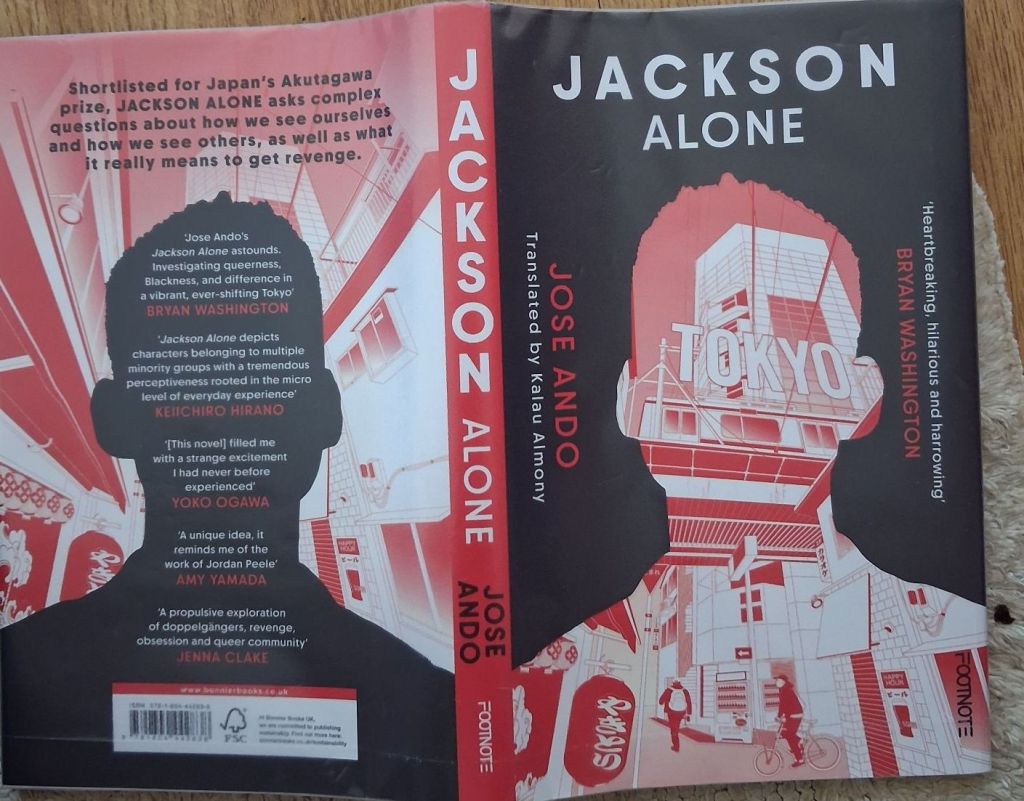
Jackson Alone is a novel that I think of, having just finished it, as something I did not quite enjoy, although I am sure I would gain (even in enjoyment) from repeated reading. My original idea not to ‘keep’ a copy of the novel has already changed as I write this, for it is very much a novel about the discontinuities in the meanings of the word ‘identity’ in English (on the one hand a word expressing unique individuality and, on the other, being exactly – in every detail, the same as another thing). These meanings persist in the difference in uses of the word in, say, philosophy and the social sciences as examples of highly disciplined discourses (and within social sciences between some branches of individual psychology (since Erik Erickson. at least) and sociology – so imagine the divides in social psychology and forensic psychology). Let’s take the opening paragraph of the novel: [2]
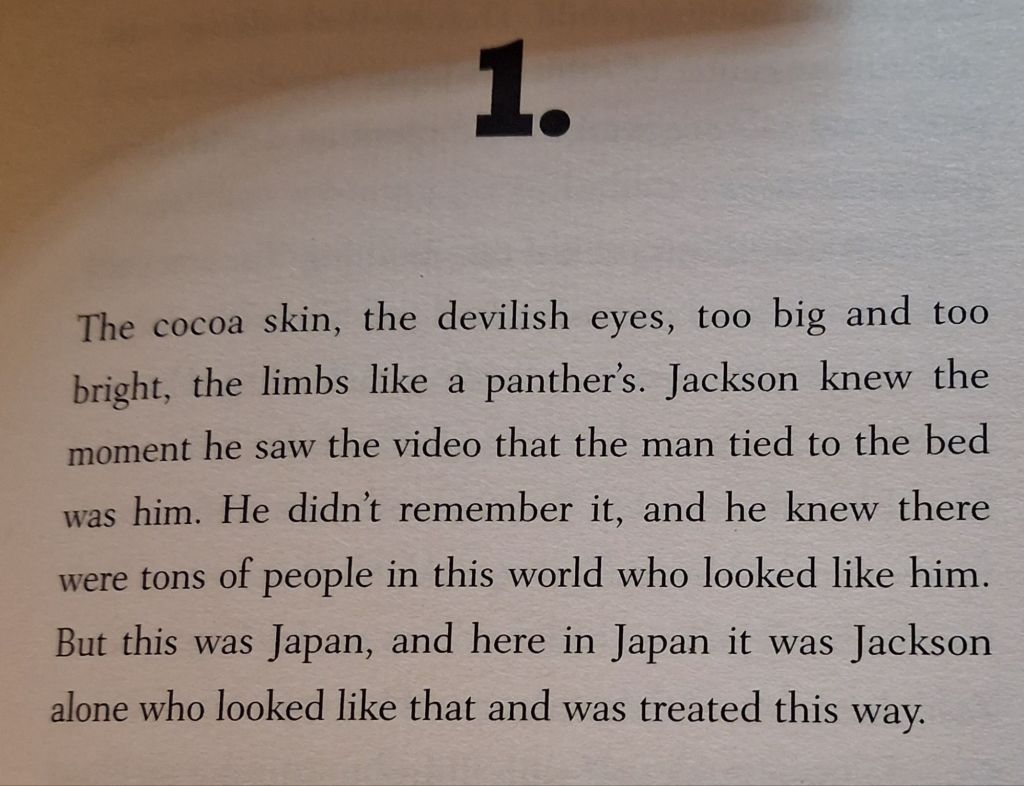
It is a paragraph about, with surprises, a male finding himself in a recorded past he doesn’t personally recollect, and contrasting whether what he found is ‘him’, his individual identity, or merely a ‘sameness’, an identity, with ‘tons of people in the world who looked like him’. Yet this identity (whether individual or that of the sameness of each person in a notional group to each other) is already highly relational, described that is by comparison of its parts to the parts of things other than itself, whether animal, vegetable or mythical: a panther, cocoa beans, and a ‘devil’.
Jackson identifies himself as the man in a violent pornographic video or, alternately, he identifies someone like himself. The play on the concept of identity as unique or based on sameness, in the eyes of particular beholder of course, all starts with this. The plot of the novel involves Jackson finding another four people who might or might not look alike, depending on lots of things – for in the plot they go to great lengths to be like each other enough (exchanging clothes for instance) but often mostly the attitude of the beholder about what constitutes inclusion in being alike. Each thinks they or each other might be the man in the video.
This play on identity – difference and similarity – extends to the five men identifying as The Jackson Five, at one point, thus associating with a group in which si.ilarity and individual difference played out to tragic ends for some.
However, I don’t intend to elaborate on the novel, for that would require a re-reading for which I am not ready yet. But it is a short novel and a highly in innovative artwork. Do read it.
The point may be that losing yourself is as much pertinent to identity as finding yourself, the question ‘to whom am I the same?’ is not unlike ‘what is unique in me that I feel interested in the significance of losing it?’. When I feel least confident about identity politics is when it forgets this ambivalence.
With love
Steven xxxxxxx
_____________________________
[1] Satoshi Yamazaki (2025) ‘Rising literary star Jose Ando champions minorities’ in The Asahi Shimbun on 23rd January 2025 Available at: Rising literary star Jose Ando champions minorities | The Asahi Shimbun: Breaking News, Japan News and Analysis
[2] Jose Ando (trans by Kalau Almony 2026: 1), Jackson Alone London, Footnote Press
 Steve_Bamlett_blog