



I wonder what a world would be like where there was no concept of reading. I won’t even tread into the world of ‘writing’ for I am no writer and have no right therefore to write or speak of it’s effects for good or ill, at least as far as I am concerned. But read I have always done – as a boy I wandered outside still with a book in my hand. But reading is not confined to books or journal print, or even sauce bottle labels – for without anything else people sometimes read these. Reading is a metaphor for enhanced seeing – for reading the structured design not only of different genres of writing and its internal structure of paragraphs and sentences but of visual signs, codes or even representations of other domains of being than than itself in say a painting, sculpture or building but of people where elements of expression of the whole animal, and social and dynamic otherness in motion, are co-read from sight, auditory, small and touch are coordinated and co-read, even especially complex id that animal has communicative power, especially too if that includes language, that it articulates in speech or other codes.
Hence all kinds of reading apply to the personal growth afforded. Reading doesn’t solve problems in relation t our questions about the being, meaning and knowability of self or others. It posits comprehension of what is read without ensuring it – indeed it lives in the space where also live strong forces like misreading, over-reading, under-reading or ambiguity, even multiple meanings and potential actions simultaneously. Reading is only in limited cases about the accuracy of, and more often about the multiple inference-bearing suggestibility, of its results. Without the latter there would be no art. And this applies not just to narrative art whether told in a form that has a temporal narrative aspect, or inferred from the time spent looking and ‘reading’ a still art form like a painting, photograph, sculpture or building. And even narrative is not excluded from still forms, given the demands made by some of them because of its internal complexity or ‘business’, or externally demonstrated size and volume (with small and large sculptures setting different challenges here in sculpture say) , or elements of interior and exterior design in buildings and some sculpture. Reading of course often requires some knowledge of representational systems – such as the semantics, syntax or genres of language forms, of architectural conventions, or their absence, as in when we learn to read a church, or of the composition and material qualities of painting media. It also demands knowledge of the tools used in using making each kind of readable object and even cultural practices aligned to reading like the configurations of symbolic iconographies.
All of that complexity woven into each skill is often the source of people feeling that you can ‘read too much into’ something you hear, see, try to comprehend or smell. None of us are immune. I have just finished James H. Rubin’s (1994) Manet’s Silence and the Poetics of Bouquets, London, Reaktion Books (with his portrait of Mallarmé on the cover):
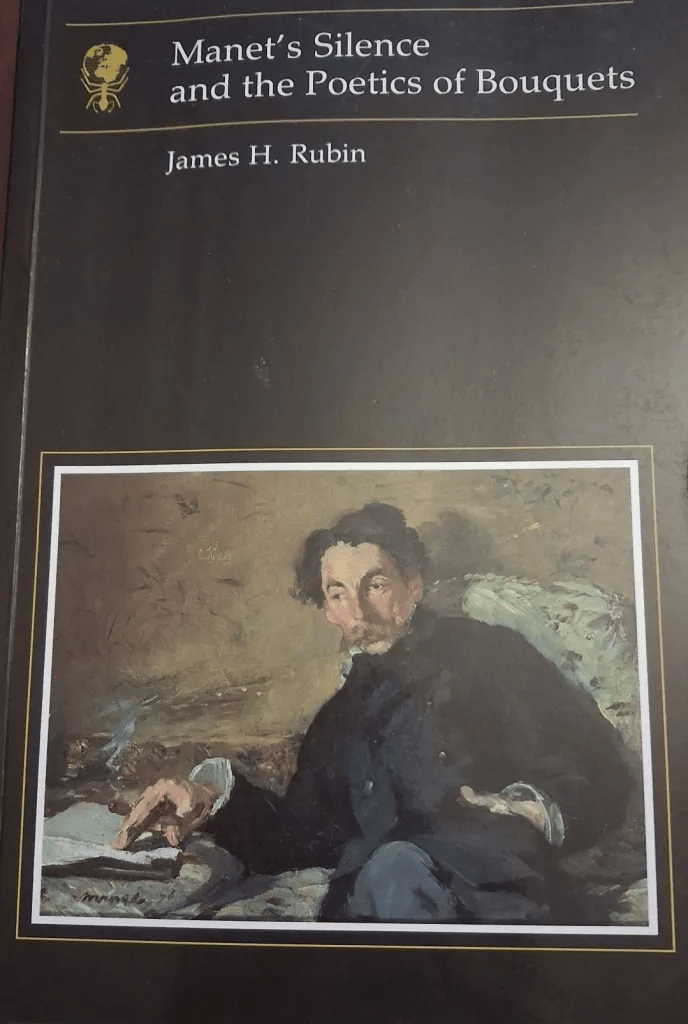
This is a most powerful book, which like all Reaktion books of the 1990s claimed to be doing more than the discipline of the History of Art did with talk about artworks, reading them critically and in the light of the wider significance of art in the domains of both society, the self and the history of psychosocial emotional regulation and ideology. Yet Rubin’s background means that this book, brilliant as it is, bears the mark of his high status in academia, with readings that do to death accounts of theoretical/critical writing like that of Zola and Mallarmé, over-reading the theoretical significance perhaps or ironing out honest contradictions in the writer’s position on his subject. I will see more on this later.
Sometimes, despite being often accused myself of willful over-reading, I found some of the visual details of paintings read to extremes. Take the reading of Manet’s 1868 Portrait of Zola that even I couldn’t achieve.In Zola’s portrait Rubin points out how important Zola was to Manet’s early career by his defence and promotion of the painter in his journalistic art criticism, his main claim to fame before the great novels came to pass and mythicised Manet even further. Thus the reproduction of Manet’s Olympia, which Zola praised and defended, is made to look as if its gaze is directed at Zola in the portrait. It enshrines the common interest in Japonisme and has book relating to the writer’s commentaries on Manet’s painterly achievement. All of this is just spot on. The following section, however, after the first descriptive sentence, feels less solid in its reading (not that I consider ‘solid reading’ a virtue):
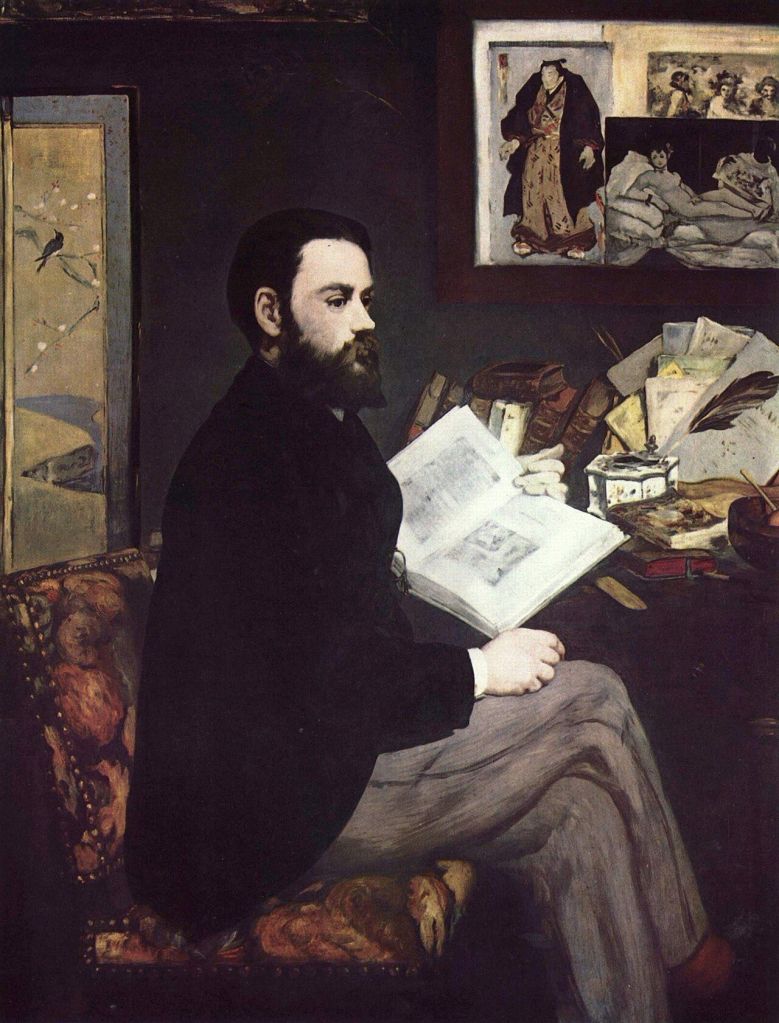
Featured amongst the author’s clutter are his inkstand, his letter-opener, his books, including one with a curiously multi-coloured binding, lying on a pile on his desk, and his pamphlets on Manet – the tools and products, in fact, of his craft. The title of one pamphlet serves as Manet’s signature, a visual pun obliquely echoed by the parallel between the broadly brushed quill-pen – the ‘hand-tool’ of Zola’s art – and the painter’s own punning and illusion-making paintbrush.
Given that much of the chapter before this makes reference to how hand and eye cooperate to signify the manual crafted nature of Manet’s vision, the play with paintbrush and quill-pen as respectively punning sign of each other is clearly an important point for Rubin, but perhaps based more on the kind of reading Rubin wants that might appear justifiable to other ‘readers’ of the Zola portrait, for whom the quill pen, just because it is represented by clever action of a paintbrush, is not necessarily a punning reference to the paintbrush that created it – although it is a stunningly ingenious point to make. Rubin wants it to back up descriptions of the meaning of Manet’s paining methods earlier in the chapter ‘Paradoxes of the Visual Hand’ (pp. 32 – 90) such as this about Manet’s use of smotth passages in his painting compared to visible signs of the remnant of the action of his hand or ‘hand-tool’ paintbrush:
The hand translates the eye’s presence and role in representation, while at the same time distancing us from the so-called ‘real’ or external world to which representation refers us. The mark of the hand is thus the index of a duality: it suggests physical limitations that give vision its historical ground, yet it is also the bearer of originality, of that which exceeds previous limits. … it distinguishes one artist’s product from another’s; it is the tool of vision and yet the creator of a unique visuality; it is subject to technical conventions, yet it interprets or defies, and sometimes redefines them. …, it is both the means to posess reality and yet the sign of exclusion from it. The brush inserts the self, however uncertain, into realitybut maintains reality at the distance of its tip. Such paradoxes constitute a framework for Manet’s painting.
That is all brilliant thinking based on clever reading of the process of art as it is visible and ‘readable’ in the finished artwork – in those remaining visible brushstrokes – or in Titian’s case, in his later paintings, even hand-prints, but that perhaps you want o see a quill-pen painted by a brush as such a pun to support your reading. When I first read it I was awestruck. It led to these lines in my mock Browning poem in my last blog (see it at this link):
.... But me, well I’ve Mallarmé
To point out that the eyes are by the hand
Guided, not the mind, in painters! ....
The idea is a gross simplification of what Rubin says even here, but I am allowing my absinthe-drinker who is supposed to speak the lines to be an under-reader of complexities of art theoretical statements. In fact Rubin’s point is that Manet, and impressionism too as a whole, is a practice in which vision is guided by the hand so that painters do not use stock or conventional ways of representing what they see in the world, or memories from the practice of past artistic Master. He believes that giving the hand relative freedom to experiment in representing vision of the external world, and allowing signs of that experimentation to survive in the finished artwork means the hand guides the eye to re-see the world anew – as it actually looks not what past painters thought it looked like. The idea can be represented in reverse too and mean much the same – the eye guides the hand, because what the hand does that does not satisfy the eye’s vision can ve scraped off or over into a pentimento. The pot is that it is not the ‘mind’ that guides us if ‘mind’ means memory, especially memory of a painter’s training rather than of a painter’s vision en plein air. This is even ore fully spelled out on the last page of that chapter (see below) about the need for Manet to reduce the narrative element of a picture in order to highlight a central visual impact – as in his painting of the death of a toreador. He cut down the painting from one with a narrative or theatrical context to one pared down to the look of the death of the man himself.
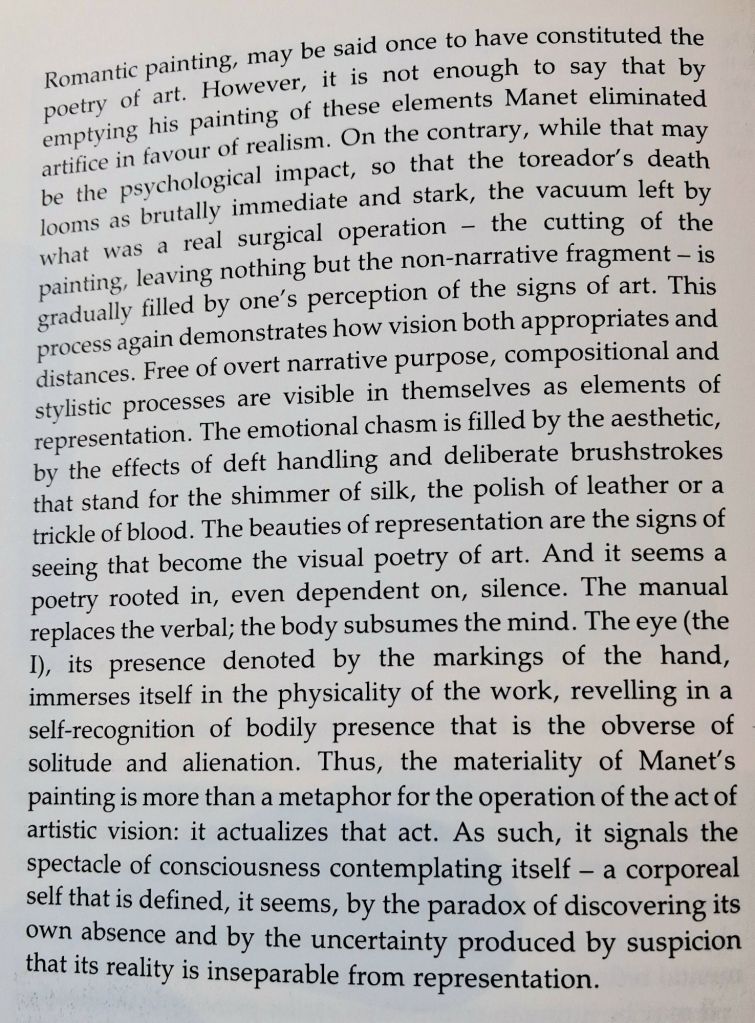
You can see why I put the phrase ‘rather than the mind’ in the lines I wrote. But that is itself a simplification of how Manet and his contemporaries saw things. In a very fine highly academic reading of Mallarmé‘s essay on Manet, which only exists in a contemporary English translation (and is an appendix to this boo), it is clear the ‘mind’ does guide both ‘hand and ‘yey’ in the poet’s view of Manet’s process, except it is not mind that consists mainly of memory but that part of mental operation that is ‘The Idea of the Will’. The painter wills the hand and wills the eye and both hand and eye contest, as if they were embodied separate wills, to make a representation that does justice to a truer external vision of the ‘real’ world because it emerges out of this contest. But what knots the book ties itself up into to say that in ways that pass muster in the academic world with its claim to rigour of thought and expression, and exclusion of what might be easily understood.
So I will stick with my lines. Absinthe drinkers are not usually rigorous academics once they become specialised as absinthe drinkers even if they once were. Meanwhile take this blog as testimony of my need to read – even things that are far from irresistible as reading material. I need to go back to the irresistible – that being the best novels and poetry I read – but the index of their irresistibility is often the kind of demand they make on me to read them ‘closely’. Close reading is the source of joy not academic reputation – not anymore.
By the way, it is Rubin’s main contention that, if it is the silent expressiveness of the artistically crafted visual that matters, Manet’s practice was at its greatest in representing bouquets of flowers, or even vegetables. To that conclusion I can’t follow him either. It is reading that forces you to grow but only if you make it come so close, its ambiguous nature in pain as well as pleasure is evident. Bye for now.
With love
Steven xxxxxxxxxxxxx
 Steve_Bamlett_blog