


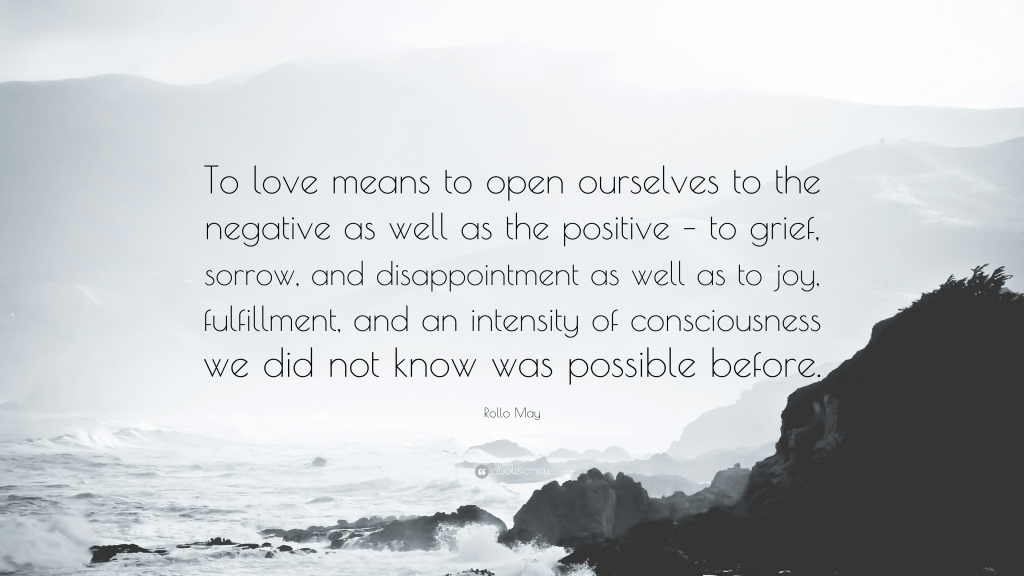
Oh what a tangled web is this prompt question! Even if we discount the current fashion in invoking the word ‘positive’ all the time, the question seems loaded. What is the implication? Is it that given the chance, people will write about a ‘negative example’ of where they’ve felt loved? It seems impossible then to proceed without querying that caveat against the fact of ‘negative’ (for the binary thinking of contemporaneity calls that forth) or ‘other than positive’examples – where love feels an evil thrust upon one, a ‘burden’ or at best, ‘a matter of indifference’.
Most people will remember from some part of their lives examples where their love for another has been received in that way, but do we remember receiving the love of another ourselves in one of those ways or in a way we cannot describe as entirely ‘positive’. It raises the spectre once thought to be at the heart of existential and humanist descriptions of psychodynamic experience explored, for instance by R.D. Laing – the negative or damaging effects of ‘conditional love’, love that comes with a demand on you to be or act in some way that you feel beyond your capacity or unsuitable to your autonomous control of your ‘own life’ as you see it. However, given the strength of pressure in asserting that love can only ‘be’ love if it is unconditional (asks nothing from the beloved before and after it is asserted or claimed) we all still doubt if such a state exists, or cannot be labelled differently, such as co-dependency in relations of addiction, where only one person in it is apparently addicted to something but the rest are addicted to the labelled person’s ‘addiction’ in one of many ways.
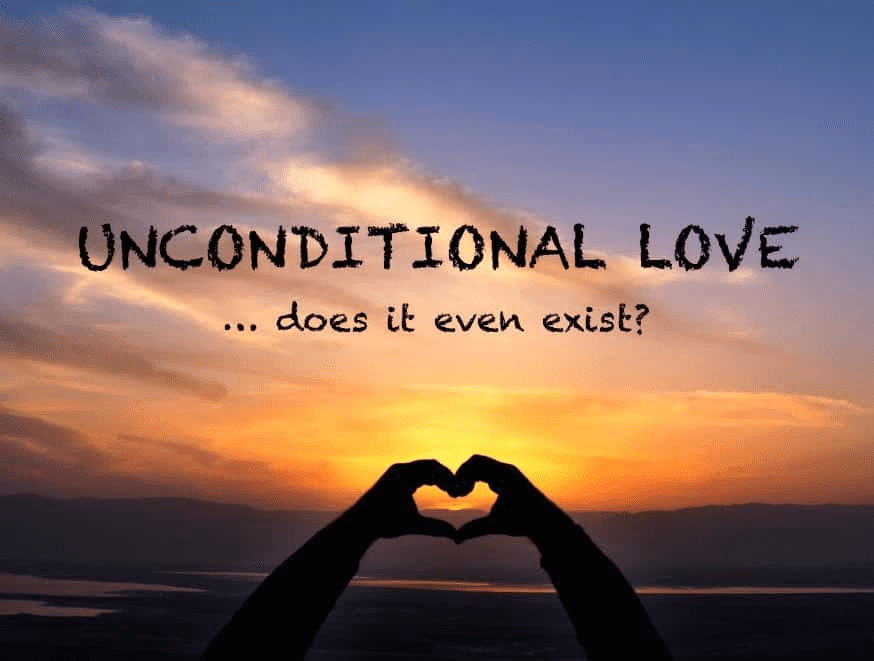
However, there is another twist in the story of existential humanism that, as in the opening graphic quotation from Rollo May, dissolves any distinction that demands we ask only for POSITIVE experiences in life, as proof of what love could be, in aspiration or realisation. From the latter perspective the exclusion of the ‘negative’ in the experience of love, loving or being loved, is a developmental limitation, a refusal to accept the dynamic in love that breaks through barriers and boundaries set by normative standards.
In my view, we love when the relationship is dynamic enough not to stop at mere acceptance that some experience in the best of relationships feels ‘negative’, but explores and moves dynamically beyond the negativity even in the description of the issue without permanent invalidation of the person holding, and projecting and introjecting, most of the negative stress in the dynamic. This is very like the idea of ‘holding’ in parenthood as described by Donald Winnicott, or ‘containment’ in Wilfred Bion. Of course there is a problem that both developed these ideas in terms of conditional pressure on ‘mothers’ (as in the linked piece), whilst claiming they were addressing the issue outside sex/gender but we can deal with that surely. Can’t we? We do so when we approach the problem through the binary-boundary dissolving, condition-testing power of love .
Well, that’s what I think anyway.
Love to you
Steven xxxxxxxxxx
 Steve_Bamlett_blog