


Uninventing the myth of Shakespeare: seeing the film of Maggie O’Farrell’s Hamnet.

There is a real issue of ontology involved in this question – for it raises the question not only of what to choose but what, being ‘uninvented’ that something might be, if indeed it could be anything at all, for to uninvent ‘it’ presupposes first that the ‘something’ did not exist before it was invented and is therefore , by being uninvented, being returned to non-existence – or nothingness (if that isn’t too Sartrean). And I am answering this question using a case study, precisely with this in mind. Maggie O’Farrell’s novel Hamnet. It is a case study because it, in large part, pretends that there is no Shakespeare myth, if that myth is primarily one of the individual genius, touched but not contained by merest mortal being. The Shakespeare of Matthew Arnold shows other mortals that he, the one that out-tops knowledge, has like them the smell of mortality but that most of his grandeur remains unknown to ‘the foil’d searching’ of that same ‘mortality’ (in brief other members of human kind and their tawdry knowledge of themselves.:
Shakespeare By Matthew Arnold

Others abide our question. Thou art free.
We ask and ask—Thou smilest and art still,
Out-topping knowledge. For the loftiest hill,
Who to the stars uncrowns his majesty,

Planting his steadfast footsteps in the sea,
Making the heaven of heavens his dwelling-place,
Spares but the cloudy border of his base
To the foil'd searching of mortality;

And thou, who didst the stars and sunbeams know,
Self-school'd, self-scann'd, self-honour'd, self-secure,
Didst tread on earth unguess'd at.—Better so!

All pains the immortal spirit must endure,
All weakness which impairs, all griefs which bow,
Find their sole speech in that victorious brow.
Of course, nowadays, we tend to think that notions of who or what we mean by Shakespeare are intellectual and ideological constructions of the period of history that invents them for their own uses. No-one is that clearer than in Arnold and few now see Shakespeare as so self-made as he did, but rather as a man and writer not unlike others of his period. Danny Leigh, however, in a recent review in The Financial Times (January 8th 2026) of Chloé Zhao’s film Hamnet (co-written with O’Farrell), while reprising the film in terms of its predicted prize-winning reputation shows quite a lot about the Shakespeare it implies – and rather than one who is ‘free’ of being bothered to ask our questions about him as a person
The Oscar odds do favour Jessie Buckley, who gives a no-holds-barred performance as Agnes, Shakespeare’s wife. Agnes, yes, not the customary Anne. (O’Farrell, who co-wrote the script with Zhao, cites the archival record.) In a movie where names mean a lot, that fits the reappraisal of a heroine unkindly treated by traditional histories. The title character is her son, one of three children. (Hamnet and Hamlet, we learn, were once used interchangeably.) And Shakespeare is just William, played by Paul Mescal.
We get the vibe of this paragraph very early by starting our listing of the characters of interest in terms of their role in a family first, and in historical evidence second, and with a wife whose character (and even name) the historical record simplifies. Moreover, although ‘just William’ as description of Mescal’s Will Shakespeare in is not meant to raise visions of Richmal Compton’s Just William, the same basis of shades heroic masculinity is somewhere in each, however varied by nuance and ideals of which we fall short. Indeed for many there will be disappointment that the relatively marginal role of the dramatist William Shakespeare, husband to Agnes, is given as much prominence in the film as it is, without real justification from O’Farrell’s novel. Of course both O’Farrell and Zhao were not going to waste the costly Paul Mescal both as a financial pull to promoters and to audiences. But note just how integral Mescal; was to become in the tweet below from Film Updates. Mescal has become an actorly gaze, hiding behind the remnants of the make-up in which he played the ghost of Old King Hamlet, the father of Hamlet. Even the epigram of the film shouts out that in Tudor times, just as Anne and Agnes were interchangeable as written names of the same person, so were Hamnet and Hamlet. The whole point of this film is that Shakespeare wrote Hamlet in order to play the Father of his own son, as a means of mourning him and registering the effects of such cataclysmic familial loss.

If we uninvent one myth of Shakespeare, it seems we buy into another, but in this case the myth we call the Gaze of the Father. The idea is that the patriarchal surveillance is a matter not only of care and control – indeed surveillance – but also the mutual gaze of attachment. The validation of the nuance-filled protective gaze of the father has mythical associations in religions of the God-the-Father (here in Catholicism) and in some versions of familial internal object psychology (as in this example). We have uninvented only to substitute with another construction of another kind of ideal figure. Of course, it can’t have worked for everyone, because Francesca Steele in the i newspaper (9th January 2025) calls Jessica Buckley’s a ‘performance for the ages’, whilst Mescal is ‘good, though his acting feels a tad delicate’. Perhaps women of Steele (or her type) do not feel so safe with men who project, through their gaze alone, the feel of being able to ‘hold you’. Nevertheless, the film instates family at its heart, whilst resurrecting notions of patriarchal duty, not always evidenced in Tudor history. See the film still below, where Dad gazes smilingly on his twins, here cross-dressed, pretending to be, or really, tricked by their exchange of sex/gender roles. The sense of family is strong, even in the concerned look that the elder daughter Sussanah gives upon the whole scene, for she will represent the sibling who knows what it must mean to face life and death with balance. Francesca Steele is probably right to see it as at base (whatever its links to fantasy and Gothic nature) as ‘a story of family and relationships, life’s inevitabilities and the surprises we carve from them’.
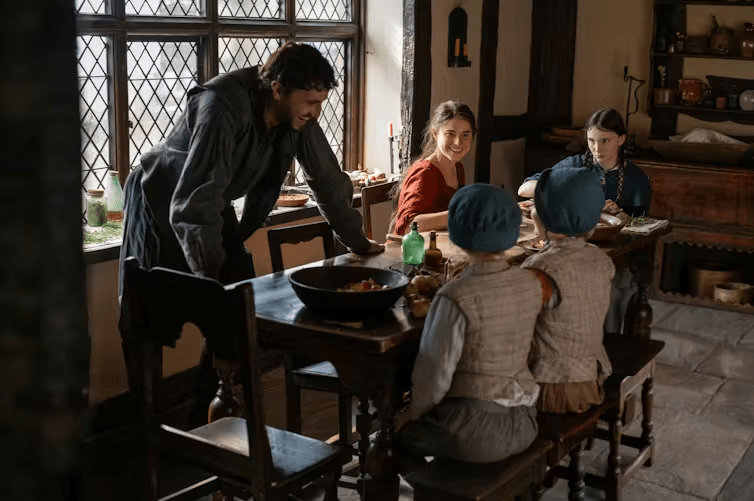
The Shakespeare family in Hamnet. Focus Features
The ‘trick’ played on William here by Hamnet and Judith is more than an amusing episode for the attribution of meanings of vulnerability by codes of sex/gender play across the film. When the twins are born,Jjudith is believed to be still-born, until she belatedly takes a breath in her mother’s arms. Agnes believes this to be the stamp of possible death on her daughter, should her premonition of having only two children at her side at her own death come to be. In believing the myth of Judith’s vulnerability, she perhaps fails to see the mark of such vulnerability on the boy rather the girl. There is much play with the in interaction of the supposed sex/gender binaries and those of life and death, and the boundary between each. Taken from the feminist model of O’Farrell’s book, the notion of the innate vulnerability of women as a tool of patriarchy is the stuff of both novel and film.

Agnes, as portrayed in both, is a girl and woman associated with wild free nature from the beginning. We find her in the opening shots curled as if inside the womb of a vast hollow under an ancient tree, a scene that evokes a natural grotto of wild colour. Inside that structure is a pit-like hole in which variously people find the meanings of birth and dying, life and death. That is noit the only binary played with here. She carries a tamed hawk (as much as a hawk can be tamed, and this binds here too to themes of the wild set against the tame, nature outside social determinations and domesticity right inside them. Even Will stares into it.It is a hole, gap or portal that returns in the pastoral wood painted backdrop of the Globe theatre as the portal of exit and entry between the stage and tiring house of the stage – the ghost of the father oft filling it, as does young Hamnet Shakespeare’s visionary ghost for Agnes at the end of her visionary audience of Hamlet, her husband’s play – at the end of the film (surely its crowning glory as a film. And if the human taming of the wild plays a part so does the humanisation of super-nature – from the darkly limned connection of women of knowledge and natural power to witches to the role of ghosts and the suggested monstrous that lie in the pits and dark portals to the unconscious.
Anna Walker in The Conversation (online on the 8th January 2026) makes the best case in representing the film as a feminist heroism, if only in making it clear that emotion worked into art, either in writing or auditing it, is solely a male preserve. She says the film shifts from the myth of the playwright of comprehensive and contained knowledge to his ‘personal rather than professional life but does this by focusing chiefly on the experience of his previously maligned wife, Anne Hathaway’. Walker even charts the history of the maligned wife of the usual myth (usually invoking Shakespeare’s gifting to his wife in a will of his ‘second-best bed’, thus:
From the 18th century to well into the 20th, Shakespeare biographers and researchers tended to represent Hathaway in highly negative terms. …. / This perception of Hathaway is grounded in sexist assumptions drawn from the few known facts of their marriage. … / The popular 1998 romantic comedy, Shakespeare in Love, reproduced the “shrewish” Hathaway narrative. She is absent from the film, but Shakespeare (Joseph Fiennes) dolefully comments on his sexless, loveless marriage and finds genuine passion instead with London-based heroine, Viola (Gwyneth Paltrow). … / In sharp contrast, Hamnet’s Agnes (Jessie Buckley) is a young, robust and free-spirited woman who is associated with nature rather than dull domesticity. /…
While many representations of Elizabethan life are centred on the largely male-dominated culture of politics and courtly life, Hamnet offers an account of the busy and productive life of an ordinary (if eccentric) Elizabethan wife and mother. Agnes is in charge of the labour-intensive life of the household. Her family home is situated in the centre of Stratford, boarded by a muddy, dirty, bustling thoroughfare. Women are shown as managing the core human processes of birth and death, birthing in an all-female environment and desperately struggling to keep their children alive in an age of precarious health and mortality.
Of course, though I feel this is a good-enough reading, it hardly accounts for the fact that the film buyes into the patriarchal half way through and the cruelty of the methods of ‘confinement’ (during child-birth) being used symbolically for the wider entrapment of women in that family, whatever their competencies. The change hangs around those moments whem Mrs Shakespeare (Emily Watson), William’s mother, forces Agnes to have her first baby at home. From thence, Agness has given up the fight against excelling mainly in the domestic realm.
One thing also that Anna Walker gets wrong in my book, though she says ‘ other critics have argued‘ it (with that link as evidence) is that ‘the film’s climax – in which Hamlet is interpreted as the artistic expression of Shakespeare’s personal grief over the loss of his son – is one of the less convincing aspects of the film. Hamlet is essentially a revenge tragedy and Shakespeare’s plots were largely derived from classical and historical sources rather than personal experience’. Critics like to boast their knowledge when they have it but the truth of the genre-based reading of Hamlet, does not conflict with this film, and to think it does misreads the film’s climax. As she enters the Globe and Scene ! of Act 1 proceeds Agnes says very loudly, while being hushed by those around: ‘What has any of this to do with my son?’ The answer is – in some contexts of interpretation, none at all, but not in every.
The beauty of the climax is that it reanimates the Shakespeare myth. We see Will contemplating suicide in the symbolic river as he pens ‘To Be or Not to Be’ as a monologue and this is weak, but the edited final scene of the play, ending with the actor playing Hamlet addressing the phrase ‘the rest is silence’ is truly beautiful, even though a powerful misreading of the play, which moment in fact Fortinbras intrudes upon to busy up that silence and end it in order to take over the Danish throne (a bit like Donald Trump now). For me the whole film comes into being in its climax, because it is the force of a female and lower class reading of the play that is seen to triumph.

This is particularly so when Agnes leads the rest of the audience in reaching out to grasp the dying Hamlet’s hand. It is not Hamlet, but then who knows what Hamlet is. And the Shakespeare myth is precisely that he was not ‘for an age but for all time’, and in my view, that is a much healthier response to art of the finest, however many years have passed from the circumstances of its inception. Moreover, that statement comes from a peer of Shakespeare’s own time, the scholarly if wanton Ben Jonson.

The truth is that no-one can ever uninvent what has existed, for control over the residues of time is not on offer to mortals of any age. Even if we uninvented the ‘atomic bomb’, would we uninvent its tragic consequences or merely forget them provided they don’t involve us directly. The genocide in Gaza is deliberately being forgotten but its consequence will resume its memory and reality in future minds too.
All for now
With love
Steven xxxxxxxxxxxxxx
 Steve_Bamlett_blog