


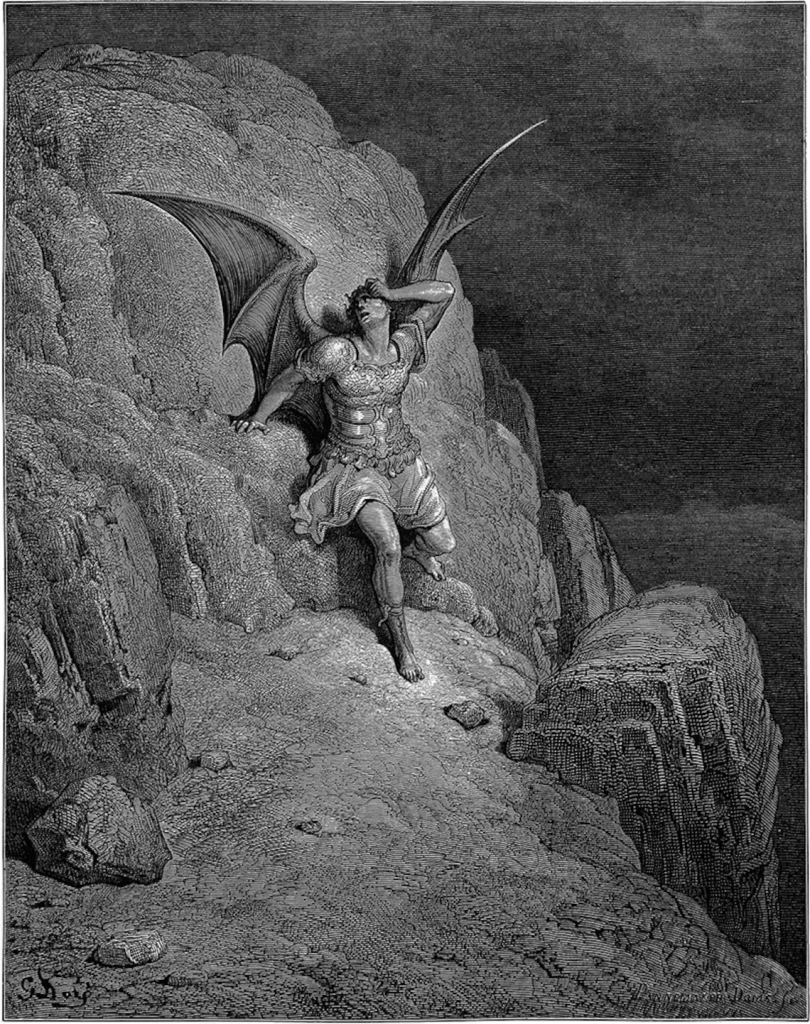
Gustave Doré’s version of Satan after the Fall may be thinking: ‘Am I happy here?’
Those of us who refuse the blandishments of comforting religions still appreciate the call of bliss, so called, of perfect and unqualified satisfaction and that superfluous emotion we call joy. We all now live in a world into which we feel thrown, to use Heidegger’s metaphor, conscious that we shaped it or let it overwhelm us, as in its complexity it must otherwise. The existential philosophers and the counselors that derive from them try to help us make sense of the choices we must make to realise the form, appearance, and meaning of our own chosen being-in-the-world, shaped and determined in ways over which we have no control by such materials as seem to be what which we are born with before we re-design them, within limits, by our choice-making.
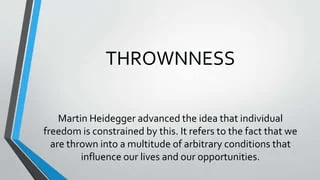
The pursuit of happiness (which I have written about before – at this link), a kind of lower-register of joy, has a chequered history in prior philosophy, and in modern existentialism seems less than a satisfactory life-goal, even though it may exist as an epiphenomenon of our other goals: a side-effect as it were of those we experience as giving meaning to our existence in the absence of any prior blueprint for that meaning. Blueprints, after all, as Sartre says in Existentialism is a Humanism, require supernatural agency or an a-priori idealisation of what it means to be human. See this adequate online summary of the existential trope, Existence precedes Essence, wherein ‘essence’ might very roughly speaking be understood as a blueprint definition of the object, although it is a term from Aquinas:
The basic given of the human predicament is that we are forced to choose what we will become, to define ourselves by our choice of action: all that is given is that we are, not what we are. Whilst a penknife’s essence is pre-defined (it isn’t really a penknife if it hasn’t got a blade and won’t cut); human beings have no essence to begin with:
… man first of all exists, encounters himself, surges up in the world – and defines himself afterwards. If man as the existentialist sees him is not definable, it is because to begin with he is nothing. He will not be anything until later, and then he will be what he makes of himself (p.28).
So for the penknife essence comes before existence; whereas for human beings the reverse is true – ….
Hence, the importance to those who believe the idea of God the Father [or the ultra-male Leader of a pantheon of godettes] is a way of packaging obscene old ideas of patriarchal authority and the fight to assert power over their subjects of representations of resistance to such Gods. The classical example par excellence is Prometheus. If even Euripides, at the late end of the age of Classical Athens, makes room for seeing that rebellious God as a hero and his tormentor, Zeus, as a kind of tyrant in Prometheus Bound, when Shelley tells the tale in the nineteenth century, it has to be of Prometheus Unbound, and be an allegory of class revolution of the ‘Many’ against the ‘Few’.
But other religious cultures afterwards produced even more powerful monotheistic tyrants, such that in Miracle Plays, even common people find their precepts for human behaviour too tight, and the Devil gets some good arguments in moralistic high drama in tje Renaissance. There was, I suppose, a hegemonic religious culture such as that in seventeenth century Britain, but the idea of God didn’t always remain the same across political divides.
Finding William Empson something of a special pleader in his Milton’s God for the belief that John Milton got himself in a mess when he modelled his God on the idea of an omnipotent and aggressive military leader and King in Paradise Lost, wherein even Christ is also a sub-commander of armies, auch as those Kings, Charles I in fact, he had opposed in the Civil War and signed the death warrant thereof. According to Empson. The poem shows how unreasonable and oppressive the idea of such a God is, in St Augustine too.
Empson invokes William Blake’s idea that the ‘Milton was of the Devil’s party, without knowing it’ but Blake was so only in order to reinvent God in the image of human energy, freedom and renewal in Satan.
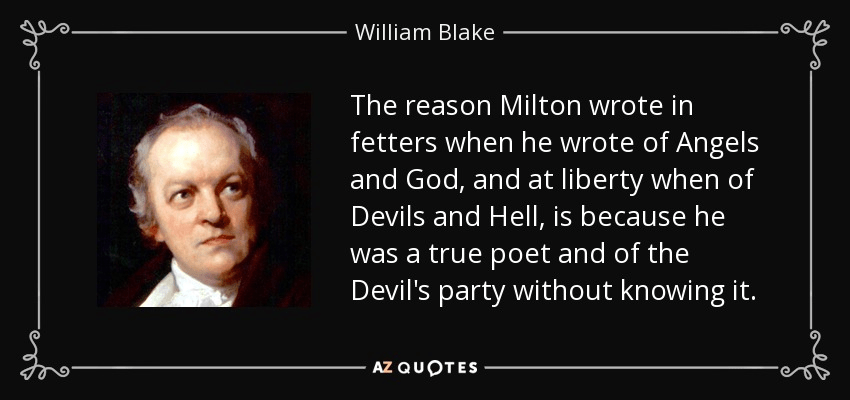
His vision of Satan in Milton’s Hell is replete with beauty and energy, where flames are the flames of desire:
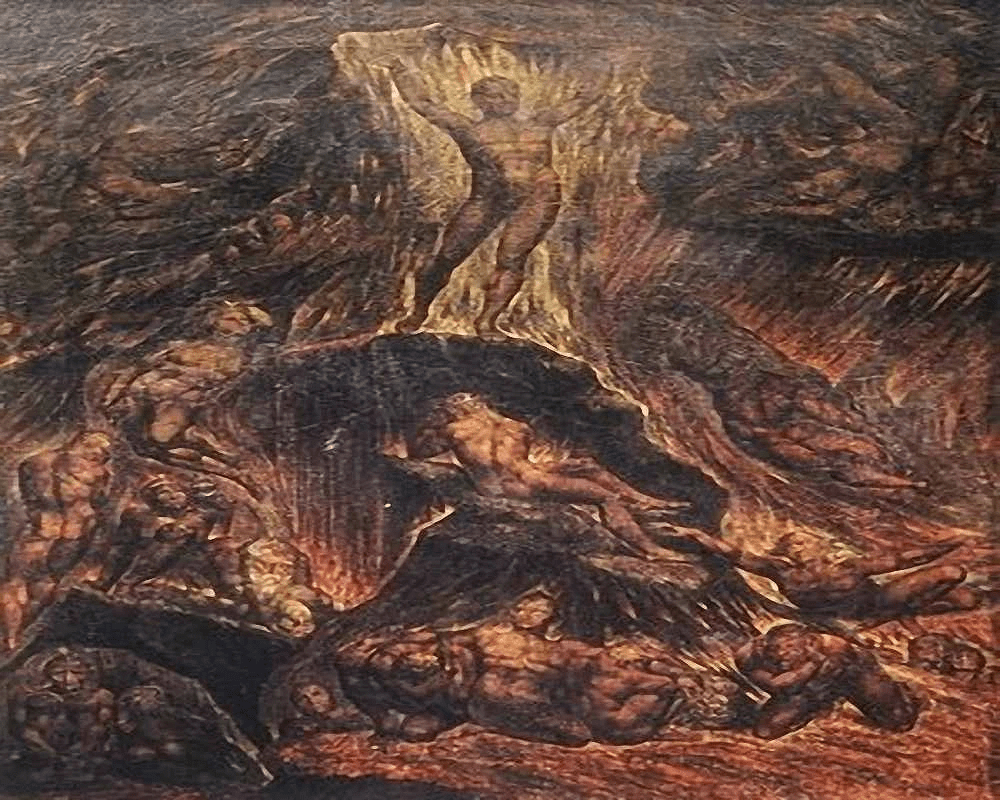
As I see it now, Milton knows that we, and he, as human beings are bound to find God in his telling as more hideous than Satan, despite the weight of moral nastiness piled into the descriptions of him together with some unsurpassed beauty, for it was written by and for ‘fallen’ or ‘thrown’ beings, though he would not have used the concept of the thrown. People thrown into the world, as Satan is thrown from the battlements of Heaven to ‘fall’ for nine days, and eventually find himself in Hell, cannot help like an existentialist to wonder why they must suffer such loss and reinforce that by losing all choice of how to live, to appease the God avenging himself on Satan, Adam and Eve and yet unborn people.
Those who reject a supernaturally authorised blueprint of what is good in human life will look for models elsewhere, and their eyes are bound eventually to fall on representations of Satan. Satan in the first book of Paradise Lost begins by regretting his loss of happiness in heaven, only to begin to see that happiness is a pallid state of emotional being anyway. The characterisation of Lucifer’s angelic happiness is almost drained of blood in its abstraction and brevity How much more lively the verse,( effective the alliteration and the beat of the rhythm when it ivokes the ‘Horrours’ God has let loose on those who stood against His will. The whole point of this verse is to emphasise God’s military power and its theatricality, in its use of sound like ‘Thunder’ to mark his aggression.
                     ...  Farewel happy Fields
Where Joy for ever dwells: Hail horrours, hail
Infernal world, and thou profoundest Hell
Receive thy new Possessor: One who brings
A mind not to be chang’d by Place or Time.
The mind is its own place, and in it self
Can make a Heav’n of Hell, a Hell of Heav’n.
What matter where, if I be still the same,
And what I should be, all but less then he
Whom Thunder hath made greater? Here at least
We shall be free;
It is Satan whose value, at least to himself, by the show that God puts on to demonstrate his fall – even creating a space which, as soon as he gets there, thereof Satan can become the ‘new Possessor’. Happiness is remendered bland not only by its evocation in one and half iambic pentameters but by the music and stage effects that God sets up Satan to be worthy thereof. Like the thrown individual now interpreted by Sartre, the fallen being emphasises the power of its own mind to interpret its circumstances in ways that change their nature diametrically – Hell can be Heaven and vice versa. That is so like the doctrine of the existential and cognitive psychotherapists: Satan is almost the first to insist on the cognitive-affective restructuring of your circumstances. After all does not this 2024 definition of the process as done by mental health nurses (see the full source at this link) sort of sound like what Satan does for himself by asserting the power of his mind:
Cognitive restructuring (CR) aims to get people to challenge and modify their cognitive distortions, generating alternative, more adaptive thoughts. Behavioral, emotional, and physiological responses are modified by analyzing and changing dysfunctional thoughts. The person must have the cognitive capacity to participate in the analysis of their thoughts. CR for people with depression has positive effects, although there is little research on how it should be structured and applied.
Existential psychotherapy goes one step further seeing therapy as the route to optimising personal freedom from biopsychosocial determinations and circumstances. But Satan already does that in that he is the possessor of the space-time configuration named Hell not made by him but into which he is thrown but in which he asserts his freedom, even after God shows to him that his power extends over Hell in Book 10 of Paradise Lost by making all the inhabitants of Pandemonium they build in Hell a group of dust-crawling snakes, for even God cannot keep them in that condition forever. Having mental power to make choices – even in seeing tour space-time location as you wish makes Satan FREE, which even God is not – bound as he is to over-react when anyone crosses him (I know so many bad mental health professionals like that. It is at the heart of the problems in the Tees, Esk, and Wear Valley (TEWV) about which Wes Streeting was recently so rightly damning! (I know for a number of reasons not only working for them.) Let’s see Satan’s assertion again! He has:
A mind not to be chang’d by Place or Time.
The mind is its own place, and in it self
Can make a Heav’n of Hell, a Hell of Heav’n.
What matter where, if I be still the same,
And what I should be, all but less then he
Whom Thunder hath made greater? Here at least
We shall be free;
Note that this does not say he never changes his mind but that it won’t be changed by ‘Place or Time’ (the circumstnces into which – infernal or on earth – into which you are ‘thrown’, by whatever force or set of forces. This kind of mind even challenges the power of minds who claim to know better – about him, the world, cosmos and moral universe.
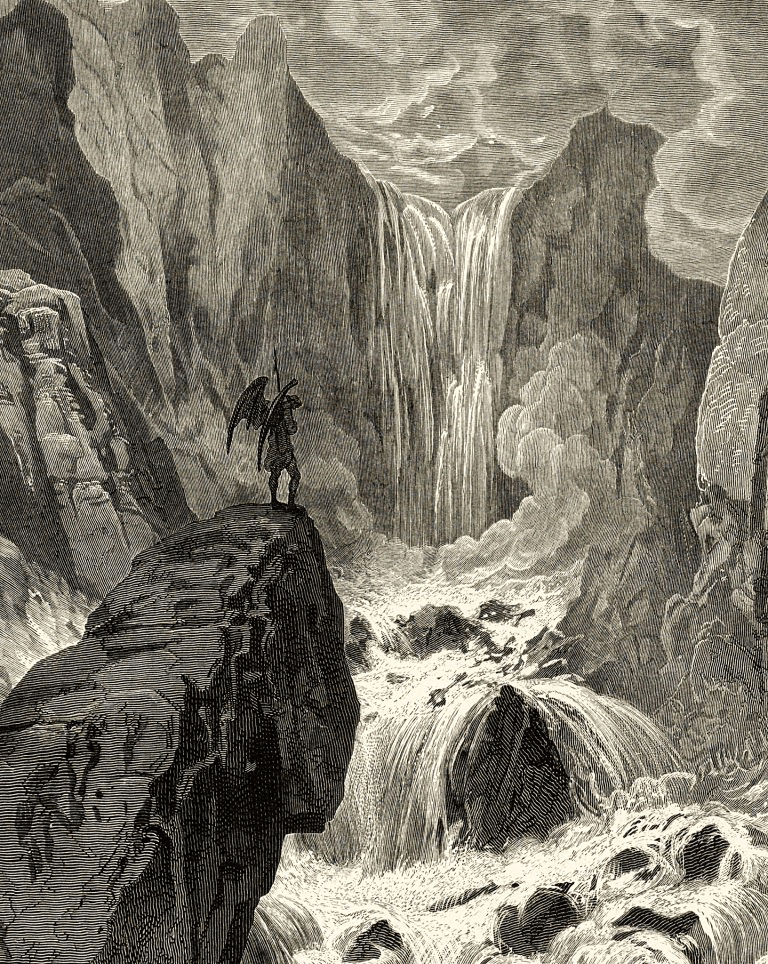
Gustave Doré’s Satan surveys a place to which he could with his Mind adapt himself’
Of course, he’s Satan, and I am not advising (and Milton certainly isn’t despite William Blake and William Empson) that we use him as our model. what power he gets he uses to trivialise demonic and human lives, in that sense he is more like the new Right and Donald Trump in particular. But as a determination to be more than that into which we are thrown – including space-time conditions, as well as biopsychosocial limitations – it is really worth thinking about flexibly and adaptively.
All for now
With love
Steven xxxxxxxxxxxx
 Steve_Bamlett_blog