


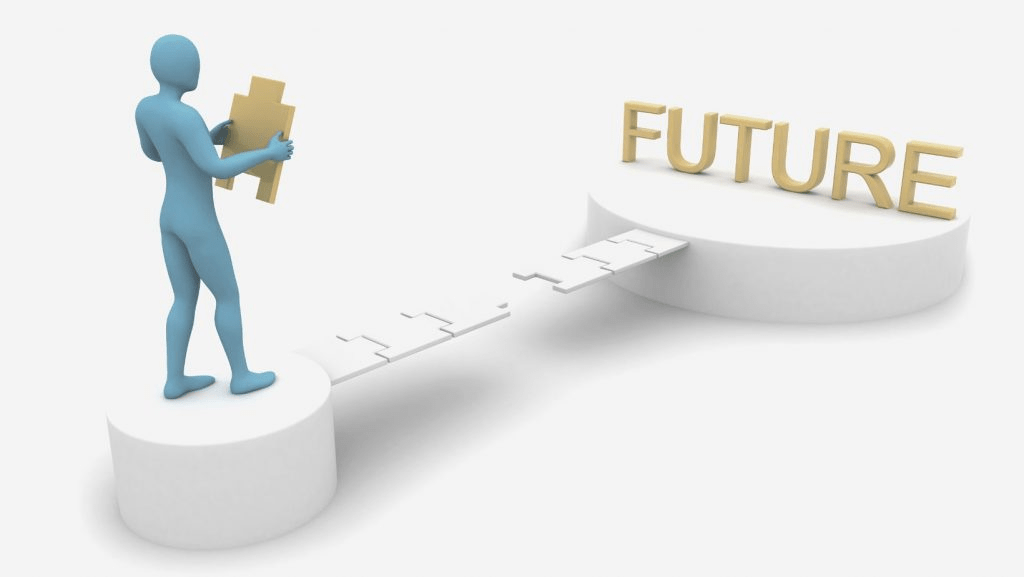
Look again at the strange and impossible meme above. It tries to visualise the rationale of the motivational technique in which you ‘visualise your future and step towards it’. In theory, visualising where you want to be makes you more likely to visualise and practice the things you do to make that future possible. Hence, in the meme, the stepper-out holds the jigsaw piece that will complete the bridge-like path towards his future. Confidently step forth, meme-person, and complete the bridge as you step on it!.
Of course, his first step will already spoil the figure’s illusions, for the bridge would collapse without the missing piece. Held firmly in their hands, rather than assist their progress, the heavy piece of construction will aid the collapse of the bridge that misses that piece, acting merely as additional weight to add to one’s failure to get where you want. The meme-maker didn’t intend that extrapolation of their visualisation, but the bridge to the desired future is paved with such effects in which your motivation itself propels only your failure to meet your desired goal.
However, this question wants us to look around where we are now and compare it with what we visualized in a well-past present, the future which is our present now. It’s a tricky process, open to all kinds of illusory conclusions – its main purpose to confirm our belief that, if we believe, our path is set to achieve what we want, or to be some way along the path. Perhaps even the body who has fallen off the deficient bridge to the future of their magical thought still thinks they can walk the low way, with aids, to their imagined future.
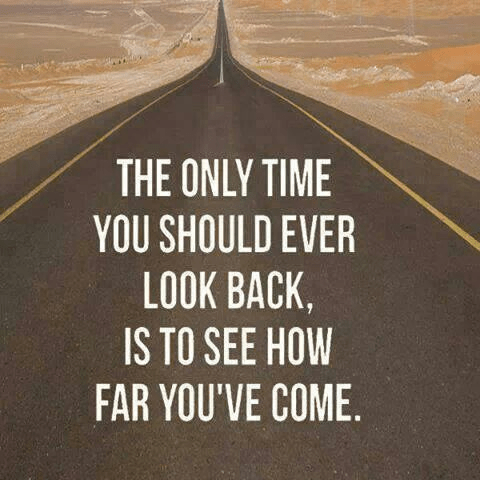
Most of the ‘looking back’ from the present to the past memes advise prexisely that you don’t do that, because that ‘is not the way you’re going’. That is that they fixate that you stay in the illusory condition that where you are actually going will be where you imagine you want to be (if you want it enough). Others look back in self-satisfaction:
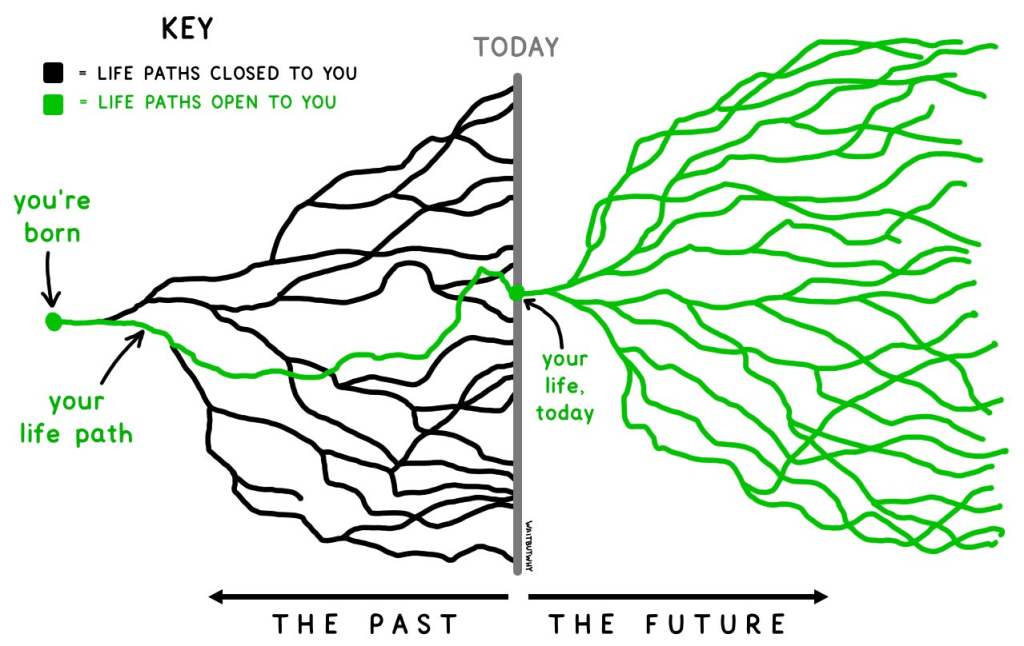
But these memes aren’t all that useful because they imagine that past and future contain only one intended path that leads through your present to your future. Isn’t the meme below more accurate? Where you are today is a result of determinations and sometimes choices (or a mixture of the two), but they are not the only paths that you could have taken. Those counterfactual paths in the past are of different sorts. Some will have terminated before today, depending on that mix of uncontrollable determinations and events and more controllable choices. Your future, looked forward to from today, has an equal number of paths opening up, some of which will get you to a future of your desire, imagination, or fear – but others will not. Some will terminate before you get there. Others will meet a future you could never have visualised.
We are not in total control of the path we take – which is not to say we have none. though at some points, we may not. That is the lesson Oedipus takes from Creon at the end of Oedipus Tyrannus, here in Gilbert Murray’s words:
Creon.
I see no light; and, seeing not, I may not swear.
Oedipus.
Then take me hence. I care not.
Creon.
Go in peace, and give these children o'er.
Oedipus.
Ah no! Take not away my daughters!
[They are taken from him.
Creon.
Seek not to be master more.
Did not thy masteries of old forsake thee when the end was near?
Sometimes we have no control and discover that apparent free choices were not so free after all as we thought when we made them. For instance, Oedipus did not know when he did so that he was choosing to kill his father and marry his mother. Nor did his parents choose that Oedipus would be alive at the point when it was predicted at Delphi that he would kill and marry them respectively. Can we any longer trust our desires in this light.
The Greeks could evoke all kinds of determinations of events unbeknownst to us, but we have our equivalents. We can and should make choices but ought to do so in the consideration that there is much we do not know about how these choices were reached and how they might unfold, for they will have consequences on others that will provoke reactions that might change things for us.
Visualising the future my AI responded is ‘proven’ to increase success by 23%. But such calculations are full of error in their conception of how visualisation is done and how success in meeting one’s vision is measured, not least faults in the tools of measurement – usually by faulty subjective measures, biased towards interpreting one’s life as a ‘success’. In this respect those who cannot read Oedipus Tyrannus or King Lear meaningfully will never understand that we can’t always ‘seek to be master’, even of ourselves and the fulfillment of our most simpke wishes – to maintain our family in hard times for instance.
Bye for now
Love, Steven xxxxx
 Steve_Bamlett_blog
One thought on “Visualize your future and step towards it: Looking around to see the limits of motivational techniques”