


Why not start with versifying of my own:
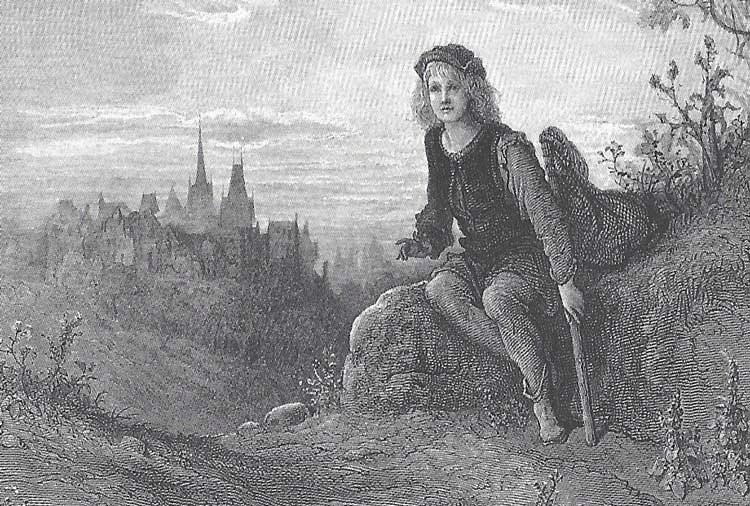
But that is not the city, said Dick
And looked away to one not built,
Its roads with gold inlaid so thick,
Building, gilding his inner guilt
That he knew would rule that city
As mayor, without love nor pity.
Meanwhile, in Hell, Satan's fine gilded horn
A Trump of doom did sound: began to build
In the pattern of an ancient city,
His free imagination of a place
Where all bowed down equal in common love
Of his command to be participants
In self-governance, ruled by him alone.
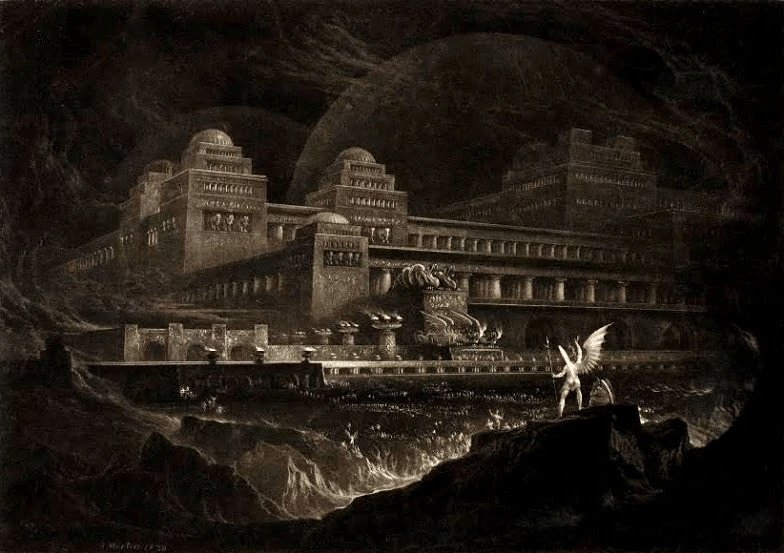
In Book 1 of Paradise Lost, Milton’s Satan has no sooner fallen, for nine days, than he stands again and orders to his wishes his response to his defeat, that must start with a city to rival ‘The City of God’ in Heaven. Milton describes the building of the city of Pandemonium as if it happened merely through the description of Satan’s wishes acting on his environment, from the detection of raw materials for the build, to mining them with appropriate oversight, from Mammon, the ‘least erected spirit’ who only ever looked downwards at the wealth beneath his feet, an early model of Dick Whittington’s dream of a city ‘paved with gold’.
There stood a Hill not far whose griesly top [ 670 ]
Belch'd fire and rowling smoak; the rest entire
Shon with a glossie scurff, undoubted sign
That in his womb was hid metallic Ore,
The work of Sulphur. Thither wing'd with speed
A numerous Brigad hasten'd. As when Bands [ 675 ]
Of Pioners with Spade and Pickax arm'd
Forerun the Royal Camp, to trench a Field,
Or cast a Rampart. Mammon led them on,
Mammon, the least erected Spirit that fell
From heav'n, for ev'n in heav'n his looks and thoughts [ 680 ]
Were always downward bent, admiring more
The riches of Heav'ns pavement, trod'n Gold,
Then aught divine or holy else enjoy'd
In vision beatific: by him first
Men also, and by his suggestion taught, [ 685 ]
Ransack'd the Center, and with impious hands
Rifl'd the bowels of thir mother Earth
For Treasures better hid. Soon had his crew
Op'nd into the Hill a spacious wound
And dig'd out ribs of Gold. Let none admire [ 690 ]
That riches grow in Hell; that soyle may best
Deserve the precious bane. And here let those
Who boast in mortal things, and wond'ring tell
Of Babel, and the works of Memphian Kings
Learn how thir greatest Monuments of Fame, [ 695 ]
And Strength and Art are easily out-done
By Spirits reprobate, and in an hour
What in an age they with incessant toyle
And hands innumerable scarce perform.
Nigh on the Plain in many cells prepar'd, [ 700 ]
That underneath had veins of liquid fire
Sluc'd from the Lake, a second multitude
With wondrous Art found out the massie Ore,
Severing each kind, and scum'd the Bullion dross:
A third as soon had form'd within the ground [ 705 ]
A various mould, and from the boyling cells
By strange conveyance fill'd each hollow nook,
As in an Organ from one blast of wind
To many a row of Pipes the sound-board breaths.
Anon out of the earth a Fabrick huge [ 710 ]
Rose like an Exhalation, with the sound
Of Dulcet Symphonies and voices sweet,
Built like a Temple, where Pilasters round
Were set, and Doric pillars overlaid
With Golden Architrave; nor did there want [ 715 ]
Cornice or Freeze, with bossy Sculptures grav'n,
The Roof was fretted Gold. Not Babilon,
Nor great Alcairo such magnificence
Equal'd in all thir glories, to inshrine
Belus or Serapis thir Gods, or seat [ 720 ]
Thir Kings, when Ægypt with Assyria strove
In wealth and luxurie. Th' ascending pile
Stood fixt her stately highth, and strait the dores
Op'ning thir brazen foulds discover wide
Within, her ample spaces, o're the smooth [ 725 ]
And level pavement: from the arched roof
Pendant by suttle Magic many a row
Of Starry Lamps and blazing Cressets fed
With Naphtha and Asphaltus yeilded light
As from a sky. The hasty multitude [ 730 ]
Admiring enter'd, and the work some praise
And some the Architect: his hand was known
In Heav'n by many a Towred structure high,
Where Scepter'd Angels held thir residence,
And sat as Princes, whom the supreme King [ 735 ]
Exalted to such power, and gave to rule,
Each in his Hierarchie, the Orders bright.
Nor was his name unheard or unador'd
In ancient Greece; and in Ausonian land
Men call'd him Mulciber; and how he fell [ 740 ]
From Heav'n, they fabl'd, thrown by angry Jove
Sheer o're the Chrystal Battlements: from Morn
To Noon he fell, from Noon to dewy Eve,
A Summers day; and with the setting Sun
Dropt from the Zenith like a falling Star, [ 745 ]
On Lemnos th' Ægean Ile: thus they relate,
Erring; for he with this rebellious rout
Fell long before; nor aught avail'd him now
To have built in Heav'n high Towrs; nor did he scape
By all his Engins, but was headlong sent [ 750 ]
With his industrious crew to build in hell.
Mean while the winged Haralds by command
Of Sovran power, with awful Ceremony
And Trumpets sound throughout the Host proclaim
A solemn Councel forthwith to be held [ 755 ]
At Pandæmonium, the high Capital
Of Satan and his Peers:
The city of Satan’s desire is built at pace and invisibly in ways no city of the past has ever been built, for time and space bend to Satanic desire, and the known world has no pattern of this, for in that mortal world cities are the product of wealth, imagination and labour at wealth’s service that both have weighty physical characteristics, not least in the wear and tear of other lives. It is Satan in part who holds the point of view behind the lines that boast that any city he imagines will, in genesis, planning, construction and readiness for use, excel that of any city mere mortals know by visiting it, hearing of others visiting it or now destroyed and revered as a bookish remnant in a guide to ancient ruins. Those:
... greatest Monuments of Fame, [ 695 ]
And Strength and Art are easily out-done
By Spirits reprobate, and in an hour
What in an age they with incessant toyle
And hands innumerable scarce perform.
It is so because desire and wants know no boundary that gainsays them when you start with an entitled spirit, as imperialist like Satan does: to whom no thing is material, even money is a god, Mammon, whose downward-looking peculiarities of search serve you, and labour has no cost. Its architect is so great – the one who built, after doing so in Heaven too, is no sooner summoned than the fruits of his architectural imagination are ready for use. Read again that wonderful passage about Mulciber, the architectural God that the Ancients got wrong and whose fall was not as magnificent as the Ancients said, and who, before we hear of what he built in Hell, it (Pandemonium) is already built. For the verse just moves on to the demons being summoned to and into the building, whose exterior and interior structures we never see described. Mulciber, instead:
... was headlong sent [ 750 ]
With his industrious crew to build in hell.
Mean while the winged Haralds by command
Of Sovran power, with awful Ceremony
And Trumpets sound throughout the Host proclaim
A solemn Councel forthwith to be held [ 755 ]
At Pandæmonium, the high Capital
Of Satan and his Peers:
Lines 750 to 751 is all we get of the infernal build of this city, for it already exists in the same mental force that commands all demons to attend upon it. The next lines of the poem concern themselves with the crowds accessing the already-built city and the beginning of deliberations between ‘Satan and his Peers’.
So why ask what cities I want to visit? The wanting and the desire is, for Dick and Satan, for a city that reflects their superior imagined power, that exists already in their wishes. Pandemonium is no sooner built than forgotten, We hear of it again only in Book 10, when Satan having dispatched his daughter Sin, and their Son, Death, by his incestuous engendering to plague Earth, travels home to find Hell’s gates now unguarded and his demons messing about in a city that now finds no other purpose, its generative desiring evil being away creating colonies:
... Th' other way Satan went down
The Causey to Hell Gate; on either side [ 415 ]
Disparted Chaos over built exclaimd,
And with rebounding surge the barrs assaild,
That scorn'd his indignation: through the Gate,
Wide open and unguarded, Satan pass'd,
And all about found desolate; for those [ 420 ]
Appointed to sit there, had left thir charge,
Flown to the upper World; the rest were all
Farr to the inland retir'd, about the walls
Of Pandæmonium, Citie and proud seate
Of Lucifer, so by allusion calld, [ 425 ]
Of that bright Starr to Satan paragond.
There kept thir Watch the Legions, while the Grand
In Council sate, sollicitous what chance
Might intercept thir Emperour sent, so hee
Departing gave command, and they observ'd. [ 430 ]
As when the Tartar from his Russian Foe
By Astracan over the Snowie Plaines
Retires, or Bactrian Sophi from the hornes
Of Turkish Crescent, leaves all waste beyond
The Realm of Aladule, in his retreate [ 435 ]
To Tauris or Casbeen. So these the late
Heav'n-banisht Host, left desert utmost Hell
Many a dark League, reduc't in careful Watch
Round thir Metropolis, and now expecting
Each hour thir great adventurer from the search [ 440 ]
Of Forrein Worlds:
Satan gets mad that his Hell gate guards had flown, but soon cools having seen that without him they flock to his city and sing of his name, Lucifer: the lords of a waste-land otherwise, having applied to it the most wasteful of ways of controlling one’s Empire – a scorched earth policy. One would have though Satan might have complained that, without him, his people did nothing but lie about, watching for his return, but he doesn’t. Instead he uses the city as a launch pad for adventures beyond Hell’s border, like all good Imperialists and settler colonials. Who would visit Pandemonium now. It is a home of has-beens. He has, he says:
.........returnd
Successful beyond hope, to lead ye forth
Triumphant out of this infernal Pit
Abominable, accurst, the house of woe, [ 465 ]
And Dungeon of our Tyrant: Now possess,
As Lords, a spacious World, to our native Heaven
Little inferiour, by my adventure hard
With peril great atchiev'd.
And this is the fate of cities once built. They attest only to wishes that soon outspan those they have satisfied.
With love
Steven xxxxxxxx
 Steve_Bamlett_blog