


Apologies for another nit-picking response but this question embeds a very poor assumption that events are a cause of well-being or ill-being, the former being positive the latter negative. It is an assumption built into that facile tool in developmental psychology, the Life-Events Inventory. Here is a description of it, followed by a brief history of its development as a psychological tool, both by Craig A. Jackson, from the journal Occupational Medicine:
The Life Events Inventory (LEI) is a checklist of potential stressful events for individuals to self-complete by serially scanning and ticking (true positive) if any of the 55 listed events occurred to them in the previous 6 months. An advantage of the LEI is that it focuses on potentially distressing events from both the domestic and occupational spheres and does not limit the assessment to solely occupational sources—which makes the LEI useful in gathering a distress profile of the ‘whole person’. There are no recommended optimum conditions for the completion of this scale, although it’s brevity does mean that it can be completed equally well in clinical settings or in ‘working time’. The LEI can be scored in a variety of ways which is also useful in providing multiple outcome measures.
The LEI was adapted, developed, updated and simplified by Spurgeon et al. [1] from earlier work from the original Schedule of Recent Experiences Checklist by Holmes and Rahe (1967) and modified and renamed as the LEI by Cochrane and Robertson (1973). Both of the previous versions of this scale were validated for use with limited populations of students, psychiatrists and psychiatric inpatients and as such had limited applicability to general working populations. [1]
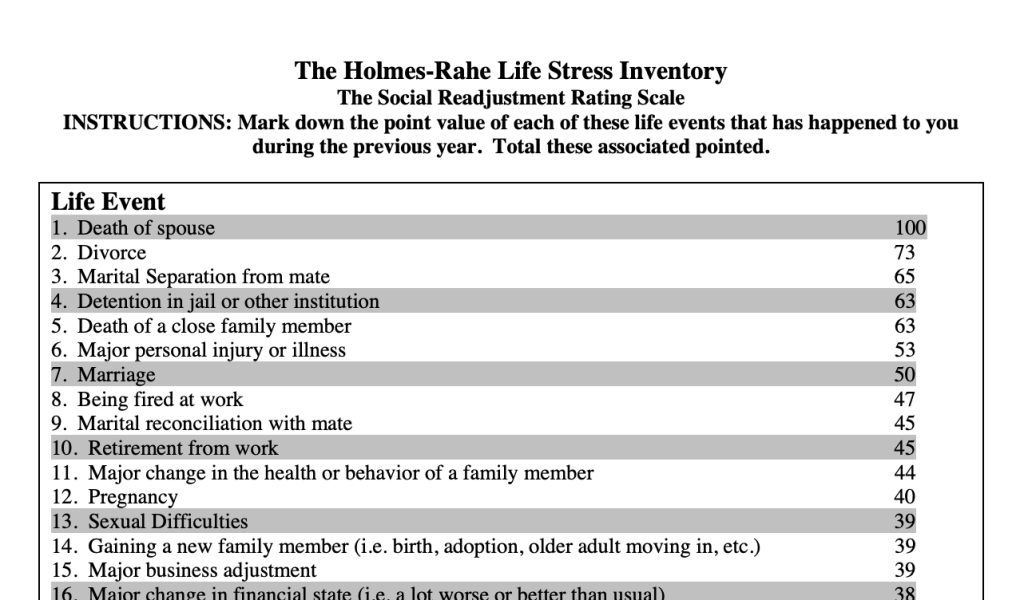
Like most psychological tools it measures the effect of tools by aggregating subjective scores of their effect from a sample and using mean scores as a supposedly objective measure that might be used to assist people attempting to understand the stress impact of events they are undergoing, whether negative stress or compensating eustress (positive stress conducive to well-being). Sometimes, the compensation is greater than the negative response stresses it is compensating. Those could clearly be said I suppose to be positive events, if you think the measures and calculations to get at these scores are at all valid and reliable.
To forget however that the stress measures are measures of subjective responses, even if provably ones that are shared with a significant amount of other subjective responses from persons, is a problem. Life events are not positive or negative per se but only in the responses to them, which clearly have many determinants – indeed an event is often a cluster of such determinants, each with additive (or subtractive if you prefer) effect. One of the canonical reminders of that is that ‘Being Married’ typically scores as both high negative and positive stress , even in agrregations – there being many possible states of what ‘being married’ means, and the kind of measures applied (other ones entirely than stress for instance). Here is an intersting study abstract:
Marital status is associated with psychological well-being, with the married faring better than the formerly and never-married. However, this conclusion derives from research focusing more on negative than positive well-being. We examine the association between marital status and negative well-being, measured as depressive symptoms, and positive well-being, measured as autonomy, environmental mastery, personal growth, positive relations with others, self-acceptance, and purpose in life. Using Wave 2 of Midlife in the United States (2004–2006; n = 1,711), we find that the continuously married fare better on the negative dimension than do the formerly married. The results for some measures of positive well-being also reveal an advantage for the continuously married, compared with the formerly and the never-married. However, results for other positive measures indicate that the unmarried, and the remarried, fare better—not worse—than the continuously married. Further, some results suggest greater benefits for remarried or never-married women than men. [2]
It’s all very complicated but it matters because clearly it is possible to generalise, if you don’t take into account the complications, that .being married’ is both a determinant of psychological relief from stress and a cause of ill-being (compared to being single) AT THE SAME TIME.
So I don’t propose to list my ‘positive events’ over a year, for it makes sense that they could, if there were any and I am not committing to that or denying it, not be positive except in terms of other circumstances and factors which makes them fully the experience they were, including my own agency in filtering and assessing them in order to respond to them. It is a mere given for existentialist psychology and counselling therapy to assume that we have some choice in our interpretation of events and perhaps in our response. But the problem with those dogmas is that they are often used to blame the bias to negativity in the responder, when that response is resistant to the psychological practitioner’s skills at their optimum level.
Would it not be better to say responses are always mixed and to learn not to find ways of negating the ‘negative’ (which those counsellors believe to produce positives) but accepting them as the meaning of life too and relating them to our specific vulnerabilities and understanding these, as well as the vulnerabilities of others. This is psychological communalism. It doesn’t make us ‘flow’ into success necessarily but it helps modify the horrible demand upon oneself and others that ‘success’ is an individual goal. Let’s try out the view that is a local and communal one – but maybe the layer of desire manipulators we call the tools of commodity capitalism (including advertising and the product of events aimed at increasing commodity consumer demand – Black Fridays, Christmas [even in the Philippines], etc.) have by now made that impossible. That would be a truly negative event for all of us.

With love
Steven xxxxxxxxxxxxxxx
________________________________________________________________
[1] Craig A. Jackson (2009) ‘The Life Events Inventory (LEI)’ in Occupational Medicine, Volume 59, Issue 3, May 2009, Page 208, https://doi.org/10.1093/occmed/kqn181. Available abstract (from where quotations are taken) at: https://academic.oup.com/occmed/article-abstract/59/3/208/1507303
[2] Tze-Li Hsu and Anne E. Barrett (2020) ‘The Association between Marital Status and Psychological Well-being: Variation across Negative and Positive Dimensions’ in Journal of Family Issues Volume 41, Issue 11, https://doi.org/10.1177/0192513X20910184. Abstract here available at: https://journals.sagepub.com/doi/abs/10.1177/0192513X20910184
 Steve_Bamlett_blog