


The ubiquitous phenomenon of the unreliable narrator in the novelin the novel is an admission that the only truth in human hearts is its tendency to ambivalence; knowing, feeling and sensing opposite ideas , emotions and sensations to be true and possible at the same time. Why should we ‘know’ this? I use a reading of John Banville’s Venetian Vespers (2025) as a test case.
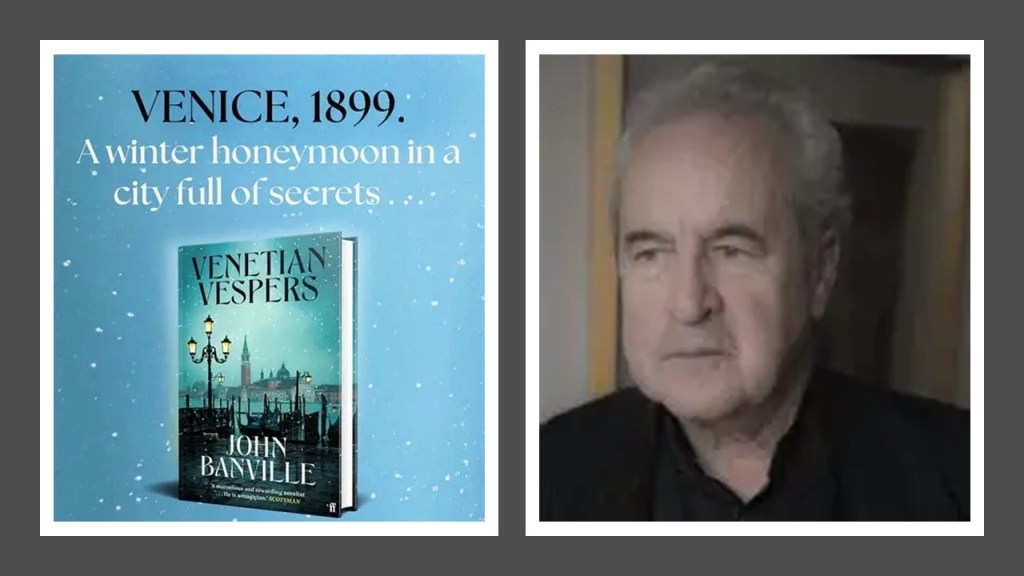
In a novel obsessed by doppelgangers or doubles, there must be a reason that the first lines exactly double the last lines, except in their phrasal hierarchy in the respective sentences in which they appear:
Dusk, a deserted room, a scrap of black silk on a marble table, darkening waters behind. This was the scene, unpeopled, dim and silent, that I had been dreaming of for months, …. [1]
… I stopped on the threshold and turned, and saw with a start what seemed to me, and still seems, the inscrutable solution to the stillborn enigma I am condemned to nurse within me until the end of my days: dusk, a deserted room, a scrap of black silk on a marble table, darkening waters behind. [2]
The novel’s main events take place in the Dioscuri Palace in Venice, named after the twin ‘sons of Zeus’, Castor and Polĺux, from which term in Greek [Dioskouroi – GOD’S SONS] the Italian derives. It relates to twin brother and sister who do not look alike, and involves the protagonist, Evelyn Dolman’s, wife, who her brother says, when he sees a picture of her, looks like the identical twin of his sister. The house contains all kind of ghostly doubles, including some uncanny reflections in the Gothic Palace owned by a Count who often apes the mannerisms if Count Dracula – not dining with his guests when they arrive but staying with them nevertheless till he must seek his actual.lair. The key scene is a rape, which as seen conducted in a mirror seems to birth doubles that are liminal versions of another self fir each participant – a ghost for the victim, a feral beast for the perpetrator of the crime:
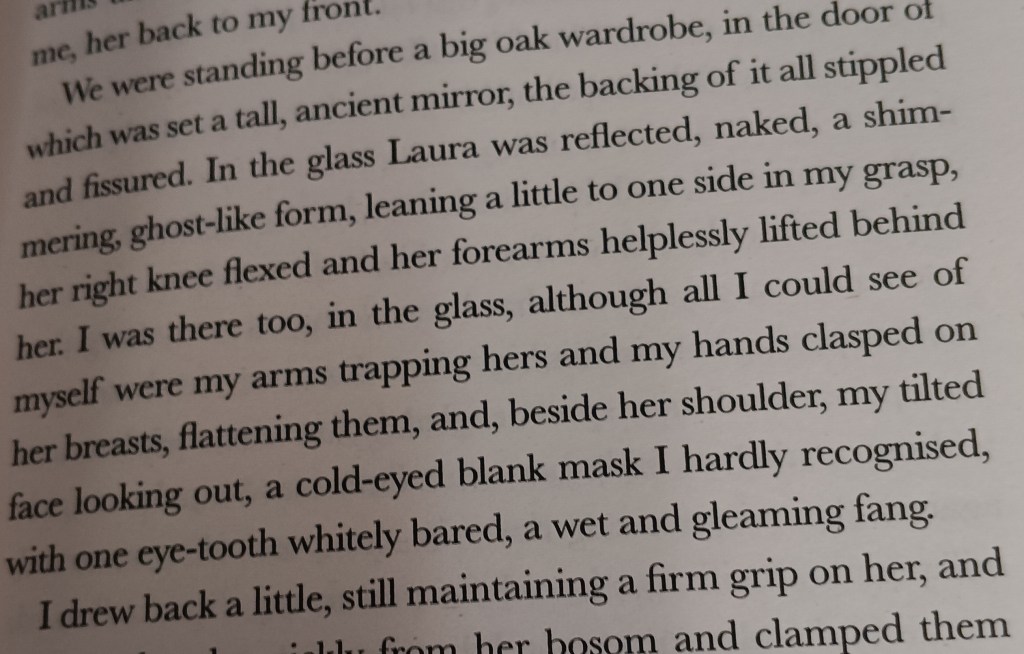
Such appearances in such mirrors can be deceptive. However, isn’t it always the case that things that are meant to reproduce a likeness actually just as often reproduce an ideologically or emotionally tinged interpretation different to its assumed original. This is true throughout the novel, where nothing is either as it seems or as it is described. Victims become perpetrators of the crime of which they were victim, sexual delight in what is described as a special or ideal form becomes confused with mere likeness of naked function, when the Evelyn is unveiled to replace his wife in bed with not one but two women, who also share sexual love with each other. A cathedral, St Mark’s Basilica, is ‘like’ a giant threatening spider.
This play with appearances is appropriate in a novel of criminal and marital double bluff. The ghostly and uncanny evocation of the gloom of Venice, with its dark streets and canals, its palazzi with numerous blind ill-lit corridors in which either ghosts or women in hiding may lurk. It is, in a way, very like a Wilkie Collins novel where ‘dark secrets’ hide shady sexual and monetary relations that the bebeneficiaries of which require to be hidden. Evelyn’s wife is even called Laura, evoking ‘The Woman in White (novel) – Wikipedia https://share.google/Wezrb4np6EozSrcaf. Evelyn believes that ‘at the heart of our marriage there lay a dark and troubling secret’, which is frankly about the ambivalences in the couple’s sexual lived, but is, in fact, much darker and much more troubling than he know. That it is a generalised ‘scret’ is betrayed by its analogy with the ‘night world’ of Venice. [3]
Evelyn later even generalised that layer of ‘secret life’ to the whole world, that is violent and antipathetic to the vulnerable, especially of life forms that are themselves hidden by necessity, ‘sequestered animated forms’. [4]

The sense of sequestered forms of life vulnerable to other secret loves can in a thin reading of the novel be taken to be explained by the fact that tbough throughout the novel, Evelyn and us believe in his, at least patial guilt in his sexual conduct as a man, we are to learn that he and a rather bluestocking sister-in-law of his are the true victims of secret lives and machinations to preserve their secrecy. However, I will not use spoilers here.
The fact that his unreliable narration is only doubled by the unreliability, for reasons of duplicity or ignorance, of others makes the novel multi-faceted. More is going on than we realise. But this takes me back to where I started, the doubling of the first and last phrases of the novel.
It is very strange that at the end of the novel where the existence of all kinds of secrets, including secret plots, have been uncovered, Evelyn still speaks of the ‘stillborn enigma I am condemned to nurse within me until the end of my days’. What kind of failure to resolve the problems and secrets of the novel are we speaking of here?
We are forced to read the repeated phrase again but more carefully.
Dusk (or ‘dusk’), a deserted room, a scrap of black silk on a marble table, darkening waters behind.
In the opening of the novel we cannot know what the ‘scrap of black silk’ is, but at the end we do, it is a black silk stocking of his wife’s abandoned by her and now dropped behind him in the piano nobile (first floor suite of principal rooms in a large house)of the Discouri Palace as he leaves Venice in disgrace. But the ‘black silk’ is more than this in the novel, it is a remnant scrap of a dream of the allure of feminine clothing, particularly clothing worn near to the skin> it is lying as it does at the end of the novel as well as at the beginning one of the few things that remains to explain why for Evelyn there remains a secret life, a ‘stillborn enigma I am condemned to nurse within me until the end of my days’ that has not been resolved in the exposition of the twisty turny plots used by and against him in the novel. For we understand how Evelyn has become a destitute bachelor in these plots, a denizen of otherwise deserted rooms, in a context of a darkening prospect for his life, so why this ‘stillborn enigma’, and why ‘stillborn’ as if a child Evelyn nearly bore. After all the unreliability of the narrator of nearly every story in the novel is now exposed, even that of Evelyn. Yes, it leaves us with the sense of the Gothic novels of Wilkie Collins that that there remains an ambivalence under every surface ‘truth’ or pretence at normality but not one needing to be solved in continuing narrative.
For me the unresolved enigma of the novel is Evelyn’s status in the genderqueer. Evelyn is a male and a female name at the time of the novel’s setting but its ambiguity does play games at the opening of the novel, as does Evelyn’s over-denial of his likeness as a writer to Beardsley and, even more so, Oscar Wilde. [5] But it is not the queered sexuality of either that matters but there fascination for finely dressed women. The only ‘secret’ in the novel never resolved is one that plays no part in the narrative of the novel but is nevertheless shared with the reader, if no-one else. It is triggered by his observation of Laura, his wife, ascending to bed, an attributed partly to the effect of the Count’s wine at their arrival dinner and overlays his sense of expectation of Laura undressing in the bedroom: [6]
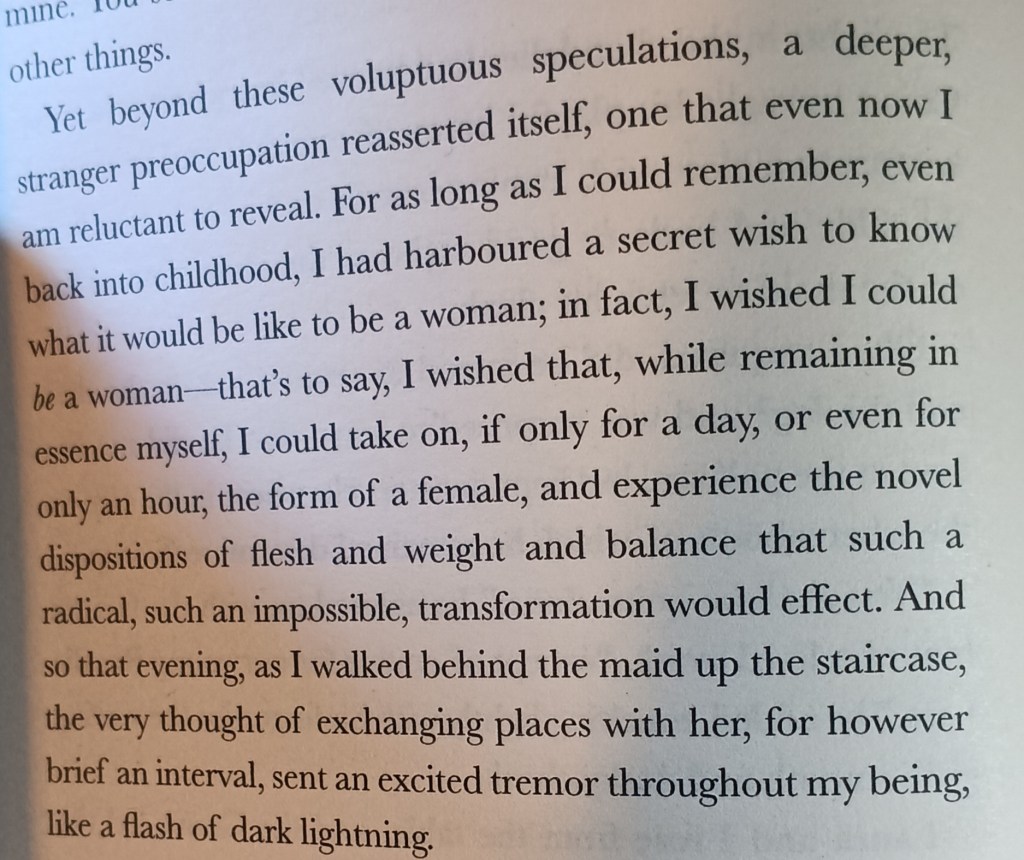
However you spin it, this goes well beyond clothes fetishism and a liking for the feelnof silk, whilst being intrinsically linked to the imagined and remembered feel of clothing associated with women: ‘the novel dispositions of flesh and weight and balance that such a radical, such an impossible, transformation would effect’. The man desires not to look and feel like a woman might, but to ‘be’ a woman, a thing he thinks ‘impossible’ but desirous. Whether the i.possibility is biological or a thing of social convention is never decided but, elsewhere in the nov, in his identification with Cesca Ransome for instance, it seems of the order of the wild against the tamed binary, the becoming of an ‘some exotic creature of the wild’ and ‘enclosed in a cage’: [7]
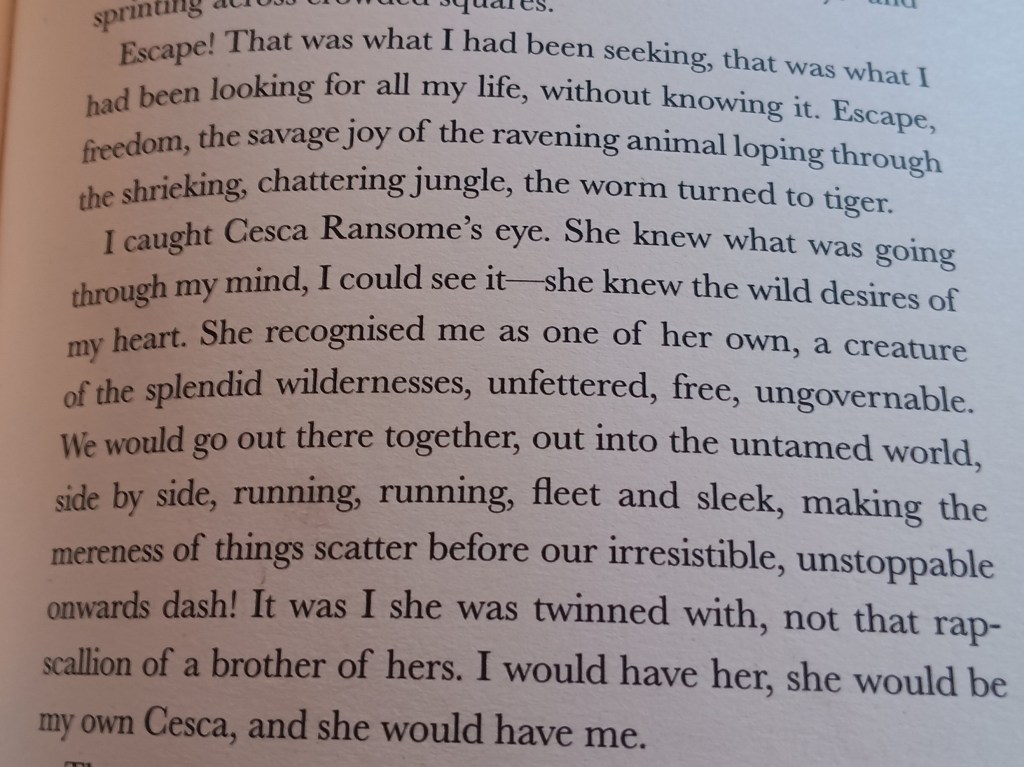
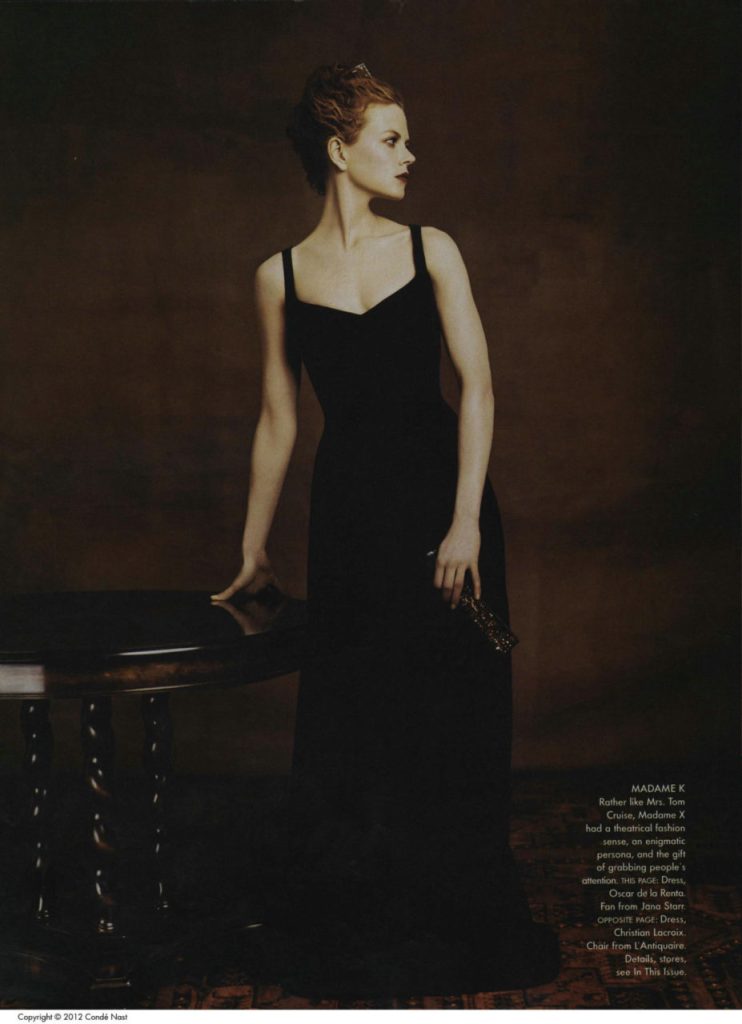
The irresilutuon and darkness of futuristic of this novel is locked in the qenderqueer and is a darkness not of terror, except to incomprehensible, but of the unknown possibility winking through the constructed impossible. One way of thinking about it is in terms of how John Singer Satgent must have felt as his brush inhabited Madame X.
With love
Steven xxxxxx
________________________
[1] John Banville (2025: 3) Venetian Vespers London, Faber & Faber
[2] ibid: 350
[3] ibid: 54f.
[4] ibid: 193
[5] ibid: 7
[6] ibid: 50
[7] ibid: 181
 Steve_Bamlett_blog