



I have always felt the words of the New Testament contained the truths by which we could and perhaps ought to live – and continue to respect them whilst being in a state of absolute non-belief in the existence of a god, or gods. Recently as I thought about this question I again came across The Epistle of James, of which Wikipedia says that, though some see it as merely a contribution to doctrinal debate, particularly aimed at the strong position of St. Paul, others see it as rooted in a response in Judaic Christianity to :
tensions between rich and poor, emerging divisions between Jews and Christians, and ethical concerns for marginalized groups. The Epistle of James emphasizes perseverance in the face of trials and encourages readers to live in accordance with the teachings they have received. The letter addresses a range of moral and ethical concerns, including pride, hypocrisy, favoritism, and slander. It advocates for humility, the pursuit of wisdom aligned with spiritual values rather than worldly ones, and the practice of prayer in all circumstances.
The Epistle of James was disputed and sparsely cited in early Christianity, gained wider recognition only by the late 4th century, and was criticized by Martin Luther during the Reformation for its teachings on faith and works, though it remained part of the New Testament canon. It emphasizes that true faith must be demonstrated through works, teaching that faith without works is dead, and highlighting care for the poor, ethical living, and communal practices like anointing the sick.
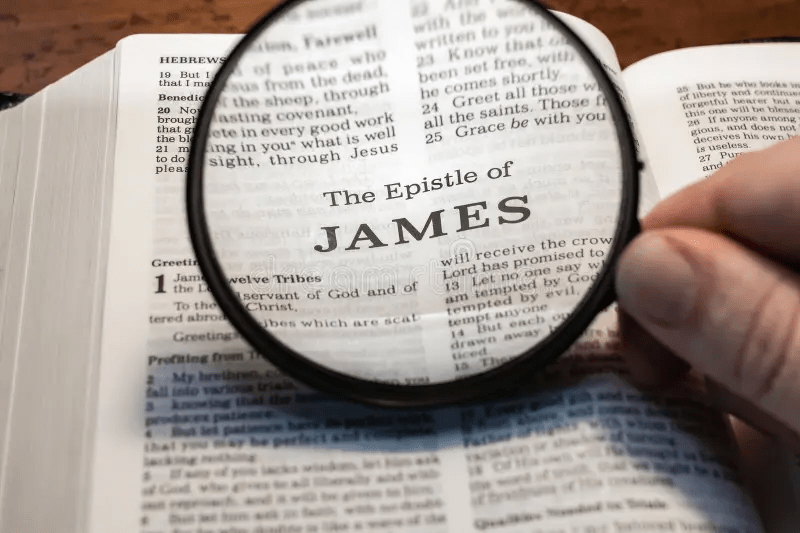
Of course we have to remember before we read the epistle that religions have always been capable of having a get out clause for people accusing believers of being hypocrites, for in religious terms, the ‘works’ expected of a believer are not necessarily ‘deeds’ practised in the external everyday word but those which are commanded primarily in religious ritual or liturgy, in demonstration of the consequence of belief in a sacred place. Thus much of what James has to say can be taken as entirely to do with ritual works – how you create equalities within church ritual between each of all believers (whether rich or poor, foreign or co-national, women and men and so on). That is the context of Martin Luther, and other Protestant sages, rejecting its apparent belief in salvation through works not faith alone, for the efficacy of works without faith were the running sore of the established Catholic Church – from the practice of liturgy to the justification of the Church’s right to make works into purchasable commodities, as it did prior to the Reformation in Protestant claims, the instruments of salvation such as indulgences.
Hence forget thinking that we justify ourselves – whatever we see ourselves to be – by mere ritual actions in a space considered as different from, or reserved from, the world we have to live in year-by-year, month-by-month, week-by-week …. micro-second by micro-second but in the things we do in all the tedium of the long duration up to and including our death. The rule of ethical living is not one of beliefs and trust, faith if you like, but what you do with life: these are your ‘works’ and they aren’t regulated by institutions but by the belief that one’s own agency in the world has to be made to seem to matter, even if in the bigger picture, our individual agency is largely insignificant, objectively considered, in a world of big data. Now, read James’ epistolary highlights below:
1:9 Let the brother of low degree rejoice in that he is exalted:
1:10 But the rich, in that he is made low: because as the flower of the grass he shall pass away.
...
2:14 What doth it profit, my brethren, though a man say he hath faith, and have not works? can faith save him?
2:15 If a brother or sister be naked, and destitute of daily food,
2:16 And one of you say unto them, Depart in peace, be ye warmed and filled; notwithstanding ye give them not those things which are needful to the body; what doth it profit?
2:17 Even so faith, if it hath not works, is dead, being alone.
2:18 Yea, a man may say, Thou hast faith, and I have works: shew me thy faith without thy works, and I will shew thee my faith by my works.
2:19 Thou believest that there is one God; thou doest well: the devils also believe, and tremble.
2:20 But wilt thou know, O vain man, that faith without works is dead?
...
2:24 Ye see then how that by works a man is justified, and not by faith only.
So:
Do! when I lost all of my possessions?
I hope to find I've lost my inhibitions
Too. Ask for help I know will be given
From common wealth pools that aren't riven
By hatreds for my assumed difference
To them whose being is their affluence.
In just doing 'unto' me the same things
They'd expect from me, taking what life brings -
Including the faith that being human
Is more about the good things you do than
The beliefs that feed your faith in being
Good whatever you do. What we're seeing
Through the dark glass of our moral sat-nav
(A compass is passé) is what we have
Is of less matter that what we all do
When, in presence of the need of those who
Have nothing like my power, wealth, nor few
Resources like my own. These are my kin
Of choice not birth. The songs they want me sing
Are not those of what 'I have' or 'I am'
But what 'I do' for whom, that's not a scam.
Granted such doggerel verse is hardly the heightened scripture we atheists need to convince that we aren’t scammers with the needs of others, or have not bought into seeing life as the pursuit of possessions alone, or worse, creating myths around our self-belief and the concepts it supports and exports of who I am. Hence, I want a real equivalent of these beautiful and witty two verses in the King James version:
2:19 Thou believest that there is one God; thou doest well: the devils also believe, and tremble.
2:20 But wilt thou know, O vain man, that faith without works is dead?
Might it be.
You believe you're motivated by good!
Well, scammers do that too whilst trembling they'll
Be found out that they've so sunk, in delusions, low

But believe it or not, self-belief would
Not pass ethical tests, nor pierce the veil
Twixt the corpse you have and the life you others owe.
Bye for now
Love Steven xxxxxxxx
 Steve_Bamlett_blog