


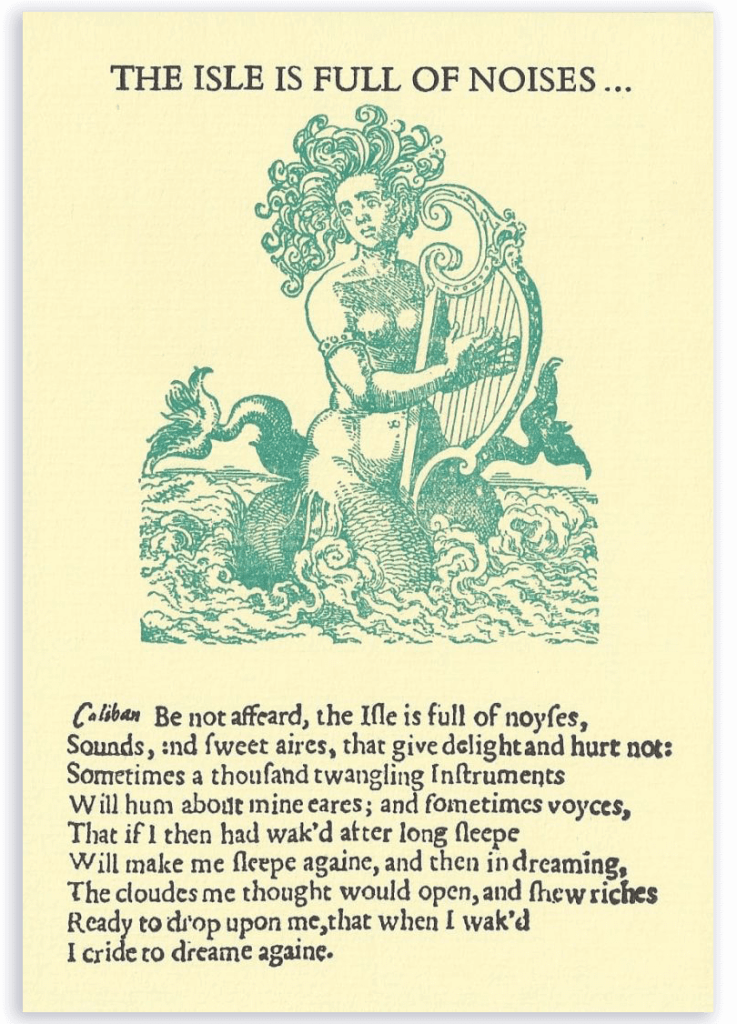
When two drunk men sing, a spirit of air and light catches the melody underlying their brawling voices and plays it it such that it enchants those who failed to do it justice by their broken voices, guttural with vomit. Shakespeare in The Tempest (Act 3 Scene 2) attempts to show how music might sound to those who have no idea of its value beyond the bodily needs it accompanies in the world. Drunken Stephano and Trinculo hear only the ‘tune’ of the sung ‘catch’ played by ‘the picture of Nobody’. Using (as he reassures Stephano and Trinculo about the magical qualities of his island) some of the most evocative verbal music in Shakespeare and evoking by defining it (without any reference to its name) as a harmony of beautifully played instrumental devices, noise and voices. Music is inarticulate longing that promises delight but also tears in the probable impossibility of re-achieving its magic once lost to you, but for the grace of some power beyond the self.
Yet even when assured by Caliban that what they have heard is music, the two drunks see his description as if it indicated a juke box in a pub playing music for free, rather than having to pay for it: ‘This will prove a brave kingdom to me, where I shall have my music for nothing‘. One of the biggest puzzles in Shakespeare for me is why, after Caliban shows the baseness of his murderous imagination in pushing the drunks onto the murder of Prospero, his current master and the barrier to his desired rape of Prospero’s daughter, Miranda, he is allowed such poetic receptivity to the beauty of music:
Ariel plays the tune on a tabour and pipe

STEPHANO
What is this same?
TRINCULO
This is the tune of our catch, played by the picture
of Nobody.
STEPHANO
If thou beest a man, show thyself in thy likeness:
if thou beest a devil, take't as thou list.
TRINCULO
O, forgive me my sins!
STEPHANO
He that dies pays all debts: I defy thee. Mercy upon us!
CALIBAN
Art thou afeard?
STEPHANO
No, monster, not I.
CALIBAN
Be not afeard; the isle is full of noises,
Sounds and sweet airs, that give delight and hurt not.
Sometimes a thousand twangling instruments
Will hum about mine ears, and sometime voices
That, if I then had waked after long sleep,
Will make me sleep again: and then, in dreaming,
The clouds methought would open and show riches
Ready to drop upon me that, when I waked,
I cried to dream again.
STEPHANO
This will prove a brave kingdom to me, where I shall
have my music for nothing.
CALIBAN
When Prospero is destroyed.
Caliban still needs that ‘Prospero is destroyed. But what seems to happen here could illustrate a point Shakespeare made in The Merchant of Venice, Act V Scene 1:
Here will we sit and let the sounds of music
Creep in our ears; soft stillness and the night
Become the touches of sweet harmony.
Sit, Jessica. Look how the floor of heaven
Is thick inlaid with patens of bright gold.
There’s not the smallest orb which thou behold’st
But in his motion like an angel sings,
Still choiring to the young-eyed cherubins.
Such harmony is in immortal souls,
But whilst this muddy vesture of decay
Doth grossly close it in, we cannot hear it.

Enter Stephano and musicians.

Come, ho! and wake Diana with a hymn.
With sweetest touches pierce your mistress’ ear,
And draw her home with music.
Music plays.
JESSICA
I am never merry when I hear sweet music.
LORENZO
The reason is, your spirits are attentive.
For do but note a wild and wanton herd
Or race of youthful and unhandled colts,
Fetching mad bounds, bellowing and neighing loud,
Which is the hot condition of their blood,
If they but hear perchance a trumpet sound,
Or any air of music touch their ears,
You shall perceive them make a mutual stand,
Their savage eyes turned to a modest gaze
By the sweet power of music. Therefore the poet
Did feign that Orpheus drew trees, stones, and floods,
Since naught so stockish, hard, and full of rage,
But music for the time doth change his nature.
The man that hath no music in himself,
Nor is not moved with concord of sweet sounds,
Is fit for treasons, stratagems, and spoils;
The motions of his spirit are dull as night,
And his affections dark as Erebus.
Let no such man be trusted. Mark the music.
Music is not only a spiritual thing but one that calms even animals in the ‘hot condition of their blood’, like Caliban lusting after both Miranda for sex and Prospero’s death in the interests of his own freedom. And not just animals. Lorenzo cites Ovid’s Orpheus, the lyrist who proves that ‘naught so stockish, hard, and full of rage, /But music for a time doth change his nature’.
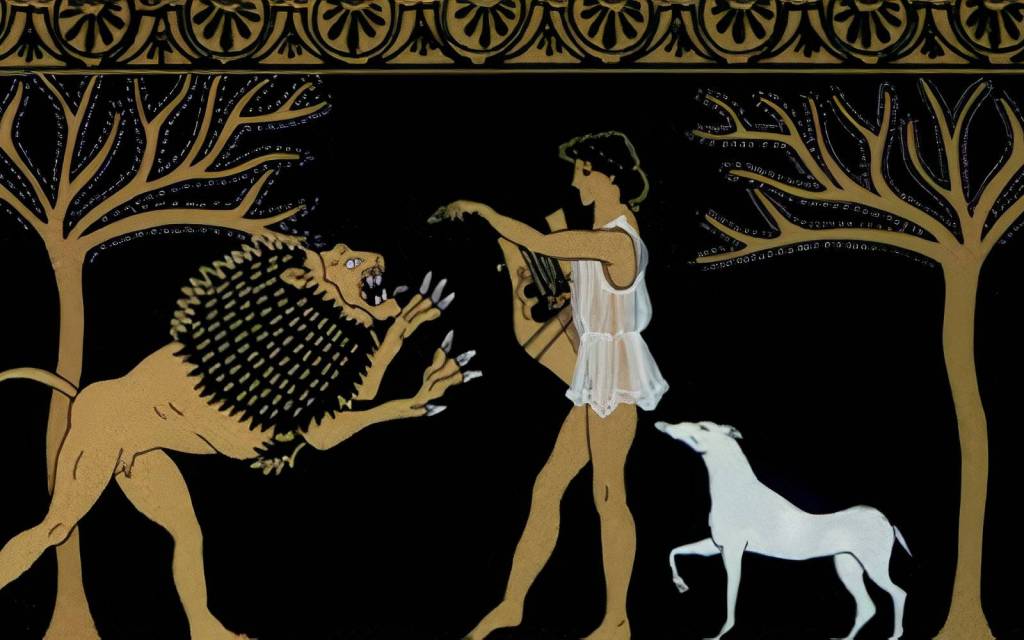
However, I resist seeing Caliban as an example of Lorenzo’s theory. Caliban speaks in his own voice words in verse beautifully instinct with the meanings and materials of making music. Lorenzo’s examples are of things that do not participate in music other than in being passively receptive of it. What is more passive than a stone, but Orpheus gives stones a changed nature by his song?
But Caliban does not fit Lorenzo’s theory. He can not only be affected by music but himself make it in his own verse whilst using his awareness of the calming effects of music to bind Stephano and Trinculo to his evil ‘treasons, stratagems, and spoils’ with ‘affections dark as Erebus’ driving him on. Even Stephano and Trinculo would be well advised that ‘no such man be trusted’, in Caliban’s case, a monster rather than a man. But it is not true, as it may be of the two men in the scene that Caliban has ‘no music in himself, / nor is not moved with concord of sweet sounds’. Quite the reverse – because were that true, how could he articulate music and its effect on human feeling so well.
Hence, towards the end of his career, Shakespeare appears not to support the view that any art can in its beauty and harmony be as consistent with harmful treason, betrayal and self-intetest as with more ethically motivated behaviour. Shakespeare does not see the products of either art and artifice as binaries but as acts impossible to morally distinguish from each other in reality. The problem is that bad motives can be as productive of aesthetic and emotional harmony and beauty as good ones. Shakespeare is no fool.
I can, I have to say, live without music; except in as much as they fuel the political rights of the dispossessed, not those on the make.
With love
Steven xxxxxxx
 Steve_Bamlett_blog