


Relax what exactly? Well! Relax the tension, ‘inter alia’:: this blog touches on seeing Suzie Miller’s ‘Inter Alia’ streamed at the Gala Theatre Durham on 4th September 2025.

The whole point of the Frankie Goes to Hollywood lyrics and the excitable video and still images that once accompanied it on its release as I remember is to show that the meaning of relaxation is only a means of playing with the intensity of the tension that life, and in that song, sex promotes and then requires to be intermittently and consummately inhibited to allow some release either along the way or in consummation (‘if you want to come’).
The song and its video interpreted the words in terms of the achievement of sexual orgasm but I wonder now whether modern life interprets everything in terms of achievements where relaxation and tension are so integrated that both are needed – and the relaxation and tension applies to the promotion of everything – whether it be a career, the need to make changes in the things that were they to stay the same would create significant harm such as the rape laws and the manner of their implementation or the constitution and maintenance of sex/gender roles, and so many inter alia phenomena – particularly that so often described as toxic masculinity. All of the latter are dealt with Suzie Miller’s play Inter Alia, currently exhausting its cast live at the National Theatre and from last night streamed across UK cinemas, and soon to go worldwide.
When Jessica Parks, the protagonist of a play – a lawyer who has reached the top rank of her profession as a High Court judge – relaxes, with other female feminist lawyers on the same professional greasy pole, they attend a frenetic karaoke club, into which the stage transforms, together with crowds created from shadows, in which these powerful women relax by pressurising each other to get up and hold the stage and sing along to tunes intended to excite sometimes the very relaxation of moral regulation, that lie sometimes behind and between the awful crimes against women and children, when these people are vulnerable to them, they sit in court to adjudge or stand in court to prosecute or defend. In that latter respect, this play is so reminiscent of Miller’s great initial success as a playwright for spectacular female actors, Prima Facie (I versified on this in a blog sometime ago linked here). The egging each other on single-sex groups is not always an innocent thing, or ‘just a laugh’, as the saying goes. It lies at the root of the toxic masculinity that prosecutes the crime in this play and is made up not only of peer seed/gendered pressure, but the proliferation of internet imagery and false stereotypes and core beliefs about the nature of sex/gender as a divisive binary thing.

Harry, the Prefect off to school after shopping, uniform akimbo (in the characteristic ‘flash of yellow’ is an unpopular boy at school – he hates sports, alienated from male peers and yet keen to fit in, dependent on his mother and embarassed by doing so. Acted supremely well – here playing with Mum pretending to have forgot to buy the milk and then producing it from its hiding place.
But let’s stick to being excitable about relaxation first, whose etymology (according to etymonline.com) is cited thus, surprising us, at first with its initial meaning of the reduction of something larger into something smaller or more manageably flexible:
relax (v.) : late 14c., relaxen, “to make (something) less compact or dense” (transitive), originally especially in medicine, of muscles, etc., from Old French relaschier “set free; soften; reduce” (14c.) and directly from Latin relaxare “relax, loosen, open, stretch out, widen again; make loose,” from re- “back” (see re-) + laxare “loosen,” from laxus “loose” (from PIE root *sleg- “be slack, be languid”). A doublet of release.
Meaning “decrease tension” is from early 15c. From 1660s as “to make less severe or rigorous.” Intransitive sense of “become loose or languid” is by 1762; that of “become less tense” is recorded from 1935. Of persons, “to become less formal,” by 1837. Related: Relaxed; relaxing. As a noun, “relaxation, an act of relaxing,” from 17c.
When Rosamund Pike plays the text of this play, she creates a significant gulping pause before she reads out at a family meeting the victim statement wherein Amy, the victim, speaks out object that Amy having, in drunken relaxation, had her breasts fondled by Jessica’s upper-sixth form son, Harry, touches – Harry’s —– [gulp!] —— ‘erect penis’. Being relaxed or otherwise about talking to one’s son about the use of his penis is a recurrent theme of the play – once when Jessica mistakenly thinks her very young son is watching porn on his laptop (it turns out to be an online ‘game’ that Jessica had told him wasn’t good to play and hence his guilty looks) talks about the unrealistic expectations put on boys by porn’s fantasy size pleasures and penises, illustrated by her by use of various size pepper-grinders as illustrative props. Later, as a child on the beach, represented by a rigid frame inside a yellow jacket, Harry is taught how to shout out ‘I don’t want this man to touch my penis’ to the unyielding sea. About the touching of male parts, Jessica teaches to do so relaxedly, as with her husband in a wonderfully beautiful symbolised sex scene, is to go through a lot of tension about the appropriateness of the touch, who is doing to whom when and in the context of what power differentials and informed consent.
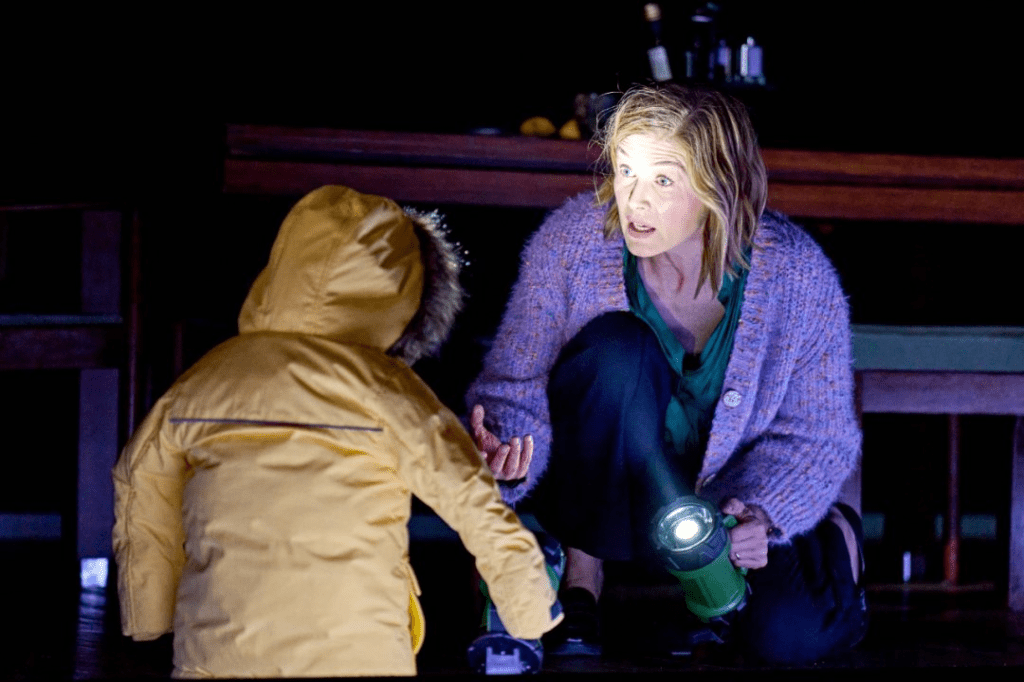
The scene where Jessica remembers finding Harry in a park after fearing his abduction by a man gazing at the park’s edges.
The need to ‘relax’ has, from the ‘of course, unreliable evidence of Google n-grams, risen it seems as social and working life life has been increasingly driven for greater numbers of the population by competitive need for demonstrable social success – not only in one’s work (Jessica remembers being the first to get a silk in the unspoken competition, with its group sex/gender edge, with her barrister husband) but in leisure and in the achievement of proofs of prowess – for young men as sexual achievers for instance. In the example below relax becomes more frequently used in the 1950s, there is a peak here (around my birth date in fact) – those years where according to Prime Minister Harold Macmillan we ‘never had it so good’ – but the rise is, as they say ‘exponential’ from 1980 as neoliberalism ensures that relaxation is as frenetic a need as the excitation to individual competitive success. After all you only need to be ‘mindful’ when your mind is being pushed by overweening needs for more and more mindless gratification.

Some people are snooty about Miller’s new play and its star, Rosamund Pike – as inferior to Prima Facie and Jody Comer – but it is not inferior at all, not even a ‘sequel’ nor in competition with either of those entities of excellence (if it were there are elements of distinct superiority of nuance in Inter Alia‘s moral vision and its enactment). The distinction between a ‘moral’ and a ‘legal’ debate is sustained brilliantly throughout, as is the insistence that nuance in moral judgement applies to the long line that creates perpetrators of crime out of victims of patriarchy – whether male or female. In many ways, this play reminds one of the TV series Adolescence (see my blog here) with its keen focus on the background of male child development in the frenzy of both toxic masculinist ideology, human inadequacy and the over-simplifications of some strident varieties of feminism, which trace all sex crime back to individual male fault rather than to patriarchy as a principle of selective development that few of us – even female feminist High Court judges – really change but rather collude with, aping the joy of being as deserving and like men as possible except for the ‘soft skills’.
The condemnation of rape perpetrated on girls and women is not lesser than that in Prima Facie, but it it does not present it as the equivalent of an unchangeable binary rooted in biology alone. Hence the decision to make this play about the struggles, hopes and desires of career professional feminist mothers of boys, even to show the accident that leads the mother of girls in the play on a similar career track to socially ‘cut’ Jessica because called upon to have empathy for a young male who has raped, even though both shudder earlier at the fact that the conviction of eighteen year old Harry will mean his own rape in an adult male prison. There is nothing easy about this nuanced view, either for a feminist woman to negotiate in contemporary life controlled by narratives into which even powerful judges cannot intervene or for a dramatist. Take the way, Miller describes her protagonist, Jessica Parks in her stage directions:
Set London home, park and inner-city Crown Courts. Jessica Parks is a Crown Court Judge in London. She speaks into three spaces, each with its own language, its own tone and its own ways of seeing and hearing.
1. Judge
2. Mother
3. With her friends (including at karaoke where she can really let loose).
The life of a woman managing each of these spaces is complicated and involves complex juggling. Jessica jokes that she is living her life ‘inter alia’ because, as a woman, one’s life is lived amongst all the other things. All of Jessica’s three spaces are invaded, converge upon each other, and become messy, as her son finds himself in a situation she cannot understand or fathom. [1]
It is the messiness that interests Miller and us as audience – those times and relationships where dogmas never cover and often wish to bury from sight because they aren’t easily handled (as drama with a ‘clear’ message or as phenomena in social life). And these spaces get messy even where we claim to be ‘relaxed’ or ‘let loose’ (in karaoke or anything else).The karaoke scene was always implicit for, from the beginning we see Jessica enacting the role of judge playfully, able in her first line to determine what she is seeing in court is the play of patriarchal power (‘Ugh! The patriarchy’) in the form of the self-serving barrister, Mr Buckley, but herself playing her role so that she can relish ‘The power’, as she describes it to the audience of her inner monologue as she enforces her institutional right to make a man wait, and to slow down the pace of his cross-questioning in the interests of ‘trembling witnesses; / bruised women, / weeping children.’ All in all, the court-role is another karaoke role played out by a wannabe rock star – hence it is played to the accompaniment of a tiny rock band at her rear and with the elaborate command of a microphone – although that command of the microphone will slip more as the play’s narratives progress into messy co-crisis.

Packed with sound, fury and colour – the flashes of the instution deconstructed from the Union Jack, Jessica knows what power is but does not use all of it for the purposes of ‘change’, but some of it to maintain her individual power within the system. it is, after all her only lever for change, even in as small a way as the insertion of ‘soft skills’ into court process as it deals with complex life issues. But power needs to simplify.
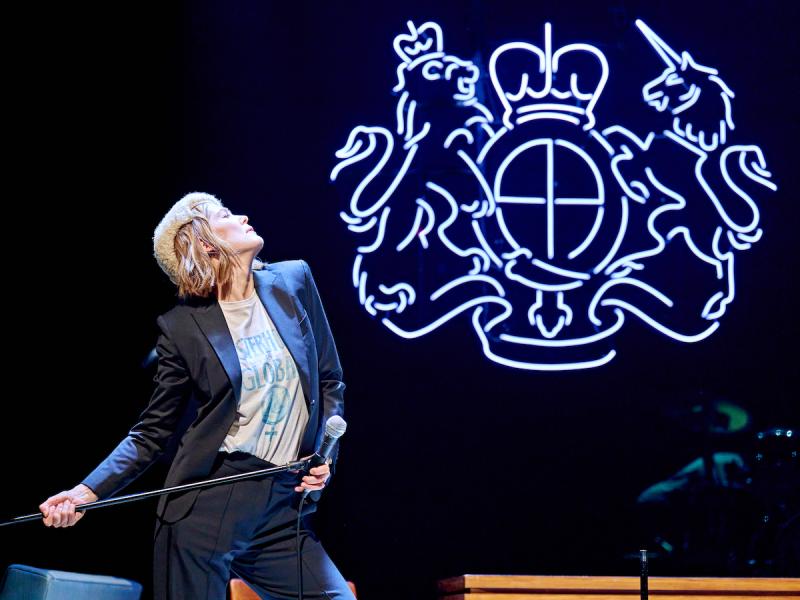
When not grandstanding and displaying her achievement, Jessica does also try to infuse some aspects of morality into an amoral legal system, with its reliance on binary prosecution and defence, simplistic yes / no responses and refusal to allow for explanation or elaboration of nuance ( I here present the text in the lines – not unlike poetry, it has in the published play text);
It's here I can effect change. ...
I signal to the jury that these are real
people
doing the best they can to give evidence for
the court.
I do not signal,
as some judges, older, male, do,
impatience
frustration
or annoyance
at hazy memory
or lack of clarity.
Because the truth is not always easy to
explain.
It’s my way of bringing some morality into
the court.
Of course it is not a court of morals,
it is a court of law,
but I like that I can make it more human.
More compassionate. [2]
It is like poetry because it needs to instruct the actor how to embody the charachter and feel her breating through pauses, relaxations of pace and efficiency of speech, tolerance for human ‘word-use, nuance, tone, breath’, as she says a very little later. Courts are not at all places for unscripted nuance and even here, with her power as a judge, Jessica is constrained but not only by the patriarchy easily recognisable by its male paraphernalia, for she will find that trying to find empathy from Grace, her fellow feminist judge and friend, she becomes the object of the latter’s authority only when she herself needs time to explain the complexities of raising and relating to an erring son: ‘She stands up as if is going to give me a (hug) … as if she is going to walk me to the door’. [3]
The space of the stage is often used to show not only the constraints of a court-room but also of supposedly safe domestic space. We have to imagine that Jessica is only grandstanding some power in her all-male household by standing on a table, as judges stand on a dais to seek authority. In reality, her power is being whittled away by the very soft realities she is set up to maintain but which undermine, the love and protection of her family, her son – and especially the image of her son as potentially lost child.
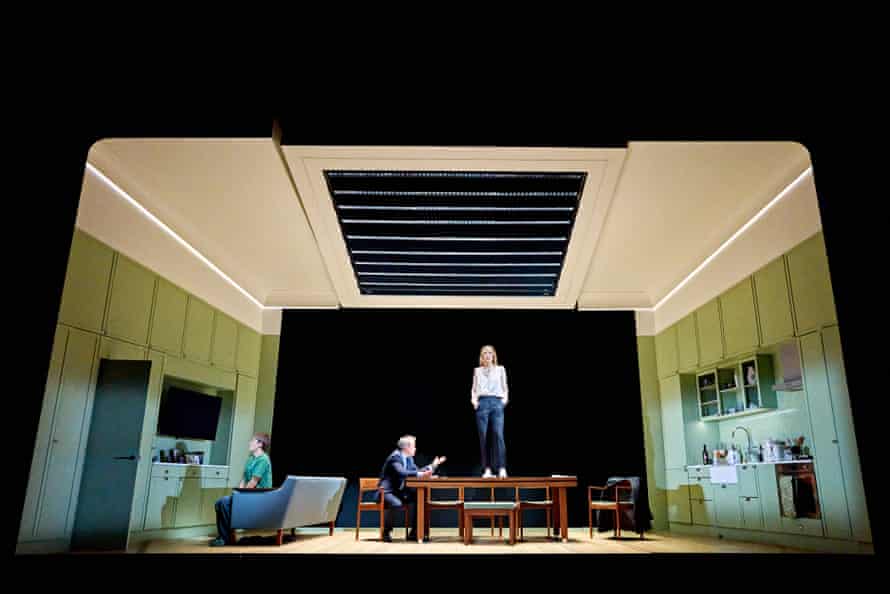
The home can be a space of fear and defeat, of genuine chains to the kitchen sink. And in domestic roles nuance, though everything is the source of messiness too.

Seeing porn on her son’s laptop for the first time and sharing of violently worded disrespect to women she is revolted that her boy is now ‘fully in the bro zone, the fucking / manosphere’. [4] The manosphere is also a place her husband is in, that she services by ironing the very Hawaiian shirt in which Harry will take Amy sexually whilst she is unconscious. The manosphere is quite a relaxing space for men, though only because it raises the tension of the performances required to sustain it, at least in patriarchy.
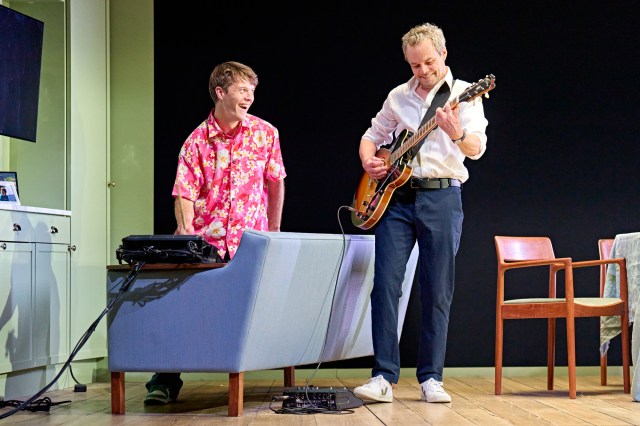
While finding the play porn raises the prospect of Harry’s guilt of actual sexual violence against his childhood friend Amy, also evokes the child from which the man evolved (as she speaks this a little boy in yellow jacket – Harry at 10 – holds her hand on stage: its excruciatingly beautiful:
I conjure a memory of Harry
 as a little boy.
Laughing.
His tender, rambunctious, energetic,
curious boyhood.
I think on the patriarchy.
How furious we all are over what it’s doing
to girls.
But we raise these beautiful boys,
and then, what does the patriarchy do to
them? [5]
Those children, include Amy increasingly haunt Amy, as the stage’s space opens out into the space of a child’s play park with dark corners for hiding and ‘getting lost’. Jessica has no torch strong enough for some of these darknesses and sometimes reverts from judge to pleader:

There is a lot of tenderness for boys – and even for men – in this play, including recognition that a woman might relax into male sexual allure, even after marriage:
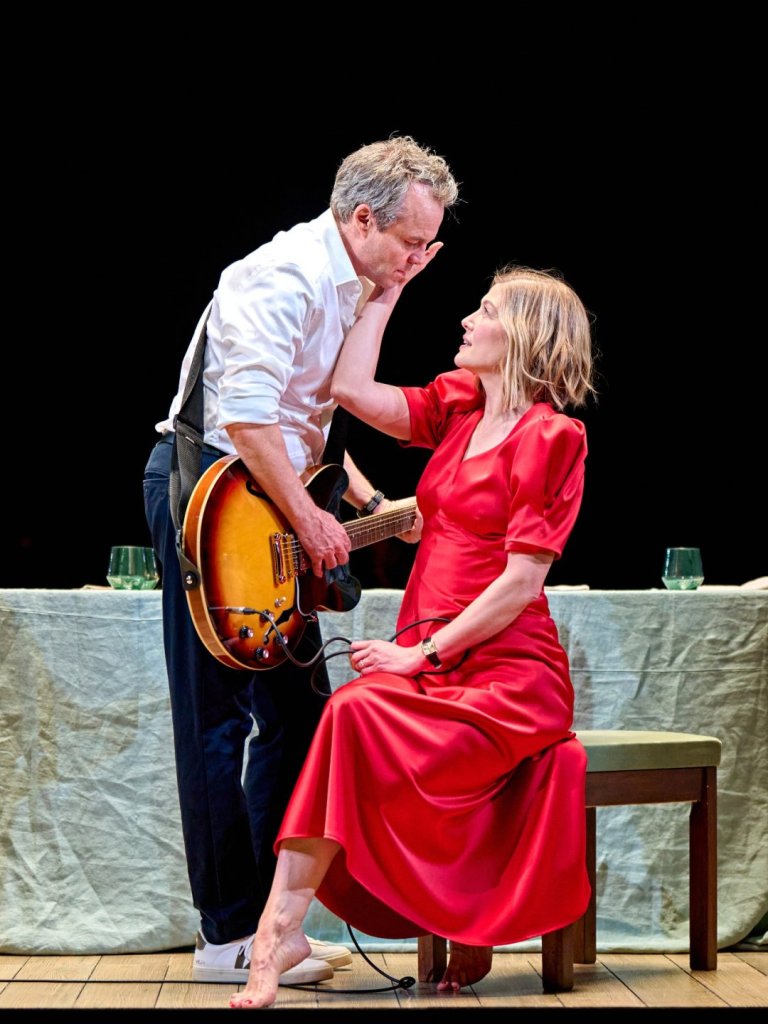
In the end Jessica is diagnosed by a son who would rather face prison than lie anymore about what he did to Amy, his friend. In the final scene, Jessica is still trying to rescue from the human – and inalienably patriarchal – construction of a supposed system of justice some sense of moral grasp, whilst being unable to co-ordinate together the languages of the various systems she inhabits. We can choose to believe no man or boy would compromise his own personal saftety by such honesty but in the play it feels right and moving. To a son who sees how damaged he is by patriarchy, his mother’s juggling of nuance is just an example of ‘being lost’, more lost than a lost child.
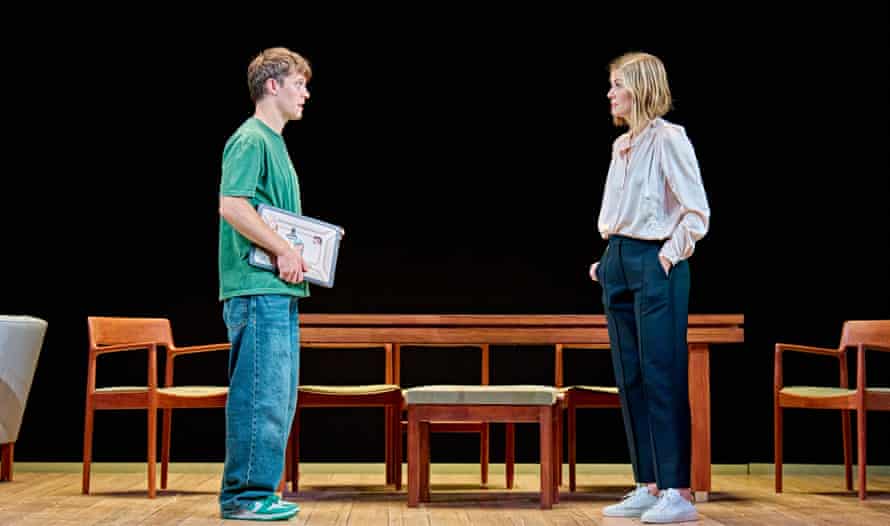
JESSICA. Look, I understand
What you’re trying to do.
But –
It’s different in the law.
Not guilty.
It doesn’t mean you’re innocent.
It just means the jury can’t be sure.
HARRY. But that’s not justice –
JESSICA. It’s how the system works.
HARRY. But what about Amy?
She just
what,
loses?
JESSICA. I feel my face burn.
In the moments that pass
I wonder what a court of morals
might look like?
(What human aspects it might adopt.)
JESSICA. I know you want –
To own up;
be accountable.
I know you want Amy to know you’re
sorry.
And as a woman, I’m glad.
But as your mother…
I can’t –
I need to try and / save you.
HARRY. Mum?
Are you telling me I should still
plead not guilty?
Beat.
JESSICA. Yes.
A huge pause between them.
HARRY. No. You’re wrong.
Who are you?
I don’t know you. I don’t know who you
are.
They stand before each other.
Seeing each other completely.
She backs away.
She is lost. [6]
At this point, the stage setting reverts to the park / forest where lots of children play, including Amy and young Harry. Amy knows that Jessica is lost, too. The ending of this play is inexplicably moving, inarticulately so: a space where binaries like legal / moral operates no more comfortably than male / female. It is a sign of a playwright maturing so much they, like later Shakespeare, lose themselves in enchanted spaces over which no law has regulation that their final plays can be resolved only by magical thinking. Expect none of the latter from Suzie Miller.
You must see this play. It won’t relax you. Tension is our lot in life.
With love
Steven
xxxxxxx xxxxx
_________________________________________
[1] Suzie Miller (2025: 6, Writers’ Notes to the theatre Crew) Inter Alia London, Nick Hern Books
[2] ibid: 12, Scene One.
[3] ibid: 106, Scene Twenty
[4] ibid: 98, Scene Nineteen
[5] ibid: 102, Scene Nineteen
[6] ibid: 116f., Scene Twenty-One
 Steve_Bamlett_blog