


Is desire measured by size? Is that the same question as ‘does size matter?’? The i newspaper’ tries to get us interested in the ‘lipstick effect’!!
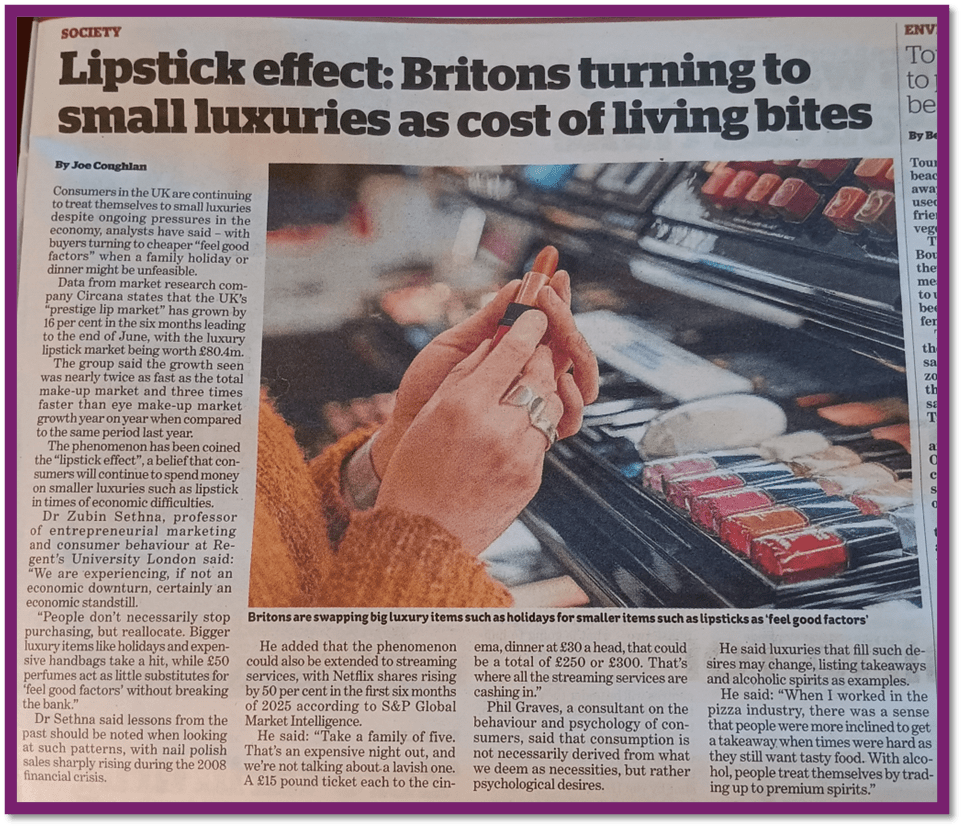
I probably would not have read this piece, in our daily i newspaper for Tuesday 29 July 2025 on page 5, were it not for the WordPress prompt, partly because the picture accompanying it holds little interest to me (I am one of those queer men who never fantasised about lipsticks as a product or an object) and partly because the fate of the sturdy ‘British’ bemoaning the loss of ‘big luxury items such as holidays’ in their life bores me silly. However had I not read it, I would have missed a feature of this item that does interest me. For, the article tries to explain how the gap made by those ‘big’ things is filled with ‘smaller items,such as lipsticks as “feel good factors”‘ (as described in the picture caption) or as ‘small luxuries’ in the headline of the article.
Hang on a minute, I thought, in an earlier blog (linked here) I considered a few lines from Marlowe’s The Jew of Malta that have always haunted me because of the opaque concentration of their poetry. Here is what I said:
Packing giant meaning into small spaces is a trick of early modern literature. In Marlowe’s The Jew of Malta, the rich man’s imagination is of wealth beyond the conventional, and its meaning amounts to this:
And thus methinks should men of judgment frame
Their means of traffic from the vulgar trade,
And as their wealth increaseth, so inclose
Infinite riches in a little room.
But that magical line iambic pentameter line that I italicise and embolden above is haunting for many reasons. for Barabbas, the Jew in this frankly horribly anti-Semitic play, wants to single out the nature of his ‘judgement’ of the value of the wealth he desires from the ‘vulgar trade’, from those who traffic in big things in big spaces, lofty grandiose imaginations, who want the effects of the wealth they handle visible from a long way off. Proper judgement he says packs what we desire – for him wealth of course – in its most concentrated for – gold and jewels – in the smallest ‘safe’: in a space barely noticeable – a ‘little room’.
Of course, this article isn’t quite arguing that. What it wants us to notice is that retrenchment in family spending (the grand word the Elliot family use to discuss cutting back on their spending in Persuasion) does not cut out luxuries – expensive items – but goes for ones of smaller and less noticeable size, for which the lipstick is the best example. And here is the supposedly concrete evidence from market research by a company named Circana:
… the UK’s “prestige lip market” has grown by 16 per cent in the six months leading to the end of June, with the luxury lipstick market being worth £80.4m.
Impressive heh! But the ‘data’ is clearly insufficient on its own being merely associational or correlational rather than causal – for as the most modest student of statistics will repeat to you – ‘correlation does not equate with cause’, because it misses out other factors than the two compared – here decline of average income in the UK with rise in the size of a luxury market in a tiny item. The obvious factor missed out is the accompanying change in the distribution of wealth: The top-end lipsticks rise in sales because because the already wealthy get wealthier relative to the rest of the consumers in an economy. Be that, as it may, market research companies always love to splash into the newspapers with half-truths that ideologically boost our interest in the supposedly ‘natural’ swings in market economics. And with these companies come hangers-on – those graduates in Psychology (of which i am one) who seeing the lack of pay-off in teaching, counselling and even forensic psychology, turn to employment in those very market research companies, glossing with lippy of the highest order the lips mouthing truths about society, but in fact being the ideological servants of market leaders, pulling in wealth for the rich however poor the rest of those supposedly served by ‘capitalist economies’ become.
Some of those graduates find their best bet is to commodity their knowledge, as independent traders in knowledge, skills and values of capitalist consumer psychology, for sale to businesses in the interests of higher profits. Such a man is quoted in this article as ‘Phil Graves, a consultant on the behaviour and psychology of consumers’, but first here is his website, wherein the cosy familiarity of ‘Phil ‘used in the i to domesticate him for the common reader is the more ‘professional moniker ‘Philip’:

Wow!: “I believe you need to understand your customers better than they understand themselves.” Passion is often thought to be a fine quality, but is anyone fooled by the use of the empty chairs, carefully placed on an angle askew from each other, to exploit the folklore image of psychology as a helping and listening discipline (which couldn’t be further than the truth). This myth of psyhology goes together with the fact that a rather contradictory message is conveyed in the picture – where two empty chairs meet to unload to each other, one will use what they learn from the other to get a head start on them in the competitive game that right-wing-ideological psychology oft describes life as being.Nevertheless in the plain type of a newspaper article, they trade mainly on the image of the academic credentials of psychology as ‘objective’ (again a half-truth).
But the main prevailing myth of psychology, wro gly associated with notions of tje Unconscious and preconscious in mental functioning, is that psychologists exist in order to ‘understand’ people ‘ better than they do themselves’ and to use that understanding to help them, or more usually abuse them in the interests of appropriating their resources. But that apart, here is what Phil tells us about the meaning of the ‘lipstick effect’.

So it is all about desire. Desire can be packaged into the shape of a small phallus and used to apply expensive chemical concoctions to the lips that will stick onto those lips as itself the brand of desire: But I doubt that Phil is a psychodynamic psychologist or uses the term desire as Lacan, or even Freud, suggest in contradistinction, even if in interaction with, rather different terms: namely ‘need’ and ‘want’. After all, in commercial consumer psychology, desire is not aimed at the goal of consummation other than in terms of the completion of a purchase of a commodity of some kind.
Lips may be the iconic symbol of oral appetite , sexually or in the terms of other forms of ingestion. Take into account the suggested rather impertinent and sexist advice doled out to me in the meme below:

Lipsticks, moreover, have a history of use as an image suggestive or oral phallic sex in advertising, for instance,if not as blatantly as in this brand I found reviewed in the women’s online magazine known as Glamour, where removing the casing gives access to the lip-glossing agent.

None of this, however, is implied by ‘the lipstick effect’ spoken about in this article, which instead refers to ‘ a belief that consumers will continue to spend money on smaller luxuries such as lipstick in times of economic difficulties’. There we have it – if we cannot have our desire enlarged we will still go for in small versions. We may, like Barrabas even prefer that (Infinite riches in a little room), for we indulge ourselves in ways we might not have before in those ‘small’ ways so intent are we on luxuriousness in higher or bigger quantities at times when we judge ourselves able to afford the latter. Dr Zubin Sethna uses this factor to explain the recent boom in streaming services. Phil Graves says that alcohol drinkers tend, when larger holidays on the booze are out of the window to to ‘trade up to premium spirits’ when they do have an alcoholic drink.
You might have noted from my overall tone in this blog that I have my doubts about this. Is desire quantifiable by volume or other like measure – weight, overall size – or is it dependent on the qualities of those involved in mutually desirous acts and behaviours. I think the latter. One blogger has shown that it is perhaps more likely that the phrase ‘Big (or Good) things come in small packages’ is used ironically rather than as an expression of a truth. In that sense it is as problematic a saying as that other apparent contradiction: ‘Less is more’, for in truth ‘less’ is usually less, as Oliver Twist found when he needed more food but found none available on the parish, at least as far as Mr Bumble the Beadle was concerned:

Bye for now
With love
Steven xxxxxx
 Steve_Bamlett_blog