The perception of beauty as an act of morality in the queer art of Paul Cadmus. If satirical visual art codes the objects of its satiric gaze as ugly, then how does it encode its moral alternatives to the immorality of ugliness?
Paul Cadmus is so disregarded a painter at the present time that he is revered largely only in the male queer community and then mainly for the beauty of his male Nudes. But there is always much more to Paul Cadmus, and some of the beauty of his male nudes is much more nuanced than we like to think, and relatable sometimes with that which can be described as ugly even at the level of appearance alone. He never challenged the categorisation of his art as social satire, and satirical artists necessarily have much to do, rather more than with the depiction of beauty, with things we are asked to recognise as ugly, even if beautifully formed pictures of ugliness.
One painting of his has troubled me since I first started looking at his work. It is called Point o’ View and was painted during the time of the discovery of Fire Island as a retreat for queer people, men in particular.[1] Cadmus had some reason, Jack Parlett tells us to find his recollection of the time difficult. Brian Ferrari has pointed out that:
Paul Cadmus met 21-year-old Princeton theater student Sandy Campbell at a party in 1943. The young man asked the artist to do a pencil portrait that he could give to his mother, as he suspected that he would soon be drafted. Cadmus was instantly smitten with the handsome young man. He went on to draw, paint and photograph him frequently throughout the following year.[2]
Cadmus represents Campbell sometimes as much younger than his draft-able age (as in the first painting on the left in the collage below) with characteristic red hair and soul-melting sexualised eyes and lips. He clearly felt him to be as central to his life as he makes him in his great 1944 painting Reflection (right below):

Ferrari describes the further circumstances and dramatis personae of the staging of this painting thus:
Donald Windham was the original model for the figure laying on the floor. Before the painting was completed, however, the two models fell in love. Cadmus was not happy with this turn of events, and Windham’s likeness disappeared from the finished painting, with the figure’s head turned slightly away.[3]
Cadmus stayed in Fire Island in 1943 with Sandy Campbell – during the day the lads all went far afield from the pied a terre in Saltaire to isolated beaches to bathe naked. Although less militarized than other places, the military -seeming paraphernalia guarding against beach assault was there and appears as a series of fences in the Fire Island paintings as we shall see, that take on a symbolic value, together with the long beach vistas and night lights in the sky of the island, of an apparent unsettling, even threatening, nature. Jack Parlett tells us that the beach was off limits at night and it kept Cadmus shut in with Sandy – but not just Sandy. I take it that Parlett’s account continues the story told by Ferrari above, for still in a secret affair with Windham, Campbell had the latter invited to sleep on the sofa in the apartment used by them whilst Campbell slept with Cadmus. Parlett says that Campbell frequently got up at night to share intimacy with Windham.[4]
The secret of this affair however was not shared with Cadmus, who it was claimed had not before noticed, until weeks after the visit to Fire Island ended, when Cadmus asked Campbell to leave his St. Luke’s home, obviously feeling betrayed. Now let’s look at Point o’ View (1945):

See Paul Cadmus, Point o’ View, 1945, Williams College Museum of Art, Williamstown, Massachusetts, Egg tempera on panel, 18 1/2 x 15 3/16 in.
In the painting a figure that looks like Cadmus sits in the Rodin Thinker pose on the step of a raised beach building. In the foreground is a heavily foreshortened (over-foreshortened) redheaded male figure who seems to me to represent Campbell. However the fences and barred wood supports in the piece seem suggestive of prison bars and military camp barriers, their shadows doubling the effect as they fall gloomily inward, criss-crossing under the enclosure beneath the beach architecture. It is a ‘house built on sand’ indeed – hence the black holes opening at the base of its struts, like that recorded by The Gospel of Matthew, Chapter 7:
24 “Everyone then who hears these words of mine and does them will be like a wise man who built his house on the rock.”
25 And the rain fell, and the floods came, and the winds blew and beat on that house, but it did not fall, because it had been founded on the rock.
26 And everyone who hears these words of mine and does not do them will be like a foolish man who built his house on the sand.
27 And the rain fell, and the floods came, and the winds blew and beat against that house, and it fell, and great was the fall of it.
28 And when Jesus finished these sayings, the crowds were astonished at his teaching,
29 for he was teaching them as one who had authority, and not as their scribes.
But the most telling and disturbing element of Point o’ View is the ugliness achieved in representing the naked body of the man I take to be Sandy Campbell. At first glance, the mound of flesh seems either disjointed or fragmented, and we struggle to get the perspective on the body necessary. We see it too closely – the hunk of the upper torso seems unbalanced, with its irregular jutting prominences and clefts, like a landscape in skin, the bulbous swells of bones and distorted mix of extreme colouration. We lose entirely from immediate seeing, without readjustment of mental perspective, the effect of wholeness we usually feel in seeing complete bodies with a substantial and three-dimensional effect in their viewing. It is all rather ugly surely. This is a hunk of meat, not unlike the ides conveyed by the name of the main favoured cruising area of the Island, the Meat Rack.

There is a considerable attempt here to see the truths underlying a veneer of social lies, that is characteristic of satire – even at its height in eighteenth century in Alexander Pope and Jonathan Swift – but one dependent on being able to take multiple perspectives on an issue. However, I think another feature of the times is at play here, perhaps even influencing the title of this work. I do not know if a place named Point o’ View exists on Fire Island but there is a very famous Point o’ Woods.
However, this painting comes within the period of E.M. Forster’s greatest influence on Cadmus, although before his painting What I Believe, a painting named after a Forster essay and featuring a representation of the novelist.

Forster was a kind of social satirist himself – able to see through the veneer of culture for instance in the Schlegel family in Howards End, and behind shows of prettiness to underlying ugliness in all of his novels, and for him this was the virtue of the novel – that it used methods akin to everyday acts of moral perception – how we see each other and how we improve on how we see each other so that the ugliness we think we see sometimes becomes a veneer behind which what we could see his beauty and vice-versa. He pointed to this by refusing to make what the literary theorist, Percy Lubbock saw as an essential and defining technique of the novel – usually called ‘point of view’ – as important as other things that the novel presents to us, namely characters (or ‘people’ as he calls them) and story in that very under-rated critical book Aspects of the Novel (1927). He deals with the issues that Percy Lubbock does whilst invalidating Lubbock’s understanding of Tolstoy’s War and Peace first in his two chapters on People and again when dealing with Story or Plot. In his first sally on the issue he says:
A novelist can shift his view [Pg 122] point if it comes off, … . Indeed this power to expand and contract perception (of which the shifting view point is a symptom), this right to intermittent knowledge:—I find it one of the great advantages of the novel-form, and it has a parallel in our perception of life. We are stupider at some times than others; we can enter into people’s minds occasionally but not always, because our own minds get tired; and this intermittence lends in the long run variety and colour to the experiences we receive. A quantity of novelists, English novelists especially, have behaved like this to the people in their books: played fast and loose with them, and I cannot see why they should be censured.[5]
Forster has it both ways. The novel-form elicits the capacity for the narrator to shape-shift into seeing the perspective that any of their characters see or seeing from yet another more generalised position that gives the reader advantage over the characters and is sometimes wrongly called ‘omniscient’. However, Forster also says this capacity is like a more ordinary one in lived life – moral perception in which we use a ‘power to expand and contract perception (of which the shifting view point is a symptom)’ in order to see more clearly and fairly what there is to see. Such power depends on the energy we lend to acts of discrimination and judgment, even in determining what we are seeing and our will to use that energy, especially ‘when our minds get tired’. We can choose to see as others might be seeing or not, and this choice is not just one based on having the energy so to do but the moral or ethical will. The laziest and most unethical vision of the world however, as a author, is put the barrier of one’s own dull mind between the person you write and the reader. The novelist might intervene with generalised social, psychological or religious comment (as George Eliot does – but Forster does not favour her) but they must not tell us about their ‘people’ in their novels, as if their understanding was greater than the characters could be at some other point or now:
… It is not dangerous for a novelist to draw back from his characters, as Hardy and Conrad do, and to generalize about the conditions under which he thinks life is carried on. It is confidences about the individual people that do harm, and beckon the reader away from the people to an examination of the novelist’s mind. …[6]
This moral stance may be easier to the narrative form in the novel but is available to narrative painting as well, such as socially satiric painting is. And why should not this shifting of point of view be not used in paintings about the moral relations of people in a specific environment, such as in the (fictitious?) place Point o’ View. Certainly multiple points of view are characteristic of narrative painting, especially large British Victorian narratives like William Powell Frith’s Derby Day.
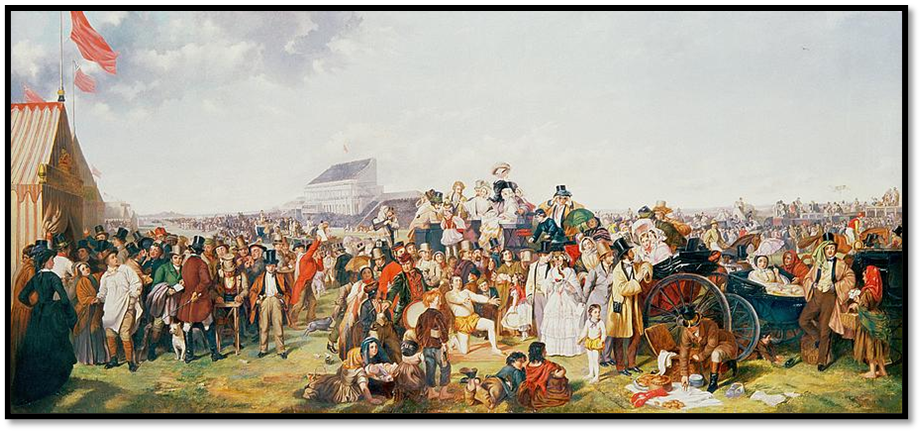
It is absolutely central to the structure of such paintings that there is no unitary perspective and many possible vanishing points for the gaze as it continually resituates itself. This is why The Pre-Raphaelite Brotherhood as a group of narrative painters chose models of painting that preceded Raphael and his supposed institution of a single vanishing point in his major paintings. To tell the story there must be sub-plots and interests in the characters that vary, even when these variations interact, as the must in a complex story. This was not new to art in the Renaissance. Tintoretto’s Christ Washing the Feet of the Disciples has many varied vanishing points and allows many stories to be considered both singly and in interaction from its many perspectives:

Cadmus choose models of art before Raphael for a similar reason, even aping their use of egg tempera. Although there are only two people in Point O’ View, our perspectives on the scene continually play directional and focusing games, only one of which is based on the lateral gaze of the central character looking entirely across the midfield of the spectator’s vision. At times we look up, down, to one corner or another and the figure of the man whose head points into the picture frame level poses another problem – how do we locate in space the hand that curls into a fist, but not quite, above his red head, and how do we account for the location and projection of his finger from the hand towards the viewer even further, which, although presumably the hand of a young man has the shaded and wattled look of the skin and nails of an older man.
In stories, we are always trying to locate the meaning of characters, as these meanings develop and fade and change. In pictures this has to be done by the puzzle they present to our own and each other’s perception. My own feeling about Point o’ View, is that the painter throws us into conflicting readings about the young man that veer between form and formlessness (or form distortion) and between the potential for beauty or the ugly. In appearance terms these can but need not equate with characters that we commend or otherwise. Having said this, I also have to say that I am here disputing the reading of the Fire island pictures of this period established by Lincoln Kirstein in his (still) lonely representation of Cadmus as an elitist follower of perfection beyond the city crowds. He says that ‘this series of beach pictures stands as something perfect and virginal amid a generality of the coarse and abrupt’.[7] All of the possibilities must have come into play in the Fire Island stories, even for those who do not know the background story – and very few would (although interestingly Kirstein would as friend, employer and brother-in-law of Cadmus). What we do see is the form of a semi-naked whose visual relation to the more formal figure behind him is continually called into play.
When I began to doubt this I decided to read a little more around the literature that explains ugliness, not least because Cadmus himself raises the issue of the use of beauty and ugliness as a possible code for moral evaluation of his people in his socially satiric narrative pictures, like the very grand (huge at 46 x 92 inches) Subway Symphony (1975 – 76) which does not use the softness of egg tempera but garishly coloured acrylic paint on canvas. Kirstein believes that Cadmus stops short of censor and contempt for his people but attempts a view of mid-way state of a status – quo capable perhaps of deeper descent or some unknown ascent to something better. There are three floors visible in the painting creating interesting inset vanishing points. Kirstein calls it, continuing a Dante analogy, Cadmus’s ‘purgatory: a man-made limbo, the accepted limbo of citizens quite accustomed to constant noise, unwelcome neighbors, discontinuity, and accident’.[8] One portal to the street level, is a set of stairs at the bottom of which a representation of Cadmus leans sketching – just below an attractive young rent-boy eyeing a stereotyped camp potential punter. One to a lower inferno shows an older woman robbed and/or raped and lying in the ground beneath this purgatorial mayhem. Whatever else we know Cadmus is not seeing the whole picture from his point of view or even a large part of it, just as in the amazing The Tower (1960) or Artist and Model (1971) in which Cadmus sees less in the mirror he draws from – he appears to see only himself – than we as viewers do, whilst his model looks laterally across the viewer’s field of vision. But the points of view in Subway Symphony are legion.
But Cadmus’ own comments from a 1977 broadside publication for Midtown Galleries – placed by Kirstein in margins to his book not to interrupt his flow of interpretation – doesn’t quite stress the neutrality Kirstein sees but rather problems in interpretation of what is beautiful (in appearance or ethics) and what ‘ugly’. They are difficult to interpret and in places hard to defend, but it is worth trying to get to grips with the words conceptually:
Theme: UGLINESS. Ugliness rules there … To distill an attar or essence I must select only the perfect petals, the most hellish .. Percentages; two or three percent of the subway’s denizens , at most, are beautiful BLACK IS BEAUTIFUL, WHITE IS BEAUTIFUL … Environment: ugly, hateful, sordid, dilapidated, neglected, despised … “Beauty is in the eye of the beholder” Ugliness is also in the eye of the beholder … William Carlos Williams said somewhere, I am told, syphilis is beautiful … UGLY equals BEAUTIFUL? And vice-versa? … Will it be said that I am anti-Semitic, anti-black, anti-white, anti-hard hat, anti-ALL, anti-people? I am NOT. I am anti a society that makes people this way, that makes humanoids of humans, an environment that causes this … I am FOR human beings as individuals. […] The ugliness is not all physical. It is spiritual (or spiritless). The goals, if any, are ugly and material … Overeating …. Overdrinking … over indulgence […] People refuse to see the obvious. They need to have their noses rubbed in it, their noses and mouths and eyes that crave only euphemisms, soda pop, bubble gum, sweetness-and-light, candied violence, anything to minimize, or distract from the horrible, grotesque daily life (death).[9] P105f.

This is not written nor can it be read as a logical set of statements or an argument. It contains every contradiction you might desire – ranting against euphemism , for instance, in the language of euphemism. What is clear is that beauty and ugliness are problematic characteristics that are neither mutually opposed to each other nor a binary. We use them as if they were a binary a binary to support other binaries, like good and evil, white and black, without truly seeing the purpose for which we are using them – to keep social groups identified in mass and in opposition to their polar opposite mass of non-individuated being, setting black against white, and classes against their favoured opponents.
And a recent (2022) neuropsychological-focused experimental study by Fatima M. Felisberti has argued that for human beings there is no evidence that clearly supports the idea from ‘folk psychology’ (the euphemisms of daily life that pass for wisdom about people) that ‘experiences of ugliness are associated with the negation of beauty and disorder’, although may be because ‘empirical evidence is remarkably rare’.[10] The study asked people to take photographs of ugliness in two contexts: in rural and urban landscapes. The photographs were then evaluated by two groups of people – the first understanding that the photographers had been instructed as they were, the second not knowing this – to account for any self-fulfilling prophesy.


Reflective notes from evaluators of photographs ‘revealed that emotional experiences with visual ugliness could overlap (e.g. decay), but ugliness was associated more frequently with fear and death in landscapes, and with sadness and disgust in urban scenes. The findings uncovered a complex layer of associations’. Felisberti argues in her concluding discussion that associations with ugliness are:
complex and intertwined with behaviours contingent on a composite of socio-cultural, emotional, and evolutionary factors. The experience of ugliness and beauty seem to be independent of each other, not simply opposites, since both can co-exist in artworks, architecture, film, music and fashion, as well as the environment …. The experience of ugliness also seems distinct from that of beauty in evolutionary and emotional terms. … There are differences in emotion processing too; the emotions most often associated with ugliness—pain, fear, disgust and distress—involve some neural networks distinct
from those associated with beauty.
In a nutshell, findings … indicate that the experience of ugliness is not simply the endpoint of an imaginary beauty-ugliness aesthetic evaluation scale, but rather an independent experience not only entangled with the negation of beauty, but also able to coexist with it.
Now when I compare those findings with Cadmus’ notes, I think they help us see that Cadmus is insisting that we examine our notion of ugliness for our role in its production, pulling from it those imposed ideological factors to find the root of what fascinates us in ‘ugliness’, some of which will be an attraction to the beauty that co-exists wit it. Moreover, that task is a moral one – it is about being willing to expend the energy to see the world from varied viewpoints where categories don’t determine beauty or goodness but genuine human interaction does. It is the same task that Tolstoy sets himself – to shapeshift between human perspectives, or Dickens, or Forster, and not allow prescribed classifications to read for us what is beautiful and too easily equate that with what is good. Presumably syphilis is beautiful when we take the chance to really look at it as a human experience and not just class it as a ‘sexual disease’ and sign of disorder – only seen in order to be eradicated. Similarly moral prohibition overeating should not allow us to see every instance or token of a fat person as ‘ugly’. This is an issue Cadmus takes up in his painting where one fat person makes herself ugly mainly in the manner in which she views the fat peace-seeker sat next her with his pregnant wife.
There is an analogue in poetry here. In Auden’s Lullaby, the lyrist sings to his lover aware that much of his ‘Individual beauty’ has been burned away in age and sickness BUT though ‘mortal, guilty’ of the world’s sins, he is the ‘entirely beautiful’ because I allow him to ‘lie’ (in both senses of the word) just as all ‘living creatures’ must lie, next to someone who meets their need for warmth.
Lay your sleeping head, my love,
Human on my faithless arm;
Time and fevers burn away
Individual beauty from
Thoughtful children, and the grave
Proves the child ephemeral:
But in my arms till break of day
Let the living creature lie,
Mortal, guilty, but to me
The entirely beautiful.
Now when I look back on Point O’ View, I see Cadmus chained, in his memory to a lover who betrayed him who can from some points of view look like an immoral betrayer and ugly, but examined closely, is still the entirely beautiful actor of substantial life he was when Cadmus first met him. In What I Believe (Cadmus’ version), the gaze can initiate beauty from what could be ugly.

The only viewpoint in that painting that finds everything ugly is that representation of Death standing in an open grave, revolted though, not by the individuals who gaze on each other with care at another’s possible vulnerability, but at the sight now behind him of a host of missiles from a fortification of war.
What we need is what Forster spoke of in a little easy-to-read but rich study of novels as a form, the ‘power to expand and contract perception (of which the shifting view point is a symptom)’.
All I have to say
All my love
Steven xxxxxxx
[1] For my blog on Jack Parlett’s great study of the role of Fire Island in queer Lives and art, Fire Island: Love, Loss and Liberation in an American Paradise, see: https://livesteven.com/2022/10/11/queer-people-have-a-particular-stake-in-the-question-of-paradise-do-places-have-biographies-as-well-as-histories-inner-lives-and-the-stuff-of-changes-that-occur-in-time-tempered-by-reflec/
[2] Brian Ferrari (2024) ‘Artist’s Muse: Donald Windham & Sandy Campbell’ in Brian Ferrari’s Blog: Writing and Rambling in NYC {Posted July 30, 2024} Available at: https://brianferrarinyc.com/2024/07/30/artists-muse-donald-windham-sandy-campbell/
[3] Ibid.
[4] Jack Parlett (2022: 61ff.) Fire Island: Love, Loss and Liberation in an American Paradise London, Granta Books.
[5] From Chapter 4 ‘People (continued)’ in 1927 USA edition of Aspects of the Novel. My bolding. available free online at: https://www.gutenberg.org/cache/epub/70492/pg70492-images.html
[6] Ibid.
[7] Lincoln Kirstein (1992:65) Paul Cadmus San Franscisco, California, Pomegranate Books.
[8] Ibid: 106
[9] Margins of ibid: 105f.
[10] Fatima M. Felisberti (2022) ‘Experiences of Ugliness in Nature and Urban environments’ in Empirical Studies of the Arts 2022, vol 40 (2) , 102 – 208.


One thought on “The perception of beauty as an act of morality in the queer art of Paul Cadmus. If satirical visual art codes the objects of its satiric gaze as ugly, then how does it encode its moral alternatives to the immorality of ugliness?”