It’s all bananas: theatre posters and Samuel Beckett’s ‘Krapp’s Last Tape’.
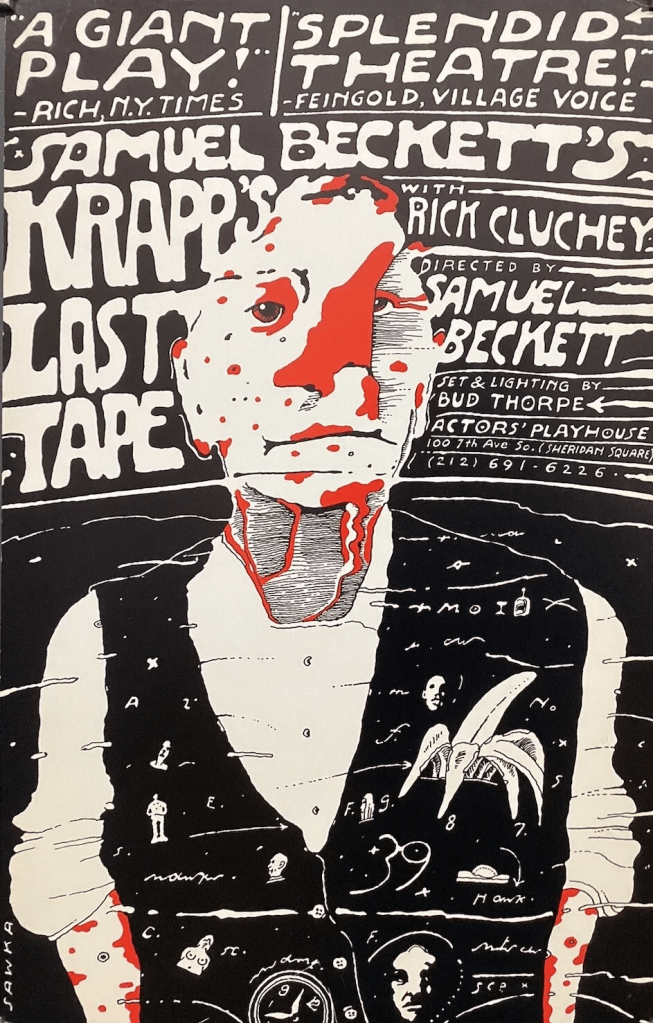
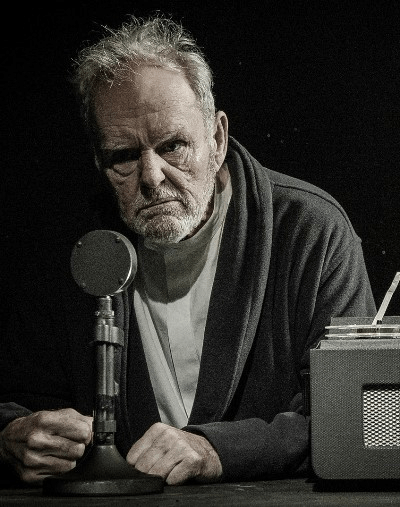
The poster for the rather famous production starring Rich Cluchey; the lower photograph is Cluchey in the role
Tomorrow I am going to see Krapp’s Last Tape at York Theatre Royal. The show booked up a long time ago but I managed to get a return in the front of the Dress Circle for the 7.30 performance tomorrow (these seats are £65). The play is in this production predicted as 55 minutes long and York is a good way from Crook in County Durham but I go on a train just after 4 p.m returning bu one that gets in at 10 p.m. But I have always wanted to see this play and I feel special pleasure that an actor as distinguished as Gary Oldman feels a desire to not only act the role but direct the play. I have already reflected on some early thoughts about that in a previous blog (see it at the link here). When i first caught up with my desire to see the play I wrote some tediously artificial verse (compared with my genuine tensions that prompted the verse – at this link).I am truly excited to be going to tell truth and I did not wamt to blog again until I had seen the show. However, I find myself without a subject.
‘I can write therefore’, I thought, ‘on the role played for me by the York Theatre Royal poster, which can apparently be bought at the theatre (£35 signed by Gary Oldman). I got to this idea because in my current book cataloguing exercise I am up to a couple of books about graphic design and its significance as a form at art, design or both that has that uncertain status because it is an art the crosses the borders between information giving, advertising with an aim to increase sales of a commodity like a theatre ticket and art. Of course the famous example is Toulouse Lautrec until, as with most things, Picasso took hold of it. But the field is large. The current book for cataloguing is Steven Heller and Veronique Vienne’s text 100 Ideas that Changed Graphic Design, whose cover illustrates at least some of the ideas within – especially that of making lettering itself an art form:
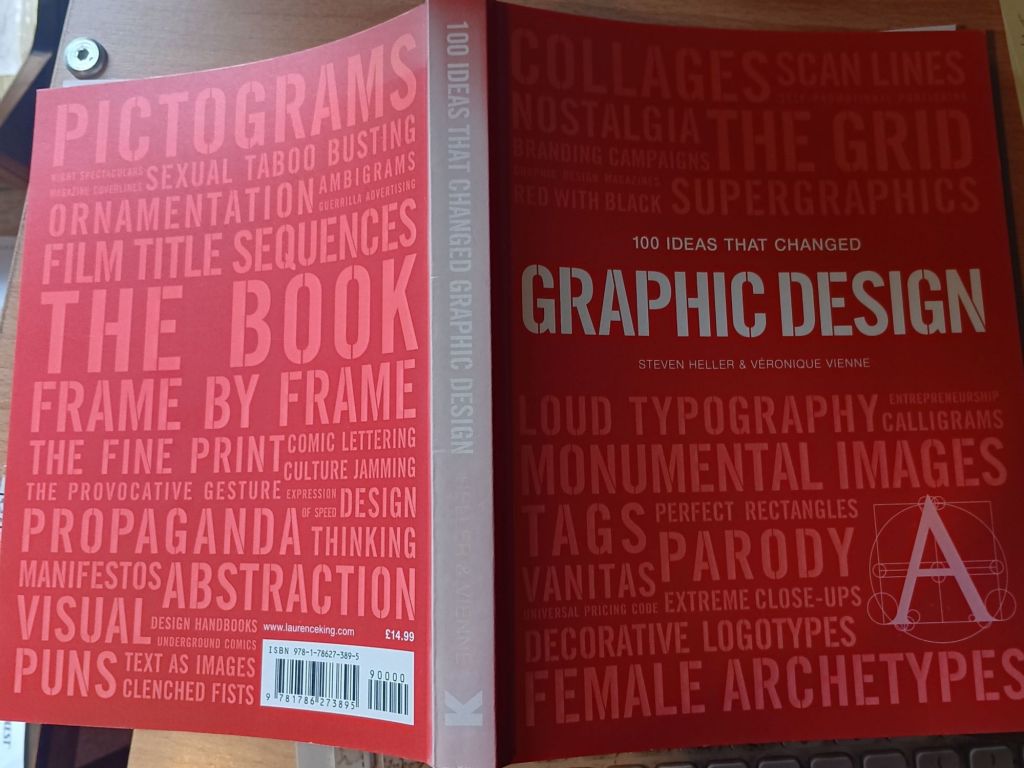
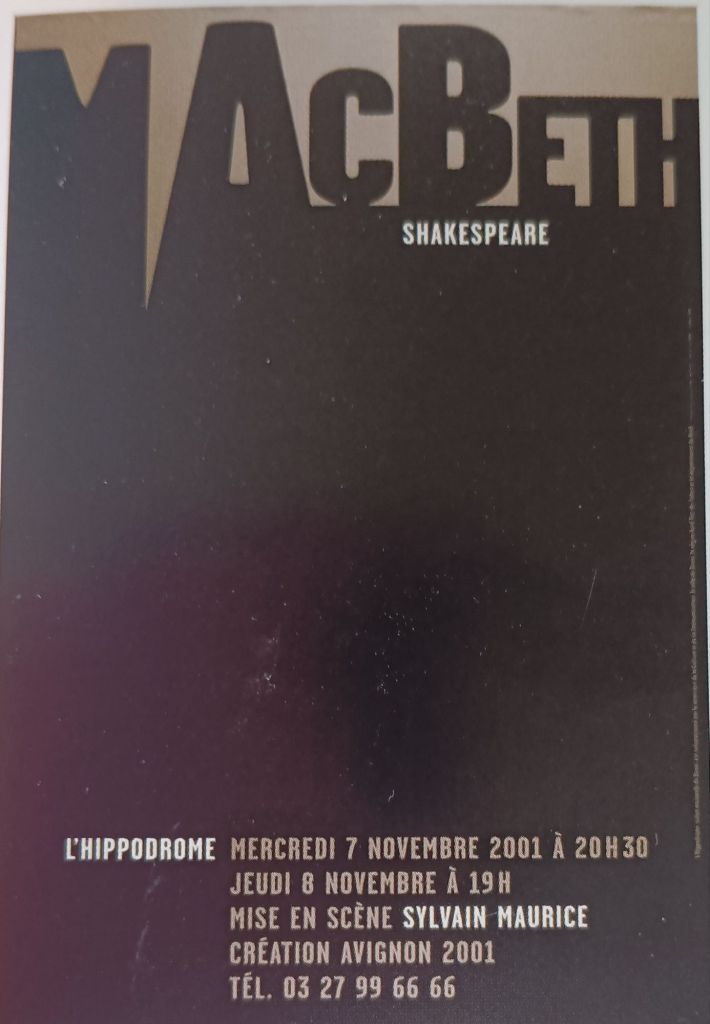
In a section on the use of innovative lettering, they make points about how seeing and reading merge in the creation of expectations of a book, from its cover or a play or film from a poster. In some cases, they argue textual font plat can be combined with other ideas – such as the pursuit of a ‘perfect rectangle’ as the frame of a poster, which make a poster ‘as elegant as a beautiful building’. One of the examples combines this pursuit with various effects of font-play. They instance a Catherine Zask design for a performance of Shakespeare’s Macbeth, saying that she is ‘known for her ability to suggest drama with simple letterforms. Here the space between the ‘M’ and the ‘A’ is sharp as a dagger’. [1] In fact, as with most great ideas that space can ve read many ways and not just the iconic dagger of a dagger-filled drama, it is a flaw in a castle wall formed of the extension of the letterforms downward to suggest the perfect rectangle of a castle wall, with its battlements represented in the letter shapes atop of it.
However, having sought out the poster for the York production, I found many more for lauded past productions and others less well known. No infetence can be drawn from this. Too often a drama gets fame or notoriety from its star, whether these match the needs of this play’s reproduction yet another time. Stardom can ruin a production. I notice, for instance, that What’s On Stage published today a notice put up in the York Theatre to ask audiences from applauding Oldman as he enters the stage, presumably for his star status. The message reads:
In order to enhance the audience experience, we kindly ask that you refrain from applauding when Gary enters. Please hold all applause until the end of the performance.
Posters can too often rather emphasise the importance of the star over the performance, particularly in a on-man short play, whose reputation is of part containing massive challenges for its actor, and requiring literally a man to play it who shows he has had plentiful experience. Krapp in the play is 69, which was considered a much more significantly older age than it is currently, when the play was first released for Patrick Magee to play:
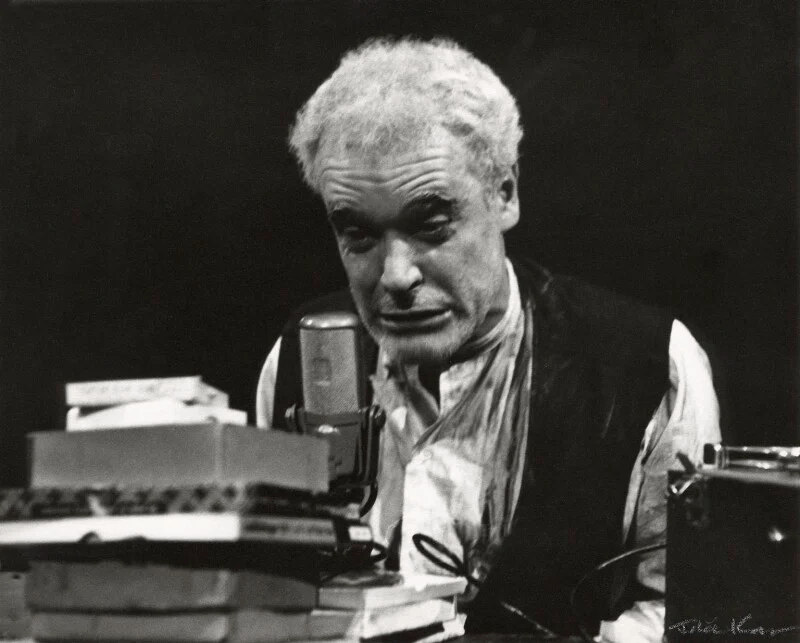
But some productions have used their posters precisely to emphasise a kind of swan-song reputation drama, as is the role of King Lear in Shakespeare’s eponymous play, emphasising the august age of the actor as in the posters below in which the part was played by John Hurt and Michael Gambon respectively.
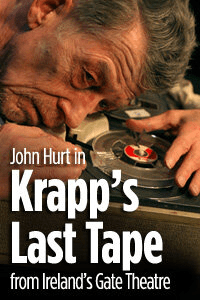
In John Hurt’s case the redness in his eyes (seen as a sign of older age, reflects the redness in the middle of the tape he fumbles with. In later stag direction’s of the play Beckett referred to this centre as a ‘magic eye’ and asks in the version he directed in 1969 for it remain the only thing illuminated in the dying light on the stage at the performance’s end. The eye imagery matters in the play and this is therefore aches to be recognised as the intelligent poster it is – but no doubt the Gate Theatre wanted the subliminal message of a swan song from a great performer to be a message to get people to their seats.
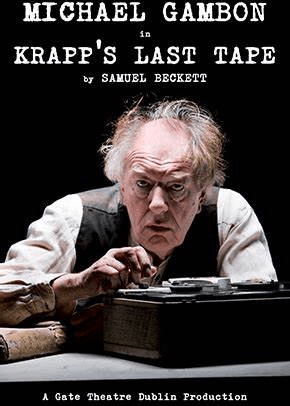
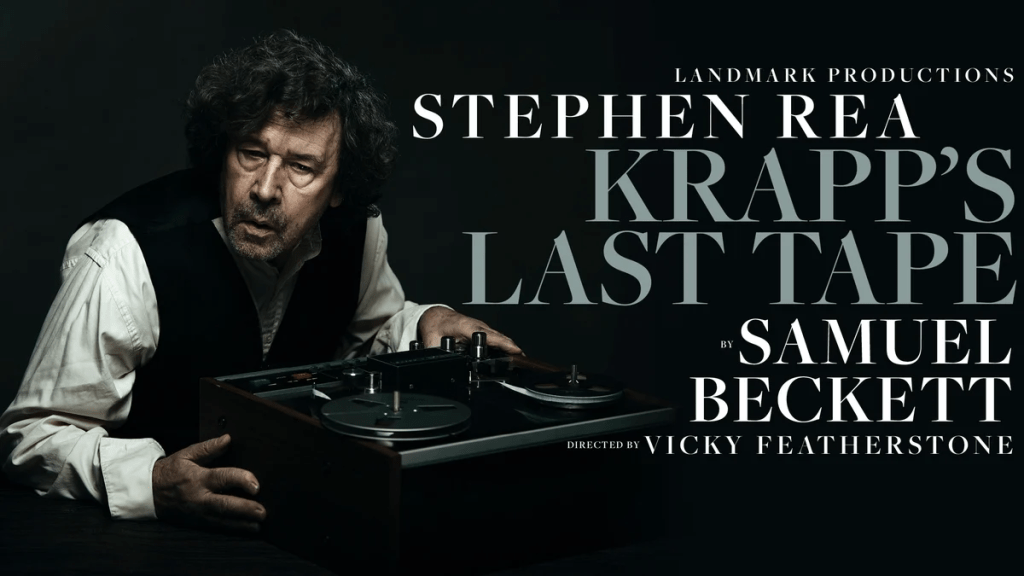
Again at the Gate, the poster for the production starring Michael Gambon emphasises and magnifies the man’s age and interprets it as decrepitude (de-Krapp – itude). He looks at you to appeal to you to recognise that this state will be yours too. Stephen Rea, a considerable actor with a considerable reputation – if not quite that of Gary Oldman – may have been dismayed to find his performance of the role running alongside, though in a different city, to Oldman’s. It plays in The Barbican but the Landmark Theatre company, with the considerable talent of Vicky Featherstone directing) rather emphasises the aging actor feature in its poster.
Prefacing this piece are the poster for the well known Rich Cluchey production and although Cluchey’s profile is recognisable (you can see him playing the role up there too so you can check if you agree with me), the Cluchey-playing-Krapp figure in the poster is nor primarily there to emphasise the role’s, nor the actor’s, age. Almost a carttoon graphic, its features include elements from the play – the bananas Krapp ritually consumes and obsession with age and numbers (tape spool numbers and ages – 39 is there because it ios the age of the voice of Krapp on the tape predominantly played – though it is not his ‘last tape’). Krapp’s flaws seem to run red with blood and to make futher gaps and absences in his face, but the aim of the poster is to point you to symbolic meanings in the play not its actor.
Other posters, where unfortunately though I recognize the faces of the actors, their names escape, do a double job, emphasising the clowning aspect of the role – not unlike the clowning idea in Waiting for Godot– rather than just the age of the actor. Here the emphasis might be on a serious actor showing they can deal with the absurd dark humour so often in Beckett, thought the first of those below, may tease with the second childhood idea of older age:
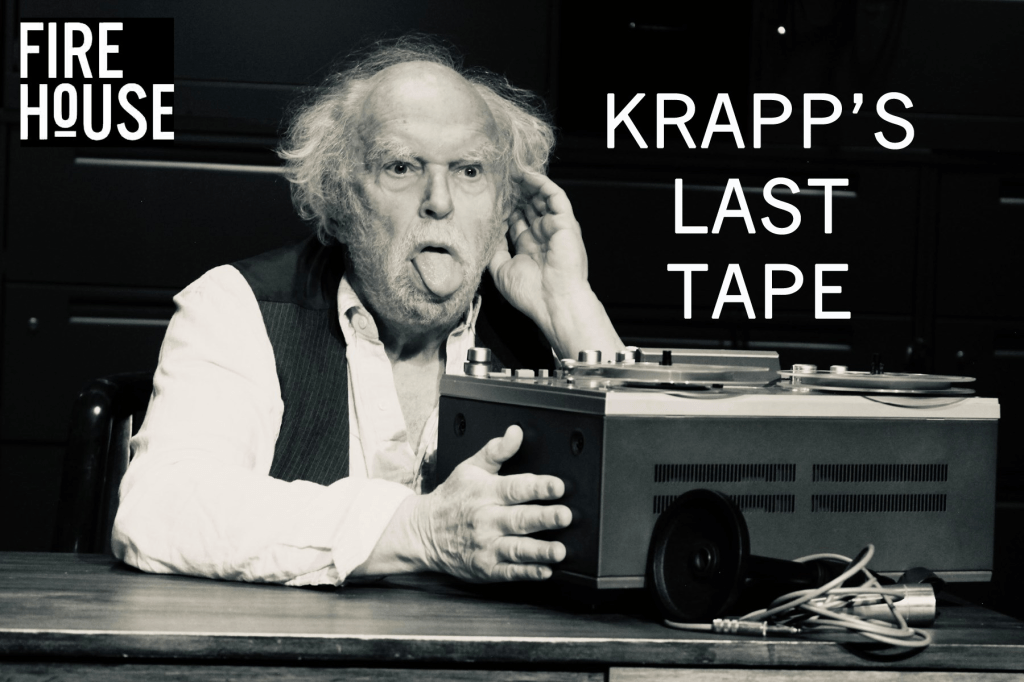
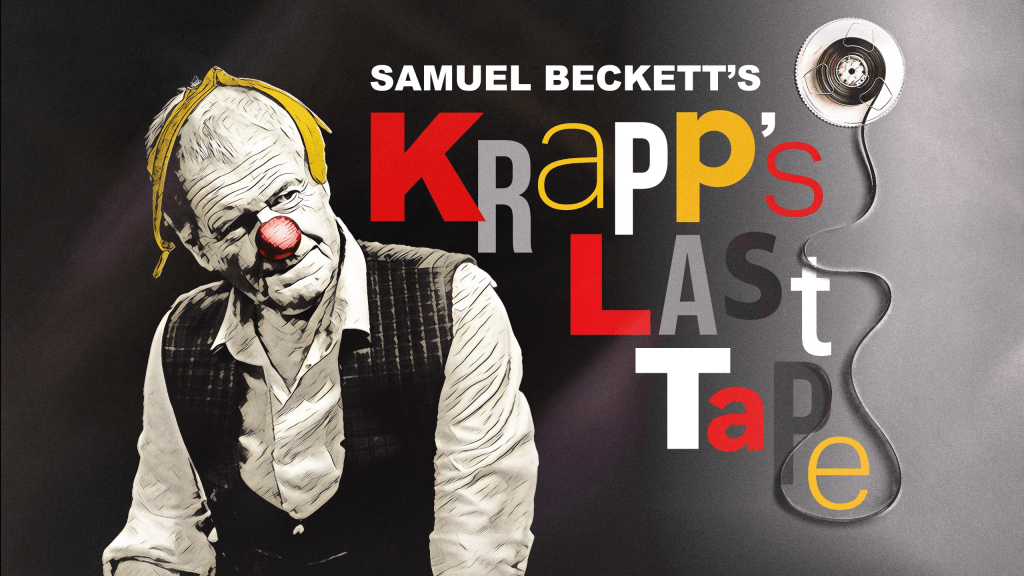
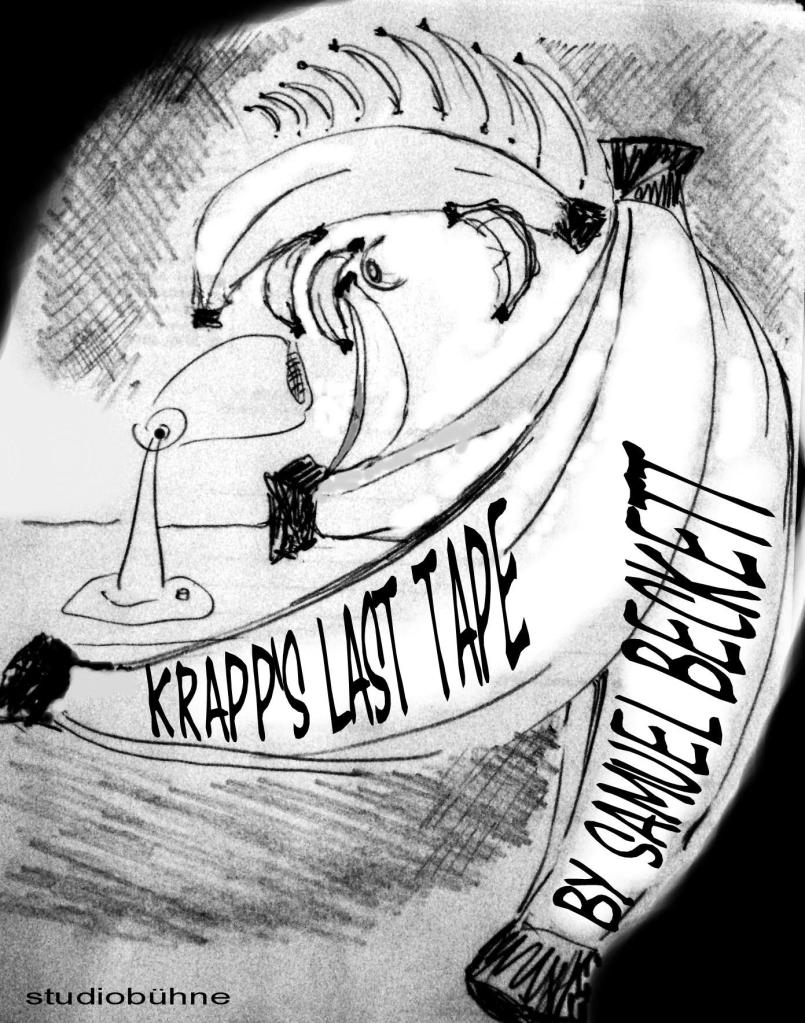
Other posters play with the comedy element, especially the absurdities of the banana-play. In the 1969 production Beckett reduced the amount of business with bananas – which really only features in its opening, but some productions have emphasised it as both comic and surreal as in the poster below – where the play seems reduced, and its main role, to ‘all bananas’.
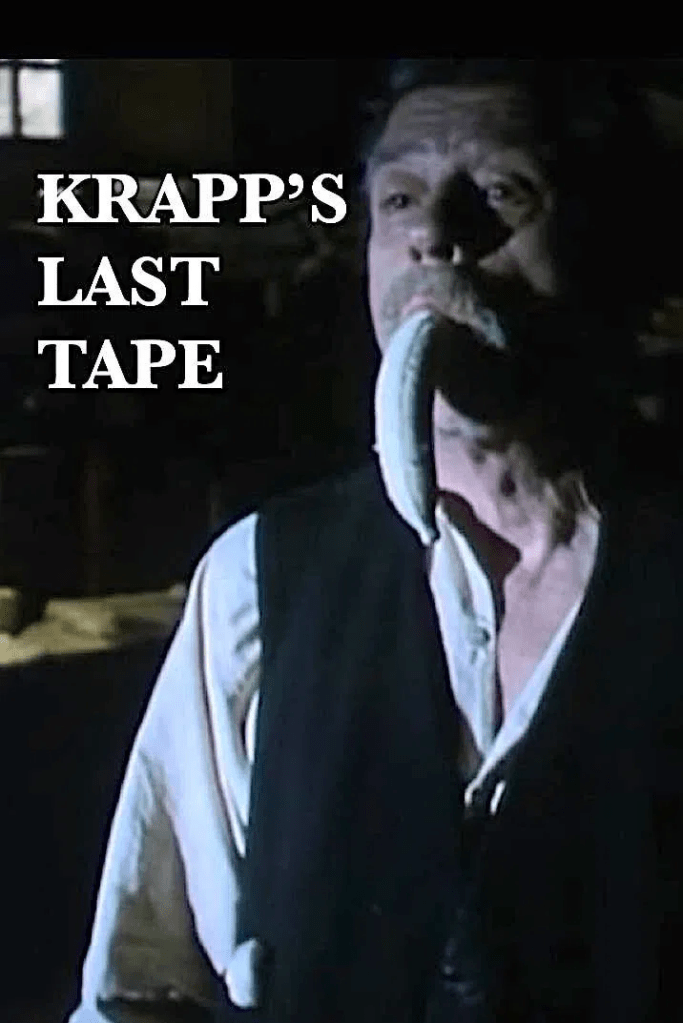
If you are performing the role combining your image with bananas ludicrousness might seem the last straw and the next poster, unlike the last, seems to me to fail in its intent to draw me to the show:
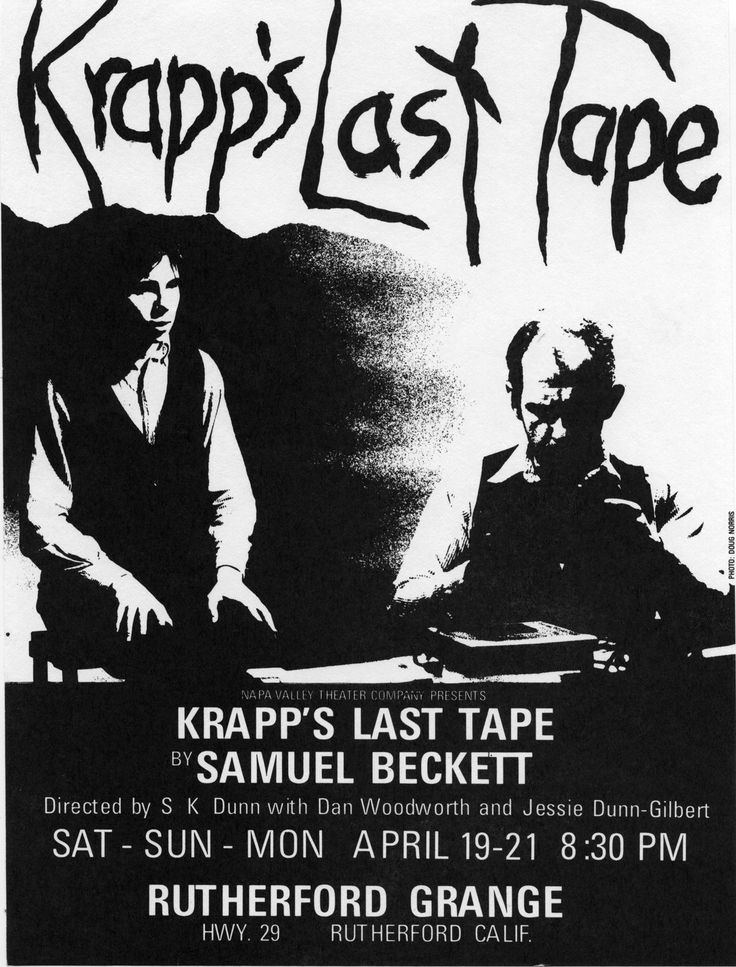
Perhaps a poster I liked most was one I found from a Californian production where the ghost young Krapp who s mentioned in the play of divides the poster with the elder man who listens and reflects on the past. The poster even organises the light/white and dark/black imagery of the play into its design, with the nuance that it is the older Krapp who is in the light.
So let’s look at the poster for York. Here is the advertising picture of it from the website (it is £10 unsigned, £35 signed by Oldman).
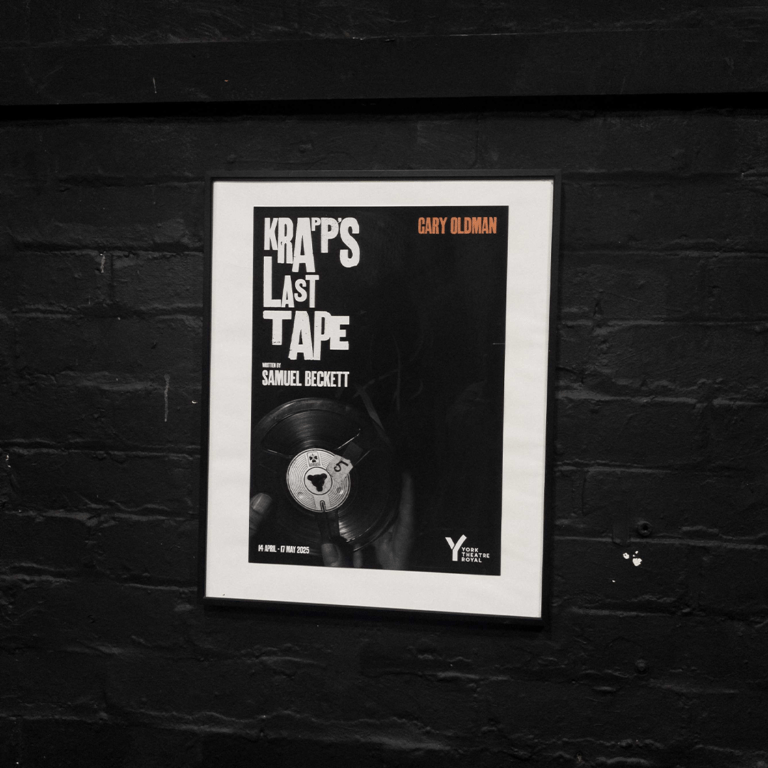
Now I rather like this. A lot of the work is done by the varied letter-forms tjhat take on the role of informing us of he theatre of the absurd elements of the play, perhaps even its dark comic range, but though Gary Oldman’s name is prominent, and the only image not in black or white -another reference to the dark-light imagery of the play – Gary Oldman is not represented. I love it that so little hasas yet been given away by the nature of the performance, though a blog from the Glasgow Theatre Blog site does say:
Questions will inevitably be asked if Oldman is deserving of the plaudits he frequently receives. This is a play of stillness, a performance from Oldman of tiny, often minute detail, and yes, he’s as good on stage as he is on screen. Krapp’s Last Tape proves Oldman to be one of the finest actors this country has ever produced. Hopefully, his next stage outing won’t be too far away.
But the point is that the poster emphasises themes – of the sequential order of tape against the disordered imagination of its makers and listeners outside of their taping activity – the role of numbers in trying to sustain the illusion of sequence, and the fragility of spooled tape to tangle outside of the strict framework that encases and organises it. These aren’t images of our day – hence there is yet another layer in the complicated treatment of time in the play – but only complicated if you overthink it. Beckett though is about real life where overthinking is not just a trait of those without sufficient cognitive-behavioural skill. I cannot wait to see the play – and yes, I admit, see Gary Oldman as well – though I will ‘refrain’ from clapping on his first stage appearance.

Bye for now then.
All my love
Steven xxxxxxx
_____________________________________
[1] Steven Heller and Veronique Vienne (2012: 125) 100 Ideas that Changed Graphic Design London, Laurence King Publishing
 Steve_Bamlett_blog
One thought on “It’s all bananas: theatre posters and Samuel Beckett’s ‘Krapp’s Last Tape’.”