In what follows, I scatter the correctly paired works variously in labeled collages:
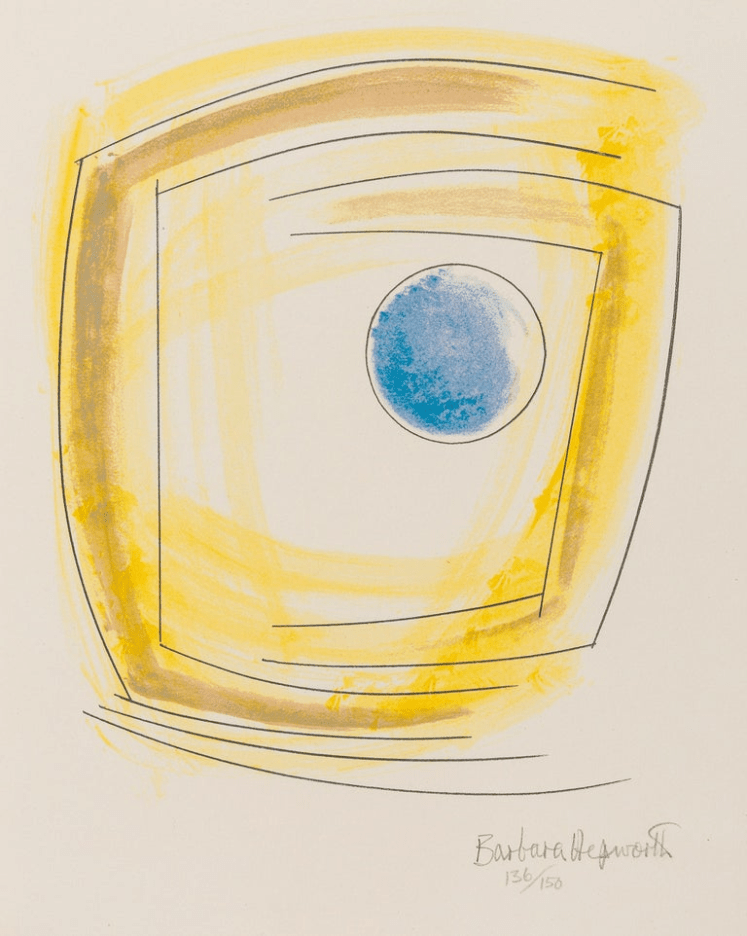

Barbara Hepworth Winter Solstice at ItDibs
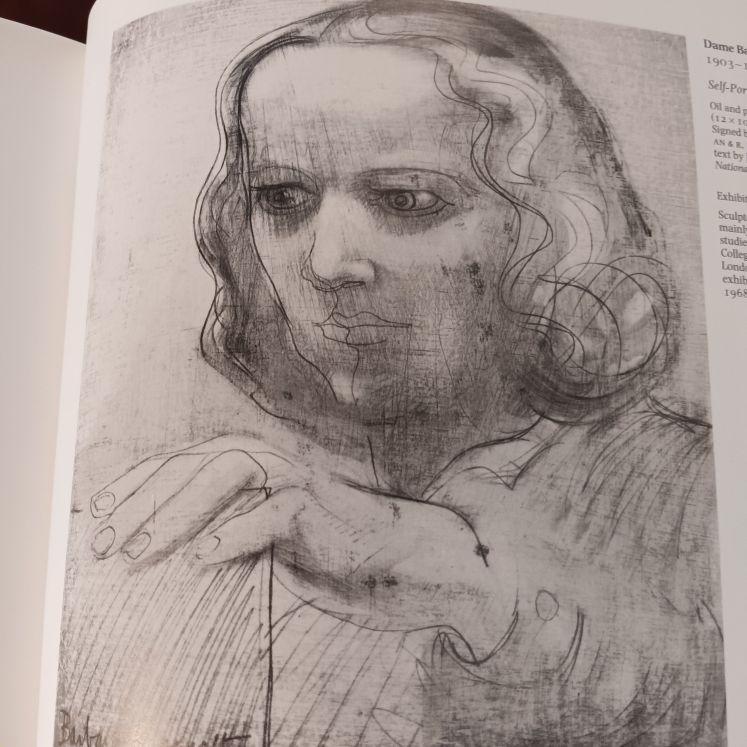
Hepworth’s idealistic iconography certainly extended to her self-portrait. The use of blank space on paper characterises the treatment of her massive forehead, full of space which her abstract figuration also has, wherein colour tones and shades and deepens that interior space. In self-reflection, that space is cognitive and reflects those huge shaping hands. The connection of cognition to making is a Hepworth trait and the solstic she draws is intellectual as well as emotional. Here use of layering in the art (of colour space and blank paper – nothing looks just like a ‘surface’ here is matched by the toning and shading on the portrait.
However, despite the musing above and scattered throughout, I have to admit that this quiz did not work for me, and not, I suppose, for anyone else, for it touched on a dead end very quickly, though Geoff, my husband, talked me through his thoughts. In the end, I think you have to admit the idea of a painter’s ‘style’, as a mode of working that characterises all of their work, or at least that of a period of their work – for art historians can speak of Titian’s ‘late style’ as a convenient fiction for a series of complex traits that come together but which are reconfigured over a vast range in each work. Nevertheless having kicked off this idea, I had to finish it. So here, first, are my answers with works little identified, ans some trial comments on ‘commonalities of style:

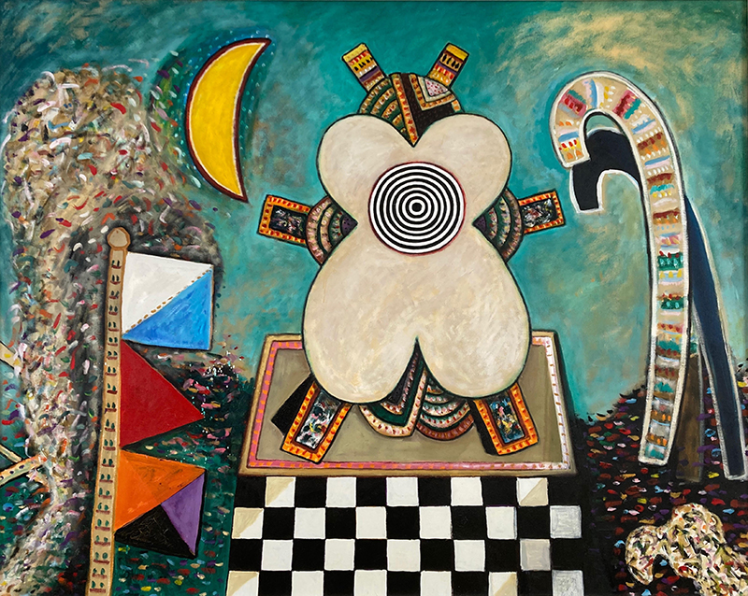
Alan Davie Beginning of a Far-Off World
There are Alan Davie pictures that would be easier to compare with the self-portrait. In this painting, the eye is continually emphasising a kind of symmetry in the design because of the central and centrally-spaced iconography; especially that of the chessboard. The figure of Davie has the feel of a likeness, but that likeness rather seems to emerge from the marks on the paper and get very disordered at its edges. However his right eye has some of the magic of the labyrinthine symbol in the painting, And the privacy of the symbolism in the painting also rhymes with the sense that Davie draws a seer seen through manipulations of the process of seeing. I suppose I chose the painting though foe the fact that it is underlain by (bounded though they be) patches of random markings rather like the extremities of Davie’s face become – his wispy hair and beard – the latter seeming to end in an arcane symbol. but had I not known the painter, I do not think I would have guessed the pairing.
The problem is, as modern art historians recognize, ‘style’ is a term that means far too much a d talk about it tends to then include other variants for discussion that differentiate works within any artist’s oeuvre as well as make distinctions between artists. Distinctions between works by a painter I love, William Roberts, seem so much harder to think about when we look at some phases of Wyndham Lewis’ work, for instance. Is this a matter of style, iconographic symbolism, or of shared thinking about the human condition and its amelioration?
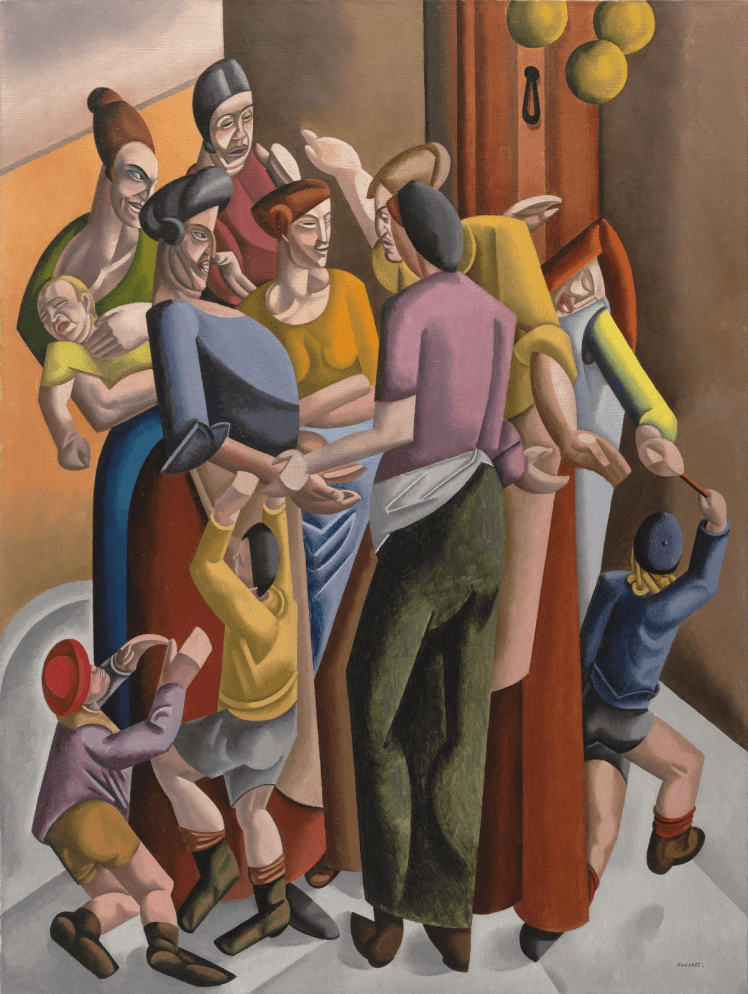
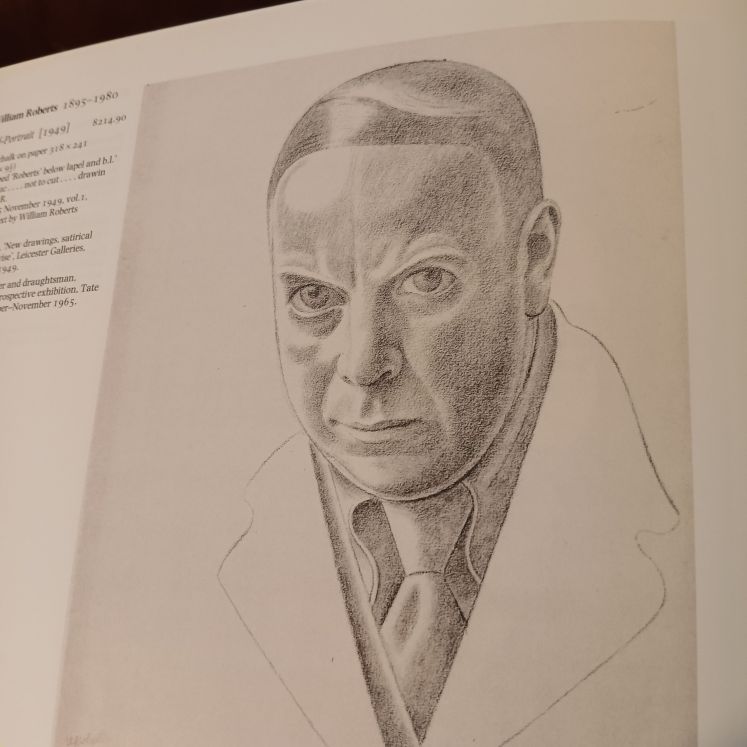
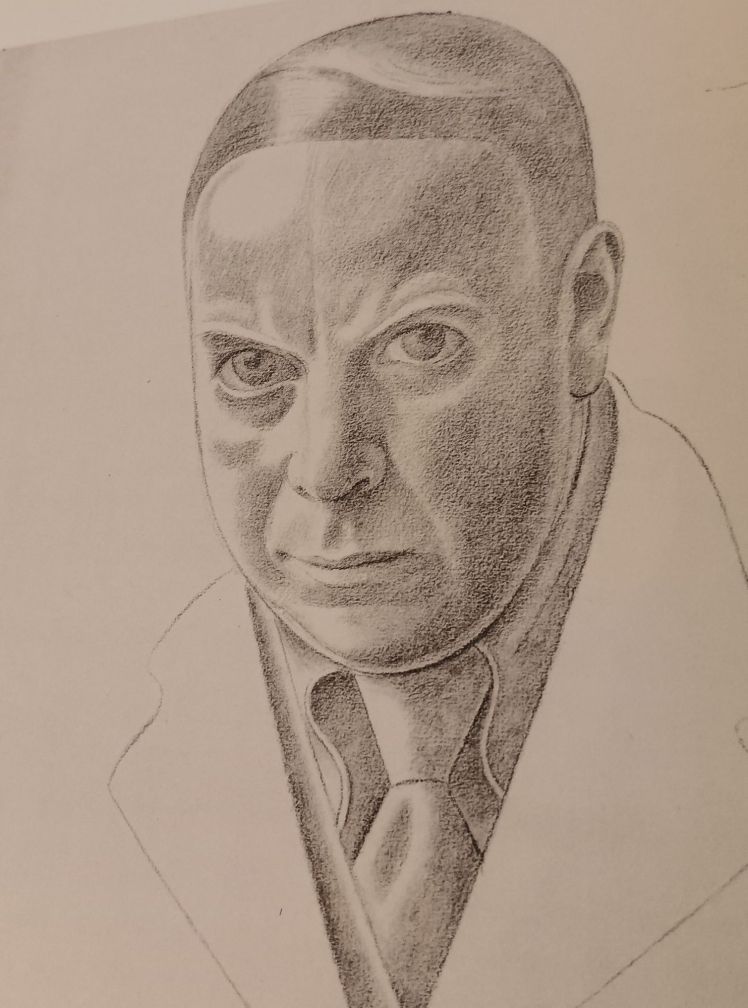
William Roberts The Three Balls
I thought the pairing of The Three Balls with Roberts self-portrait would probably be easier to make than some others. The same solidity and density of tje figures applies, as well as a kind of drliberate artifice of solidity, that makes us wary of the kind of human its portrayed. Roberts’ eyes state too glassily, and there is a dissociation between the statuesque monumentalism of the figures and their supposed activity. In the scene outside the pawn shop, there is something brutal and dangerous going on, involving a baby whose facial features seem those of a 100-year-old person.
But these things that unite the two works could equally be related to the vision of humanity and belief in the loss of social and/or aesthetic order implicit in the various visions Roberts was aligned to: he chose to call himself a Cubist, though where do we see hints of Braque here, and, if of Picasso, only of his classical era monumental beach women? These works remind you of Futurism and Vorticism, much more ideological movements in art. Here, style is only an aspect of the commonalities in the works.
Likewise, in Searle, there is the same hint of commonality between works that has more to do with the survival of Neo-Romanticism than merely style. The lithograph, The Second Eden, shows art complicit in the construction on the facia of Searle’s printed page of a Piranesi-like imaginative structure, comprising and demonstrating as decoration many architectural styles (including that of a cobweb) but declaring its own inner harmony with a sweet nature, littered with images of the psyche – the butterfly. The self-portrait has a similar whimsy of style, based upon a background comprising some kind of classical-cum-baroque capriccio.
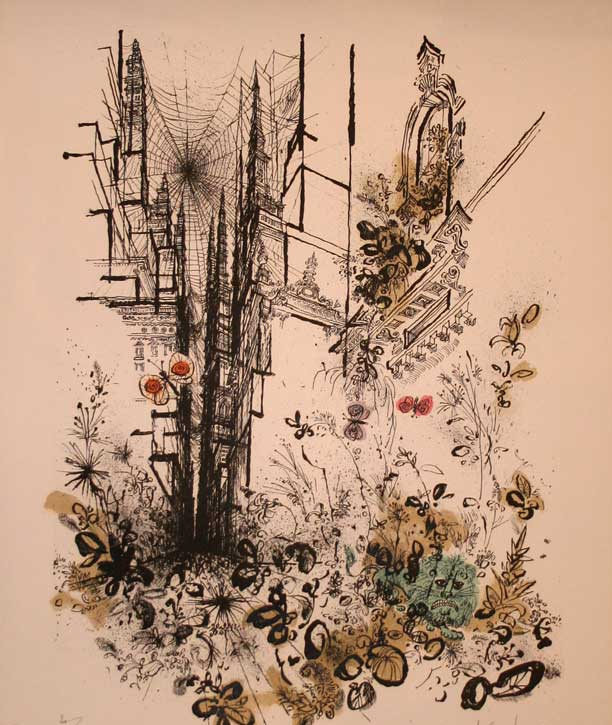
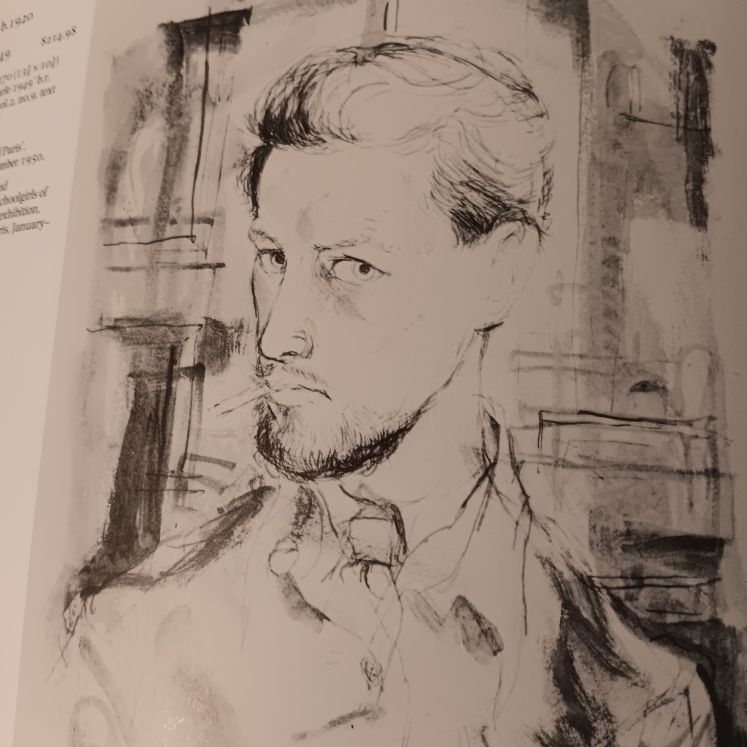
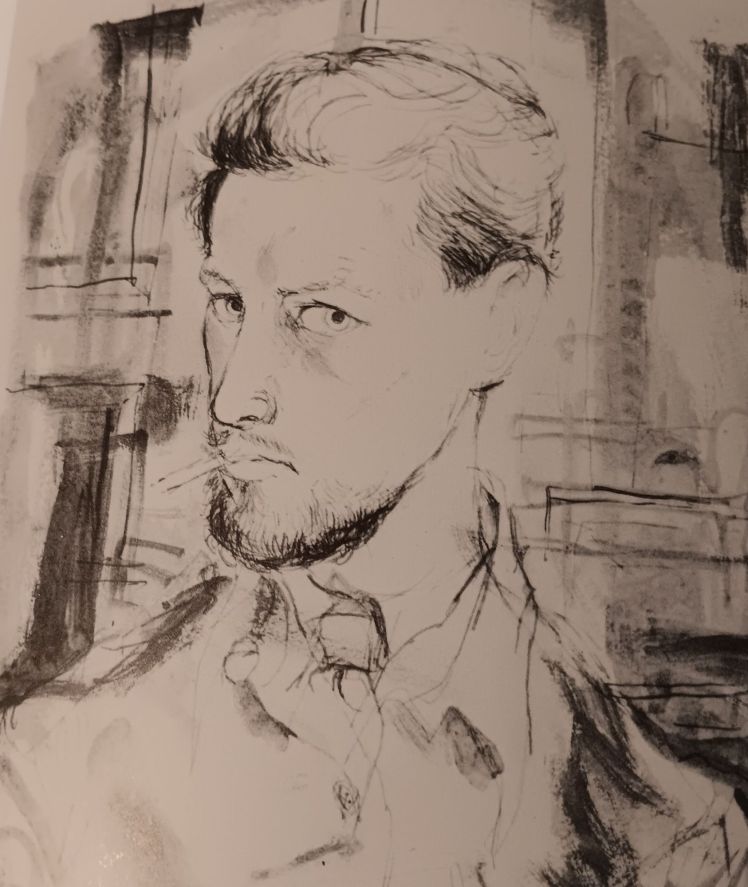
Ronald Searle Second Eden Lithograph
I think I would have been surer of guessing the pairing above than any other. I know the next painter very well but the pairing here would be less sure. The style of the self-portrait shows a good-looking young man though the style is conservative. Nevertheless, I even dare think him a greater painter of the queer than his younger queer contemporary David Hockney in his mature figurative experimental art. Vaughan was well past his own Neo-Romanticism when he painted the near abstract masterpiece Dark Seated Figure. Nothing in his self-portrait predicts those figures in this painting, where isolation and inner or penumbral darknesses (blues, greens, greys and shades of layered black) of different tones that suggest both secret companies of men in equal isolation. where in the self-portrait is that taste for off-straight lines and patches, the blend of the psychologically introjected and projected. The self-portrait is of a nice young man without the nuances of this secret man’s being or social knowledge at all suggested.
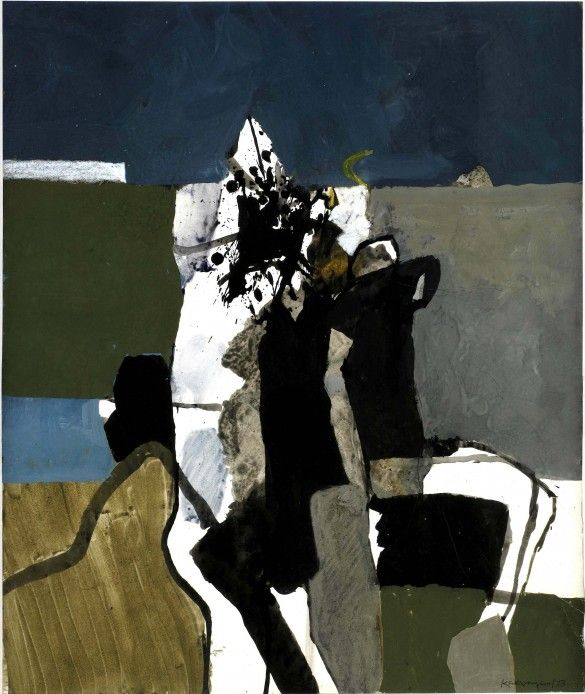

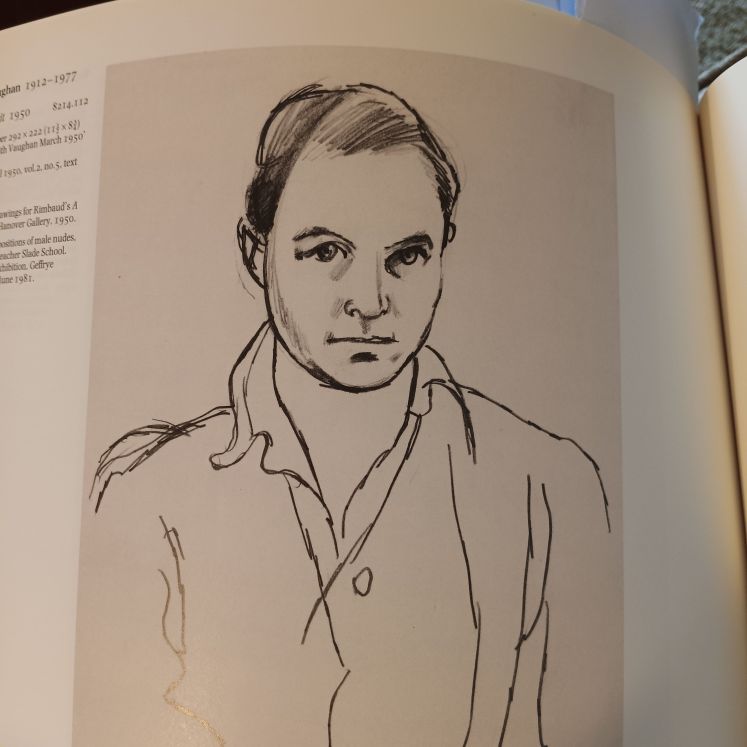
Keith Vaughan Dark Seated Figure
I may have confused in my answers did I not know Felix Topolski’s work well his spidery detail with that of Searle, but it is not alike at all, and again I think this pairing guessable, not least in the facial similarity of his Jewish London lawyer in his chambers to his own.

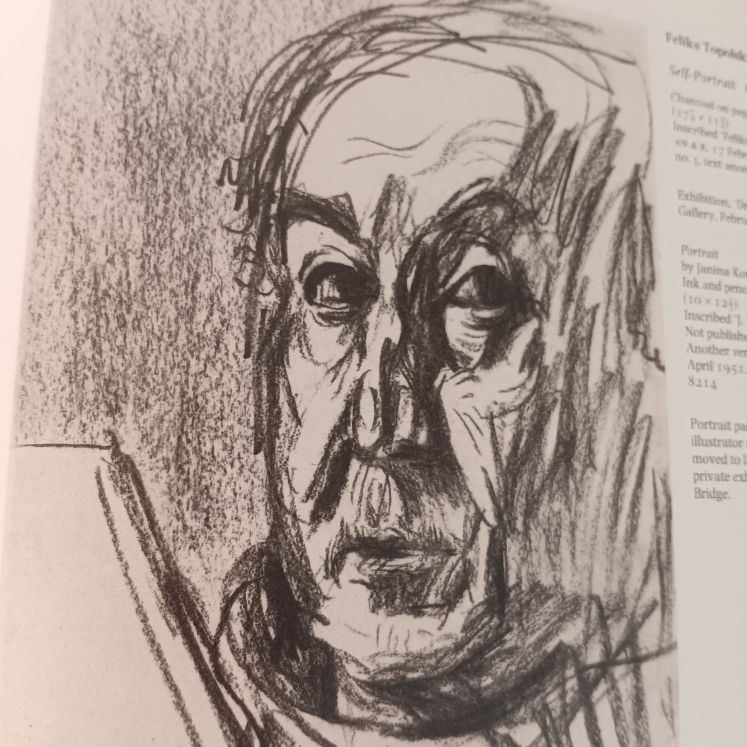
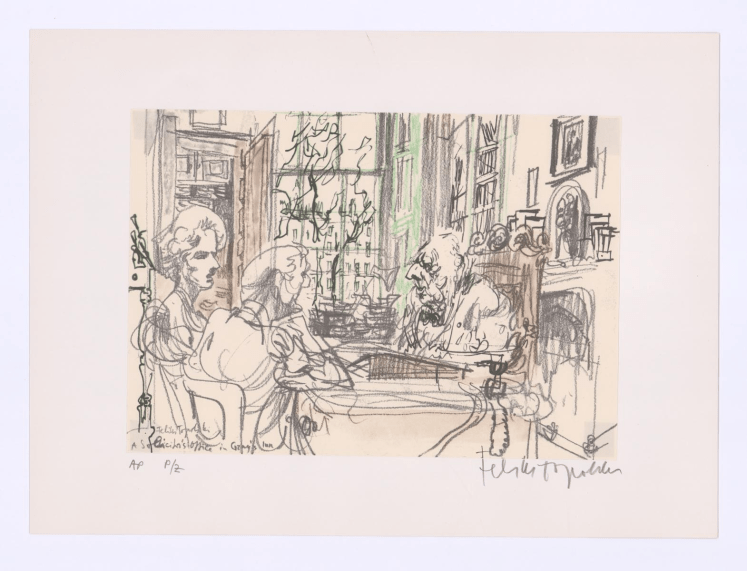
Felix Topolski (From) Legal London
It is in the styling of facial features that we see commonalities – particularly of the anatomical connection of nose and forehead, raised in a look of query at the viewer – whether clients or viewers of art. The variegation of the light intensity and shade of lines used is similar in both if more pronounced in the Legal London scenario, where the use of grey daubs seems to emphasise different layers of reality. Outside the chambers is a tree (London plane tree no doubt) that is just a squiggle of lines and seems to come to the picture plane of the scene rather than stay in the recessive space behind the window. The real give-away is the quality of the marks employed in each picture is so varied, giving both incredible psychological depth
We would not confuse that with Ceri Richards who uses lines even to make up the denser places of shadow in his pictures – and conversely blank space (as does Hepworth) to indicate sheer light and transparency. We see the pictures here as alike because their psychological take on their subject is so different. each however uses the line, often vigorously repeated when needed for areas of material or psychological density and complication.
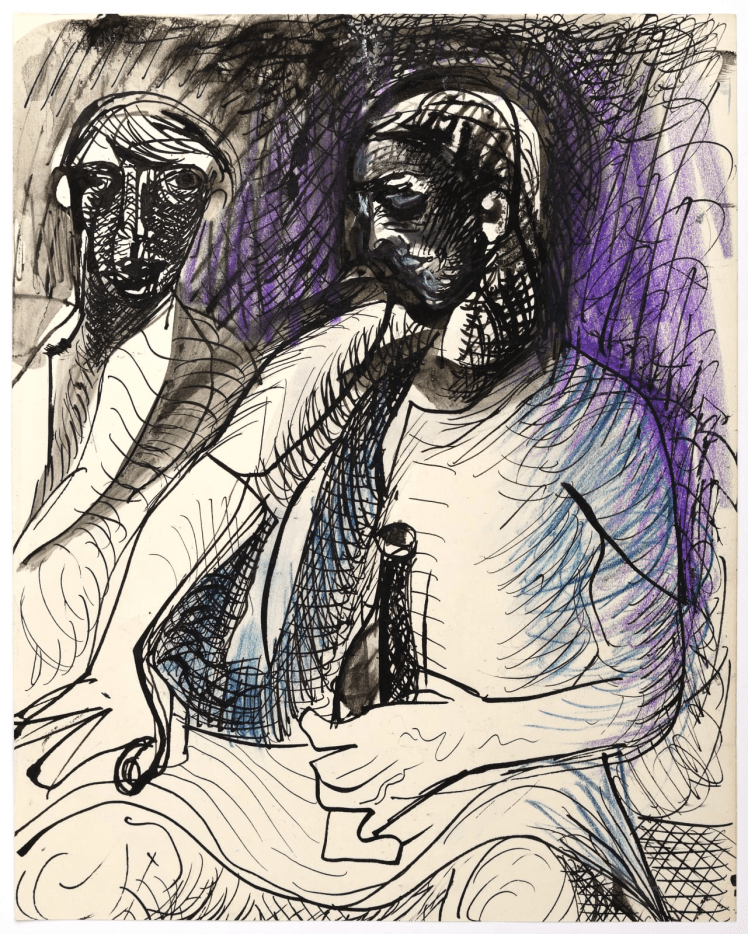
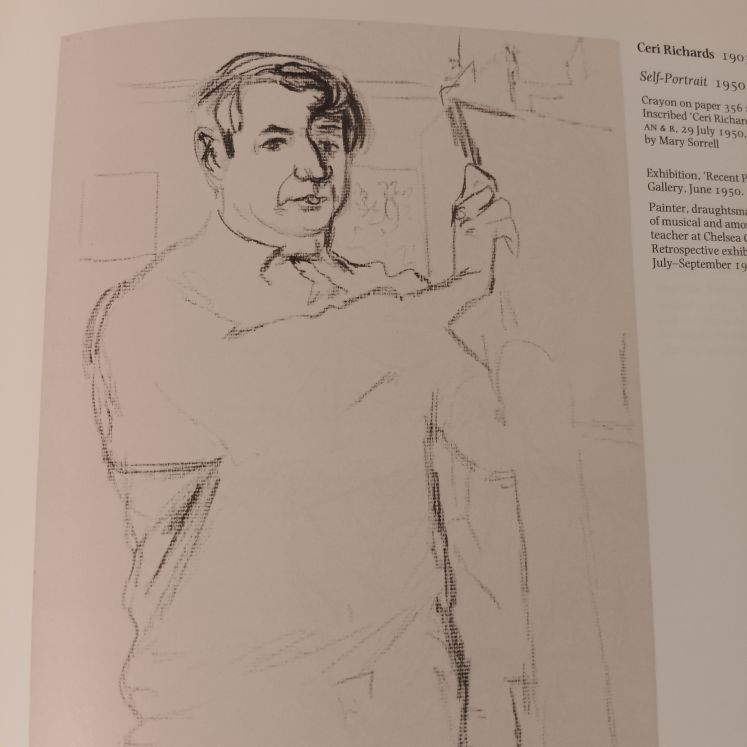
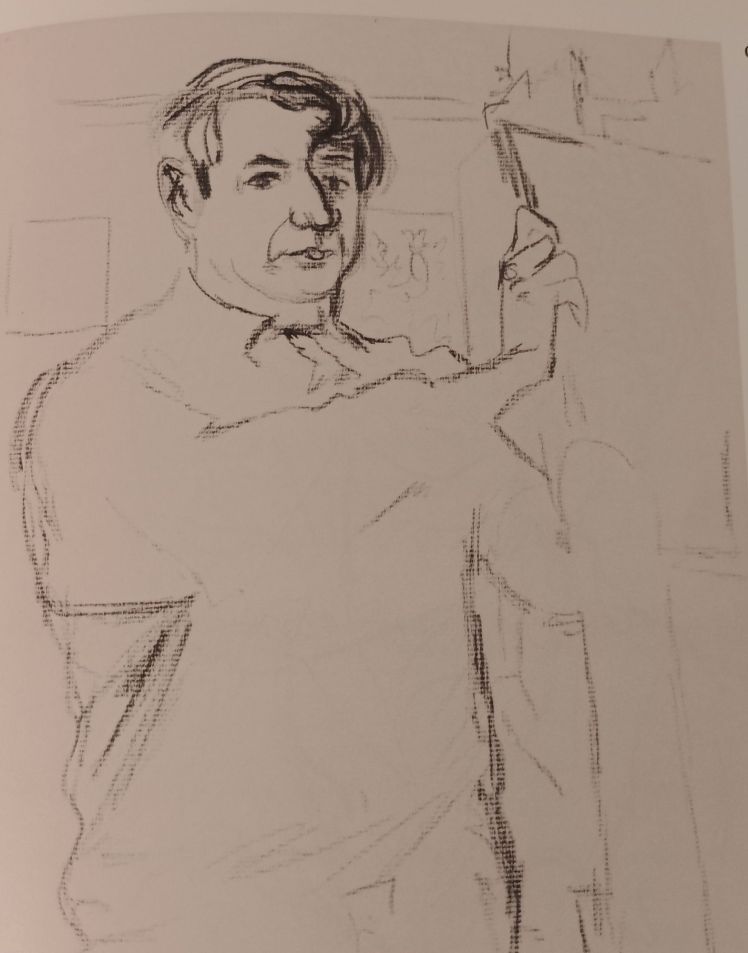
Ceri Richards Untitled XI 1942
Ceri Richards gives absolutely nothing away about himself in his self-portrait. The blankness of space is almost a retreat from embodiment. However, his two young men are deeply complex, both in the motion of their hands and limns and the bottle so closely grasped, and perhaps firing their interaction, whatever that might be.
If I had guessed Ithell Colqhoun as the painter of Scylla (but I do not think I would have) which is a picture of two rocks not unlike fleshy and gnarled fingers overhanging the prow of a punt or rowed boat underneath them, it would be because of the treatment of her hair in her self-portrait. I can say no more.


Ithell Colquhoun Scylla
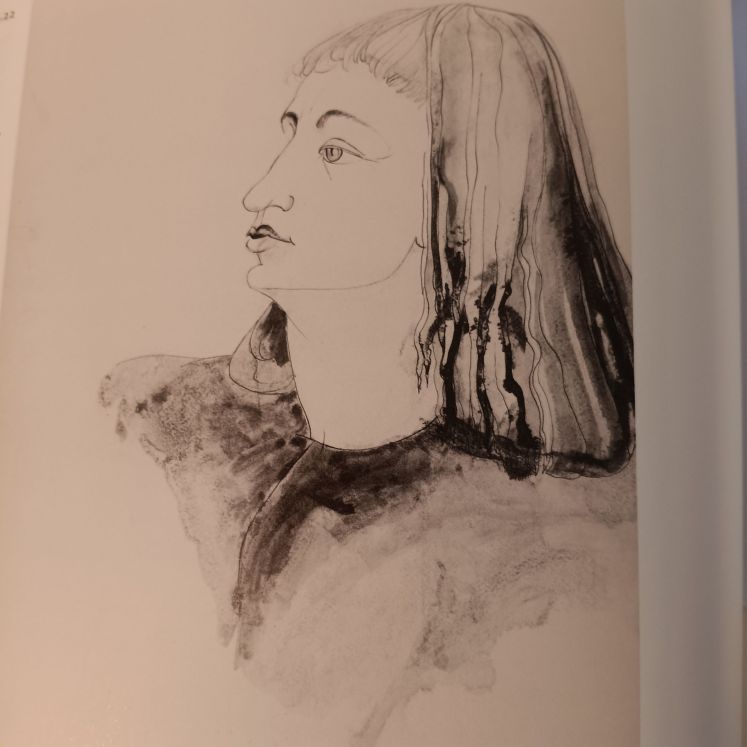
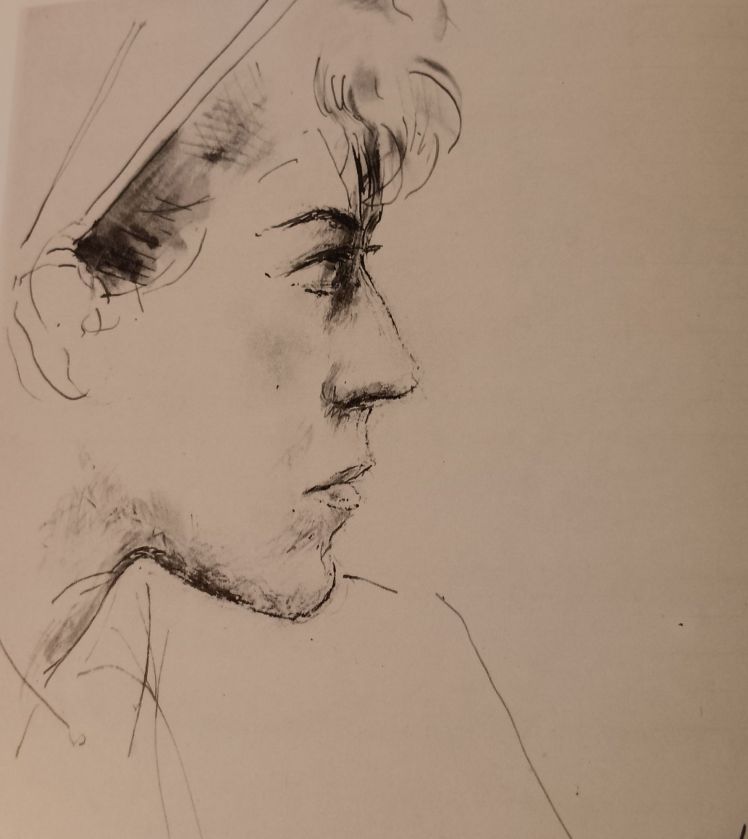
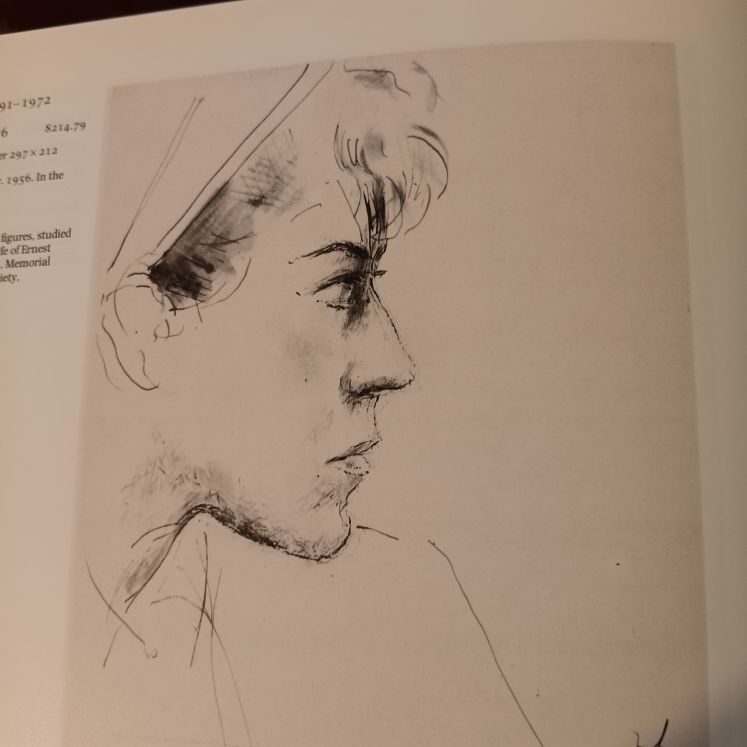
Of Dod Proctor though, the self-portrait of her gives not a clue to her most famous painting (but then as with John Minton to come, I avoided giving their figurative paintings of which they did much more because in each case they would have been a giveaway , For Dod Proctor was as much characterised by her subtlety in capturing female form as Minton young male form – too easy for both to be guessed I thought. But I might have noticed how proctor focuses on her own eyes with intense shading and hatching effects.
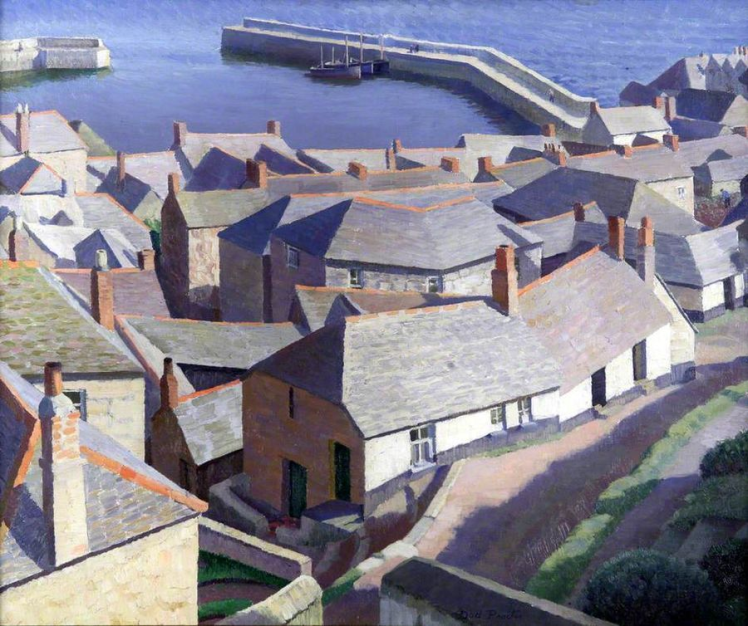
Dod Proctor Early Morning in Newlyn
The point is that Proctor in both captures a temporal state stylistically that is characteristic of mood and intent. In both there is fresh eagerness to rid oneself of the necessary shadows of an early start, which makes Newlyn seem to glare and stare at you as much as she stares and glares at her subject. And, after all, what a painter!
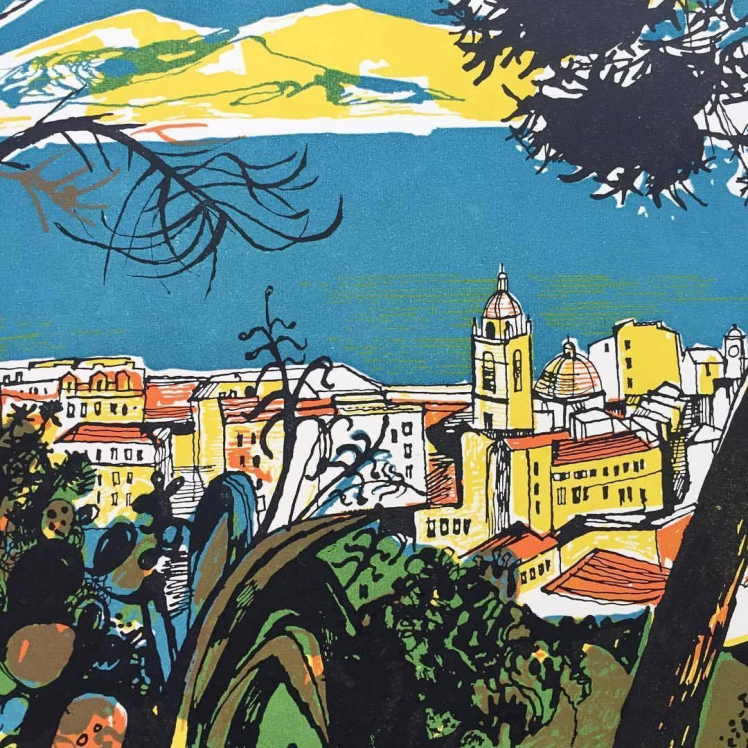
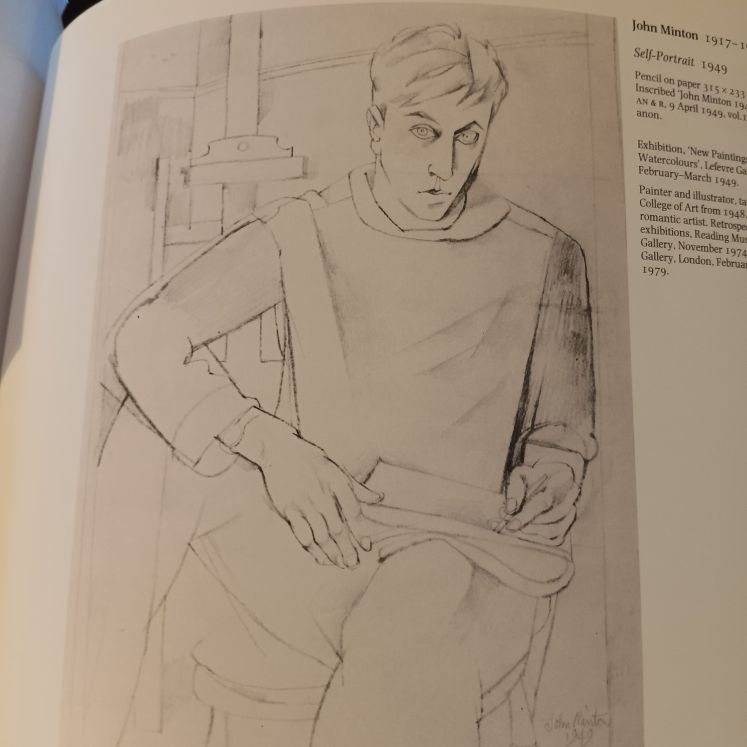
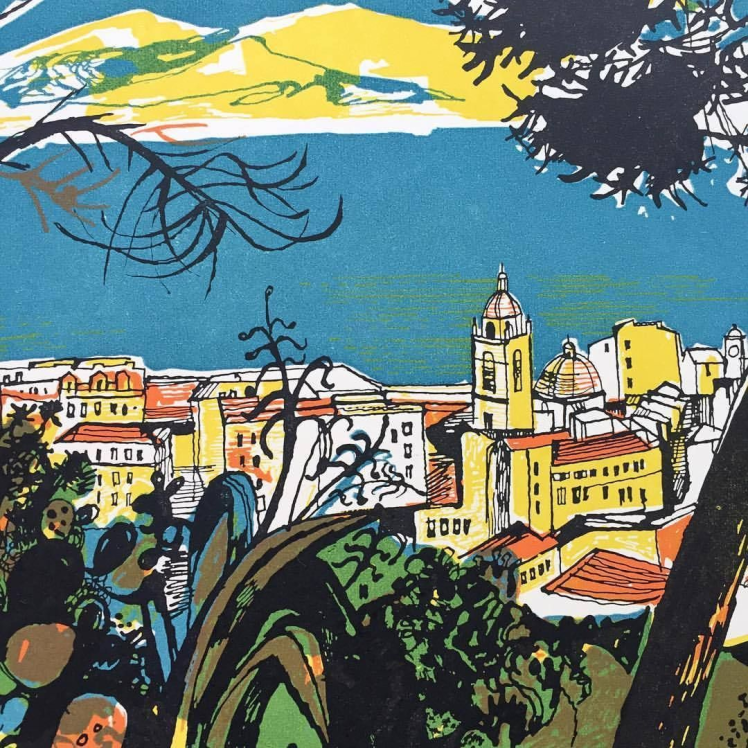
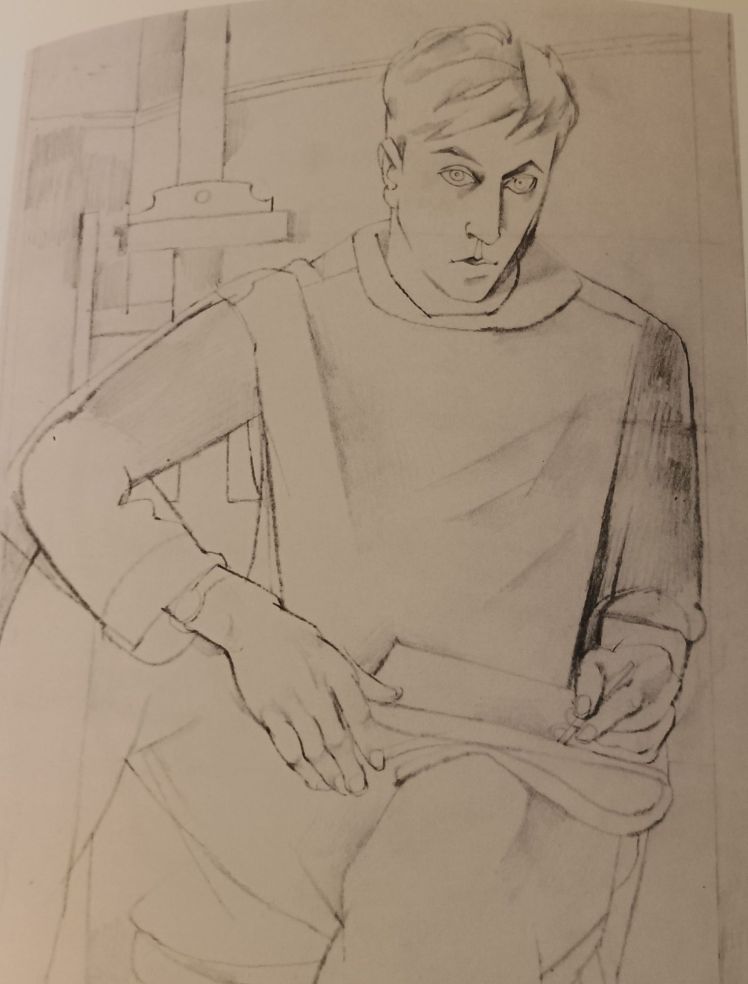
Of Minton, the View of Ajaccio, an illustration for his Corsican travel book, seems very different from the tentative line drawing of his self-portrait, except that there is the same recessive placing of the image of the painter – though mainly as an en-shadowed viewer in the Corsican towns-cape – that gives prominence to something hidden within the beauty of what we see. His style always masks what it also shows.
John Minton View of Ajaccio
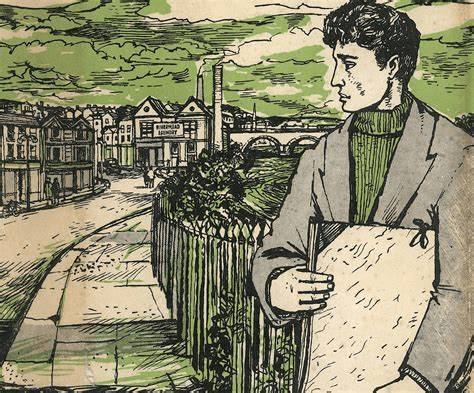
However, let’s face it I would not have guessed Minton from this, as I might, even if I did not know the novel, novelist and painter, of his dust-cover illustration for an Ernest Jones novel A Short Lease, not least because he uses himself for the model of Frost’s earnest young painter (see my blog on it here at the link).
So here is how I filled in my own pro-forma (I once made a vow never to set an exercise I did not do myself – adequately or not). But I promise – no more pretend quizzes from me. However, desperate I am for a blog subject. LOL.
| Self-Portrait Letter. | Artwork No that Matches (Roman Numerals) | Knowledge of Artist as: | Other comments. What commonalities of style are there? |
| A | [V] Untitled XI | Ceri Richards | Ceri Richards uses lines even to make up the denser places of shadow in his pictures – and conversely blank space (as does Hepworth) to indicate sheer light and transparency. We see the pictures here as alike because their psychological take on their subject is so different. each however uses the line, often vigorously repeated when needed for areas of material or psychological density and complication. Ceri Richards gives absolutely nothing away about himself in his self-portrait. The blankness of space is almost a retreat from embodiment. However, his two young men are deeply complex, both in the motion of their hands and limbs and the bottle so closely grasped, and perhaps firing their interaction, whatever that might be. |
| B | [X] Early Morning in Newlyn | Dod Proctor | Of Dod Proctor though, the self-portrait of her gives not a clue to her most famous painting Early Morning in Newlyn (but then as with John Minton to come, I avoided giving their figurative paintings of which they did much more because in each case they would have been a giveaway). Dod Proctor was as much characterised by her subtlety in capturing female form as Minton young male form – too easy for both to be guessed I thought. But I might have noticed how proctor focuses on her own eyes with intense shading and hatching effects. The point is that Proctor in both captures a temporal state stylistically that is characteristic of mood and intent. In both there is fresh eagerness to rid oneself of the necessary shadows of an early start, which makes Newlyn seem to glare and stare at you as much as she stares and glares at her subject. And, after all, what a painter! |
| C | [VII] Dark Seated Figure | Keith Vaughan | I think I would have been surer of guessing the pairing above than any other. I know the next painter very well but the pairing here would be less sure. The style of the self-portrait shows a good-looking young man though the style is conservative. Nevertheless, I even dare think him a greater painter of the queer than his younger queer contemporary David Hockney in his mature figurative experimental art. Vaughan was well past his own Neo-Romanticism when he painted the near abstract masterpiece Dark Seated Figure. Nothing in his self-portrait predicts those figures in this painting, where isolation and inner or penumbral darknesses (blues, greens, greys and shades of layered black) of different tones that suggest both secret companies of men in equal isolation. where in the self-portrait is that taste for off-straight lines and patches, the blend of the psychologically introjected and projected. The self-portrait is of a nice young man without the nuances of this secret man’s being or social knowledge at all suggested. |
| D | [III] (from) Legal London | Felix Topolski | I may have confused in my answers did I not know Felix Topolski’s work well his spidery detail with that of Searle, but it is not alike at all, and again I think this pairing guessable, not least in the facial similarity of his Jewish London lawyer in his chambers to his own. It is in the styling of facial features that we see commonalities – particularly of the anatomical connection of nose and forehead, raised in a look of query at the viewer – whether clients or viewers of art. The variegation of the light intensity and shade of lines used is similar in both if more pronounced in the Legal London scenario, where the use of grey daubs seems to emphasise different layers of reality. Outside the chambers is a tree (London plane tree no doubt) that is just a squiggle of lines and seems to come to the picture plane of the scene rather than stay in the recessive space behind the window. The real give-away is the quality of the marks employed in each picture is so varied, giving both incredible psychological depth |
| E | [IX] Second Eden | Roland Searle | Likewise, in Searle, there is the same hint of commonality between works that has more to do with the survival of Neo-Romanticism than merely style. The lithograph, The Second Eden, shows art complicit in the construction on the facia of Searle’s printed page of a Piranesi-like imaginative structure, comprising and demonstrating as decoration many architectural styles (including that of a cobweb) but declaring its own inner harmony with a sweet nature, littered with images of the psyche – the butterfly. The self-portrait has a similar whimsy of style, based upon a background comprising some kind of classical-cum-baroque capriccio. |
| F | [II] The Three Balls | William Roberts | I thought the pairing of The Three Balls with Roberts self-portrait would probably be easier to make than some others. The same solidity and density of the figures applies, as well as a kind of deliberate artifice of solidity, that makes us wary of the kind of human its portrayed. Roberts’ eyes stare too glassily, and there is a dissociation between the statuesque monumentalism of the figures and their supposed activity. In the scene outside the pawn shop, there is something brutal and dangerous going on, involving a baby whose facial features seem those of a 100-year-old person. But these things that unite the two works could equally be related to the vision of humanity and belief in the loss of social and/or aesthetic order implicit in the various visions Roberts was aligned to: he chose to call himself a Cubist, though where fo we see hints of Braque here, and, if of Picasso, only of his classical era monumental beach women. These works remind you of Futurism and Vorticism, much more ideological movements in art. Here, style is only an aspect of the commonalities in the works. |
| G | [IV] View of Ajaccio | John Minton | Of Minton, the View of Ajaccio, an illustration for his Corsican travel book, seems very different from the tentative line drawing of his self-portrait, except that there is the same recessive placing of the image of the painter – though mainly as an en-shadowed viewer in the Corsican towns-cape – that gives prominence to something hidden within the beauty of what we see. His style always masks what it also shows. |
| H | [I] Beginning of a Far-Off World | Alan Davie | There are Alan Davie pictures that would be easier to compare with the self-portrait. In this painting the eye is continually emphasising a kind of symmetry in the design, because the central, and centrally-spaced iconography and especially that of the chessboard. The figure of Davie has the feel of a likeness but that likeness rather seems to emerge from the marks on the paper and get very disordered at its edges. However his right eye has some of the magic of the labyrinthine symbol in the painting, And the privacy of the symbolism in the painting also rhymes with the sense that Davie draws a seer seen through manipulations of the process of seeing. I suppose I chose the painting though foe the fact that it is underlain by (bounded though they be) patches of random markings rather like the extremities of Davie’s face become – his wispy hair and beard – the latter seeming to end in an arcane symbol. but had I not known the painter I do not think I would have guessed the pairing. |
| I | [VIII] Scylla | Ithell Colquhoun | If I had guessed Ithell Colqhoun as the painter of Scylla (but I do not think I would have) which is a picture of two rocks not unlike fleshy and gnarled fingers overhanging the prow of a punt or rowed boat underneath them, it would be because of the treatment of her hair in her self-portrait. I can say no more. |
| J | [VI] Winter Solstice at Itdibs | Barbara Hepworth | Hepworth’s idealistic iconography certainly extended to her self-portrait. The use of blank space on paper characterises the treatment of her massive forehead, full of space which her abstract figuration also has, wherein colour tones and shades and deepens that interior space. In self-reflection, that space is cognitive and reflects those huge shaping hands. The connection of cognition to making is a Hepworth trait and the solstic she draws is intellectual as well as emotional. Here use of layering in the art (of colour space and blank paper – nothing looks just like a ‘surface’ here is matched by the toning and shading on the portrait. |
Bye for now
Love Steven xxxxxxx
 Steve_Bamlett_blog