


‘When Paul and Peter wake up in the same bed, and recognize that they have been asleep, each one of them mentally reaches back and makes connection with but one of the two streams of thought which were broken by the sleeping hours’. [1] My first thought is: “that explanatory parables open up a can of worms”.

Above is the opening sentence of a paragraph in an explanation from 1892 by the American psychologist William James in Chapter IX of his Principles of Psychology. It is a story, the aim of which is to attempt to explain and illustrate (in a story about two possibly fictional men, Paul and Peter) that thought is ‘continuous in the mind’ and in the form of a ‘stream of consciousness’. Yet never as a explanatory story open up such a can of worms – for the first thought I have is why were these two men in the staid conditions of bourgeois North America in bed together (in the ‘same bed’ as James emphasises) in the first place. Yet the purpose of both Paul and Peter is entirely to illustrate that their backstories are irrelevant, except as in as much as an illustration that each has their own separate backstory flowing like a stream of associated and brooking no interruptions or diversions. Never does Paul find himself in Peter’s steam of consciousness.. Moreover, for Peter’s point of view, an image of Paul will most certainly be in Peter’s stream of consciousness somewhere as an object floating down it in its flow it or attempting, without success, to disrupt it unsuccessfully, as some inconvenient stones do in some rivers, that image will not have a consciousness that has independent agency from the agency of Peter.
Yet along the long when both men wake up and take in their location would their first thought be: ‘Why am I in bed with Paul’ or ‘Why am I in bed in Peter’?’ respectively. The answers are denied us. Are Paul and Peter brothers? After all, brothers often sleep in the same bed – although with William James’ brother, Henry,James, that might have been a queer event (in every association of the word ‘queer’). And given that sharing of beds occurred before our own age without anyone thinking that the men must be therefore capable of having mutual , or even non-mutual, sex, it still seems strange that William James story of explanation of a principle consciousness should start ‘in media res‘ with the two men in bed with each other without prior explanation of posterior consequence being even imagined necessary.
Here is the context in James:

Within each personal consciousness, thought is sensibly continuous. I can only define ‘continuous’ as that which is without breach, crack, or division. The only breaches that can well be conceived to occur within the limits of a single mind would either be interruptions, time-gaps during which the consciousness went out; or they would be breaks in the content of the thought, so abrupt that what followed had no connection whatever with what went before. The proposition that consciousness feels continuous, means two things:
a. That even where there is a time-gap the consciousness after it feels as if it belonged together with the consciousness before it, as another part of the same self;
b. That the changes from one moment to another in the quality of the consciousness are never absolutely abrupt.
The case of the time-gaps, as the simplest, shall be taken first.
a. When Paul and Peter wake up in the same bed, and recognize that they have been asleep, each one of them mentally reaches back and makes connection with but one of the two streams of thought which were broken by the sleeping hours. As the current of an electrode buried in the ground unerringly finds its way to its own similarly buried mate, across no matter how much intervening earth; so Peter’s present instantly finds out Peter’s past, and never by mistake knits itself on to that of Paul. Paul’s thought in turn is as little liable to go astray. The past thought of Peter is appropriated by the present Peter alone. He may have a knowledge, and a correct one too, of what Paul’s last drowsy states of mind were as he sank into sleep, but it is an entirely different sort of knowledge from that which he has of his own last states. He remembers his own states, whilst he only conceives Paul’s. Remembrance is like direct feeling; its object is suffused with a warmth and intimacy to which no object of mere conception ever attains. This quality of warmth and intimacy and immediacy is what Peter’s present thought also possesses for itself. So sure as this present is me, is mine, it says, so sure is anything else that comes with the same warmth and intimacy and immediacy, me and mine. What the qualities called warmth and intimacy may in themselves be will have to be matter for future consideration. But whatever past states appear with those qualities must be admitted to receive the greeting of the present mental state, to be owned by it, and accepted as belonging together with it in a common self. This community of self is what the time-gap cannot break in twain, and is why a present thought, although not ignorant of the time-gap, can still regard itself as continuous with certain chosen portions of the past.
Consciousness, then, does not appear to itself chopped up in bits. Such words as ‘chain’ or ‘train’ do not describe it fitly as it presents itself in the first instance. It is nothing jointed; it flows. A ‘river’ or a ‘stream’ are the metaphors by which it is most naturally described. In talking of it hereafter, let us call it the stream of thought, of consciousness, or of subjective life.
b. But now there appears, even within the limits of the same self, and between thoughts all of which alike have this same sense of belonging together, a kind of jointing and separateness among the parts, of which this statement seems to take no account. I refer to the breaks that are produced by sudden contrasts in the quality of the successive segments of the stream of thought. If the words ‘chain’ and ‘train’ had no natural fitness in them, how came such words to be used at all? Does not a loud explosion rend the consciousness upon which it abruptly breaks, in twain? No; for even into our awareness of the thunder the awareness of the previous silence creeps and continues; for what we hear when the thunder crashes is not thunder pure, but thunder-breaking-upon-silence-and-contrasting-with-it. Our feeling of the same objective thunder, coming in this way, is quite different from what it would be were the thunder a continuation of previous thunder. The thunder itself we believe to abolish and exclude the silence; but the feeling of the thunder is also a feeling of the silence as just gone; and it would be difficult to find in the actual concrete consciousness or man a feeling so limited to the present as not to have an inkling of anything that went before.
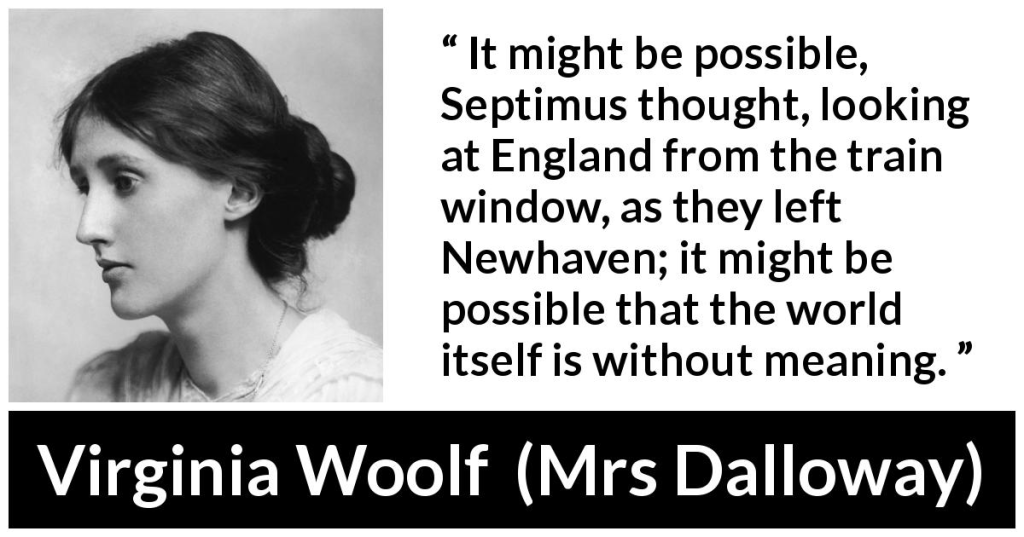
William James says enough – even in the different web version I quote above, which lacks the grace of the version used in George Miller’s edition – to show that detecting a ‘first thought’ in order to jot it down was a difficult thing – for thoughts are not he suggests jointed as in a chain but associated in their inseparable flow between each other. It was this that made the term so influential for modernist novelists attempting to show thought from the point of view of a single character – be it in Henry James himself (honouring his brother’s brilliance with much more satisfying illustrative parables like Isobel Archer in The Portrait of A Lady or the child Maisie in What Maisie Knew) or Septimus, the War Veteran in Virginia Woolf’s Mrs Dalloway or Bloom in James Joyce’s Ulysses.
So I refrain from giving you my first thought, even that I had finding myself through the flow of consciousness between sleeping and waking states when this morning, I found myself in bed with my husband Geoff (our partnership now of over 40 years). But read James again and find there a thought to stay us: the thought that binds us into our own confined consciousness:
The past thought of Peter is appropriated by the present Peter alone. He may have a knowledge, and a correct one too, of what Paul’s last drowsy states of mind were as he sank into sleep, but it is an entirely different sort of knowledge from that which he has of his own last states. He remembers his own states, whilst he only conceives Paul’s. Remembrance is like direct feeling; its object is suffused with a warmth and intimacy to which no object of mere conception ever attains.
It is similar to the tragedy in a lyric of Tennyson’s (Lyric XLV of In Memoriam) rarely though to be tragic – where the word ‘defined’ is rightly rhymed (conceptually not literally) with ‘confined’: the prison of our consciousness:

XLV
The baby new to earth and sky,
        What time his tender palm is prest
        Against the circle of the breast,
Has never thought that „this is I:”

But as he grows he gathers much,
        And learns the use of „I” and „me,”
        And finds „I am not what I see,
And other than the things I touch.”

So rounds he to a separate mind
        From whence clear memory may begin,
        As thro’ the frame that binds him in
His isolation grows defined.

This use may lie in blood and breath,
        Which else were fruitless of their due,
        Had man to learn himself anew
Beyond the second birth of Death.
What if Peter and Paul had woken in the same bed and found themselves lowing not separately but into andd through each other. Now that would be an ‘awfully big adventure’, as Peter Pan described Death.
With Love
Steven
________________________________________________
[1] William James (ed. George A. Miller 183: 232) The Principles of Psychology Cambridge, Mass. & London, Harvard University Press . Thw passage is available in a version at: https://psychclassics.yorku.ca/James/jimmy11.htm
 Steve_Bamlett_blog