


The phrase ‘walk a mile in another person’s’s shoes is usually interpreted as a call to empathy – an admonition asking you to feel pinching you as they do them, ”the experiences, challenges, thought processes’ of the person’ before you judge them. White cultures often appropriate the wisdom of other cultures but there is no real evidence that this phrase was originally Native American and spoke of ‘moccasins’ rather than shoes. The original appropriation though (if it be that – who knows) was by a minor American poet in a sentiment set of verses called Judge Softly from 1895 by a Mary Lathrap. The whole poem is quoted in this James Milsom’s charming blog, which he calls ‘heartfelt’. Yet to me it seems obtuse to sermonize to your white neighbour for their stereotyping, and sneering to accompany it, of the Native Americans for being exactly as white oppression alone created the conditions for them becoming (at least in the eyes of the oppressor convinced that they are inferior as a ‘race’). Lathrap does not challenge the notion that the stumbling person (the judgmental see only the symptoms of intoxication) is ‘fallen’ by pointing out that to fall they had to be violently pushed
“Judge Softly”
“Pray, don’t find fault with the man that limps,
Or stumbles along the road.
Unless you have worn the moccasins he wears,
Or stumbled beneath the same load.

There may be tears in his soles that hurt
Though hidden away from view.
The burden he bears placed on your back
May cause you to stumble and fall, too.

Don’t sneer at the man who is down today
Unless you have felt the same blow
That caused his fall or felt the shame
That only the fallen know.

You may be strong, but still the blows
That were his, unknown to you in the same way,
May cause you to stagger and fall, too.

Don’t be too harsh with the man that sins.
Or pelt him with words, or stone, or disdain.
Unless you are sure you have no sins of your own,
And it’s only wisdom and love that your heart contains.

For you know if the tempter’s voice
Should whisper as soft to you,
As it did to him when he went astray,
It might cause you to falter, too.

Just walk a mile in his moccasins
Before you abuse, criticize and accuse.
If just for one hour, you could find a way
To see through his eyes, instead of your own muse.

I believe you’d be surprised to see
That you’ve been blind and narrow-minded, even unkind.
There are people on reservations and in the ghettos
Who have so little hope, and too much worry on their minds.

Brother, there but for the grace of God go you and I.
Just for a moment, slip into his mind and traditions
And see the world through his spirit and eyes
Before you cast a stone or falsely judge his conditions.

Remember to walk a mile in his moccasins
And remember the lessons of humanity taught to you by your elders.
We will be known forever by the tracks we leave
In other people’s lives, our kindnesses and generosity.

Take the time to walk a mile in his moccasins.”

~ by Mary T. Lathrap, 1895
:Empathy is fine. Lathrap may look to the ‘people on reservations and in the ghettos’ but does not see the cause of the ghettoisation and the ghetto’s residents ‘little hope, and too much worry on their minds’ as a result of white actions but uses them as a lesson and caveat for the white to avoid personal sin, while they carry on their lives unchanged, for ‘Brother, there but for the grace of God go you and I’.
There is a need for empathy and compassion of course, but one that does not lead to change of assumptions about the life we ourselves continue living thoughtlessly and action to change the inequalities it is built upon is of little worth.Imagining walking in someone’s else’s shoes (and even worse their ‘moccasins’) is a kind of version of being ‘blind and narrow-minded, even unkind’ too if it fails to look beyond the effect of individual ‘burden’ to socio-political causation. Lathrap still leaves too much room for the smugness of the bourgeois faithful.
But the problem with this common phrase is that it is a kind of lie. Lathrap uses the lines, ‘There may be tears in his soles that hurt / Though hidden away from view’, to exploit the homophone soles / souls, despite the unexpected plural that derives. A man with a ‘tear in his soul’ is the picture after all she wants to paint, in order to generalise the whole poem around the right-thinking of the Christian religious.
However, the equation of shoes with a deeper life of he desires, needs and wants – even if one of imagined physical and material rather than spiritual fulfillment runs deep in capitalist culture. The variations of this can be fantastical and nuanced as in the film and musical Kinky Boots, where footwear attached to desire and its planned commodification open up new means to the possibilities of where some favourite shoes might have ‘taken you’.

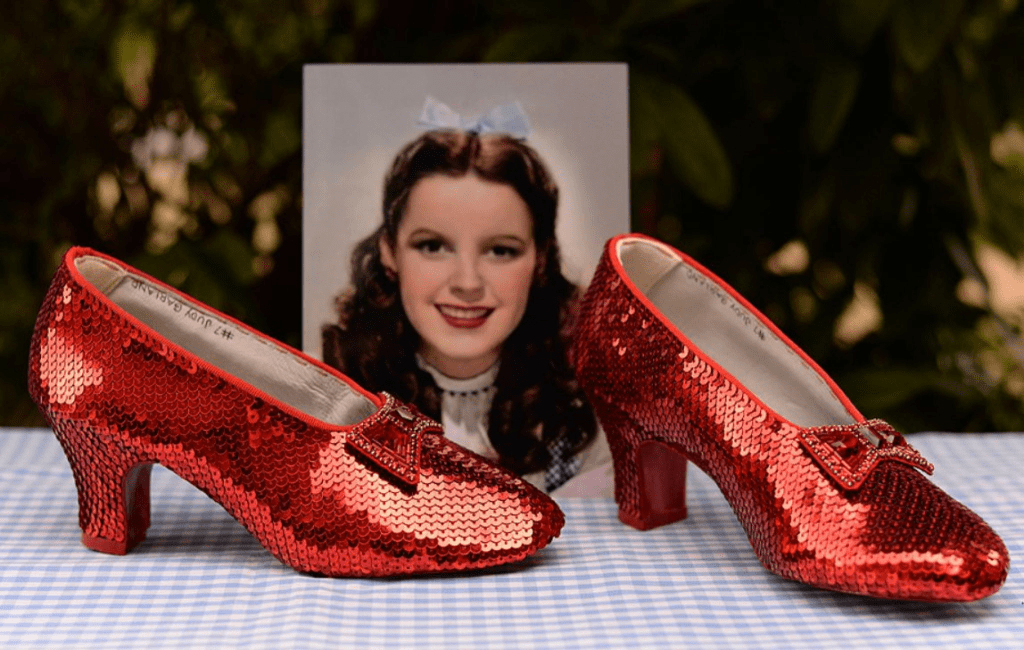
And think of the assumption in a question that asks where shoes have ‘taken you’, as if the shoes had the agency of travel rather than the person wearing them. It is a fantasy also in the 1948 acclaimed fantasy film The Red Shoes by Powell and Pressburger that, in its turn feds of Hans Andersen. And of course we think of Andersen’s second life in the Silver Shoes worn by Dorothy in the Frank L. Baum children’s classic The Wizard of Oz which MGM turned into ‘ruby slippers’ , which transport you (and not just in imagination – at least WITHIN the fiction) at a click of the heels.
Shoe shops are not a kind of non-binary access to the vision of transport. Imelda Marcos, the wife of a tyrant and one in her own right had three thousand pairs (the number often quoted) in which to re-imagine herself at each appearance. Below is the shoe locker found at the deposition of that corrupt ruling family in the Philippines:

Shoes fullfil dreams in many fictions but some are unpublished ones, oft the means by which needs get turned through active wanting to desires for the unattainable. The process of commodification helps here. Shoe advertisements play on desire for men and women that can be wishful, narcissistic or sexual .

Images from https://www.graphicmania.net/34-creative-advertisements-of-shoe-brands-its-amazing/
Shoe and sock fetishism often exploits the fascination with the transformation of feet into an image of desire but it is no as niche a phenomenon as many think. But at the base of the desirous image is the other trip down, rather than up he ladder of NEED – WANT – DESIRE. In the days of the Beveridge Report the plight of children in poverty was often symbolised in the real phenomenon of children without shoes. Lack of shoes is still an indicatyor of child poverty globally and again in the UK, as telling as malnutrition statistics.

Mary Lathrap could have looked at the same phenomenon in reservations if she had not been waylaid by the romantic image of the ‘moccasin’ as if it were a folk truth. And shoes that are recycled are not a sign of charity as we like to see it, or ecological foresightedness, but of the need of commodity capitalism to generate waste if the desire for the new and ‘innovative’ is to be carried on by the manufacture of desire.

As for me, I have only one pair of shoes at a time. This may reflect a total lack of care of appearance rather than principle but it does remind me that my shoes have taken me nowhere but to the places where it is necessary to wear some. Together, perhaps we walk miles but not in imaginative transports.
With love
Steven xxxxxxxxxxxxxxx
 Steve_Bamlett_blog