



Budgets are, you might think, something business corporations or Governments have. In both cases they balance real or expected (or predicted) income or revenue against real or expected (or predicted) expenditure in order to be able to plan to meet their goals whilst remaining fiscally in the balance, over at least an acceptable period of calculation. Budgets depend on confidence in your predictions in both cases, not only yours those who externally finance your shortfalls in income in the present and near-future in the the confident hope of a leap forward in the future. But expenditure and income are not the only outputs and inputs that people regulate by keeping some kind of budget, if only a notional one. Images of spending and earning regulate our mental and emotional lives it would seem if you look at the words people use to describe the use of them by themselves or other people. Some people give or spend to much time / emotional energy / thought in helping others to engage, we often say. But the energy may not be altruistically spent, we warn people not to spend too much on these things on the future, even when it is their own future on which energy and other things are spent.
We ask people to save some thought and energy for themselves, to live in the present on what they know what they have not what they plan to have. Even theoretical psychologists have got in on the act from early in the discipline. According to some psychologists human brains are wired not to expend overmuch energy on thought and to rely on shortcuts, even unreliable ones, when good ones don;’t exist or aren’t known. We call this cognitive miserliness:
The term cognitive miser was first introduced by Susan Fiske and Shelley Taylor in 1984. It is an important concept in social cognition theory and has been influential in other social sciences such as economics and political science.
People are limited in their capacity to process information, so they take shortcuts whenever they can.[1]
We may all be both cognitive and emotional misers but we do not like the trait, considering it an extreme that bears no relation to us. Dickens often made his most unsympathetic characters misers, although he also as often made the Jews. Those he liked had a generous disposition – he tried to put his record right on antisemitism by inventing a generous old Jewish man, Mr Riah, in Our Mutual Friend, who only looked like a miser but was not. Profligate and spendthrift men he criticised and even let them fall into evil momently, like Mr Wilkins Micawber in David Copperfield but these men were definitely not misers. For instance, though some people use one Micawber line to illustrate what good budgeting is, they are wrong to think that it shows him as a man of forethought for the future. Look at his definition of a budget:
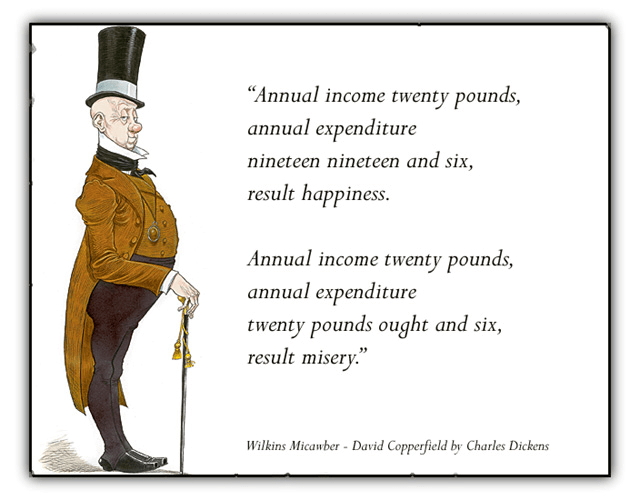
In the What differentiates ‘happiness’ and ‘misery’ is only a shilling. Now sixpence was a good sum in the 1850s but the whole meaning of the Micawber budget is that happiness and misery are about shaving as near as possible to a balance of income and expenditure on the positive side. This is not then the projective budget of a capitalist entrepreneur ready to face The Dragon’s Den on the BBC. In that show the aim is not for balance but of a trend of excess income over expenditure predictive of profit, as in the notional graphic below (i couldn’t easily found one that was in pounds sterling so bear with the dollars).
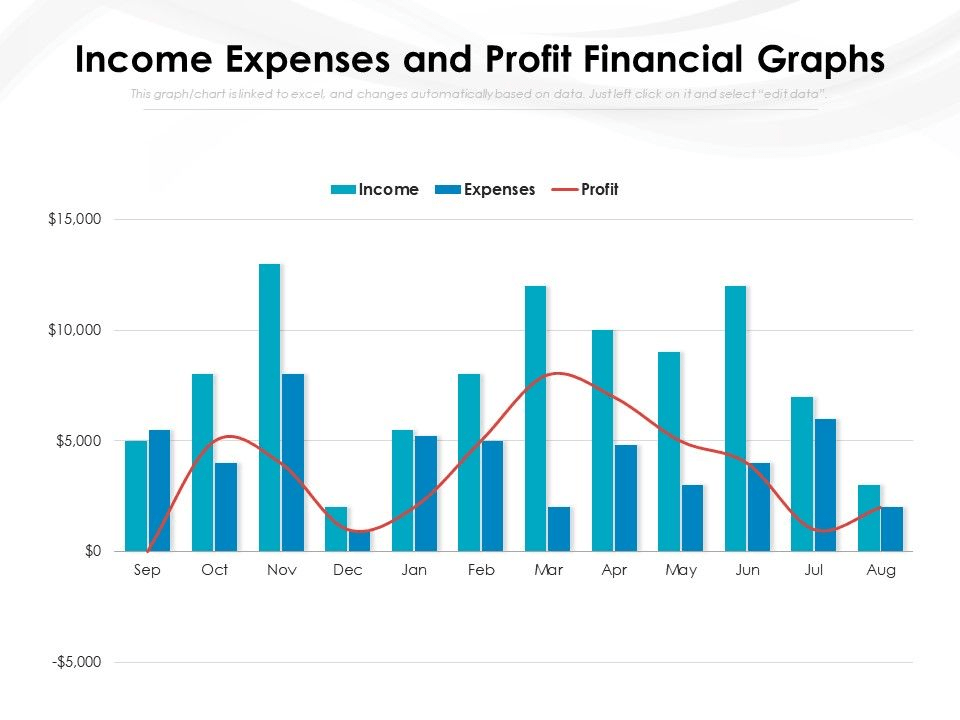
In that last model happiness occurs in summer when the expenditure are lower than income – most marvellously in March, hence the peak in profits. Now this kind of budgeting is no more miserliness than Wilkins Micawber’s , fot it can be used to make an accurate prediction of additional investment or capital expenditure. Micawber never does this – neither, thought Dickens, did his father on whom that character was in part modelled. the problem with Micawber is he did not budget for the future and indeed could only speak of budgeting for the present. When he thought of the future it was shaped not by reasonable expectations based on past and present evidence but on the ‘hope’ though he calls it confidence, that ‘something will turn up’.
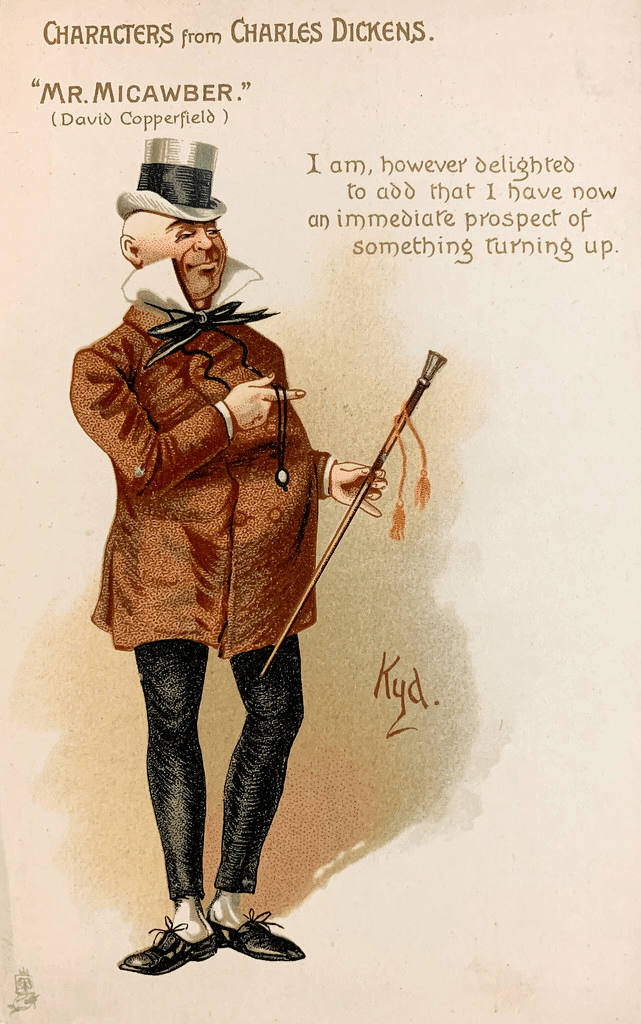
It is hardly a prospect to think of things turning up, but it is a fitting slogan for a man who will become the very literary type of the prospector in the colonies – merely digging and hoping for gold. This kind of optimism and confidence is now de rigueur and named so often ‘positive psychology’ because it makes you feel better without looking for evidence to support that confidence. And as a thinker feeler and actor in the world I think I may be more of this sort than that of Ebeneezer Scrooge – the cognitive miser par excellence leaning on utilitarian fairy tales: ‘Are there not prisons? Are there not workhouses?’ in which to consign people you do not want to think about. Micawber is loved for all the evil he temporarily gets involved in with Uriah Heep. A confident age even made him the iconic figure on a New Year’s Card, leading on the little children to a bright future . Nevertheless he is a rather ironic character to place on a New Years Card.

The future here is that on unspecific ‘certain expected events’, but look how the word ‘certain’ here is almost an oxymoron to ‘expected’, a play on words Dickens went further with in Great Expectations. We like the idea of Micawber ‘fallen back for a spring’. Most readers find an associative link to conventional thoughts about the season spring here, though in context, it is rather a spring’ a predatory jaguar might make upon a spring lamb. And Micawber is for a time a predator. Nevertheless, we welcome his restoration to good in the novel. His optimism however is still odious. Take the quotation below:
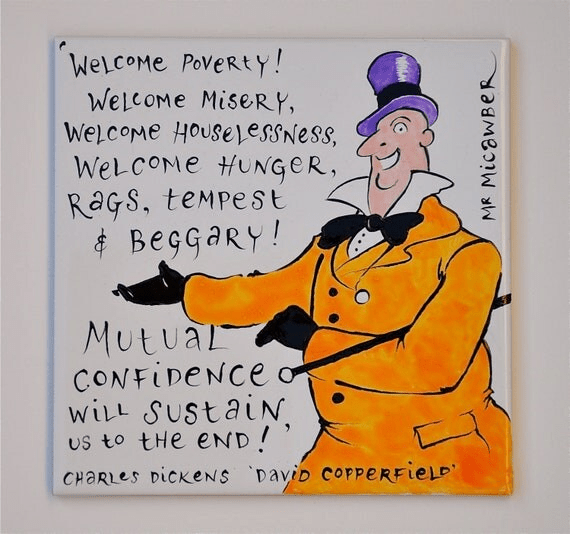
Micawber moves into a mode of thinking that was the meaning of speculative capitalism of his time, though the homelessness and hunger were usually welcomed for others rather than for oneself. But the last words here are important. ‘Mutual confidence’ is an important facet of employment law and of the ideal relationship of giverenments to the governed. It is based on a mutual optimism in the future – why, of course, Rachel Reeves attracted so much odium and not only from feral Conservatives for ‘talking the economy down’. Late capitalism was based on a confidence trick. just as vast fortunes are made by empty confidence in ‘deal-making’ (witness the great Wizard of Oz, Trump).The notion that not only individuals but groups of individuals (‘us’) can be ‘sustained’ by ‘mutual confidence’, was in a sense a discovery about capitalism in Keynes.It still based on a confidence trick and in a belief in the infinity of resources in the globe. It rules us right now.
I don’t think I will ever be a cognitive or affective miser, nor a keen confidence builder on the basis of budgeting my own resources. I may burn out soon! And perhaps Micawber does burn out – burned in a ball of global warming. In fact the word budget was born on the ambiguous cusp of optimism and pessimism. The word budget derives from the name of a pouch or wallet. The word was feminine in french though it could apply to masculine proportions. it is a word related to the word ‘bulge for instance. And men are great believers in the wishful bulges of their pouches. In that sens it was about a budget fit for ample needs (and thus expenditure). But the word was also associated with the much smaller purses carried by women, and sometimes used in slang of the ‘womb’. In those cases it could refer to something small to be spent with great care rather than Micawberish overkill. We have too long had the sense that our budget is bulging. Perhaps we need to return to those feminised meanings, even if so socially constructed, purses to imagine our beautiful natural resources of flora, fauna and minerals. We use to believe ‘Small is Beautiful’. We need to again.
______________________________________________________
[1] Cited in https://en.wikipedia.org/wiki/Cognitive_miser
[2] For the etymology see these two sources but especially the last: 2.1 https://www.etymonline.com/word/budget; and 2.2 https://wordhistories.net/2016/08/14/budget/
 Steve_Bamlett_blog