


There are good reasons for avoiding this question. I am 70, but though there is roughly a 21 year gap between my birth date and that of my parents, that gap matters so little now they are gone. At 70, they were though still doing line-dancing and facing the world in retirement. Yet, as I tried to think of this question I realise they also both died between two and four years from my present age – and that seems now to be the age gap I think about.
Nevertheless there is another effect of aging. Whilst parents can seem, in many ways and with different meanings possibly in each case, very much older than them in the younger child’s eye view, the meaning of that age gap too changes with time. Very often and in some circumstances it differs not at all, depending usually on the quality of communication and sharing of perceptions between the generations on each side of the supposed ‘gap’.
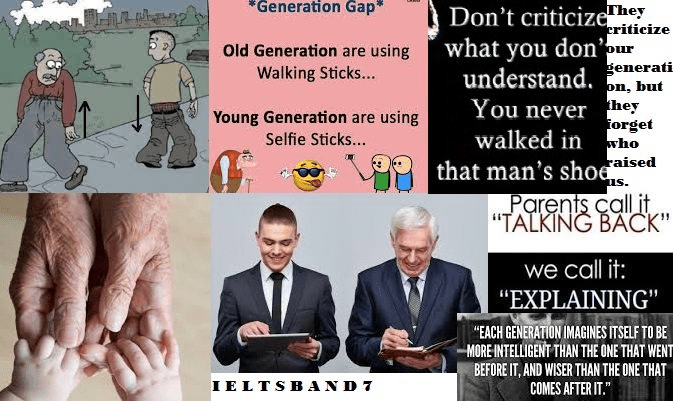
There is a clear importance in the circumstances of history – my Dad was too young to to be called up in The Second World War but he did do National Service, my mother was of a generation who leaving school at 14 went straight into plentiful jobs then in woolen mills. These circumstances changed massively during my years of growing up. But what matters too is the attitude to communication between the gap which heighten commonalities and reduces the meaning of differences, or turns them into analogies of the process of development, maturation and engagement with the world. When you are young differences in fashion can for some seem to matter (see the cartoon regarding the wearing of baggy trousers above which emphasises the cyclical nature of fashions) but they do not so much later (art least for me). I remember my husband and I being laughed at very theatrically on a London bus by young snappily dressed men for still wearing flared jeans when they were long a matter of the past.
In some ways however we recognise the ways in which parent-child relationship in very old documents better than we ought, for so many of them are about this, characterising in extremes the dynamism of the young for good and evil and the desire to either hold on to things as they always seemed or retreat in the old. Try out, perhaps, great works of literature with wide gaps of time between: Antigone and Elektra compared to King Lear, Hamlet and The Tempest for instance. A huge problem in all of these is the failure of each to hear the other side because the relationship is mediated by folk-knowledge that emphasises the appropriateness of gap as a matter of role and the reverence afforded to the role, with stereotypes of wisdom, respect and retirement and assumptions of competence based on age, all playing their part in hardening age difference in both directions. In all these plays the issue is one of the passage of succession – of the young displacing the old and how that should be done, especially so in the dual plots of Gloucester and King Lear. At the base the issue is dealing with mortality in the long run.

But at this I will let this rest. I like to keep up the daily blog count but I am not ready to write yet on Adrian Duncan’s brilliant new novel, which covers a generation gap in the same person in short form as a novel but with luxurious and slow moving depth.
For now then, that’s enough.
With love
Steven xxxxxxxxxxxxx
 Steve_Bamlett_blog