


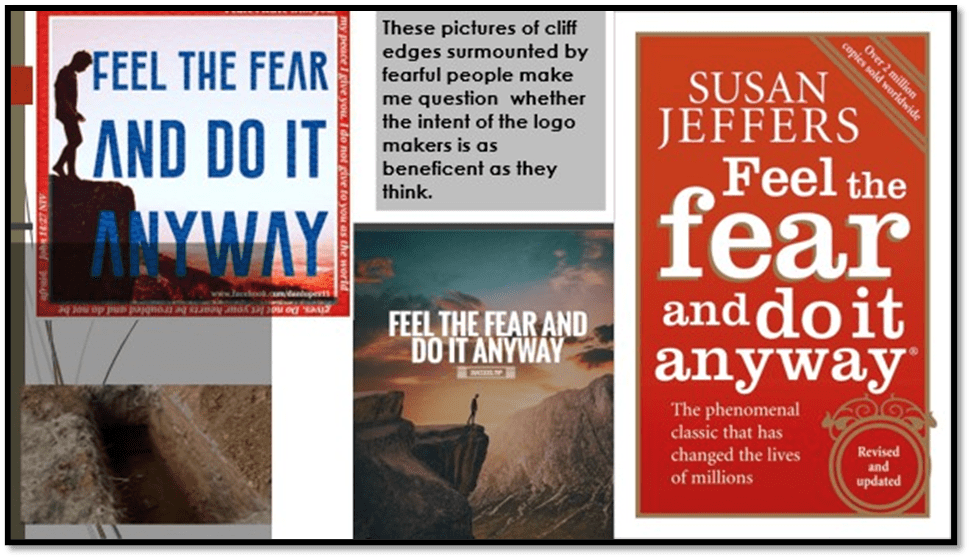
Susan Jeffers’s book, Feel The Fear And Do It Anyway: How to Turn Your Fear and Indecision into Confidence and Action, is by now a kind of holy text of popular psychology, used not only, as it was intended, at first at least, to address anxiety that locks people into extremely limited lives but to legitimate risk-taking beyond the necessity of risk assessment. In the worst cases, it is used to legitimate the absence of risk assessment or to insist that fear has no legitimate function in the organisation of the lives of animals, including human animals.
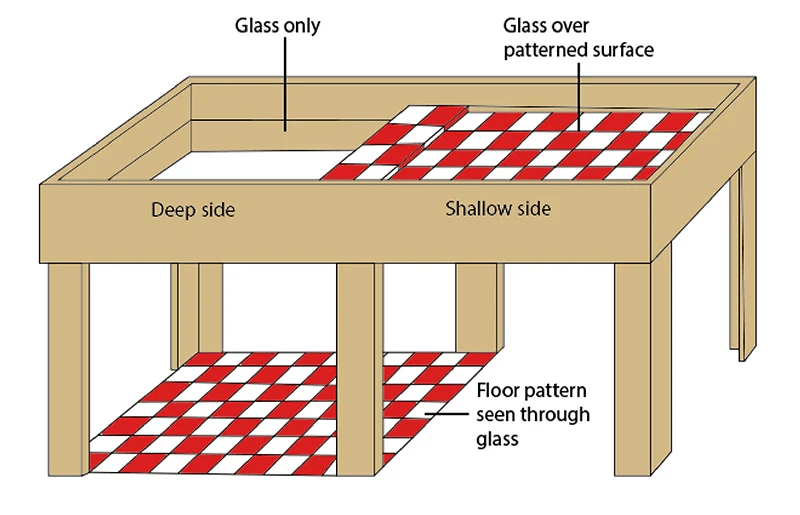
A lot of work has been done in animal psychology to query the hypothesis that certain fears are inherited genetically even across species. The visual cliff experiment by Gibson and Walk (1960) exposed crawling infants (or other young animals – for the young are thought not to have had the opportunity to acquire fear by learning – possibly erroneously) to an apparatus where there appeared to be a cliff face separating two grounds on which the baby could crawl. There was no cliff in fact for part of the continuous upper floor on which the animal stood was glass, as the graphic below the photograph below shows.
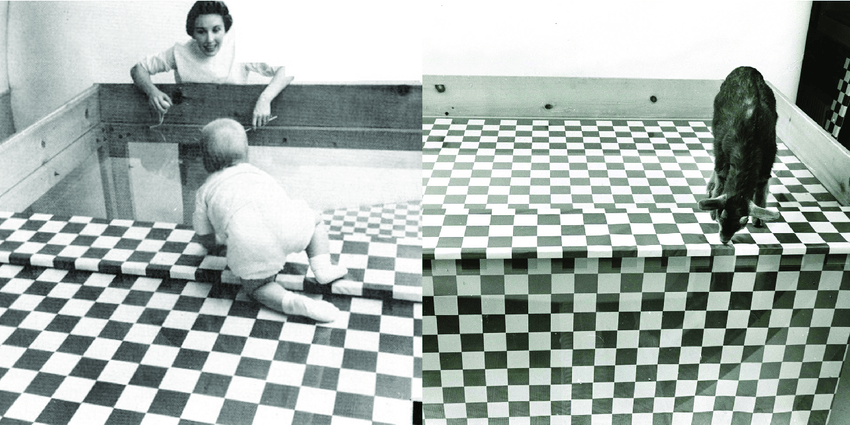
This mother is encouraging her child to crawl across the visual cliff. On the left of the collage, despite a physical surface covering the cliff, the child hesitates to move forward. On the right a young goat also demonstrates fear responses at the visual cliff. The ‘visual cliff’ is a perception experiment that can be used to demonstrate the inheritance of perceptual preferences. (Photos: William Vandivert (left); Nicholas and Dorothy Cummings Center for the History of Psychology at the University of Akron (right)) Available: https://www.researchgate.net/figure/The-visual-cliff-is-a-perception-experiment-that-can-be-used-to-demonstrate-the_fig1_368465273
Available at: https://ar.inspiredpencil.com/pictures-2023/visual-cliff-psychology
Whether or not this experiment really supports the notion that a fear of falling from heights is innate or learned is queried – enough of the argument is on the Wikipedia page on this experiment – but the issue remains that it may be advantageous to fear falling from a height. People who fail to commit suicide by falling from a height, like the Golden Gate Bridge in that marvellous film by Eric Steel The Bridge (2006), recall the fear that had to be defied and attested to the fact that that ‘they felt the fear and did it anyway’, as with the person on the right in the collage below.
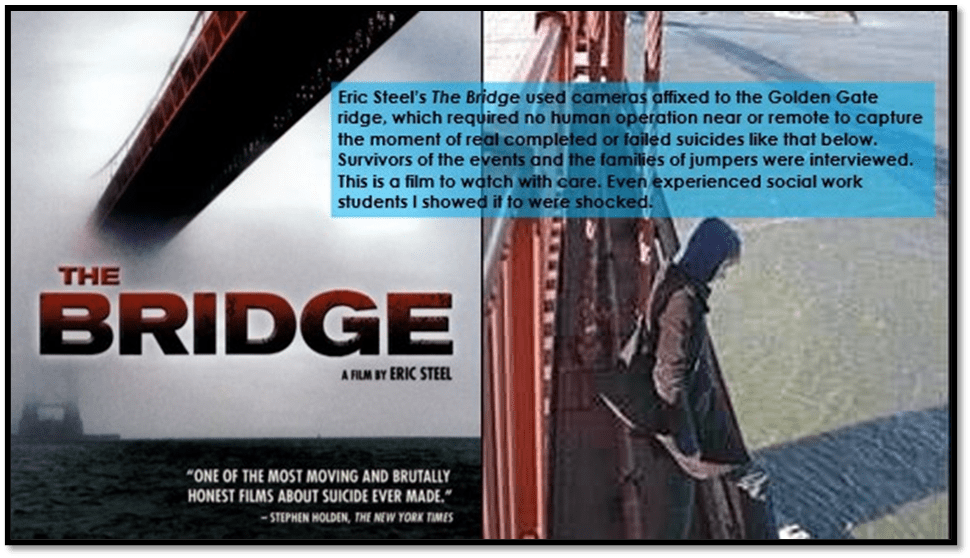
The issue is that fear communicates useful information even when irrational and counter to a fixed intention. I hesitate then to glibly use the words in a way not specifically matched to the circumstance. For instance in the young person about to leap the bridge I might persuade them, had I the opportunity, to feel their fear and validate its attempt to save their life and its re-evaluation. Doubtless the fear of jumping in this young person was less than the fear of the challenges with which continued living appeared to face them but even in that case, feeling the fear of a task that seems impossible and doing it anyway might be inappropriate. Lives are too complicated for such formulaic solutions, as Jeffers would be the first to admit – but the book nevertheless lives in the minds of others more in its bold titling than its textual contents and it has made Susan Jeffers extremely rich.
Some popular psychology slogans and logos become means of promoting positive psychology as a way of addressing a person with enormous mental challenges in order to engage them in self-help. “Just do it! Fear is okay, but let it follow the feared action, not precede it!” The circumstances where this is is appropriate are many – in rehabilitation after illness, in cases of anxiety where people have little life at all so compelling and obsessive are their fears – but even in these cases (for I have been such a ‘case’) the populat slogan falls short. The limitations of saying that only the fear of action inhibits one from the sction is reductive. Very rarely are there not other factors in disturbed lives that also need action – such as poverty, the experience of the effects of external stigma, bullying, prejudice and oppression, war, homelessness, past trauma and sometimes overwhelming multiple events that genuinely threaten the person suffering. Okay, a bully may be less so if we refuse to validate their power over us mentally – but action against them needs to be calibrated by risk assessment, a part of which a honest appraisal of the positive messages of fear play a part.
I can’t therefore answer the question. Let’s imagine, for instance, as with the unknowing participants in The Bridge (though survivors and families gave permission afterwards to use images from the place of suicide) the thing I am most scared to do is ‘take my own life’. The things that might get me to do it can be imagined but maybe should not be. They would defy imagination. In King Lear, the treachery of daughters, as Lear sees it, drives him to madness but this is set alongside, the case of Gloucester, who feels what he thinks is the treachery of sons. In Act 4 Scene 6 of the play, one true son, Edgar, in the guise of a poor man leads the blinded (by his son Edmund) Gloucester to what he tells him is a cliff-edge to commit suicide. It is, however, not a cliff-edge, and thus Edgar assesses that his elderly father’s fall to the even ground here is an acceptable risk even if in an elder with brittle bones:

Gloucester ....... Let go my hand.
Here, friend’s another purse: in it a jewel
Well worth a poor man’s taking: fairies and gods
Prosper it with thee! Go thou further off:
Bid me farewell, and let me hear thee going.
Edgar Now fare ye well, good sir.
Gloucester With all my heart.
Edgar Why I do trifle thus with his despair
Is done to cure it.
Gloucester O you mighty gods!
This world I do renounce, and in your sights
Shake patiently my great affliction off:
If I could bear it longer, and not fall
To quarrel with your great opposeless wills,
My snuff and loathe`d part of nature should
Burn itself out. If Edgar live, O, bless him!—
Now, fellow, fare thee well.
Edgar Gone, sir: farewell.—
And yet I know not how conceit may rob
The treasury of life, when life itself
Yields to the theft: had he been where he thought,
By this had thought been past. Alive or dead?—
Ho, you sir! Friend! Hear you, sir! Speak!—
Thus might he pass indeed: yet he revives.—
What are you, sir?
Gloucester Away, and let me die.
Edgar Hadst thou been aught but gossamer, feathers, air —
So many fathom down precipitating —
Thou’dst shivered like an egg: but thou dost breathe,
Hast heavy substance, bleed’st not, speak’st, art sound.
Ten masts at each make not the altitude
Which thou hast perpendicularly fell:
Thy life’s a miracle. Speak yet again.
Gloucester But have I fall’n or no?
Edgar From the dread summit of this chalky bourn.
Edgar insists that he forwards his father’s plan, having felt the fear of family abandonment, to ‘do it anyway’. But the aim is merely to show Gloucester that blind old men can be easily deceived, as he was by brother Edmund, even before the ‘vile jelly’ of his eyes was plucked out with a knife. The aim of Edgar is to use fictional stories – magical stories – to prove to Gloucester that his ‘life’s a miracle’, and that to breathe and have ‘sound’ limbs may well be a good start. He doesn’t do that by confronting the fear of the world or the fall directly, for he knows that the war against Edmund’s armies, which he leads for Albany and Cornwall by France must be won by the latter. Yet accidents in the progress to justice happen – Cordelia and the Fool are still hanged. Edgar works strategically to change not just the inner perception of Gloucester, which task ,after all, is done by deceit – however well intentioned – and joining the war with France to change the world that has fallen into evil. All of this is a temporary plan based on a risk assessment of what Gloucester can bear based on his current capacity to make decisions – its aim is to bring him to peace but it is careful and cautious, hedged with fear, not reckless abandon.
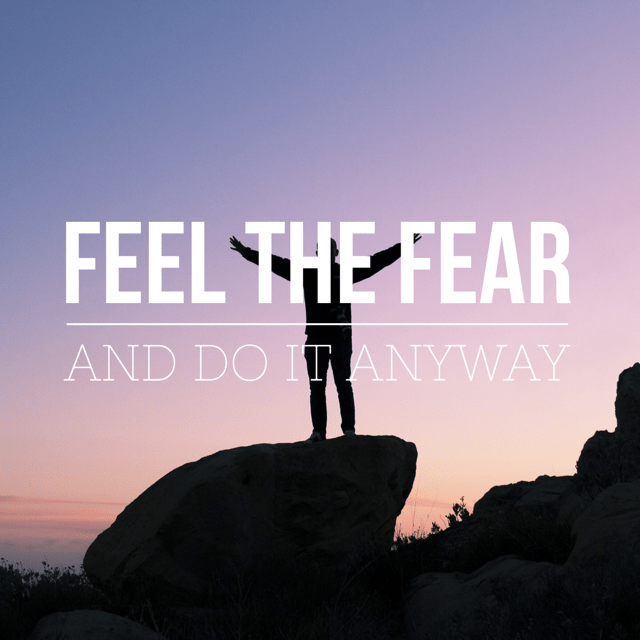
The threat and fear of suicide are often two sides of the same coin. I often blanch when I see happy memes about people leaping off cliff edges, for fun rather to kill themselves, being used with this logo, For under the seas into which they leap, there may be rocks. It might be worth investigating the knowledge of that before you leap.
With all my love
Steven xxxxxxxxxxxxxxx
 Steve_Bamlett_blog