


The only thing that is usually certain about the many quotations attributed to Socrates is that he probably never said them. Both of the main sources of Socrates’ sayings in Plato and Zenophon are unreliable. It is clear that neither were as interested in Socrates per se, as in using him to promote their own approach to understanding the meaning of the worlds they shared with their common mentor. But there is at least some agreement about what the Socratic method of teaching was and is: a kind of dialogue involving questions, answers and reflection on the answers in ways that allow the questions prompting such answers to be more refined and accurate means of eliciting truths that are consistent with the true demands of the question.
No modern definition of Socratic questioning in teaching, or Socratic method as employed in counselling, can avoid the most basic ingredient of its manner of proceeding. It starts by challenging the probity of the question asked and the assumptions of that question, and it does not give up challenging it until it shows that the search for truth is not found through question and answer alone. It is found at a layer of critical understanding that queries the very nature of questioning and answering as well as unpacking the content of inadequate questions, already containing the likelihood of receiving the untruthful answers they demand.

If Socrates in Plato uses dialogue for anything, it is to undermine the simplistic assumptions of most questioners who refuse to examine or challenge the wisdom of their questions. Some refine these dialogues to a three term process, sometimes called the dialectic. A thesis is pronounced, which through critical examination and challenge lays itself open to clarification in the listing of the opposed arguments or antitheses, which are also possible answers of the same question. This process leads to the synthesis of new questions and new answers until we move nearer a consistent unchallengeable truth. But the dialectic has lost its shine in modern usages, not least because of its complex use by Hegel and Marx.
Modern versions satisfy themselves by showing the range of Socratic questions that can be asked in order to examine or challenge one’s assumption in questioning the world and refine our questioning of it. Here is James Bowman’s list of such questions.
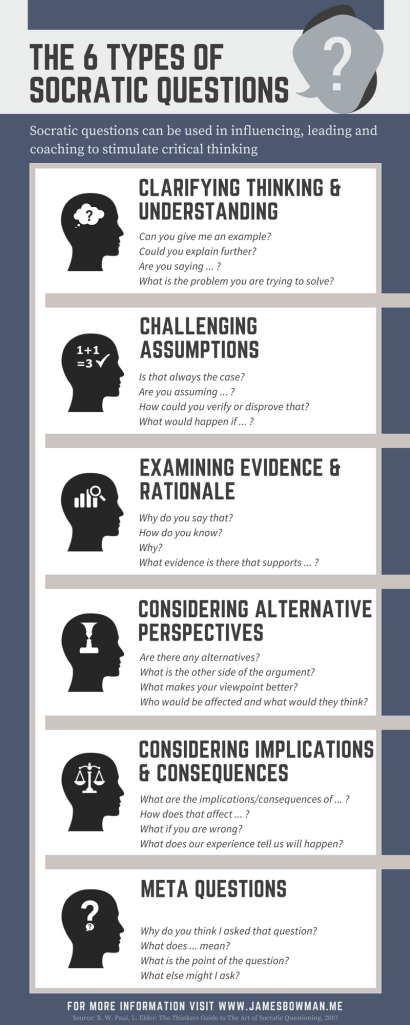
Underneath all of these are ways in which a thesis is laid open to antithesis and transformed into a new synthesis more suited to its purpose. Why is this relevant to this prompt? I think it is because the question is not likely to elicit ideas of how people see themselves as requiring challenge in the search for truth. Rather, it will be answered by lists of goals people set themselves as the answer to their stated and unstated desires and wants. They will be considered ‘challenges’ because they involve hard work and set backs.
But essentially, they will be only unexamined and unchallenged desires and wants. They belong to social ideology rather than being the true needs of a true person who can sustain challenges. Social ideological goals have a desirability as goals that are often locked in their vague definition, whether they be things or actions. Nothing truly represents them and, for that reason, may never satisfy the person desiring or wanting them because they are not their true goals but simulacra of things that ideology or convention alone has made desirable to them. Once gained, the thing gained or action achieved is seen as a poor representation of the desire prompting it, and the search continues. They might include the perfect partner, riches, a reputation for intelligence sexual allure, or their symbolisation in cars or furnished interiors.
Whatever else they are, these are no ‘ big challenges’. The challenge required is to ask why you want them. What need do they satisfy, or pretend to satisfy? The true challenge will be the synthesis of someone in yourself, whose desires are not for simulacrum of those desires as a superficial society sees them but something realisable as meaningful satisfaction.
Challenge me, Socrates!
With love
Steven xxxxxxx
 Steve_Bamlett_blog