


“Whether I shall turn out to be the hero of my own life, or whether that station will be held by anybody else, these pages must show”. (Charles Dickens: the first sentence of David Copperfield (1849-50)). Visualizing the future self and the use of memories of past visualisations when that future presents itself.
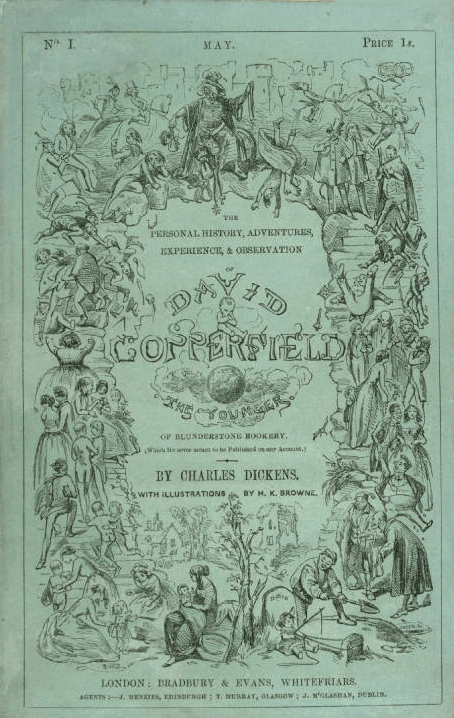
I have always been intrigued by the games played by David Copperfield as the eponymous narrator of the book in which he appears. What is also remarkable about it is zthat as a sentence, it refuses to ‘picture’ that man either with pen in hand or speaking in order to narrate his story. The sentence may assert that what these pages ‘show’ (the visual metaphor is buried there somewhere) will be the visualised versions of David as he progresses through his life, but he clouds the self of the adult life we are about to read. In many ways, so does the cover to the first issue of the serialised novel, which though it clearly shows David as a baby at its base sitting under the headstone of his dead father of the same first name and at the centre sitting on the globe of his own world, it does not identify, which of the characters rising in an encircling oval around the full title of the novel.
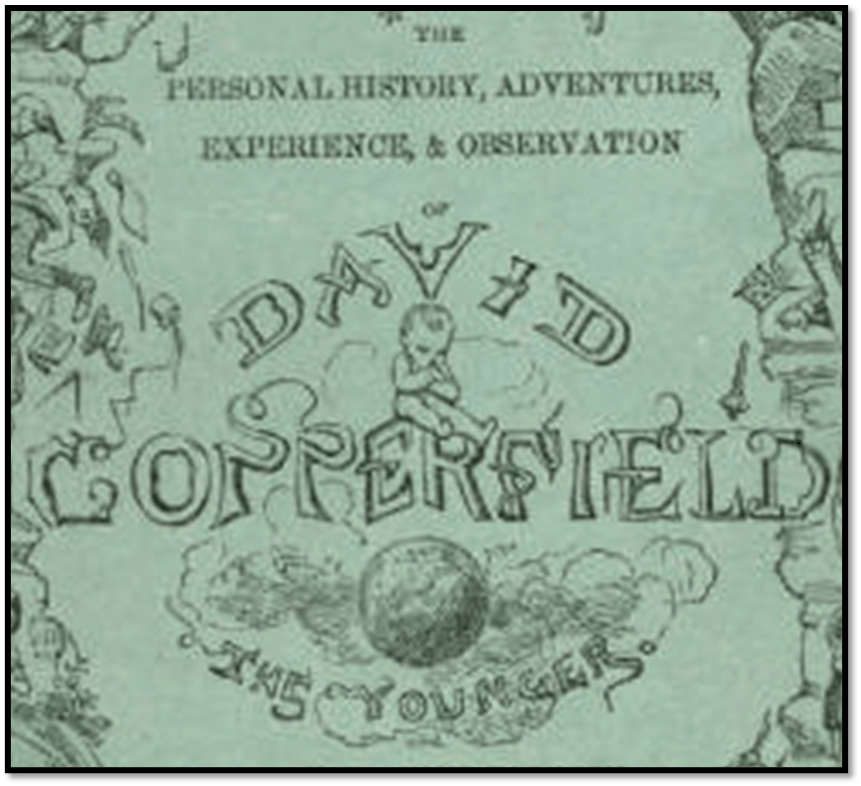
Yet that does not mean that Copperfield never visualised himself as an adult – visualised a future self. Or does he? Look at that full title which advertises that what we are to read is a number of things which record the nature of David Copperfield the Younger. These records are are: A Personal History of himself, the Adventures of himself , the Experience of himself and, finally, the Observation of Himself. David is made to be ‘observed’ to act in a ‘show’, to make of his self a visual picture. Yet words can hide and disguise what is shown. David Copperfield has many names in this book because people see him differently. The point that the first sentence makes is that the narrator refuses to tell you if he will be ‘the hero of that life’? A hero is oft a mere name for the main protagonist of a story but the heroic is also a moral staus. in both cases David may avoid as well as court observation, allowing others to take that role, at least in passing – notably James Steerforth, to whom David is ‘Doll’.
The addition to his name ‘The Younger’ too has a special effect – it renders him the avatar of his dead father, as Prince Hamlet is to King Hamlet – but it also continually suggests that each moment of the novel, the character of Copperfield is split, between the younger person who is the subject of the writing and the person who is the subject , the ‘I’ narrating it. An autobiography always proposes this split- the ‘I’ who names themselves as ‘I’ names both the younger character sometimes and themselves as the elder reflecting on and writing that character such that a reader can in some way picture hem. The point about the first sentence of the book is that Dickens ensures that the relation between the younger baby, boy, adolescent and young man, and that person re-gendered as Doll, variously pictured over time gives us little capacity to observe him in that role, as the writer of his own life, only those various selves he becomes through the progress of that story.
Why might that matter? I think it does because the novel may be called a bildungsroman or fictional autobiography – it describes the development of a person over time. Yet development is described from the vantage point of an achieved identity: the ‘I’ as it is as it sits down to write. That I’ is not the same as the various avatars that use that name to define its subjective identity through the novel but is definitively in a relationship to those growing changing identities. Though we ‘see’ a ‘picture’ of each of those selves – and also in illustrations which mattered to Dickens – we do not see the picture of the narrator. To those earlier selves he is always an unvisualised future self, or, at least, if visualised as an identity to which they all aim over time, it is rarely shared with us.
In recent time, especially the years dominated by cognitive psychology, self-visualization has become an important too in self-fashioning. Let’s take some examples from the net. The pictures in the collage below are taken from two webpages: left – Smart Leadership Hut, a site aimed at the personal-professional development of business managers (https://smartleadershiphut.com/visualization/future-self-visualization/#tab-con-4) & right Personal Well-Being, a site aimed at sharing means of psychological self-help (https://www.mentalwellbeing.net/future-self-visualization/). Their aims are not identitican, nor is the stress they place on the value of using the technique. ,

In fact their explanation of the technique is similar. It involves a process of interrogation to picture the ‘self’ one feels one inhabits in the present. That is is done the first site says by asking oneself certain questions: it instances:
- Start with asking yourself questions like:
- What about my current self is remarkable?
- Am I happy with how my current self, looks like?
- What am I missing?
- What goals do I have?
- What action do I take every day towards my goals?
- What is the quality of the decisions I take every day?
Then by using the goals of the ‘current self’ you then visually imagine the person it might produce in the future. The site describes this well in easy terms:
You can activate your future self simply by visualizing a future situation. Did you know that everything which happens in your world, your outside world, first was imagined in your inside world? Your brain can’t tell the difference between what is imagined and what is real. Your subconscious mind will always say “Yes!” to whatever you tell it.
According to neuroscience the process of visualizing ideas in your head create the same biochemical reactions and feelings in your brain as if you were to have experienced it in real life already.
So, when you do future self visualization your subconscious mind will get a memory of the new experience.
There is, of course considerable simplification of the processes of the brain here, that ignore much of the reflexive and critical work done by the central nervous system, to test the reality of images conjured in the brain, for instance, and it is nonsense to use the similarity in brain neurochemical states to argue similarity of the memories stored and the manner of their storage – as picture, semi-verbal propositions or other manner. But popular websites are held to no high standard in the citing of evidence. The Mental Well-being site is even flimsier in handling this matter although its conclusions are centrally important to the understanding of psychosis (where mental images and propositions cannot be distinguished from ‘perceived’ or ‘logical’ ‘reality’ in some states of mind). Nevertheless it is important to recognise that the creation of images of a currently non-existent ‘reality’ in everyday life (such as when we daydream about our hopes in a new job or in a relationship) has a family relation to psychosis.
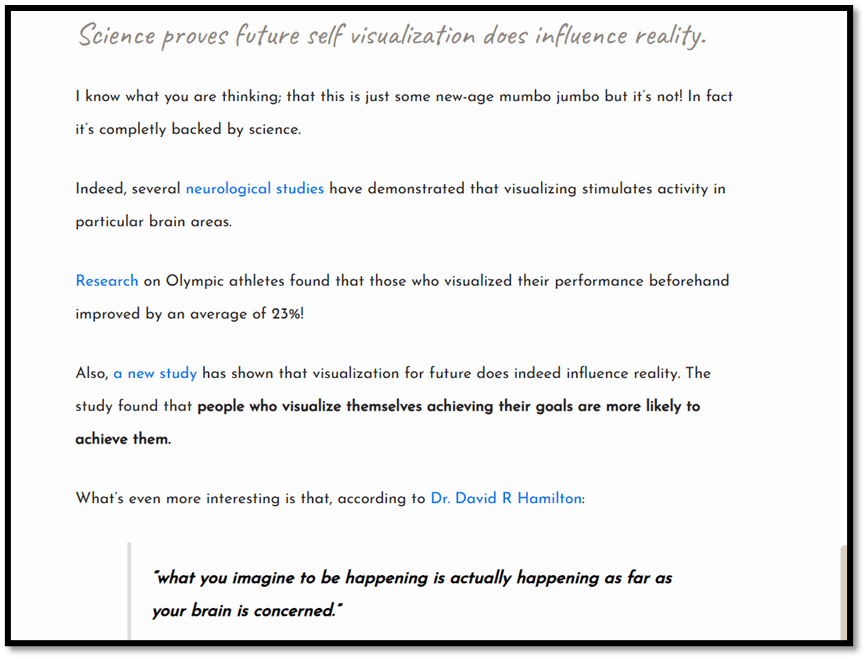
Hence, if I thought one year ago about what I and my life would look like now – that future fantasy as a thing registered in the brain would have a similar character to an event that actually happened and would be stored similarly and recalled when the year is over in certain circumstances. This has two advantages – first we feel validated in our thinking (even when the event is negative) in that we have what one site calls a ‘A-HA’ moment, wherein we feel personally attached to the control factors in our future goals and our work towards them.
Second, it helps you see things about yourself you may have been blind to before, such as an aptitude that is greater than an original assessment of it or a tendency to over-wishful thinking. But note that his is true of negative predictions in one’s life too. Stoic philosophers often encouraged negative self-visualizations, says the first site, to gain validation of truths about the world’s mutability and the lack of personal control in that world and this not only validates their ideas but create a means of testing the reality of future wishes and potentially vain thoughts.

One year ago, I saw the life I and my husband would lead as developing into foreign travel we had left behind and of consolidating our relationship after some storms. Five weeks ago my husband became seriously ill. For part of the time it looked as if it were possible he might die. He didn’t. But the picture I had a year ago has substantially changed, and it is not always beneficial when that picture is both too positive and too geared to notions of personal happiness and incremental gain. Sometimes past images of one’s own future become means to give us pain and sadness, for we feel as if we have lost a thing that, in truth, we never had – registered as a memory it is actually a fantasy.
Certainly, our own future self-visualisations failed to prepare my husband for a much more limited life and me for providing care in substitute for wishes of self-control he still wants to meet. Too often, these assumed trajectories of our lives make realities more painful. Hence, I think what must be the case is that visualizations of the future must be as capable of embracing multiple possibilities, even if one is more bolstered by hope. At the moment, we do not know the degree of my husband’s recovery.
We both hope it is to a comparable state to before his illness – but a fixed belief that this alone is the picture we should look towards would be dangerous. Life is a balancing act – even when ‘looking forward’. There is a strong tendency for the phrase ‘looking forward’ to mean to anticipate the future with joy but if we have that idea alone we will be less able to cope I believe with the fact that the future lies in a direction that crosses a plain whose name is Uncertainty not Wishful Thinking. That does not stop us hoping, however!
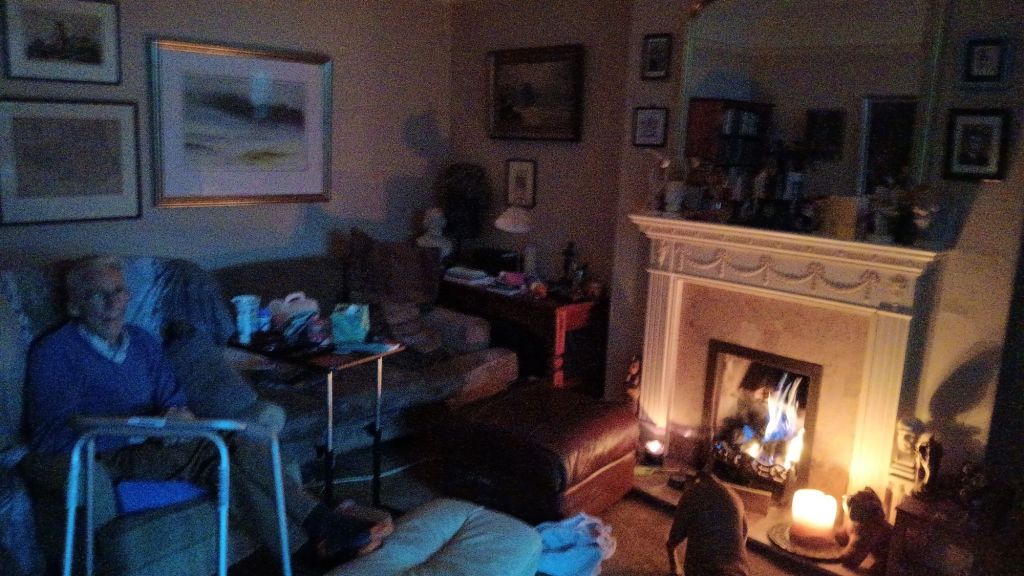
Will we turn out to be the heroes of each other’s lives. Those stories are yet to be written.
With love
Steven xxxxxx
 Steve_Bamlett_blog