


The Indeed website is an online job search and career placement service, describing itself as the ‘#1’ of its kind. About this I can’t comment on, although their own description is below (part of it at least):

Detail of: https://www.indeed.com/about
However, I noticed that it raises the issue of the first day at a new job as a general issue for people who use its service to gain a first job or change to a new one. They offer a list of tips or advice points about dealing with ‘first day nerves’: fifteen of them. Here they are:
- 15 tips to help overcome new job anxiety from the Indeed Carer Guide
- 1. Validate your strengths
- 2. Acknowledge that anxiety is temporary
- 3. Discuss your nerves with someone you trust
- 4. Prepare as much as possible
- 5. Ask for advance information
- 6. Study your new role
- 7. Allow yourself some uncertainty
- 8. Challenge any catastrophic thinking
- 9. Contact your new employer
- 10. Re-frame your anxiety
- 11. Practise mindfulness
- 12. Plan helpful resources
- 13. Make friends with colleagues
- 14. Accept feedback and ask questions
- 15. Manage expectations
Advice from the Indeed Career Guide available at: https://uk.indeed.com/career-advice/starting-new-job/new-job-anxiety
Much of the thinking in these tips is culled from the current fashion for a combination of watered down mindfulness, CBT and ‘positive psychology’ in popular (and even academic and professional practice where it remains no more validated by the weight of evidence than it is in popular psychology and in the range of examples of advice – from useful to useless- in the self-help industry). Mental-health service-users on whom these techniques are applied often despair to see them arise again in their lives. The evidence for these approaches varies but none of it says the methods are themselves effective, although contact with a skilled and empathetic helper with skills in constructive challenge of a person’s core beliefs, without undermining the person’s foundational security, certainly is. I turn to it because it is no more than fashion and to pick up the last tip it gives, which is to ‘Manage expectations‘.
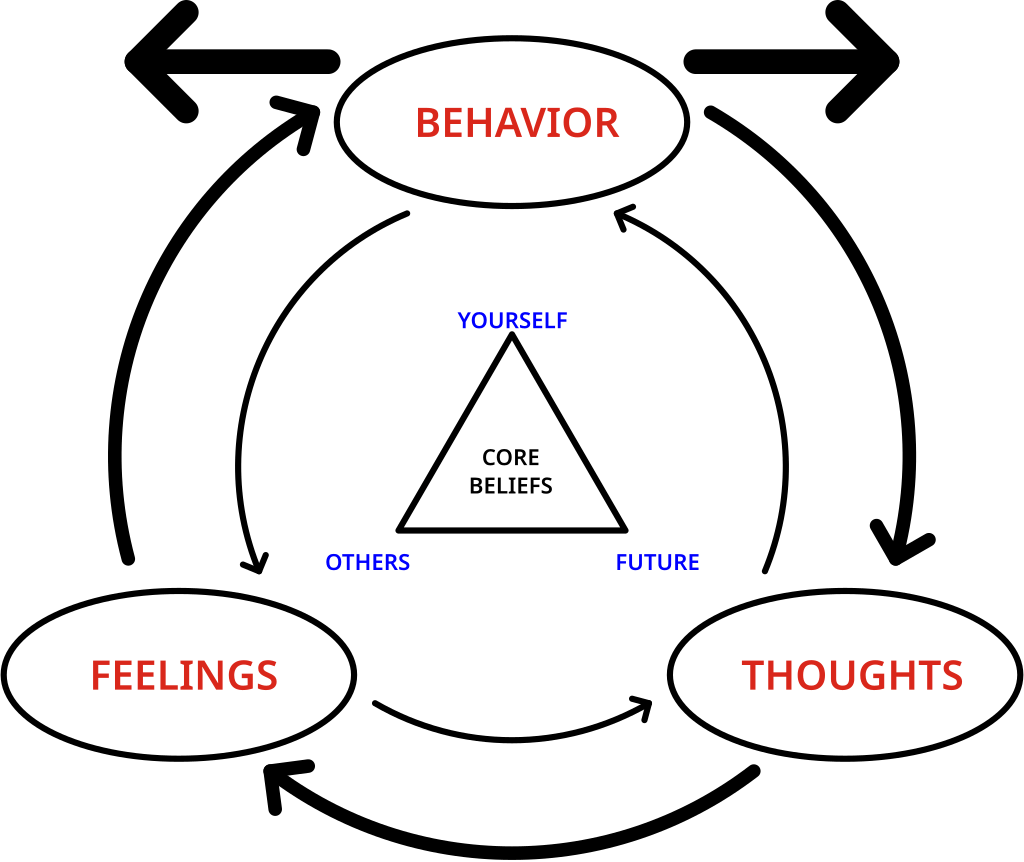
The diagram depicts how feelings, thoughts, and behaviors all influence each other. The triangle in the middle represents CBT’s tenet that all humans’ core beliefs can be organized using three categories: self, others, future. By Urstadt at English Wikipedia
Expectations are alone the key, I think at least, to the first day phenomenon whether it be a first in day at work, or any other status, including the first dat of attempting to live with new needs of support from others or being a carer. Without it, the rest are dangerous tips, for they raise expectations of a prescription for success in dealing with the matter, and for guilt in the person attempting them if they fail. Imagine, for instance, the effect of the advice – expressed as an injunction ‘Make friends with colleagues’ on a person with deep social anxiety – at the level of a disorder or even less than that – or social phobia. The advice would pose yet another threat – a challenge that feels unsolvable to some with that unaddressed set of core beliefs – in which they will feel certain to fail. When I went first as a student in the 1970s to University College London, I remember the first words of the Student union Leader on the first Freshers’ Day talk was to ‘make friends today or you probably never will for all of your degree programme’. Admittedly the advice is not usually so insensitive. But clearly how we manage expectations is vital for all initiates in new experience. Indeed’s fuller description of how to manage expectations reads thus:
You may think you can do a great job straight away, but it’s unlikely. Learning new tasks, new software and business processes takes time. Some parts of your job may be easier than others but knowing you can learn the difficult aspects as time goes on helps you free up the mental space to learn and embrace new ideas and ways of working.

There is more to the challenge of a new job even than the unfamiliar ‘tasks’, ‘software’ and ‘business processes’. Most of the learning I think in a new job or any new experience centre around issues of trust, in self and others, and attachment, to a sufficient self-concept that matches the demands of the role being newly undertaken, and to others in the business. When I attempted to be a secondary school teacher, I remember reading in a textbook about the experience of first time teachers being tested and ‘sussed out’ by their learners – who themselves must adjust to this new person and the strength of their authority and manner of delivery.
I failed miserably in this very arena as a schoolteacher, not as most thought in the fear of observation of my teaching, although the anxiety did generalise to that. In some new experiences colleagues, far from being open to be a source of trusted support seem to set out to undermine the ‘newby’, especially if in a position of supposed authority over them and sometimes because the social culture of the workplace reacts toxically to anything that might challenge it to accept change in itself. In my first day as a Primary Care Graduate Mental Health Worker, a new role set up by the 2000 NHS PLAN, it was made clear to me that the counsellors in GP surgeries and some doctors were set on destroying the challenge to their experience and, what they saw as, superior qualifications this new role posed to their own established roles. Often the conflict was conducted in public or by reputation destruction with other collaborators in working or even service users.
Because the expectations that need managing are not only those cognitions in the initiate in the experience but of others affected by the initiates presence. Sometimes those expectations are based on illusions on what is required – especially by the initiate who will be less likely to be able to understand that the rhetoric describing a role is often far removed from the real, and more importantly, even the possibility of attaining an expected superior or ideal standard. Herein lies the dilemma of perfectionism in a role that D. W. Winnicott addressed in his concept of ‘good-enough’ not a perfect’ parent. The same problem is endemic in first-day nerves in whatever role, even beginning to try and live with a chronic condition.

Winnicott
Illusions and delusion (or other kinds of exaggerated beliefs and structures of belief) dog the initiate, but they are not all their own. They may be those of supporters (spouses, family or friends) or of work colleagues – sometimes mischievously the latter invent scenario of expected events to scare the initiate and make the ‘regulars’ feel powerful for a moment, at least over somebody. Public schools I believe made a thing of this, but I found it in grammar school. Part of an illusion passing as an expectation is the very trigger to ‘catastrophic thinking’ and again this is is not the ‘fault’ or ‘flaw’ of the individual initiate; ‘If you don’t make friends very soon, you never will’ is an example of this. Another is a joke I used to see played on initiates who used to teach software to newbies in a company and would say, whatever you do never press the Function 12 key (F12) on the computer. Some people were reduced to quivers of uncontainable anxiety about the catastrophes involved if thir finger slipped. This is not unlike the terror inflicted on sub-postmasters by The Post Office in the Horizon scandal – to the cost of some (not only initiates but they were more vulnerable) of jobs, savings, income, freedom (for those falsely imprisoned) and, for some, putatively, their life.
No doubt the real problem for many will be self-esteem, and though some recover this easily after being thrown into uncertainty, some very definitely do not. Indeed tells us to ‘validate our strengths’ but in some places their seems to be a culture of never validating others that makes self-validation seem an act of hubris for which punishment will follow. Self-esteem is sometime hard to capture for those whose early experience has invalidated them – for abused children for instance, and particularly Winnicott thought children not obviously abused but the offspring of perfectionist parents. John Stuart Mill was one such case and though it did not stop him becoming a great philosophical and political thinker, he became so at a cost as his autobiography shows. The management of expectations however barely covers the struggles he went through, as with John Ruskin, another great Victorian but one who revered his parents.

Great minds and hearts with parental issues: J.S, Mill and John Ruskin
In the end, employees and other role-holders are subject to the power of others, and very few are not. Thence they will find it near impossible to ‘allow yourself some uncertainty’ in their job. It can lead to the sack or worse. David Lodge, in his novel Changing Places, wrote of an academic so insecure they had to win’ in ever case. In a meeting with colleagues, all lecturers in literature, including his head of department, you had to name a work you had not read. You could only one if there were others who had not read it, too. He says he has not read Hamlet by Shakespeare. He wins the game but loses his job the next week. Though this is an absurd illustration, it is a good instance of less extreme cases where keeping illusions alive is necessary – here the illusion that every literature lecturer would have read this core work in the canon. Some uncertainties can not be embraced. They must be denied. This fact leads to many errors in all kinds of situations. But the only certain thing, surely, is uncertainty.

A taxonomy of uncertainty by w:User:Rvencio – w:File:Uncertainty1.png – The uncertainty taxonomy proposed by Tannert et al. EMBO reports 8, 10, 892–896 (2007)
So that’s me on initiate nerves. Whilst I remain uncertain through the soulful night, goodnight sweet Princes (and princesses) and anyone not attached to that binary but regal nevertheless.
With love
Steven xxxxxxxxx
 Steve_Bamlett_blog
