


A quotation from Balzac is worthless as a proposition of a supposed truth as held and stated by that great soul, for these quotations are often, as this is, the stated view of a character in a novel, a thing up for debate. It is a good proposition to start with in response to this prompt question however, since it considers that there are no absolute means of evaluation, with their common binary possibilities of classification (be it bad versus good or negative versus positive).
Science sees the concepts of positive and negative as subjective concepts of evaluation, with no substantive verifiable content other than as a feeling or sensation within the person in response to situation in the outside world, such as an event. The inner feeling or sensation is ithen nterpreted by the individual using tje filters of socio-cultural paradigms of what constitutes value in any society. As a result, assumptions about what events are good or bad tend to be versions of socially constructed cognitions of value.
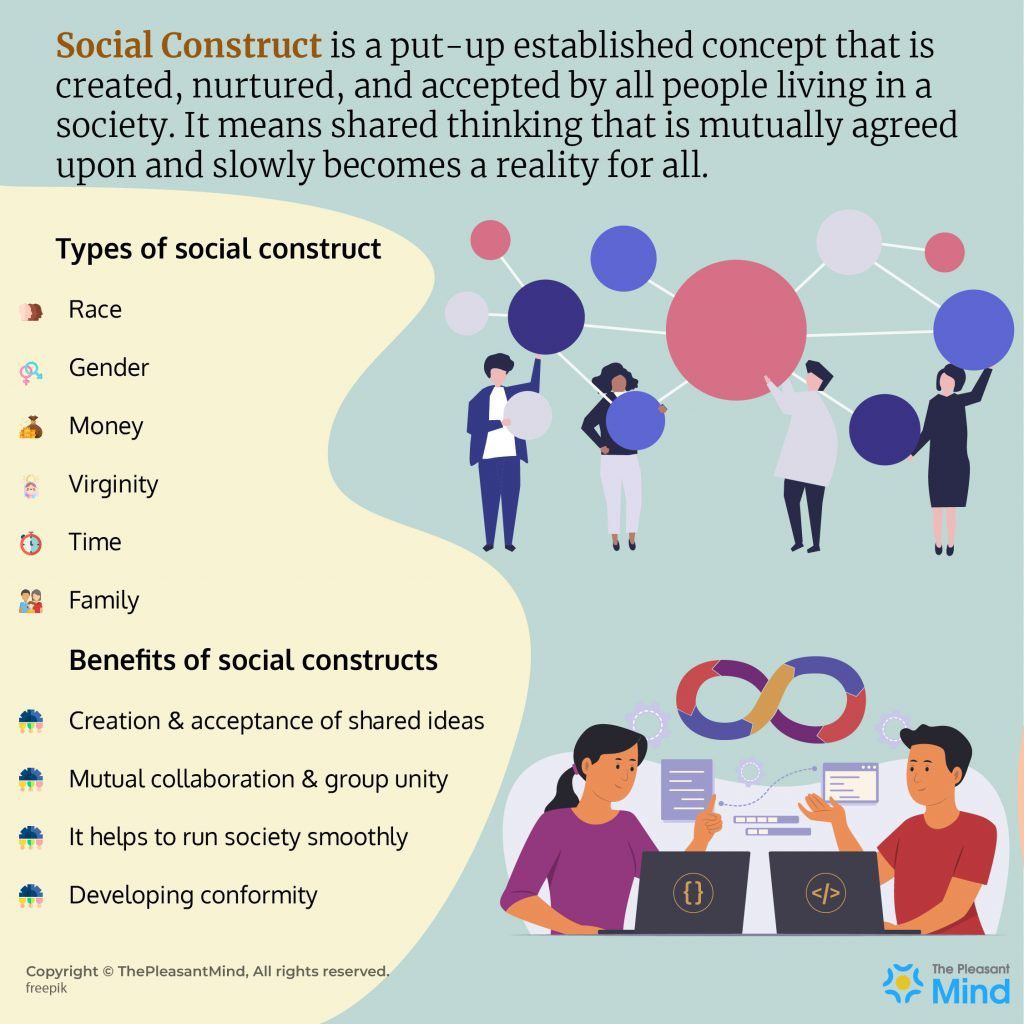
But social constructions change not only with cultural placement over space but also over time and unevenly within each individual in a society and respond to the variability within event categories. What psychologists do then, in order to calculate the average response of a society to any cayegory of event, is to collect evaluative scores on a numerical scale of subjective measurement for a large enough sample in order to rank the event categories in a scaled list from extremes of good or bad and positive or negative as in the example below by Chloe Howard and colleagues in an inventory created in New Zealand.
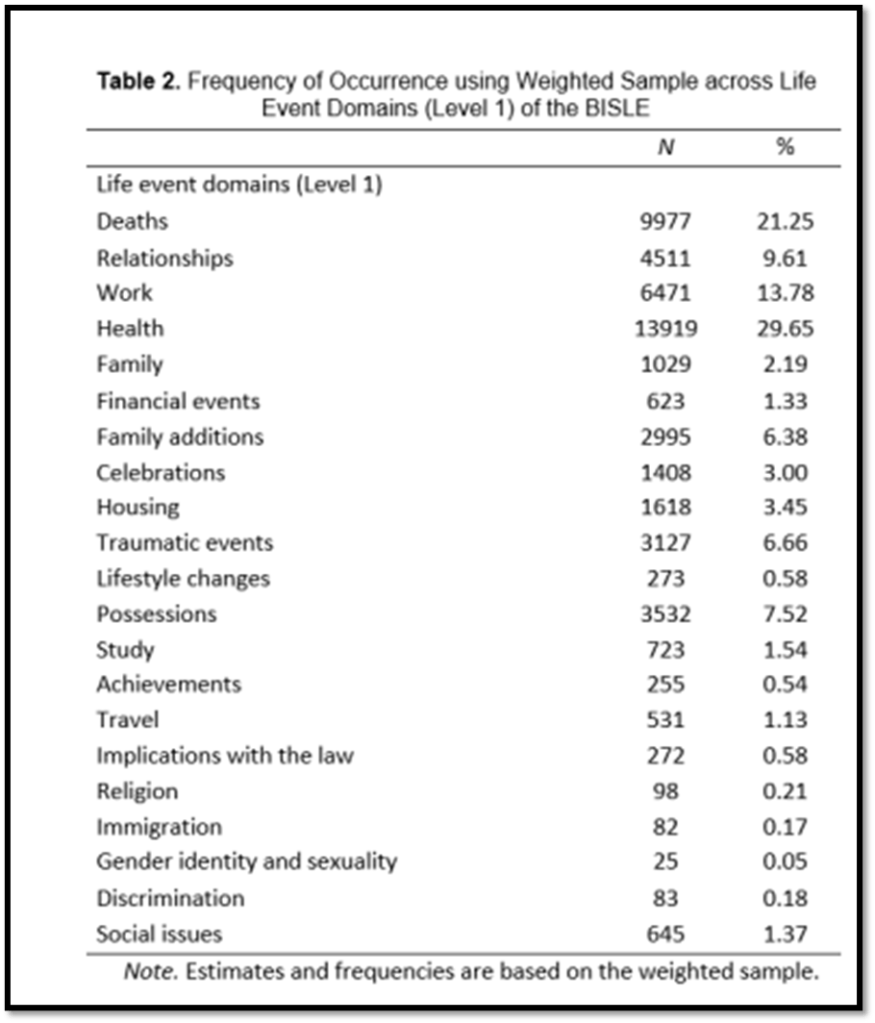
Chloe Howard , Elena Zubielevitch , Nickola C. Overall , and Chris G. Sibley ‘The Broad Inventory of Specific Life Events (BISLE): Development, Validation, and Population Prevalence ‘ in NZJP, 51(1), 59-74 . Available at: https://www.psychology.org.nz/application/files/7216/5152/9745/Howard_59-74.pdf
D. J. Cohen and colleagues in 2017 show one way of cteating binary lists in order to create groups of events more generally considered as negative or positive on the culture studied. They explain it in the graphic below. By eliminating acting events that only occur in the middle of the range from very positive to neutrally scoring events, and vice versa, lists of positive and negative events.
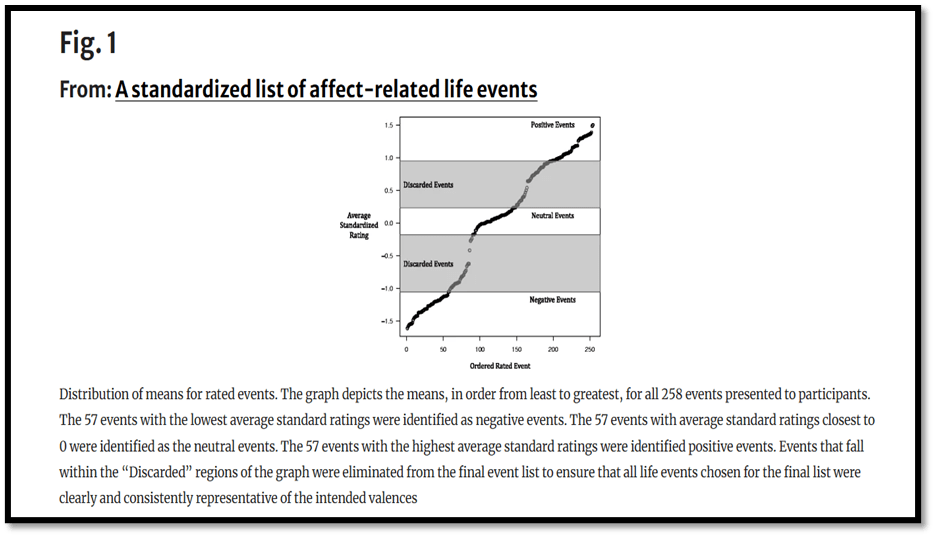
Cohen, D.J., Barker, K.A. & White, M.R. (2017) A standardized list of affect-related life events. Behav Res 50, 1806–1815 (2018). Published04 August 2017 (Issue Date: October 2018), DOIhttps://doi.org/10.3758/s13428-017-0948-9 Available at: https://rdcu.be/d1SX8
However, since the same event can often act as a variable, an event can occur as both a negative and positive affect, as ‘marriage’ does in many inventories of positive and negative events.
In effect, the scientific methodologies pointed to above complement the Balzac quotation given at the start of this blog. But how does this shed light on why the idea of positive and negative things is a silly binary and why ‘marriage’ often occurs as positive and negative in those lists (often considered as negative more significantly by women).
One idea that may help is that of the ‘circle of control’. These vary between persons, although some events are interpreted similarly in some contexts. People are asked to draw two concentric circles on a piece of paper and then place the things [often events] in the inner circle or outer doughnut ringing a place that can sat how much control we have over them in relation to thebdistance from the circles’ common centre.

What is my point? If Balzac’s character is right that the world is constituted only by events that are not positive or negative but can only be adjudicated by circumstances, one very central circumstance is the degree of power and control (down to whether we are powerless and without control in each circumstance).
If we take a popular list [with no cited scientific authority] of top causes of stress, we can infer these are negative effects.

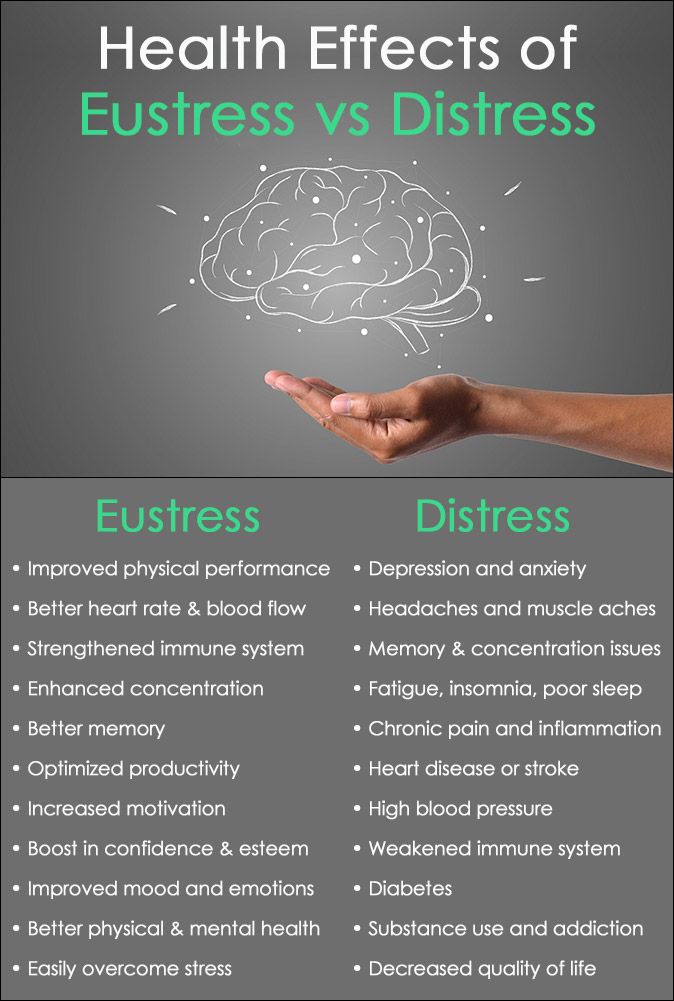
However, any of these categories might be positive or negative in relation to a number of circumstances, including our degree of control as represented in our idea of our own circle of control. Even the concept of stress has been considered in positive and negative terms, with the concept of eustress or positive stress as a means of describing the kinds of stress that make us feel good.
So this is why I have resisted naming my positive events. Recently, my dear husband fell dangerously ill. He has been in hospital for six weeks snd will be left with a chronic condition. Nothing in this event is positive, but then to call it negative is to neglect that learning that has come out of it for each of us. We can only hope that learning grows and increases our control over the processes of time as long as that is possible and life continues. This blog is dedicated to him who has had to bear the brunt of the proof of our love for each other thus far. Our love is our circumstance that will be tested in this ongoing event, but I intend that it will prevail, even in ways I don’t quite understand.
With love
Steven xxxxxxx
 Steve_Bamlett_blog