


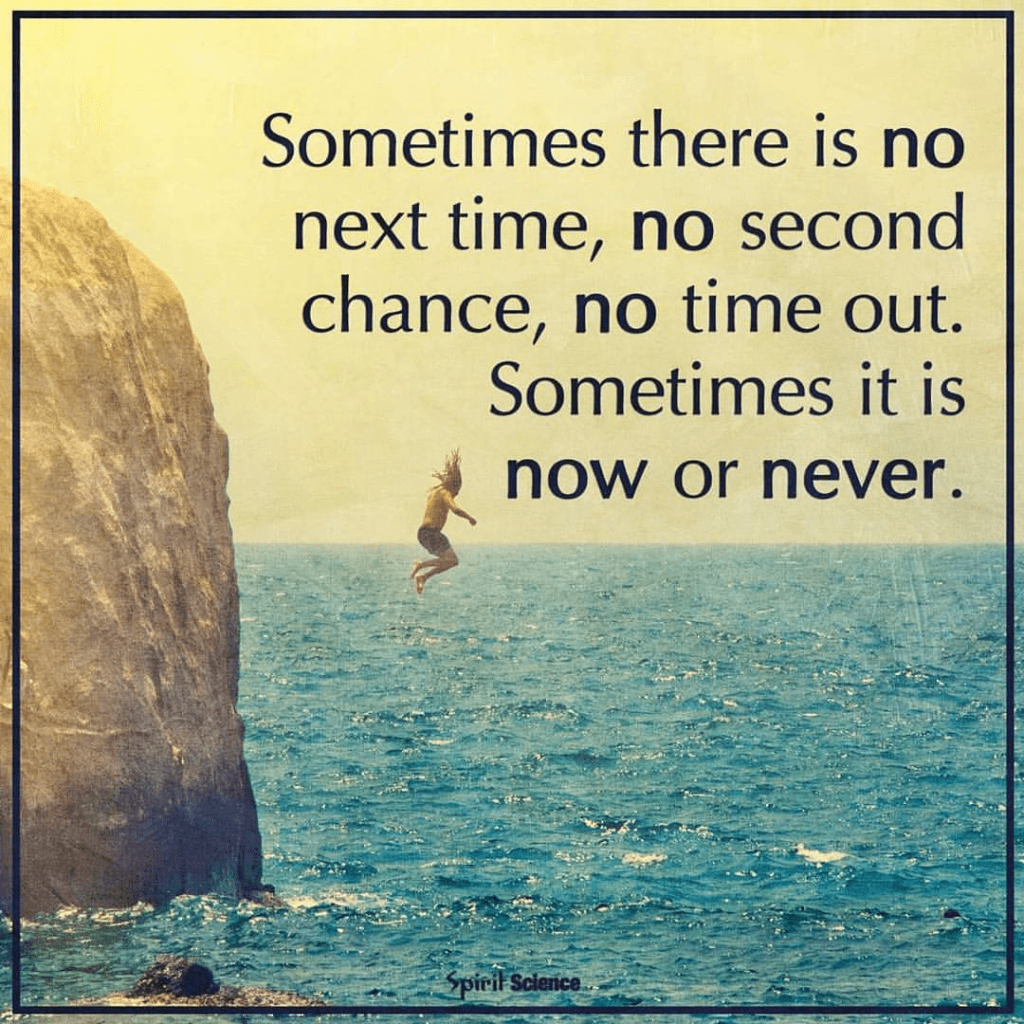
Would this man have jumped if you knew the sea contained underground rocks and dangerous currents, or if he did not know there were emergency services to redeem what to him was personal failure?
When I worked in mental health roles in both or either NHS and social work roles the concept of positive risk-taking was the driving idea. Its best expression was in a paper by Steve Morgan in 2004 who saw the practice of positive risk-taking as an extension of means of putting the transfer of power from ‘care’ professionals to the people using services, and who ought to be shaping them by participating in their planning, delivery and ongoing review.
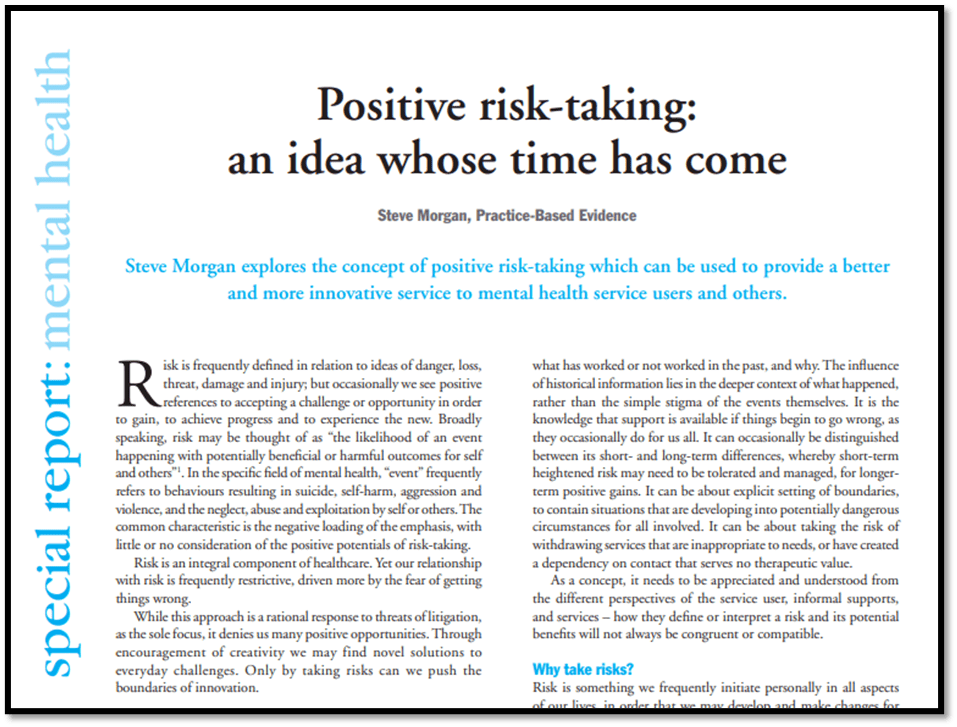
It remains a bold paper, but one frequently misrepresented and possibly inalienably lost to us by bad practice in social work and health care by the pursuit of more overwhelming priorities in these services currently: most notably a very short-range view of budget responsibility. It is an idea more sinned against than sinning. Even a cursory reading of Morgan shows that positive-risk-taking is not a ‘cheap’ option for health and social services but one requiring resourced support and planning, all of which require time, patience and resource access and availability that may be themselves things that bear a cost. Indeed, if they are to be effective, they MUST bear that cost. Note the things I emphasise in Morgan’s paper in bold below.
What is positive risk-taking?
Positive risk-taking is weighing up the potential benefits and harms of exercising one choice of action over another. This means identifying the potential risks involved, and developing plans and actions that reflect the positive potentials and stated priorities of the service user. It involves using available resources and support to achieve desired outcomes, and to minimise potential harmful outcomes. Positive risk-taking is not negligent ignorance of the potential risks. Nobody, especially users or providers of a specific service or activity, will benefit from allowing risks to play out their course through to disaster. So, in practice it is usually a carefully thought-out strategy for managing a specific situation or set of circumstances.
From the experiences of mental health services, positive risk-taking may be characterised by:
- real empowering of people through collaborative working and a clear understanding of responsibilities that service users and services can reasonably hold in specific situations
- supporting people to access opportunities for personal change and growth
- establishing trusting working relationships, whereby service users can learn from their experiences, based on taking chances just like anyone else
- understanding the consequences of different courses of action, and making decisions based on a range of choices available, and supported by adequate and accurate information
Abused by services and pushed by their agents in government (successive administrations in every tier of national and local governance and domain of health and social work practice in services have seen positive risk-taking as a means of cutting costs as the main driver to conscious ‘health’ policy. In the process the very idea of positive risk has been reduced to the refusal or withdrawal, often without explanation or information let alone adequate cooperative planning with the users of those diminishing services of support.
Too often the argument, moreover, has not been the engagement of people with mental health issues in empowered risk-taking, with support and alternatives in the case of unforeseen negative impacts of the risk-taking. It has been in its stead a belief that providing services and support created dependency on those costly services. The first thing to be ignored is the aim of such an idea in our work to promote and work collaboratively to achieve a person in receipt of services ‘to access opportunities for personal change and growth‘.
Which brings me to this question:
What’s the biggest risk you’d like to take — but haven’t been able to?
It is so double-edged. Why would you have not ‘been able to’ take that risk? Is it because it is not a positive risk at all but a negative one, even in your own estimation? Is it that your fear of the negative risks attending on the positive one are too great? Or is it that you cannot take on this risk without support and resources? It may seem that the apparently absent necessary resource is only time alone. But time is never a resource to be accessed independent of other resources – in fact it is a COSTLY resource with many contingent but necessary factors involved.
Indeed although we think we all take risks and that puts ‘spice’ in our lives (if our resources are over-sufficient for meeting our basic needs of course – think of Maslow’s hierarchy of needs) those risks ardvusually dependent onnour awareness of alternative resources.
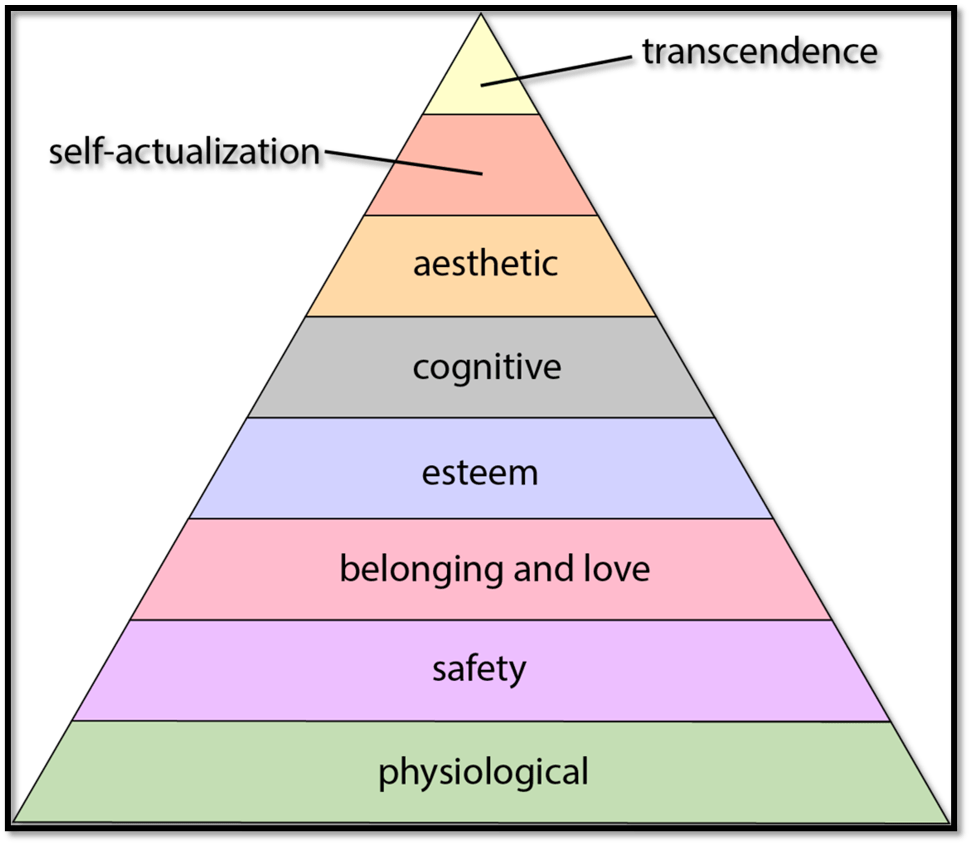
Maslow’s Hierarchy of Needs as drawn by EucalyptusTreeHugger – Own work, CC BY-SA 4.0, https://commons.wikimedia.org/w/index.php?curid=122601755
The need to eat, drink, keep warm and dry, sleep, exercise and be safe always over-ride even other basic psychological needs, like esteem. Hence, we are unlikely to take the positive risks of seeking ‘self-actualisation’ (and what Csikszentmihalyi calls ‘flow’ experience) let alone Maslow’s ‘transcendence’ when we feel pursuit of them risks our safety, and risks even homelessness and starvation.
If you do not believe that, consider what the war aims of Israel truly are (those they enact and not what they say) in Gaza now, where according to The United Nations (an unreliable source the Israeli, Americans and Present and past British governments seem in their self-interest to think) more than 80% of the population is homeless.
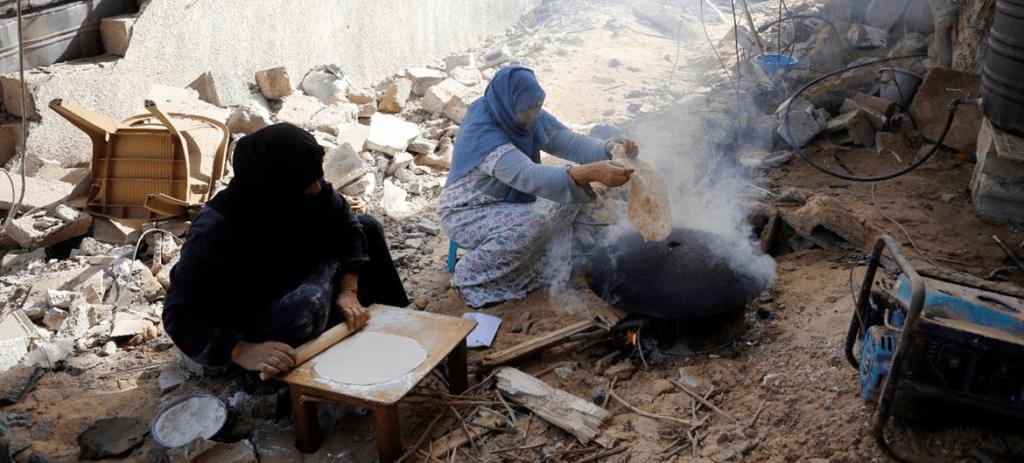
Khan Yunis from : https://news.un.org/en/story/2023/12/1144387
If we do not take risks it is because, as the situation is with users of mental health services too, we feel insufficiently supported to do so, or distrust the support claimed to be there. Given that trust itself is a factor in mental health the need to support risk is even greater and is never served by withdrawal of positive support.
Negative ‘support’ is another matter, for too often mental health controls are applied too soon and for too long and are more like the practice of occupying armies or military coups who claim to be supporting others whilst they look mainly to the maintenance of a pernicious status quo, from which their chief executive officers (or generals) benefit most.
I hate it when people blithely say: seek support because support is there. Most often it is not or is so inappropriate to need to be usable. And likewise the sloganising of ‘take positive risks’.
The mental territory of these slogans is often that of imagery that imagines taking a risk, to acquire opportunity for power, wealth or satisfaction (or some move up those scales of achievement). The images pretend there are safe zones (rocks in the picture below) as well as unsafe ones over which risk occurs, that we could avoid by staying on the safe rock we came from however limiting it is.
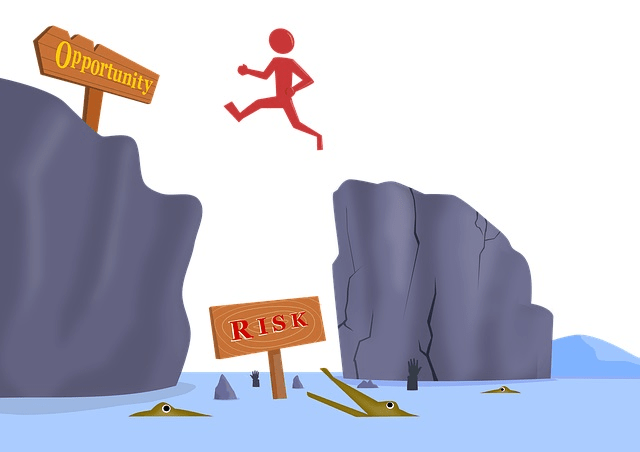
But a truer picture would show the rocks nearer to the crocodile of non-survival, as in, currently, the ecological dilemma that is the reality for too many. Many real islands on which people currently live will soon be submerged as global warming rsises sea levels.
Prophets of positive risk at their worst, like Elon Musk, think that is why we need to advance space travel. If the actions of the rich and heedless make life uninhabitable for doomed unfortunates, our Elon says, let’s colonise some other space. After all it worked in colonising the West of the USA and wiping out indigenous populations who wouldn’t take the risk, or so they were told, of modernising opportunities and capitalism.
There are positive risks we could take as a whole global society that involve a belief in mutual support. For Elon Musk these are the anathema of socialism but green socialism is a belief system in which risk is shared and so are its benefits We would all feel as ready to help another when we knew that their success could be that of the rest of us in their achievements and was not meaured by money alone. The positive risks are great and the negative ones entirely encompassed by the means that the established status quo would use to stop these risks being taken collaboratively. For at the moment taking risk is all about personal gain not personal well-being upheld by social welfare.
With love
Steven xxxxxxxxxxxxxxxxx
 Steve_Bamlett_blog