It is ‘not for those above us to tell us what we believe’, says Anne Askew (Erin Doherty in Firebrand (2023 film). This blog discusses the problem of enacting what you believe yourself capable of becoming for female actors in that film.
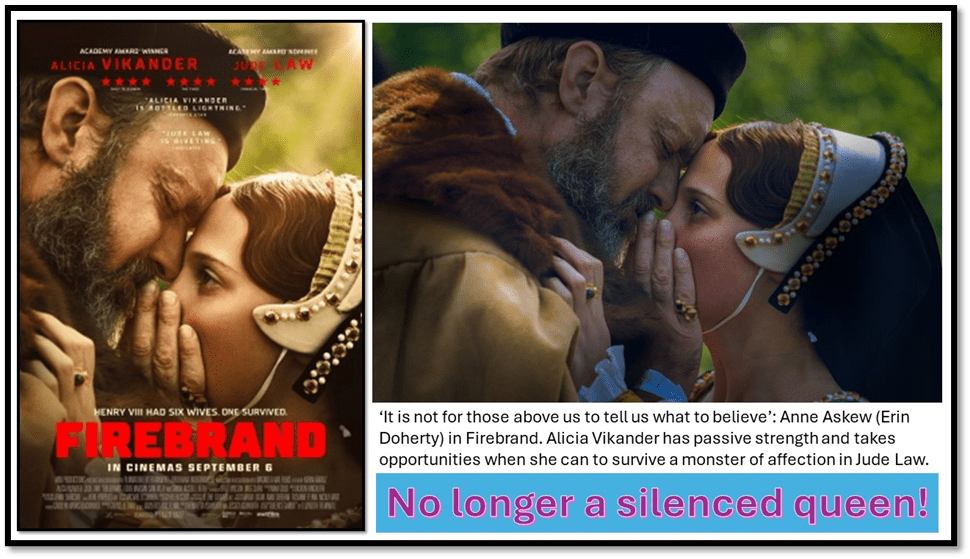
Poster from: http://www.impawards.com/2024/firebrand_xxlg.html, Fair use, https://en.wikipedia.org/w/index.php?curid=77103656
We have to forget about any idea of whether Alicia Vikander is, or is even a likely representation, of the ‘real’ Queen Katherine Parr, the last Queen, and only one to survive in that role, by virtue of marriage to King Henry VIII. Likewise, this is not Henry VIII we see in this role. Both are representations that have been through varied mediations. First the novelistic treatment by Elizabeth Fremantle in The Queen’s Gambit, which I have not read nor am likely to do so any time soon, the realisation of the screenplay by Henrietta Ashworth, Jessica Ashworth, Rosanne Flynn and Fremantle herself by a director of romance-led tradition, Karim Aïnouz. Most critics also pick up on the role of Hélène Louvart for the cinematography and rightly so. The film starts with long silent shots of sky and cloud, eventually descending to capture a romantic moon and ravens on a rocky moor in Derbyshire – the set including castle and grounds by Haddon Hall in Derbyshire.

It is all but unrecognisable in Louvart’s moody treatment, of which I try to give an impression with a collage of detail from a trailer shot below, but the love of upward shots of mock-medieval Elizabethan castle grandeur at least shows for its de-rigueur lofty trees surrounds and ubiquitous mist. Francesca Steele in the i newspaper describes these scenes as ones that penetrate ‘dank, dark old castles with shards of light and carefully framing each like an Old Masters painting’. [1] Well, yes, though your Old Master will be no older than the Romanticism of J.M.W. Turner if it an English example and not German. But that is no bad thing at all. I felt he consistency of setting and character, as if this were a Gothic novel by Ann Radcliffe.

The romantic moodiness is emphasised in order to set the feeling of awed queasiness that its residents feel when in the presence of the Lord and Master, Henry VIII, who has all the visceral and venal qualities of at least some of the mythologised presentations of Henry as the beauty of his youth deserted him. Hadon Hall, by the way, was I believe used as a setting for a recent film of Jane Eyre and the story-telling here does recall the nascent feminism, more internal than enacted (except in brief moments of uprising) of that novel eponymous character. That is how Alicia Vikander plays Parr. I chose my theme for this blog in fact partly in revolt against Steele, and other reviewers who say the same things – all in UK newspapers strangely enough for the USA response was much more intelligent. Steele says, typical of the whole response that the film garnered in the UK, ‘suffers from its passive portrayal of Katherine’, not because it not the likely performed behaviour of a queen wishing to survive in such circumstances and with a King with his marital history behind him but because it ‘makes for rather pallid viewing’.
I just don’t see this. Great acting is not all in the surface appearance nor action, even in Jude Law’s wonderful performance, but in the suggestion of what goes on beneath such surfaces and inside the hidden caverns of human felt experience. At this level Alicia Vikander, as Katherine, is impressive. It is a film in which we constantly see Henry silencing Katherine, stuffing her mouth with himself – his fingers for instance – or covering it to keep her beautifully silent. But Vikander did communicate o me what that feels like, especially in the wonderful scene in which he stuffs into her mouth an absurdly huge and costly necklace of large jewels that she had foolishly, in the judgement of most in the film, given away To say to whom they were given and how they were returned to Henry would be too much of a spoiler here but it matters a lot to my theme of how good the female acting actually is.
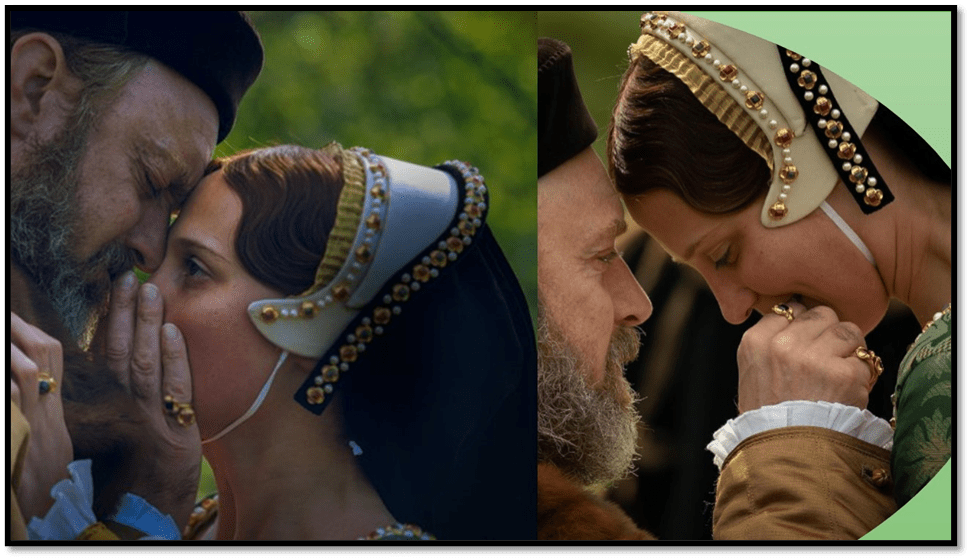
Stuffing and silencing – one of many instances
And after all, it is not even true that Vikander acts passively throughout. In The Los Angeles Times Robert Abele gets it right:
Vikander’s poised, considerate Katherine starts off active, but recedes into the background as the justifiably watchable tornado that is Law’s Oliver-Reed channelling Henry transforms the movie into a biopic of a ruler’s howling exit.[2]
Let there be no disrespect to Jude Law who literally is the greatest representation of the monstrously faulty bearer of many images (with an ordinary man underneath them all allowed out only in glimpses speedily repressed) that was Henry VIII, or at least as I imagine him. My favourite moment, and not just for its sequelae, is that where before he dies, there is the following exchange as Katherine lies lose to the King’s person on his deathbed:
HENRY: Do you love me, Katherine?
KATHERINE: (pause) I love my King.
HENRY: That’s not what I asked you.
This is the only time Henry uses ‘me’ to denote himself, the first person singular rather than the plural – the royal ‘Us’ or ‘We’ that indicated that the King’s body was the body of the whole community of his kingdom and its state combined. Yet Katherine deliberately ignores the turn to the singular, personal and human, referring only to the hegemonic symbol that the man passes as: she knows you can love a King without loving the ‘he’ who plays the King, the poor mortal with the fat bum which in one sex scene with Katherine fills the focal point of the camera lens. But such a man, if you are a consummate and experienced actor of Law’s talents must be easier to play than a woman who must in the presence of the King entirely hide that which she is in person too, for fear of her life and in preservation of beliefs sacred to her which must wait for their realisation.
Steel does pick up some of the subtlety of the role played by Vikander, though attributes the success of its theme mainly to the voice-over of the young girl, Elizabeth Tudor, who will become Elizabeth I and the head of a definitively Protestant Church of England with Services in English, with Catholic elements of course – a thing the film forgets conveniently – with a Book of Common Prayer in the English Language eventually imposed by Elizabeth I to be read in all churches by compulsion and with severe consequences for recusant priests, and based the film claims on Katherine Parr’s version of English prayers – her very last book.
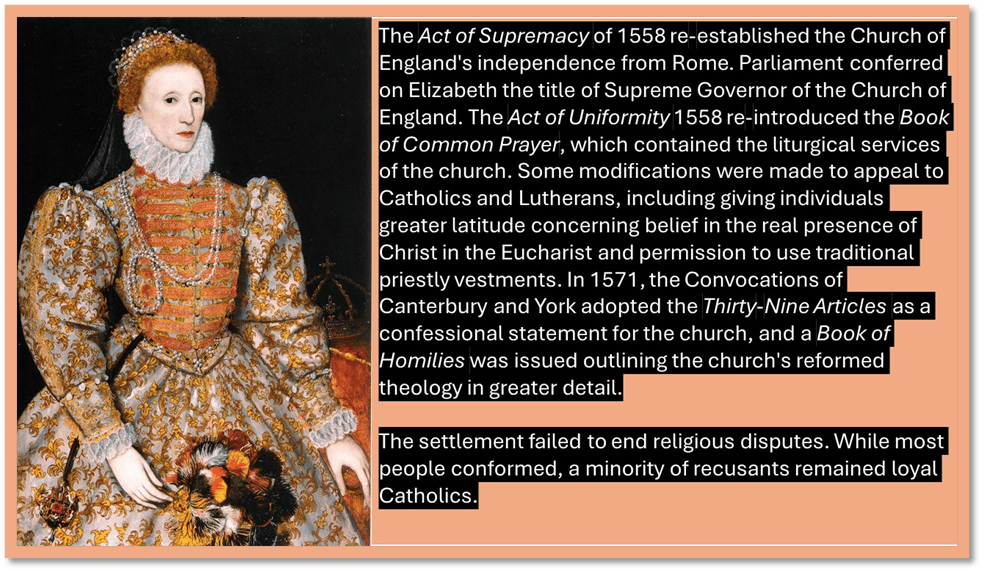
The text is from Wikipedia on The Elizabethan Church Settlement
Steele puts it thus: ‘The film makes a very interesting case for looking more closely at Parr, particularly in its voice-overs by the young Elizabeth, who is very fond of her stepmother and of course went on to cement the protestant reformation’. There is a slight of hand here that praises the way the role of Parr becomes a triumphant one, which is closely enacted in Vikander’s very subtle gestures as well as one massive event in the denouement, best not detailed here, but most impressive in the means of conveyance through subtle uses of body language. Personally I find the young Elizabeth voice-overs too childlike – the captions that tell the story Fremantle believes – that Elizabeth went on to ‘rule without war and without a men’ is grossly untrue except in the ideology of the pacific Virgin Queen baked in in Spenser’s The Faerie Queene and the various ideologically controlled portraits (the Rainbow, the Darnley ….) of Elizabeth I.
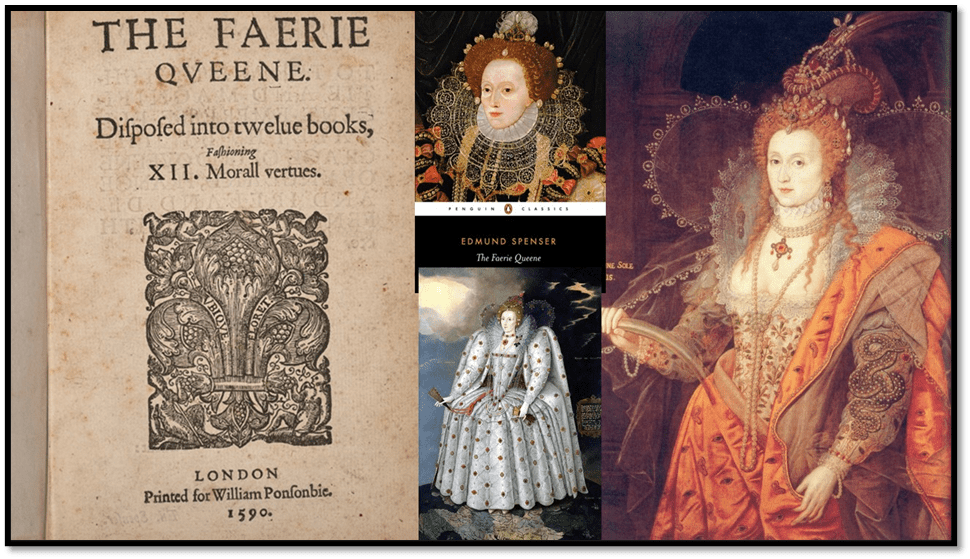
This is not to say that Junia Rees’s subtle performance of Elizabeth, if not of the first voice-over, in which is too much sugar, is not a thing that undermines the lie of the last caption. We see Rees learning the slyness and subtlety attributed to the serpent we see on the dress of the Rainbow Virgin above, which was what in fact characterised her reign, not womanly love and grace, a role she played in court masques alone. As the voice-over talks and the captions role we see a brilliantly knowing smile on the actor’s faces that shuns all peaches and cream for the eyes of wisdom that even in her own age characterised this Queen with a great love of espionage. Both Rees and a brilliant Patsy Ferran, playing Princess Mary, convey the respective historical character, at least in the many mythologies of their reigns – Mary neurotic and playing her hand too openly to succeed and Elizabeth – well – being Elizabeth, with her eyes turned to the same source of the options of her life as they must have seemed to her: the threat of summary execution (‘he will kill me like he killed my mother’ the script has her say at one point) or the opportunity to wield power more warily than Henry ever did.
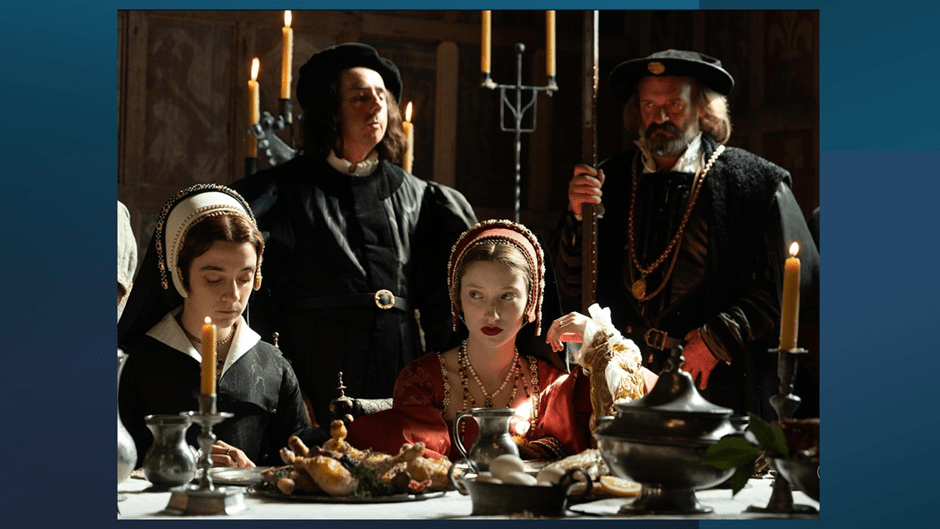
The training of gaze of the two actors of Mary and Elizabeth respectively is superlative
That Elizabeth learned this of Katherine Parr, the stepmother of Anne Boleyn, the second wife’s biological daughter (and also a Protestant like the step relations) is clear from the way that Parr teaches in every embodied moment how to appear servile to a male lord and master, whilst maintaining too in her very gaze, the look of an independence that refuses to show itself openly.
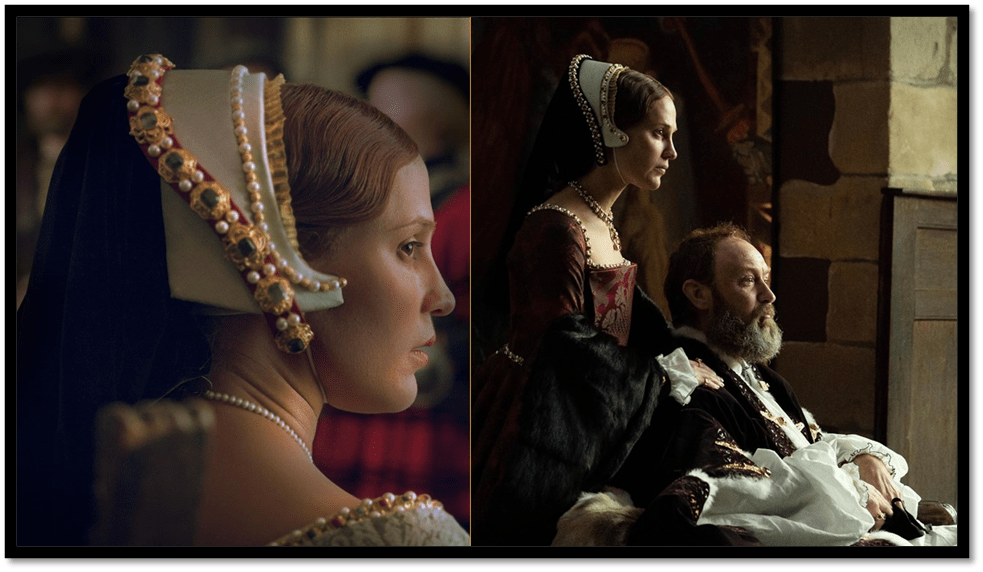
When she is perhaps giving Henry what he most desires – a son who is not sickly and unattractive like Edward – she can even ape the loving courtier and receive affection through the baby still enclosed in her womb:
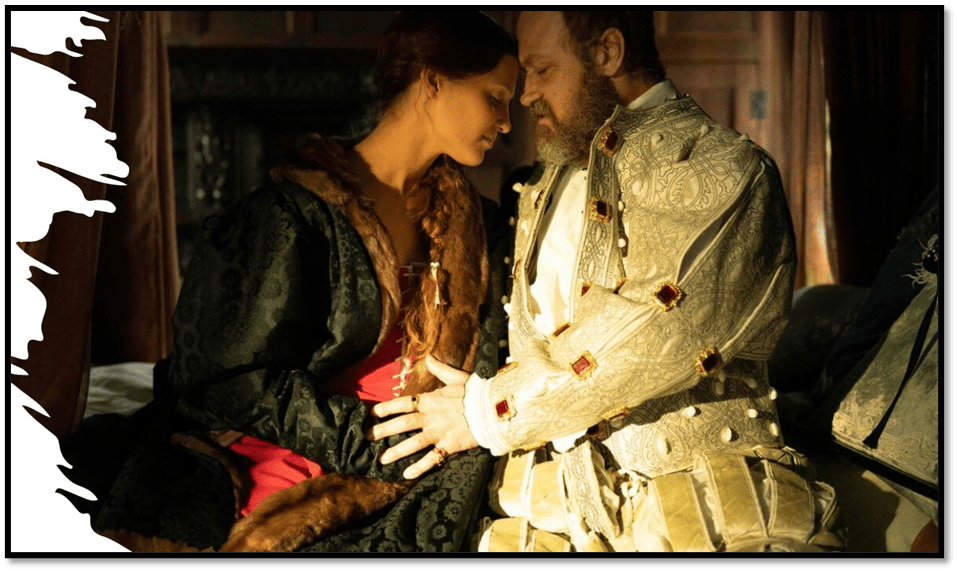
Vikander knows that Parr need not keep an eye on any threat from Henry here because bears within her a source of power. Perhaps the most visceral scene – even more so than when she applies maggots to the festering wounds on the legs of the syphilitic King is that where she aborts following Henry’s mood-bred and paranoid violence and she thrusts her hands to her vagina talking to the baby in an injunction to ‘Stay In’. This is not a moving scene of a mother’s pain in premature child-loss but of a woman who knows that it is power bleeding from her.
But Katherine too is clearly most in control when at a formal dinner – eaten with all the visceral vulgarity set to jolly and sometimes heavenly music – when she learns that Henry’s sexual eye is being self-trained on a new prize, Agnes Howard (Anna Mawn), played as somewhat a simpleton – unlikely in the very powerful Howard family. Katherine plays the scene with subtle one-upmanship. She singles Agnes out and gets her youthful vanity to sing a song that she performs without skill, talent or voice (an outcome Katherine clearly knew would be the case). This causes Henry, remembering his youthful musical lyrical skills to sing in a way that rouses the whole company and drowns out Agnes – making her presence an embarrassment to all. Without appearing to be anything other than kindly, Katherine has swung the tables and has Henry’s entire attention. This is not what Steele calls a ‘passive portrayal’ of a minor Queen, but a true teacher for the Virgin Queen to come (not so virgin of course in reality).
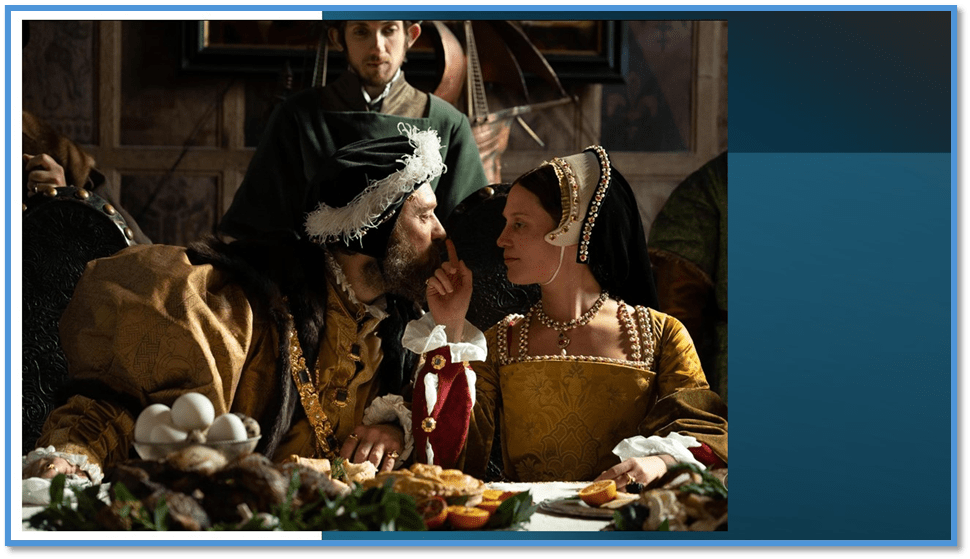
Notice in the Scene above how Katherine with one little digit of her hand silences Henry, if momently, which act takes a whole hand pushed in her mouth when Henry does it. Moreover, a consequence of Law’s brilliant portrayal of a man who at 55 must walk like a very much older man, even of that period is the way in which Katherine knows by the supposed instinct all family carers have for their disabled or ill relatives that is in fact a skill learned through bitter experience of blame for failing their cared-for by the cared-for and of genuine love, on both sides. It is in fact the secret of the film’s shocking denouement, this silent trust implicit in the ‘caring’ relationship. Henry uses a stick with great expertise, his disturbed and unsteady gait appearing as one the King hates to show in himself but must, relying on his wife to walk with him to take off some of the pressure on the stick and transfer it to her.
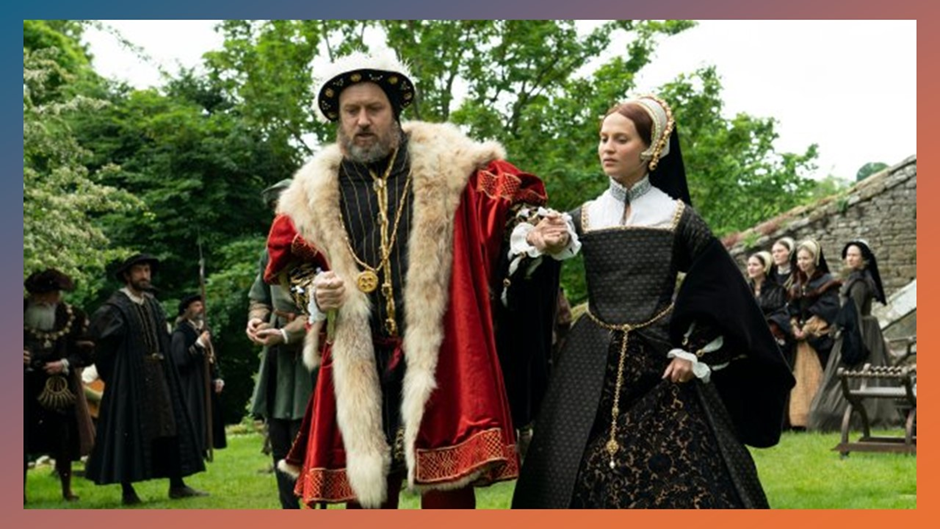
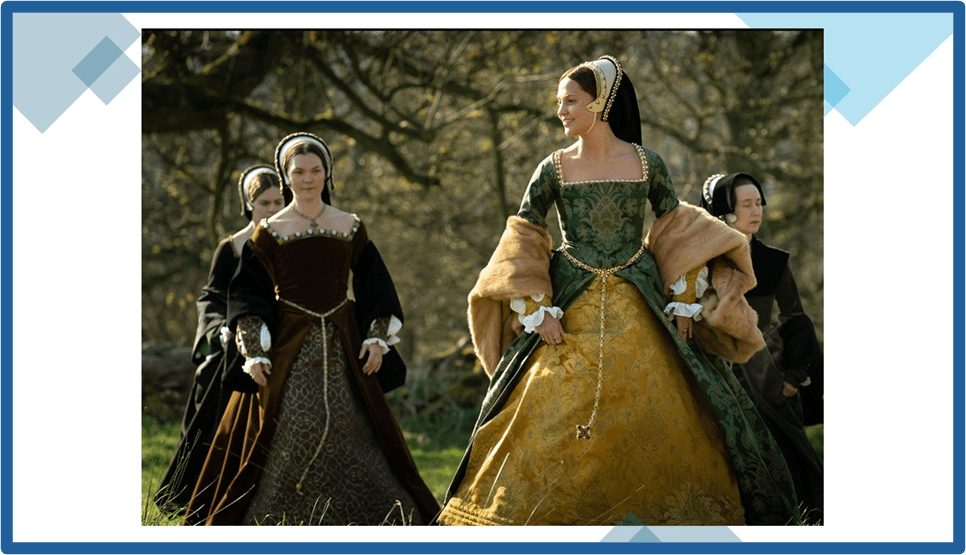
In the film’s opening whilst Henry is at war in France, Kathrine is not only active but commandeering, putting up with no nonsense from men in her retinue who had ordered that she never be left alone without them representing the King’s eyes, persuading them she knew the rituals attendant on Marian worship better than they (she says only women may visit Her shrine, a lie at which the King and Bishop of Winchester, Stephen Gardiner) roll their eyes). Treading the woods with only her gentlewomen, she is ever inch a Queen of all she surveys, which even her woodland-coloured costuming seeks to convey.
And it is not the King alone she must fear. Her arch enemy is the same Bishop of Winchester, Stephen Gardiner, whom I had wrongly though to have been burned under the Protestant rule of the Seymour family Protectors of Edward VI. In fact the wily old man, having had a role in the break from Rome, intended to maintain Catholic ritual in the church, including the use of Latin (the only feature the film focuses upon) but was imprisoned with Princess Mary and other recusants until he took on the highest Office again under Mary I. Even under Elizabeth he was allowed to die. The review of the film in The Church Times (it is rare I cite this publication) by Stephen Brown sees Katherine as the true predecessor of modern Anglicanism, even of ‘honest doubt’ in its last sentence, which I doubt was an idea in her mind, being more a product of the agnostic tendency growing in the English Church since the nineteenth century. Brown says:
Katherine walks a tightrope between not antagonising the King and being true to her religious convictions. She believes that God chose her to change Henry’s mind. Gardiner is her nemesis. Women, he declares, have no more business with the scriptures than a pig has with a saddle. To this, one of the Queen’s loyal women-in-waiting retorts “Better a pig with a saddle than an ass with a mitre.” … / …/
Firebrand is at its best when exploring how Reformation values undermined patriarchal rule. Time and again, various characters’ outright certainty is revealed as fear that an alternative vision will destroy them.[3]
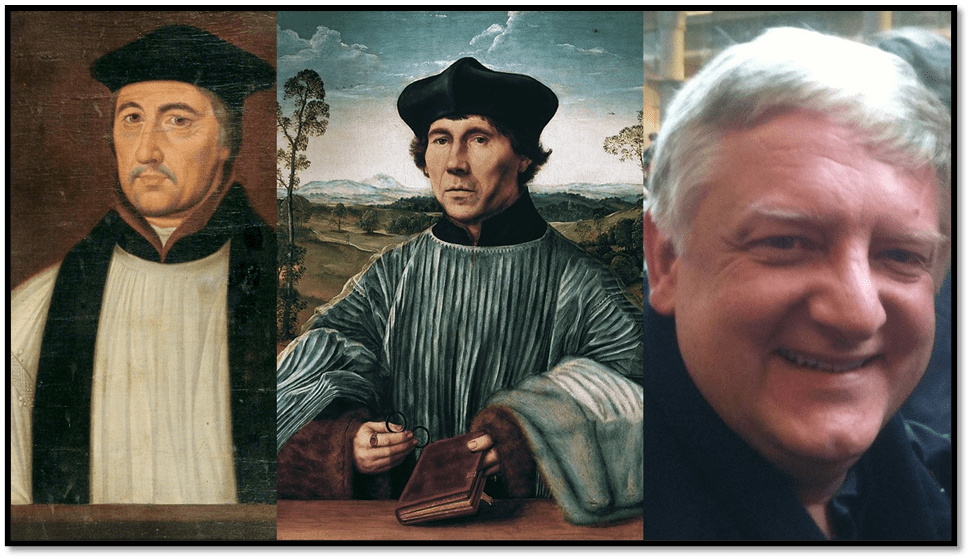
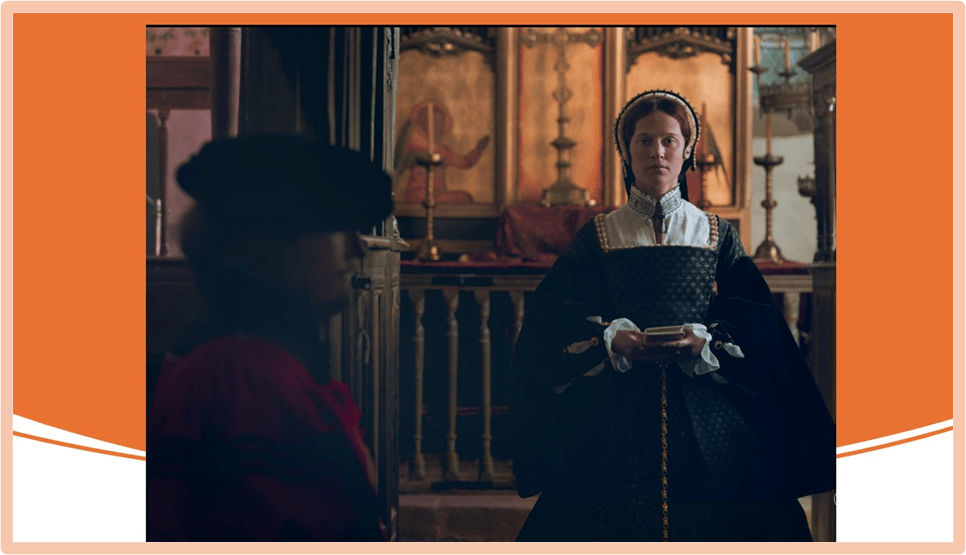
The myth of Gardiner remains lively it seems in Anglicanism. Like the Papa in Rome himself, Gardiner has become the repository of ‘patriarchal values’ of the Roman Church. The role is brilliantly played by Stephen Russell Beale, another actor against which Vikander’s acting stands up strong. But Brown is also right to point out that complex religious belief systems, even those of Henry himself who was no theological numskull, are not represented at all but in over-simplified conflictual forms. Rather we get images such as that below of Katherine when she has seen off Gardiner from her private chapel and prayed loudly in English from her own prayer book, standing in severe religious pose unbowed by the machinery of the male state around her – but that, of course, is all that films can do if they are to be at watchable.
Steele too says that the film ‘does not offer that much clarification over the nuances of the reformation, and viewers may well feel compelled to spend a fair amount of time on Wikipedia after watching, …’.. But that matters most I think not over issues of liturgy but over their political consequences. At various times Gardiner whispers to Henry the threat to his secular power of ordinary people deciding how they should worship, but radical politics, such as would become more prominent in the Civil War much later were already sprouting, indeed had been since the Middle Ages. Are though these radical strains of Protestantism, some truly Republican, even communitarian, really given much weight in this film?
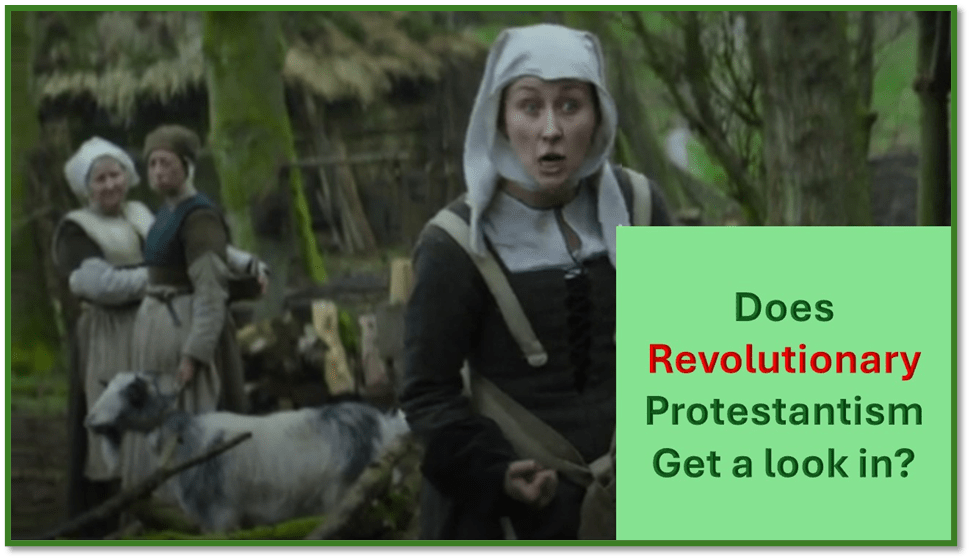
The answer to this lies in your view of the success or otherwise of the role of Anne Askew. Anne in the film is a true ‘firebrand’ and although her aristocratic origin is clear from her prior friendship with Katherine, a relationship as near to equal love as anywhere in the film – perhaps like nowhere else in the film. She is seen in contrast with Katherine walking with fine clothes in the woodland in peasant gear, making herself one with the peasantry and small town dwellers and their domesticated small-holding of animals. Her talk gets ‘red’ enough t make even Katherine’s loyal gentlewomen fear heresy> Yet none of that radicalism itself seems to matter in the denouement of the film where all the issues resolve into those of the language of Church liturgy and to predict the Elizabethan Settlement thereof. In fact, this is possibly nearer the truth of the real Askew and the truth makes Stephen Gardiner appear even more a monster than some of the film.
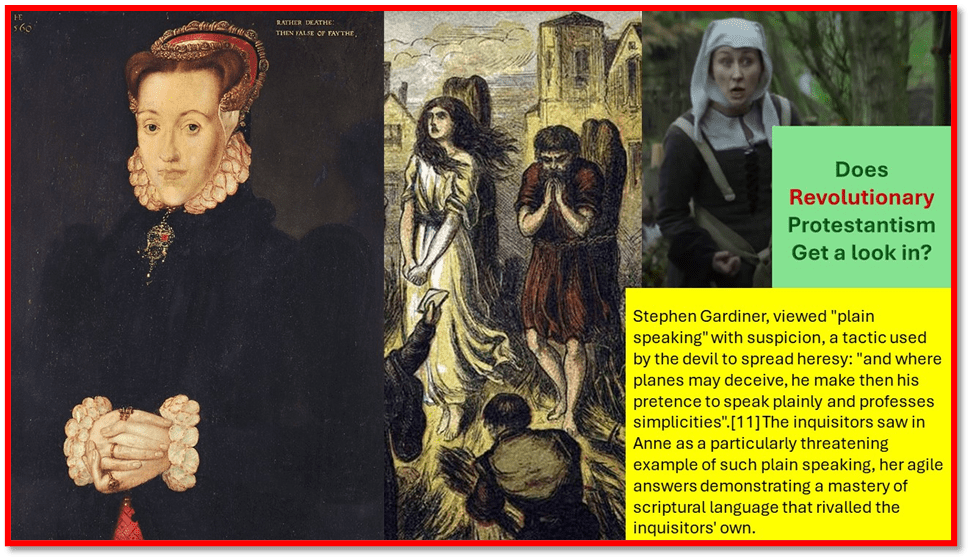
Yet burn Anne Askew did. The film uses this to increase suspense around how and when Katharine will be seen as the Protestant she was by the religiously prevaricating Henry, always aware of the consequences of change on his own power base the film tries to say. In the film Katharine gives Anne jewellery given to her by Henry to finance the Movement. We are led to believe that this is what happens after Anne’s death but the necklace is found in Protestant Europe by Thomas Seymour (Sam Riley), Katharine’s former potential betrothed. He promises to give it back to her to clear her name with the King.
Here the power games set in. The King uses his influence with the leader of the Protestant group of councillors led by Thomas’s elder brother, Duke of Somerset Edward Seymour (brother of Anne Seymour, Henry’s third wife and mother of Prince Edward) to show that were he to find proof of Katharine’s treachery to him (circumstantial though it be) he would not lose his favour in Court, where Katharine to be executed.
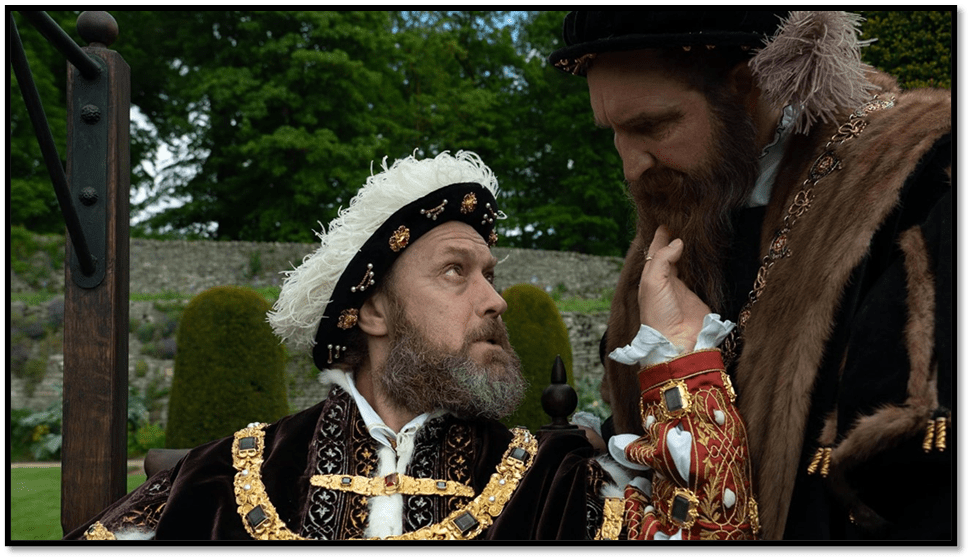
The King has a word in Edward Seymour’s ear
Edward persuades Thomas to give the compromising necklace regained from the foreign Protestant Movement to him and yet another man betrays Katharine to what he knew would be her certain death. None of this appears to be supported by known historical evidence but I makes a fascinating net of alliances demonstrating the power of patriarchy over the boundaries of Protestantism and Catholicism, which was indeed the case.
In the end the film convinces us that Anne learns self-protection and the one source of possible active power in the extreme privacies of her relationship with the King from being artful as a Queen. Artifice and art, like fiction and truths, can often have very fuzzy boundaries, as every English poet or lyricist knew, even the accomplished prince Henry, although the continuing false belief that he wrote the ballad Greensleeves is another instance where fiction and perception of truth part company. In a bitter moment in my life I once evoked one of the greatest Tudor poets in this strain. Here is the blog’s text:
The romantic is a sensually and imaginatively heightened form of interaction between people, although I sometimes feel it is mainly a narcissistic experience entirely for some and a little for everyone. It elevates the physical sensation so it isn’t the opposite of the embodied or ‘sexual’. It engages the mind and feelings with the senses. It is a source of both truth and deception, for its root is the making of fictions. As Sir Philip Sidney said:
Loving in truth and feign in verse my love
To show.As soon as you show it, you feign it that it is. But it’s potentially TRUTH of course.
Anne has learned the Art of Being Queen. It is an art, and employs art, that I think the film hints the wily Princess Elizabeth learns fro the wily Queen Katharine (the second of that name – the other being the mother of Princess Mary). In the still below, the scene is set as if in a Tudor group portrait and is backed by examples of such as frescoes or tapestries on the wall. It is most beautiful cinematographically and bears a lot of meaning about the nature of artifice in conveying belief in truths, hard otherwise to prove by mere assertion.
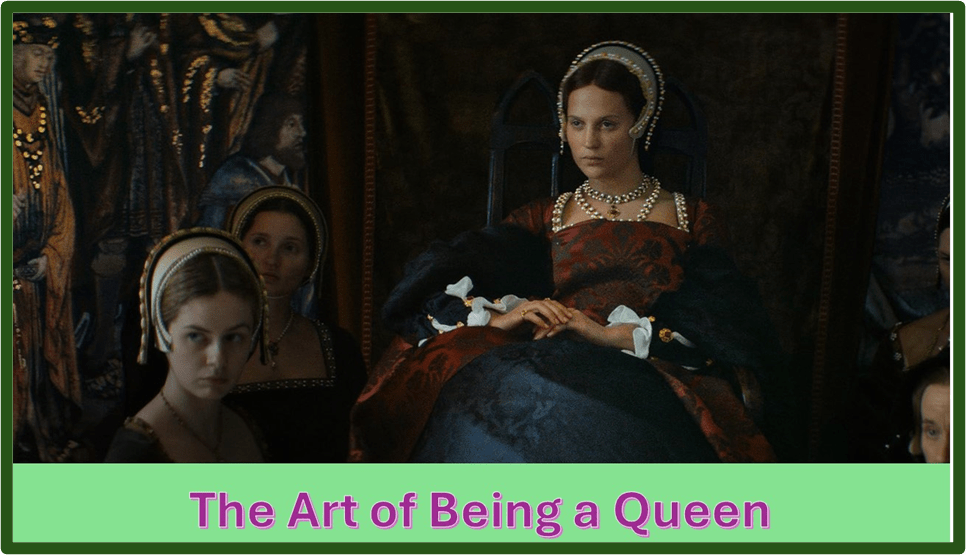
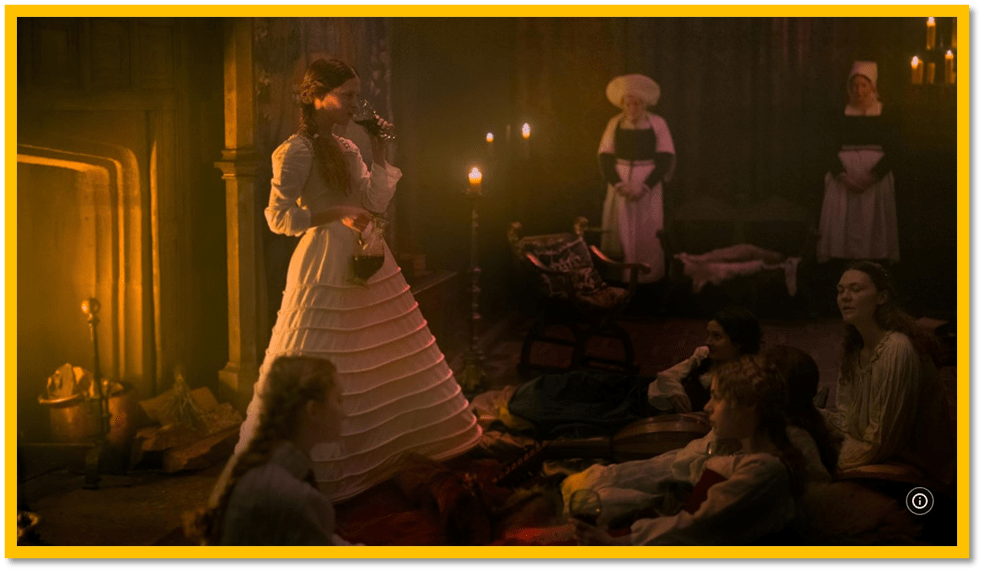
There are bolder more modernist-surrealist forms of the association of Katharine with art – of a rather wild art containing only women in which the aristocrats in focus let their hair down (always an important icon of female de-regulation even in Tudor poetry) in a way which contrasts with the stiffly over-regulated clothing and hair-pieces of the women in waiting at the wall behind them. The looseness of design of the framed image (so unlike the last example) is almost scandalous in its wild beauty.
I think I have got by without the worst of SPOILERS n this piece. See the film. Do, We are in a run of good films soon that I personally cannot wait to see and MIGHT eclipse it, but might not, such as The Critic, The Outrun, Lee, Conclave and The Return.
All my love
Steven xxxxxxxxxxxxxxxxxx
[1] Francesca Steele (2024) ‘Firebrand review: Jude Law is revolting and ruthless as Henry VIII’ in The I newspaper. (September 6, 2024, 6:00 am(Updated 6:01 am) – available at https://inews.co.uk/culture/television/firebrand-review-jude-law-3258676?ITO=msn
[2] Robert Abele (2024) ‘Review: Jude Law rages through ‘Firebrand’ as a mercurial royal while Alicia Vikander hangs on’ in The Los Angeles Times (June 14, 2024 5:26 PM PT) available at: https://www.latimes.com/entertainment-arts/movies/story/2024-06-14/firebrand-review-jude-law-alicia-vikander-henry-viii-royals
[3] Stephen Brown (2024) ‘Film review: Firebrand’ in The Church Times (06 September 2024) available at: https://www.churchtimes.co.uk/articles/2024/6-september/books-arts/film/film-review-firebrand

