


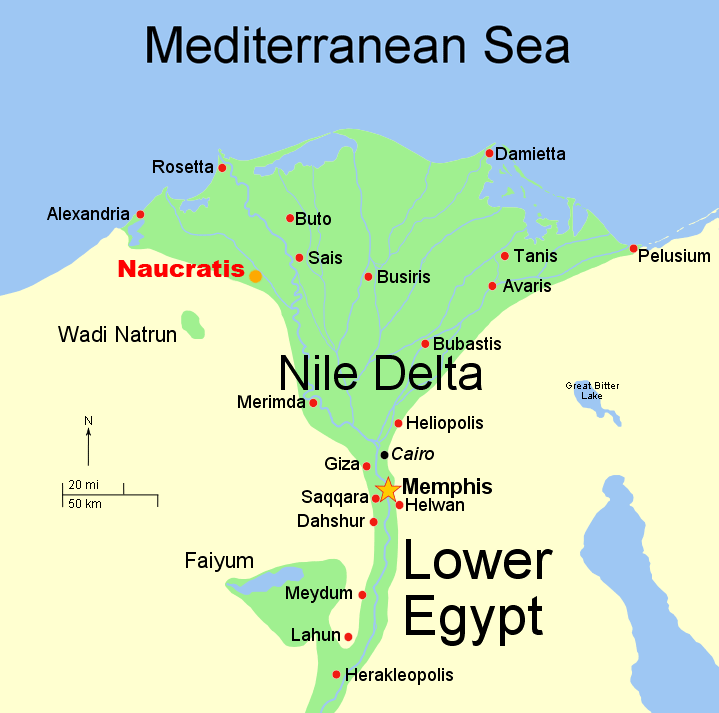
The Nile Delta city of Naukratis: By ChrisO (talk) – self-made, CC BY-SA 3.0, https://en.wikipedia.org/w/index.php?curid=16176388
Amasis II became Pharaoh in Egypt (reigning 570–526 BC) by the aid of Greek soldiers. This was a blessing and a curse, because reliant on a powerful foreign, and virtually stateless) army meant he might also be potentially under their control. What better to do than give them a city that they could convert into one of the largest shops of his nation but ensuring a constant exchange therein of cultural artefacts and practices, which extended his tastes and saved him the bother of the arduous job of keeping shop. He gave them Naukratis (Ναύκρατις) – Power or Command of the Sea – to build and set up a city on a mighty river accessible to the sea that was also a ‘shop’ (emporium) controlled by him but with its detail worked by and administered by the Greeks, who were thus kept busy from interfering with what Amasis wanted from them. Wikipedia summarises Herodotus thus:
Herodotus stated that “Amasis was partial to the Greeks, and among other favors which he granted them, gave to such as liked to settle in Egypt the city of Naucratis for their residence.” Notice that he says “gave the city (πόλῐν),” which seems to indicate the existence (now borne out by archaeological evidence) of a “city” already there. This older city, settlement more likely, was no doubt small and inhabited by a mix of native Egyptians, Greeks and possibly even Phoenicians. Thus it seems the city was turned over to the Greeks, “chartered,” in the years immediately following 570 BC. The earlier date of c. 625 BC put forward by archaeologists may be the actual establishment of a settlement at the site.[7]
Amasis indeed converted Naucratis into a major treaty-port and commercial link with the west. This was done most likely as a means to contain the Greeks and concentrate their activities in one place under his control. It became not the colony of any particular city-state but an emporion (trading post)[8] similar to Al Mina, the largest market port of north Syria.
The Story of Naucratis, in the first century BCE Egypt from: https://en.wikipedia.org/wiki/Naucratisn
Amasis II - Photograph by Osama Shukir Muhammed Amin FRCP(Glasg) - Own work, CC BY-SA 4.0, https://commons.wikimedia.org/w/index.php?curid=92683103

Empower'd in dreams, becoming Pharaoh
Amasis in my dreams, want yet that grace
Felt in the blood, and felt along the heart;
To become that cultured mind that might have
Everything, said to myself: "don't try
Owning that sweet lightness of  the world
Instead just watch it bought and sold by those
Who know it best and command with ease that
Sea of  changing goods, passing from hand to
Hand of a band of loving men".
                                                                 I said
It and it was done. The best of cities
Grew into a shop of goods yielding to
The strength of other goods. Fine Attic jars
With juice of olive filling them from Tyre
Slaves whose muscle turned useful in my mills.
Texts of ancient drama served the hungry
Need for thrill, with some meaning still to feed
My sense that it all mattered.
                                                            Matters still
Troubled me: Was plenty in goods enough
To teach me how to sail the seas of hearts
That loved moving on not me. I am not
That which commands the Sea but they, those men
Whose muscled minds make exchanges live,
Greeks, who love me now, but still for how long.
With love
Steven xxxxx
Love never fails. But whether there are prophecies, they will fail; whether there are tongues, they will cease; whether there is knowledge, it will vanish away.
1 Corinthians, Chapter 13, verse 8.
 Steve_Bamlett_blog