What’s your favorite game (card, board, video, etc.)? Why?
Let’s start with some social psychology. The theories of George Herbert Mead were collected together from notes made by his students and their attractiveness as a theory of child development to me might be explained by the way in which these theories seem to represent themselves as things that made students own and promote them to the world so it could take them seriously too. The self consists of two components for Mead, the ‘I’ and ‘me’, both of which must be understood in terms of the child confronting the ‘generalised other’.
The ‘I’ and ‘me’ can only be understood in terms of each other, each being perceptible only in the other’s opposed existence. The ‘me’ is the self seen as an object, as I imagine another sees it. Since some ‘mes’ are more generalised, such as the ‘me’ in a specific recognizable job role, there is hence the need for a structure of roles in the eye of a generalised other in order to stabilise ‘me’ in those contexts. ‘I’ is the subject through which varied ‘me’s’ finds a subjective focus and is more difficult to specify or describe.
Mead thought there were 3 stages of development of the self, as in the graphic below. .
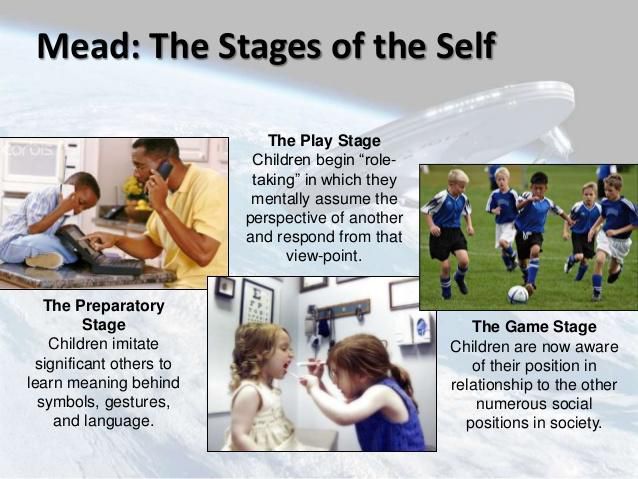
In the second, the play stage, the child role plays another as a version of itself, such as in play fantasy families or being a nurse or teacher. In the game stage, the playing comes to be understood using a more ‘objective’ and shared social structure and regulation and involves differentiation of ‘me’ in terms of the roles in a game. The most telling role is of the winner, or winners, in terms of team sports, which presupoose a loser or losers.
One particular dangerous role is that of the person who fails in the game, even to be a loser. This role never attains to the regulation required to be ‘me’ in the game and falls by the wayside and is alienated. These people hate games.
This is how I sometimes see myself, and when I do, I blame myself for my failure to take my personal development to a satisfactory completion. However, I also sometimes fancy that the game stage accepts roles in the game so thoroughly that they do not notice when some ‘me’ who loses a particular game might also be a figure in search of understanding at a deeper level. These ‘losers’ might look different if appreciated as subjective selves, interpreted not through success or failure in the game bit by empathy for their subjective difference and special nature’s. After all, empathy is a relationship between two ‘I’s’ not an ‘I’ or a ‘me’.
Thus, for now, I would like to stop blaming myself as incomplete and try to explain my not liking games, especially competitive ones, as an overdeveloped empathy. That may mean overmuch neuroticism, too, but you can’t win all the time. Lol.
All my love
Steven
 Steve_Bamlett_blog