



There is a tremendous blog by Anatoly Liberman in the Oxford University Press blogsite on the etymology of the word ‘bother’ that should give us pause before answering this. This blog shows that the oriigin of the word ‘bother’ itself bothers lots of people. He writes:
Bother is a late eighteenth-century addition to the vocabulary of English. It first surfaced in Anglo-Irish authors: Sheridan, Swift, and Sterne. Even later it was known so little that most dictionaries compiled in the first quarter of the nineteenth century did not include it, while those few that did called it slang. Three schools exist: according to one, the etymology of bother is unknown or uncertain (the latter is a genteelism for “unknown”); another school derives it directly from Irish; the third connects it with Engl. pother, though it admits that bother might be the Irish pronunciation of pother or at least influenced by pother. The first school has a noticeable advantage over the other two, but we will still have a look at the unsafe conjectures, before we flee from the battlefield.
To begin with, we may ask: “What is pother?” It means “choking smoke or dusty atmosphere; fuss, commotion.” If I am not mistaken, the first sense is “literary” and so archaic that hardly anyone remembers it. Pother appeared in English in the sixteenth century. At that time, it rhymed with mother, other, and the like. And the like is a tiny group. Mother, other, and brother have their present day root vowel from ō (long o), but a reconstructed form like *pōther leads nowhere (in historical studies, an asterisk before a form means that it has not been found in texts). That is what one can read in The Oxford Dictionary of English Etymology (ODEE).
There is a great example of ‘pother’ in Shakespeare, where King Lear equates it with the messy confusion in the heavens that is a storm in the senses of human beings who feel its force and Lear talks as if the purpose of it was retributive on the part of the Gods:
KING LEAR
Let the great gods,
That keep this dreadful pother o'er our heads,
Find out their enemies now.
(Shakespeare King Lear Act III, Scene II)
I remember one Arden editor of the play derived the word ‘pother’ from an East Anglian term for a ‘pothering’ stick used to disturb apples in a tree so that they could be harvested on the ground, the editor (I forget whom) said the word described the shower of applied ‘when the pothering pole was plied’. That always seemed quaintly inappropriate for the retributive anger Lear seems to imply, and even here the Irish etymology seems the best, as expressed by Liberman thus in testing ‘the hypothesis that bother is a direct borrowing from Irish’:
Since the first authors to use bother were from Ireland, this hypothesis looks reasonable. The Irish words cited in connection with bother are buaidhrim “I vex” and the like. Since one of them means “deaf,” it is often said that the original sense of the alleged Irish source of Engl. bother and of Engl. bother was not just “vex,” but “to deafen, bewilder with noise.” I am not sure that this premise is so obvious. The sentences are: “With the din of which tube my head you so bother” and “Lord, I was boddererd t’other day with that prating fool Tom.” Two citations do not go far, the similarity of the contexts could be due to a coincidence, and the gloss “irritate, vex, bewilder” (without reference to noise) suits both situations, especially the second, to a T. I would prefer to stay away from “noise” and “deaf(en)” as the semantic nucleus of bother.
The authors he mentions are eighteenth century Anglo-Irish authors including Laurence Sterne and Jonathan Swift, but the meaning seems much nearer to ‘pother’ as used by King Lear, including the sense that the Gods’ ‘dreadful’ vexation with human beings is an unholy din in the heavens until it finds its guilty victim of their justice. In modern slang usage, as in the Catherine Tate’s comedy character, Lauren Cooper’s signature line is ‘Am I bovvered‘.

In the obviously slightly unreliable Google n-gram, the frequency of the word only seems to rise in the ate nineteenth century as authors strain to put what they believed to be more representative demotic (or perhaps ‘slang’) words into literature representing wider groups in society.
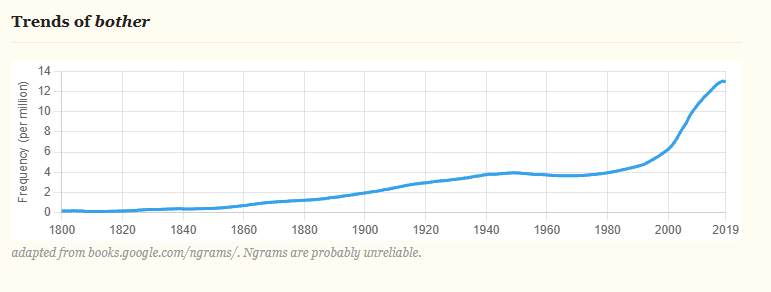
The spectacular rise of frequency in the twenty-first-century may represent the media power of the almost satiric use of the word by Tate’s Lauren Cooper, or the more telling line I remember: ‘Does this face look bovvered’. The cool rejection of the disdain of others is precisely the heroic stance being satirised, often with a sneer at the ‘commonness’ of those who use such phrases, if, in fact, they do. There is something sinister in my view in the trend to make it unfashionable or ‘uncool’ to look or indeed be ‘bothered’ by things.
The Random House WordReference site gives the contemporary USA English meanings attributed to the word both as a verb, the form in which we are asked the question in this prompt, and a noun.
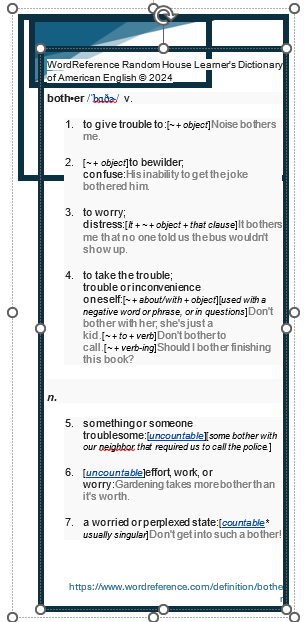
The noun references often semantically infest the verbal forms of the word. There are negatives applied to people who look or betray that they are ‘worried or vexed’. The example here (‘Don’t get into such a bother!’) is typical of the rather common modern assumption that outwardly expressed feeling is problematic and ought to be avoided. To be bothered even in the verbal sense in meaning 4 above is exampled in rather a negative sense, as if being ‘bothered’ by something was in excess of requirement. As an active transitive verb ‘to bother’ someone is to be even more impertinent. We are not meant to communicate active emotion to another or perturb either their real or pretended state of cool calm. hence, I suspect, people will, or even should approach this question with caution if they want to appear cool to others, and perhaps with a sense of irony. Some may say: ‘Nothing bothers me. I don’t allow it to’, and go on to recommend mindfulness training or relaxation therapy.
But, at the risk of looking even weirder than I usually do, I have to say that it bothers me that we are not meant to be bothered by the injustices of an-unjust world and that I often feel with King Lear the need to rant and rave on a public health on general and specific injustice, and particularly at the hypocrisy of governments. Today, David Lammy, the new UK Foreign Secretary, is visiting Israel to plead for ceasefire. As for restoring true balance to the issue by recognising a state of Palestine and supporting with the majority of countries except the USA the humanitarian object of the work of UNRWA against the defamatory accusations against it as a terrorist aid (this is the United Nations, for God’s sake). Meanwhile the media is exhorted not to ‘bother’ us about the continuing death toll in Gaza and people ask for ‘rational’ debate whilst the most irrational acts are being perpetrated on the population of Gaza, without an ounce of evidence that terrorism is actually being targeted with any success or ‘precision’. How many children are allowed to die in a precise attack after all on an area designated ‘safe’ by the Israeli authorities. So be bothered and not just by tweeting as I do:

And to be bothered is to reject the passivity that is actually COLLUSION with injustice.
All my love
Steven xxxxxxx
 Steve_Bamlett_blog
