How do you waste the most time every day?

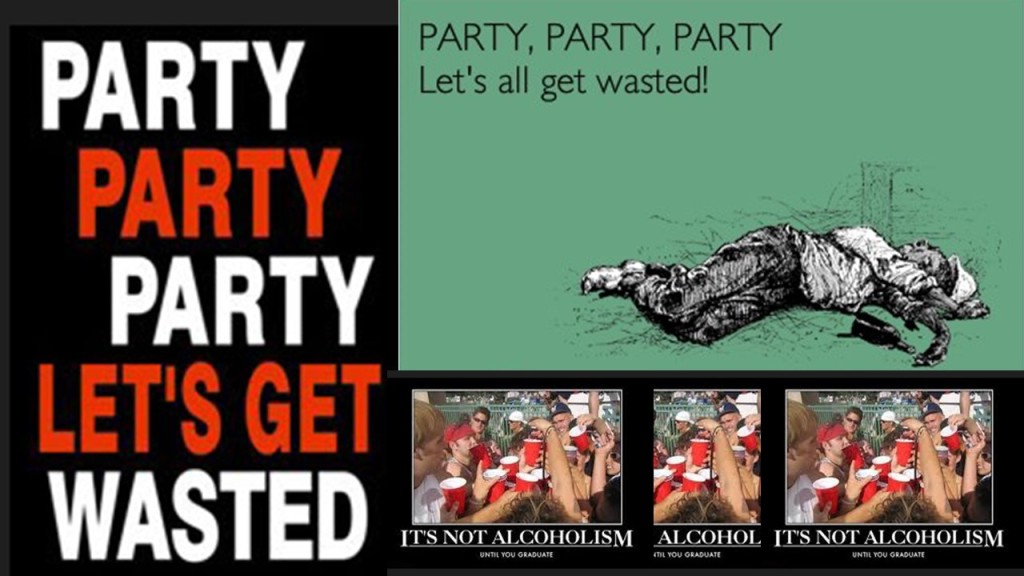
This gif is, as it is intended to be, funny because it takes a number of negative clichés that get said in moments of stress and knots them together in a way that, all together, the effect is comic.
This gif is, as it is intended to be, funny because it takes a number of negative clichés that get said in moments of stress and knots them together in a way that, all together, the effect is comic. It is particularly funny for the ‘spirit’ of it is to honour the cliché of being ‘wasted. However, how did the state of being intoxicated, drunk, or ‘out of it’ on any psychoactive substance get the name of ‘wasted’? It is usually seen as an extension of the attribution to persons who look ill or frail as looking ‘wasted’ since that is often the result of the process, whatever its benefits in the interim, but the modern usage gives a positive meaning to the determination ‘to get wasted’ and that is what the meme above exploits, getting wasted is the equivalent of what we mean when we exploit another cliché, having the ‘time of your life’, as you ‘party’ with alcohol (or those other psychoactive substances). It seems to many who went there to be a phrase that lingers from days as a student, perhaps even survives in those people (of which I was once one_ as a nostalgic trip to those days felt to be ones of easy life and emotion, although that is most likely too an illusion (as the statistics for student suicide show).

Despitec this being common knowledge, there seems a pressure to look at alcohol misuse by students as a symbol of the pursuit of happiness and social pleasure – trust another meme on this: ‘It’s only ALCOHOLISM when you graduate!’
Whatever the nuance of the meaning of phrases like wasted time and spending time being wasted both at some level register the notion, probably the invention of capitalism, that time and productivity were oner and the same notion. This structuring of thought and feeling about time mirrors the ‘need’ as ‘liberal’ economists soon saw for a common basis of measuring time. The latter was a product, it is said, of standardising time for the purposes of rationalising the greater mobility of persons and resources required by large capitalist enterprises – in the invention of railway timetables in the UK in the nineteenth century, for instance) and their imposition (as Greenwich Mean Time) in the Empire.

Clock on the Exchange, Bristol. Showing extra hand for “Bristol Time” (11 mins ‘faster’ than GMT – ‘London time’). Railway standard time was introduced in 1840 to ensure transactions conformed to a common standard. Taken by Rod Ward 20th April 2007
Time is easily seen, when translated into productivity, as a thing that can be ‘used’ or ‘wasted’ by ‘owners’ of it as a ‘resource’. The bogeymen, because they were all men in the 1960s even though they often influenced most factory-time as experienced by women workers in textiles like my mother, who operated a spinning machine, representing this when I was a child were those ‘implementing ‘time-and-motion studies’. This breed are no longer prominent and this is almost certainly because of the ubiquity of new ideas of making all time productive and not ‘wasted’ time. If you want more on this return to that great classic of history E.P. Thompson’s The Making of the English Working Class. For most working-class people vast swathes of time are owned not by the person who experiences them but by their employer and determine their work routines, calendars of availability in the year (except for state-sanctioned holidays won by working-people’s action in union) and in the shifts that fill factory time, from that point.
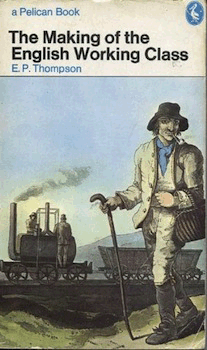
This paperback edition is like the one i bought when I was in the 6th form and that shaped me thenceforward. When, at last, I got chance to buy a copy of the print used as a its cover I bought it (in a closing-down 2nd-hand bookstore in York) and it now adorns our walls. Its treatment of time wasting as a concept used to regulate the working-class it is magnificent.
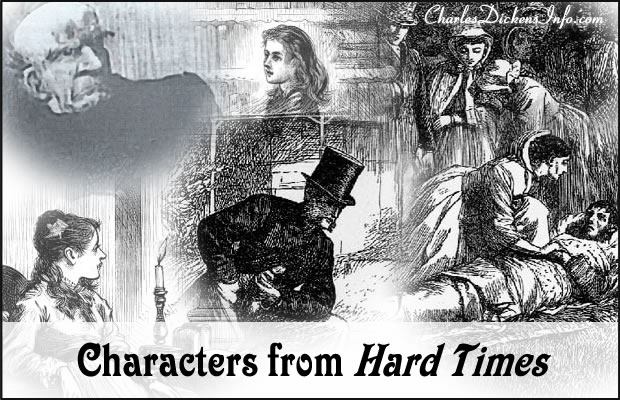
No wonder student days, even the concept of study – unless geared to the acquisition and maintenance of a work role that makes one a commodity in the labour market – are seen as a ‘waste of time’. And hence the tendency for a stereotype to grow that see any education (think of Thomas Gradgrind, the economist, and Josiah Bounderby the capitalist in union in Dickens’ Hard Times) who see only hard ‘facts’ as useful information and all else that passes as education as ‘waste’.
My own feeling is that this stereotype hardened into the policy that suddenly (under a Tory-Liberal Democrat government) introduced tuition fees, just as it ended the availability of grants for those unable to afford such education) an was even introjected by some students who began to feel their freedom from work was time to ‘waste’, or at least in which to balance ‘wasted’ time with work. The very presence of ‘wasted’ students – drunk and over-partied ones – real in a few cases and universally as a cultural meme, reinforced the stereotype. It is possible now to read booksfrom the USA that ‘prove’ that education is a ‘waste of time and money’ from right-wing gurus, taking a leaf from Ivan Illych’s Deschooling Society in some cases. The Daily Telegraph published a poll (but then of course like other right wing instruments they have always supported a ‘give the young ‘National Service in the Army’ theme, in principle) that suggests 32% of young people consider university education a ‘waste of time’. [1] No wonder undergraduate life is sometimes seen as ‘wasted’ and a time for partying to get wasted. Yet, as I pass over Palace Green in Durham I see a tent city protesting against Gaza. How is that a ‘waste of time’: it gives the only poor hope there is that our social framework is robust enough in parts to protest against genocide and starvation as tools of war.

And where am I going with this meandering reflection? I want to insist that the only waste of time is that which fails to appreciate that the gift of time is a value in itself, and is only a ‘waste’ if unappreciated, thrown away in real preparation for the suicidality of alcoholism or spent in mindlessness of the gaming and gambling of it promoted by most social media. Having fun, leisure or rest is not a ‘waste of time’ unless spent in forms which even the ones who do so know JUST to filling up empty time, that remains in reflection ’empty’ time. However, even some of the latter moments can be seen as full if they educate in concepts of what fulfills and what empties life of value (or spirit if you like – it is not a word I am comfortable with). For life only becomes so in its reflected nuance and is why I suppose Socrates felt an ‘unexamined life’ to be an empty one and to be avoided, even, if it has to be so, with hemlock.

I will probably return to my last statement for I am just reading Professor Edith Hall’s new book (2024), Facing Down the Furies, which aims to be a book about the ethics of completed suicide, including those in her family, and excoriates Socrates for not taking the option of life in being found guilty of crimes against the state in Athens and drinking hemlock to complete his self-execution, that Aristotle did.
But that will wait. Reflected life is never wasted, whatever the intensity of the reflection, and even when the reflection has negative affect attached to it. For life is not just meant to be lived but lived in the spirit of the word not just its letter. As I end, I remember Justin whose thought tended much to afterlife and discussions on it with a Catholic priest of the same name. He graduated and could have chosen life, but he chose never to examine, never to reflect, never to analyse what goods continuation outside of the trials of being ‘wasted’ might mean in the mixed experience of life with its negatives and positives. Death too soon was inevitable and it breaks my heart (again) to remember that.
Own your life if you can or at least do not allow those who own a lot of your life or claim to (whether employers or family) to consume it all. Vary the pace and the productivity, as E.P. Thompson tells us was once the norm, even if rural workers died in the process sometimes. Nibble at your free experience, reflect freely and with optimal pleasure and the necessary bit of pain. It’s worth it. You are worth it.
With love to you all, and Justin, and my beloved Geoff.
Steve xxxxxxxxxx

_______________________________________________________________
[1] https://www.telegraph.co.uk/news/2023/02/02/third-young-people-think-university-degree-waste-time/
 Steve_Bamlett_blog
2 thoughts on “Wasted time is the time you spend not appreciating having time to live life with varied pace and productivity, including the unproductive moments of rest and recuperation.”