Of course being ‘transported’ out of the current boundaries of own spatial and temporal location is not either addiction nor the action of a dangerous substance or even more dangerous behaviour but it verges on the same mechanisms in our non-rational experience. So let’s start with a biological explanation of being hooked on something, something with the power to ‘trip’ us,. to transport’ us, take us on a mental journey.
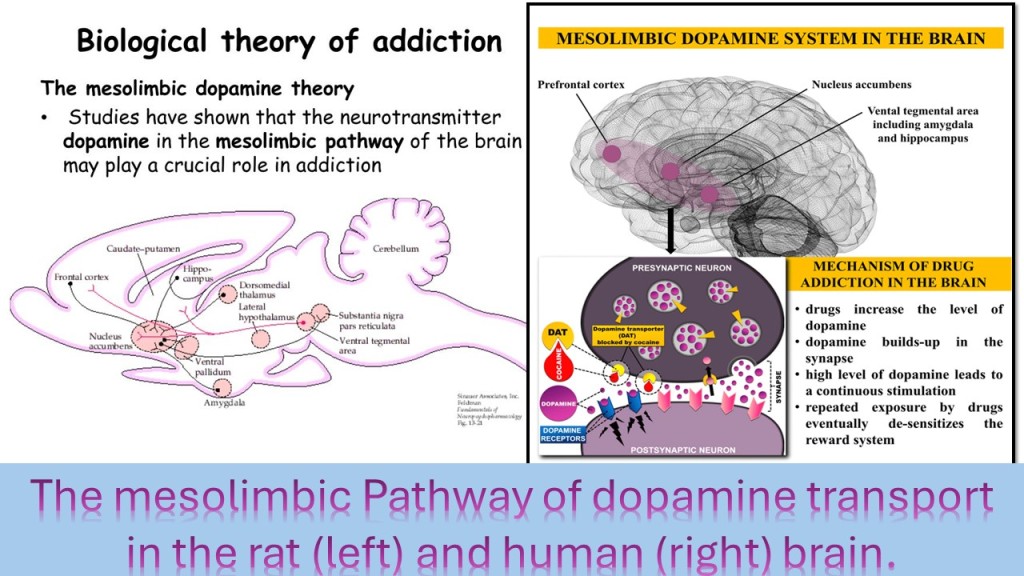
There is still ongoing work being done to establish the explanatory function of the ‘dopamine hypothesis’in relation to addictive drugs. There are studies that suggest too (as implied by my first link above) that the hypothesis also relates to the function of dopamine in behavioural addition like gambling and over-exercise. All are still questioned but have not been completely rendered unsupported, at least as partial explanations of the constant return to a substance and behaviour that ‘transports’ us. The role of dopamine seems both established and questioned as the sole explanation of addictions. Of food addiction people still query whether it is a substance or behavioural addiction although it is clearly both in obvious ways, but then show, we believe is addiction to illegal substances. In all cases however, the dopamine hypothesis is only sometimes used, and then by those committed to a medico-biological model as the driver of an illness or pathological syndrome. Below, I give an extract from the abstract to Wise and Jordan’s (2021) research that gives useful grounding to the theory, although the article confirms that the theory is still only a ‘theory’, a hypothetical explanation demanding more experimental testing.
Dopamine-depleted or dopamine-deleted animals have only unlearned reflexes; they lack learned seeking and learned avoidance. Burst-firing of dopamine neurons enables learning—long-term potentiation (LTP)—of search and avoidance responses. It sets the stage for learning that occurs between glutamatergic sensory inputs and GABAergic motor-related outputs of the striatum; this learning establishes the ability to search and avoid. Independent of burst-firing, the rate of single-spiking—or “pacemaker firing”—of dopaminergic neurons mediates motivational arousal. Motivational arousal increases during need states and its level determines the responsiveness of the animal to established predictive stimuli.
But underneath the jargon, it will still be clear to readers that the desire to be ‘transported’ by stimuli that are either substances, behaviours or induced habitual cognitive-affective (structures of thinking and feeling) states are what this tries to explain. Transport or ‘trip’ is a useful word for the goal of addiction since it appears to change our spatial and temporal boundaries to the imagined and / or imagined memory. Many of us, moreover, never distinguish memory (the return to old stimuli) and desire (the refreshing of its power to make us want and need it). It is the plaint of the lyricist in The Waste Land by T.S. Eliot:
April is the cruellest month, breeding
Lilacs out of the dead land, mixing
Memory and desire, stirring
Dull roots with spring rain.
But who does not want their ‘dull roots’ stirred? And one way is to make present, and even cast into futurity our memories such as they become desires; instinct with the fantasy desire enables and which, in turn, enables more desire. Accounts by people addicted to food speak of those people feeling constantly empty, requiring fulfillment but so do accounts of drug addiction and behavioural addiction, where the thing absent is sometimes ‘hope’. It appears many of us say that we love to be ‘transported’ to the past and will seek such ‘transport’. It helps if such a desire for exit from a lesser present to a fancied past of high engagement with our appetite, and certainly the appetitive hunger that is characteristic of the child, both in positive and negative terms. Children passionately desire repeated gratification but likewise easily reject food that raises bad associations, rejecting it and sometimes dramatically projecting it out of themselves.
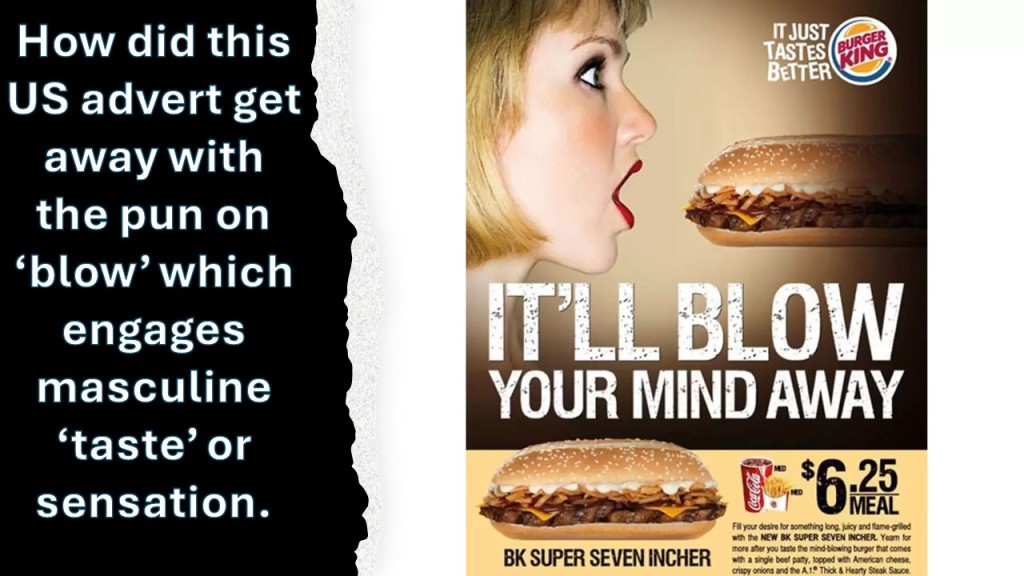
Fantasy is oft employed in raising demand for food, often using sexual imagery (sometimes grossly as below) but more often and more acceptably using childhood nostalgia.
It becomes a common trait of how the commodity has its desire rating renewed. There is a very fine example of this. The cinema chain, VUE, commissioned research by interviewing a sample of 2000 potential cinema goers in the UK to find out which foods took them back to a pleasant, and perhaps even desired, memory of childhood. They in fact found that ‘according to the poll, the smell and taste of certain foods makes 50 percent of us happy, while 43 percent said food which remind them of their childhood made them feel comforted‘. And remember too that there is the implication of desire; they also found that ’78 percent of those surveyed said they actually PINE for the food they ate as a child or teenager and the top reason given was not flavour’. Limited to what of these items they could provide as ‘rewards’ in a cinema VUE offered coke floats to audiences ‘free’ for those who paid to watch a film with them (even though coke floats were chosen by only 11% (but then it is unlikely they’d serve ‘Mum’s roast dinner’ the massive leader of the nostalgia board poll.
Otherwise selections were for the soft (and often sugary) foods:
Rice pudding (39 percent), soft boiled eggs and soldiers (30 percent), fish fingers (29 percent) and arctic roll (28 percent) made up the top FIVE – with choc ices, orange squash and cola cubes also emerging within the list of instant memory triggers.
And it seems these foods are vital to British identities, with around four out of five (78 percent) respondents saying they feel nostalgic just thinking about certain foods which they enjoyed when they were younger.
20 percent said their biggest nostalgia trigger was bread and butter pudding, 11 percent voted for the classic coke float and one in ten voted for tea time classic, beans on toast.
I suppose I would have gone for soft boiled eggs and ‘soldiers’. But only soft ones. I think that commonality in people might explain why so many of us get shirty when our boiled eggs come with hard yolks, whether we dare order ‘soldiers’ for dipping into them or not.
But deliberatively raising commodity satisfaction aside, I think yet another finding of the research is even more important and less likely to form a prompt question on WordPress. Well here goes:
There were however some unpleasant trigger memories dredged up by the poll, with liver (26 percent), soggy cabbage (25 percent) and lumpy mash (22 percent) heading the list of least favourite food memories.
Also, making us wince were Spam (19 percent), lumpy gravy (17 percent) and cold custard (12 percent).
I love that image ‘dredged up’. Out of the slime and ambiguous mud and waste at the bottom of our memories comes the fact that childhood is as most triggered by the overreaction to the repulsive in texture and taste. Even with drugs there are ‘bad trips’ as well as good ones. Science fiction often involves transport to deceptive places whose beauty masks repulsive horror. As always Milton got it right in his endless punning on the ‘transportive’ experiences of his angels, and mostly his chief and heroic fallen angel, Satan. In Book 9 of Paradise Lost he lands in Eden and is again ‘transported’ by its beauty and that of Eve. Cunning and clever however, he builds a theory of what transport to an earlier innocent age means for a devil with some experience of all kinds of new and adult hot experiences.
Thoughts, whither have ye led me, with what sweet
Compulsion thus transported to forget
What hither brought us, hate, not love, nor hope
Of Paradise for Hell, hope here to taste
Of pleasure, but all pleasure to destroy,
Save what is in destroying, other joy
To me is lost.
The dopamine hypothesis might come of its own here. Transported by the ‘sweet‘ and the ‘taste of pleasure‘, he determines to give it commodity value – to destroy the ‘compulsion’ to innocence by combining it with his world project: ‘all pleasure to destroy’. What he aims for is to replace simple pleasure with a concomitant feeling of universal loss, of pining desire, never fulfilled, for what is ‘lost’. You can imagine the joy of Burger King and VUE Cinema at that, for the unfulfilled buy more than they can afford and continue to do so in order to try and slake an unsatisfied appetite created by the apparent sweetness of desire for the distant past. Maybe Satan then becomes dopamine, working on Eve’s demand for satisfaction, even in the knowledge denied her by moralising Patriarchs like God and Adam. What Eve tastes is as much ‘fansied’ and made up of affective-cognitions like ‘expectation high’. Desire leads straight to ‘lack of restraint’, to addiction, and then to the favoured phrase expressive of repulsion in all poetry: ‘And knew not eating Death’. it is the simplest of ambiguities. She does not know the sweet apple is also repulsive, is in literal decay, so that she is in a sense eating its decay. Moreover, she does not know that, from henceforward Death will eat her and the offspring of her body. In Book 10, Death, the son of Sin, helps Sin to build a bridge to the world denying himself for a while that taste of ‘carnage’ and human flesh that awaits him. But let’s look back at Milton’s luscious verse in which Eve eats and is transported:
......... Eve
Intent now wholly on her taste, naught else
Regarded, such delight till then, as seemd,
In Fruit she never tasted, whether true
Or fansied so, through expectation high
Of knowledg, nor was God-head from her thought.
Greedily she ingorg'd without restraint,
And knew not eating Death:
And those memories of childhood food when we try them out (being in real substance a show of our ‘fansied’ dreams of return to perfect satisfaction), usually disappoint so much that we deny they disappoint us and talk about being taken back and being perfected. We forget except in our guilt at succumbing the many instances of hard yolks that will not yield to soldiers turned soft with butter, the remembrance of the decaying stink of over-boiled cabbage, and the slippage down our maw of greasy slimy liver with its taste reminiscent of urine and blood.






 Steve_Bamlett_blog