


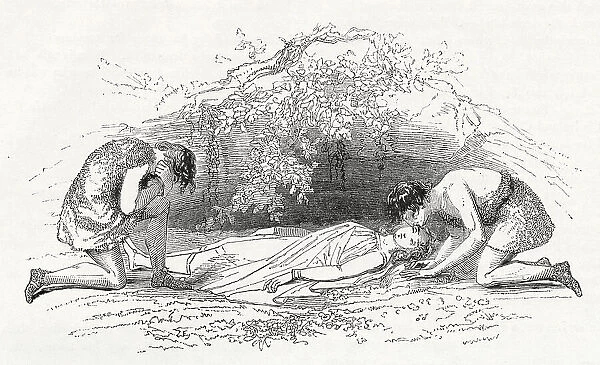
In Act 4 Scene 2 of Cymbeline, a late play of Shakespeare’s, is one of his most famous songs, possibly made so by Virginia Woolf’s obsession with it. It is, though, rarely reprinted as the dramatic lyric or part song, distributed between two roles that it is (Cymbeline, Act , Scene 2, lines 331 – 354). The whole scene is available at this link). In it, two boys mourn the supposed death of another boy they both love and know as Fidele. It is shown in the nineteenth-century Kenny Meadows illustration below:
SONG]
Guiderius. Fear no more the heat o’ the sun,
Nor the furious winter’s rages;
Thou thy worldly task hast done,
Home art gone, and ta’en thy wages:2660
Golden lads and girls all must,
As chimney-sweepers, come to dust.
Arviragus. Fear no more the frown o’ the great;
Thou art past the tyrant’s stroke;
Care no more to clothe and eat;2665
To thee the reed is as the oak:
The sceptre, learning, physic, must
All follow this, and come to dust.
Guiderius. Fear no more the lightning flash,
Arviragus. Nor the all-dreaded thunder-stone;2670
Guiderius. Fear not slander, censure rash;
Arviragus. Thou hast finish’d joy and moan:
Guiderius. [with Arviragus] All lovers young, all lovers must
Consign to thee, and come to dust.
Guiderius. No exorciser harm thee!2675
Arviragus. Nor no witchcraft charm thee!
Guiderius. Ghost unlaid forbear thee!
Arviragus. Nothing ill come near thee!
Guiderius. [with Arviragus] Quiet consummation have;
And renowned be thy grave!
Cymbeline is a play about being forced to love a person you do not love and about the mistakes you make in loving the person you think you do love indeed. It is full of threats of violent abuse – rape in particular as an instrument of power and punishment. Princess Imogen tries try to escape equally bad choices of men that either others or herself make for her (Cloten chosen by her father, Cymbeline, or Posthumus chosen by her) , though she seems to hang on to belief in her love of Posthumus (a man named after the buried dead still in action) by changing sex/gender and finds love, as a boy named Fidele (Faithful) , from two other boys Polydor and Cadwal, who are in fact her lost brothers (unbeknownst to any of them), Guiderus and Arviragus respectively. That the brothers, destined to be royal, chose the faithful love of a man for themselves and can’t not be noticed.
Incest and same-sex love are neither acceptable resolutions and the play has to restore Imogen to her chosen lover, even though he plotted to kill her. It’s weirdly complicate, so here is the Folger online edition’s quick synopsis of the whole play.
Synopsis:
Cymbeline, which takes place in ancient Britain, is filled with hidden identities, extraordinary schemes, and violent acts.
Long ago, the two sons of King Cymbeline were abducted, leaving Cymbeline with a daughter, Imogen. Cymbeline’s stepson, Cloten, is now his heir, and Cymbeline expects Imogen to marry him. She secretly marries Posthumus Leonatus instead.Banished from court, Posthumus makes a foolish bet on Imogen’s chastity, which leads to false evidence that she has betrayed him. He plots to have her killed, and starts by sending her on a journey. Meanwhile, still angry about Imogen’s marriage, Cloten plans to find and rape her.
Imogen—now disguised as a boy, “Fidele”—unwittingly encounters her brothers, who have grown up in a mountain cave unaware of their princely origins. The brothers kill Cloten, but Imogen, horrified, believes they have slain Posthumus.
Cymbeline, meanwhile, refuses to pay a tribute to the Romans, who invade Britain. After the Romans are repelled in battle, Cymbeline agrees to the tribute, his sons are restored, and Imogen and Posthumus are reconciled.
The famous song is sung by the two brothers, both princes thinking themselves to be poor and ‘rude’ (in the Elizabethan sense, of course) pastoral Welsh boys, is sung over the corpse of Fidele, and tells of how fear of all that you might fear in the world can only be avoided when you are dead. Those things to be feared include in this song even things more basic than the murder plots by your husband or rape threats from your ex that drive the story of the play as a whole, like hot or cold days in their season or the effects of overwork or even misplaced love. The song is a powerful and weighty cultural statement and Virginia Woolf knew that, possibly she did so has she felt the stones in her pockets weigh her down into the River Ouse.

Woolf’s suicide note
The pursuit of ‘quiet consummation’ covers all of life we should note in Shakespeare’s choric elegy, from work, the ill wishes of others in social situations, even the inclemency of the weather, but it is a dusty rather than a pleasurable consummation, much like the passage from Ecclesiastes, Chapter 4 that this poem translates almost (below in the King James version), where we try to escape ‘all the oppressions under the sun’
4 So I returned, and considered all the oppressions that are done under the sun: and behold the tears of such as were oppressed, and they had no comforter; and on the side of their oppressors there was power; but they had no comforter.
2 Wherefore I praised the dead which are already dead more than the living which are yet alive.
3 Yea, better is he than both they, which hath not yet been, who hath not seen the evil work that is done under the sun.
4 Again, I considered all travail, and every right work, that for this a man is envied of his neighbour. This is also vanity and vexation of spirit.
5 The fool foldeth his hands together, and eateth his own flesh.
6 Better is an handful with quietness, than both the hands full with travail and vexation of spirit.
7 Then I returned, and I saw vanity under the sun.
We like to think we are in control of our fears, that they are merely internal cognitive structures that can be addressed through cognitive-behavioural-therapy (CBT) or a programme of mindfulness training. Ruby Wax once thought so but learned better in her last book (see my blog on that). In fact ‘fear’ (or the more generalised term Freud preferred ‘angst’) probably has to be accepted as the condition of living because we are not in control of much than lead to our destination in some kind of outcome, which is undesired or contains elements that ought to be seen as undesirable by some or most people. Thus Imogen accepts her Posthumus back. Woolf instead chose the bottom of the Ouse; as does Septimus the fate that comes of jumping from a high window in Mrs Dalloway. Clarissa Dalloway has her party and accepts the fear of ill continuance; of life, in short. There are consolations – if perhaps these had run out for Woolf by the time of that fearsome novella Between the Acts where the arist completes her suicide.
My own feeling is that we should agree with Shakespeares unarticulated wisdom, that which drove this drama to a conclusion that looks as fulfilled as we like to feel we can be but is underneath the surface still troubled. There is no alternative in life: there is no ‘quiet consummation’ that we can actually experience where there is no fear of loss, rejection or ill behaviour. As both beautiful Welsh boys in the song sing over the dead body of the boy they both loved and whom contained their faith in life (Fidele ,get it!):
All lovers young, all lovers must
Consign to thee, and come to dust.
That’s true, although they might have used a better test to prove that this was a truth now rather than a projected future, for we know that Fidele is NOT DEAD and will revive from death-like sleep. Truth isn’t made the truer by rushing to its consummation. Before the silliness of CBT and mindfulness, we used to urge that People Feel The Fear And Do It Anyway.[1] That’s my thinking anyway and it is not about ‘overcoming’ fears’ but accepting they are a bedrock of living, loving and ‘doing’. You would be right to think that the fear of not ‘having it all’ can’t last, but that’s a different thing (see my blog). Death will come whether we embrace it or not and all we have will be forfeit to time and others’ succession. Fear is unavoidable though even the good things (to wit, the embrace of life and its experiences) . Fear, anxiety or angst are life seen through another less distorted lens. So boys, clench your faith in love and love your boy Fidele, though he may leave you and/or die eventually, or, worse, turn into your sister and leave you heir only to power and wealth as a consolation.
With all my love
Steven xxxxxx
[1] Susan Jeffers, of course: https://www.amazon.co.uk/Feel-Fear-Anyway-Indecision-Confidence/dp/0091907071
 Steve_Bamlett_blog