


Minor Autopoesis: learning a lesson from Doctor Who.

Autopoesis is a jargon term created from two Greek words to mean ‘self-making from within’. The Greek words are, as cited in Wikipedia, the words, αὐτo- (auto-) ‘self’, and ποίησις (poiesis) ‘creation, production’). For a time, in art and literary criticism (in the 1990s) there was a fashion for equating it with a function of art and as a code for interpreting life through the agency of individuals alone. Artistic creation was a form of self-creation or extended dramatisation of the process we were told, notably by Stephen Greenblatt. Instead of fitting into prescribed social roles, people created a role consonant with their nature, the physical and psychological raw materials they were born with, and that only they could play. In playing this role to the full, a person fulfilled their potential in life, an organisation or society, of becoming defined as the best they emergently-could-be. In some accounts, that process of self-making from within never ends.
In other lazier accounts, people merely fulfil their nature by being themselves; making themselves from within is a process of constant careful externalisation of one’s inner nature. I think it is a lazy way of thinking because it substitutes essences for emergent realities. People are just what they, in their essence, are, in this account, not what they could become, and thus, this way of thinking is exceedingly common. Russell T. Davies, in his first Doctor Who outing this season last night, determined to make this his theme.
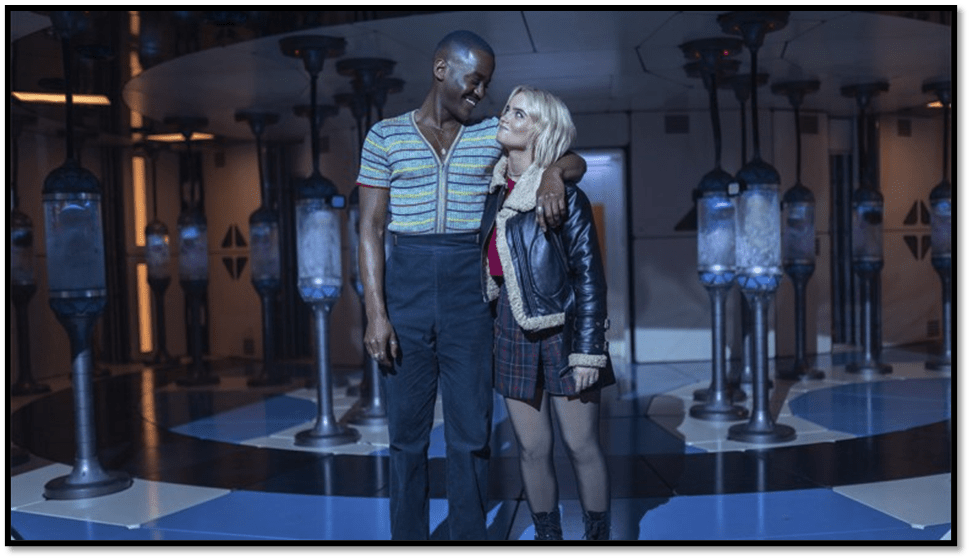
Ncuti Gatwa and Molly Gibson in the Space Baby manufactory
The new Doctor, played by the stunning Ncuti Gatwa, and his sidekick, Molly Gibson, become stranded on a space station in a fixed orbit and without motor propulsion and inhabited by ‘babies’ (the term is constantly self-corrected when used by the Doctor to ‘Space-Babies‘). The latter are looked after by a rather disturbed child-carer or nanny, who acts as if she were a robotic AI instrument built into the space station’s nano-technology, Nan-E (get it- tee-hee). Nan-E regulates the lives of said ‘babies (Space-Babies)‘, equipped with automated regulation of Space-Baby toileting, nose-blowing and wiping – and snot collection – by its mechanical devices. Just a note though before proceeding: given the long-winded way of referencing these Space-Babies, from now on, I will abbreviate the Space Babies to SBs to shorten that writing process and, perhaps, get some fellow feeling going between me (another SB) and them.
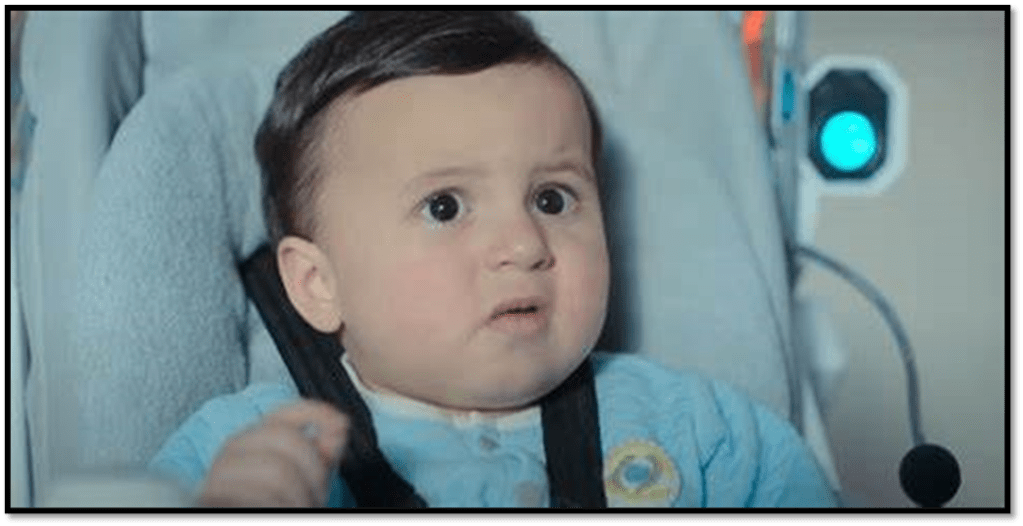
The first SB the Doctor confronts. Me to a T?!
The SBs are cognitively developed beings but are far from being emotionally developed, as our society sees such development. They have very basic fears of the unknown, immediate response to fear of rejection, and also highly and easily sensitised empathy even for an enemy or perceived monster. Socio-biologists see such behaviours as adaptive in human babies. They ensure that the baby will evoke the need to care for the baby in adults. I doubt that very much, but it is undoubtedly the case that the description of these SBs fits me all over.
At one point the apparent leader of the SBs, who, like her followers, still propels herself in a motorised baby-buggy like a rather clumsy Dalek in its casing, feels that the adults newly come into her life [and misrecognised as Mummy and Daddy] are criticising her for not growing up or doing it all wrong. For her, this immediately seems to constitute rejection by the Daddy-Doctor because she has failed to be good and do as it was intentioned she should do. Daddy-Doctor picks up the hapless SB from her buggy and reassures her that she, like everyone else, is an individual; the ‘only one of her kind’ and therefore must by definition have acted as was intended by her nature. She gurgles and moves in on the Doctor.

The SB leader moves in on Ncuti Gatwa. Here, I felt again great symmetry of desire with the SB genus. This new Doctor is beautiful, ain’t he?
This moral learning, that we are all doing the best we can as the ‘only one of our kind’, is the ethical crux of the episode. But to get this, you need both the story and its allegorical background. We frequently see the snot being taken from the SB’s noses. It seems not so much for the purpose of the collection of the snot, though as with all excrement, snot has to go somewhere. Only in the denouement of the story will we realise that the fact that, in a floating space station, the fact that snot has to go somewhere, is the reason and function of the space station’s lower regions. These regions are ‘low’ and ‘base’ in more than physical orientation, for they are the perpetual store of SB excretions, including ‘poo’ whose stink is only referenced with explanation later, as well as gooey sticky snot that clings to the base region’s walls.
This elemental storyline almost fits with the standard psychoanalytic explanation of ‘disgust’ reactions. As humans evolve into upright two-legged, rather than four-limbed, creatures, they developed consciousness that made them proud of their heightened perceptions and sense organs that necessitated that some functions of the use of animal senses had to be interpreted as low and base. As the nose is raised from its original promixity on evolution to the anus and, at the same time, the uses of the sense of smell are divorced from proximity to excretion processes in them and companion animals, humans lift their mind too from their lower functions. Potty-training teaches children to fear excretion and not to touch or handle faeces, urine or its ambiguous conductors, or snot – with much education focused on these issues (including nose-picking).
The child learns to see its excretions as other than itself and to feel disgust and, sometimes, fear of those excretions that can extend even to the excretion of blood. Thus, in a physically and morally base part of the space station, the disgusting sticky and smelly Bogeyman creature has been made-up into fearsome life. We get it all explained by the Doctor thus: SB nose wipe excretions build up SB snot (and faeces we’ll later learn). Snot is the building material of bogies (the sort picked from the nose), and lots of bogies are the raw materials of a Bogeyman. And, as was further explained in the episode, since we all need some kind of monster to fear, and maybe babies and SBs need it more than most, a Bogeyman is the fictive creation of our need for a monster to embody otherwise inexplicable and overwhelming fear and disgust reactions.
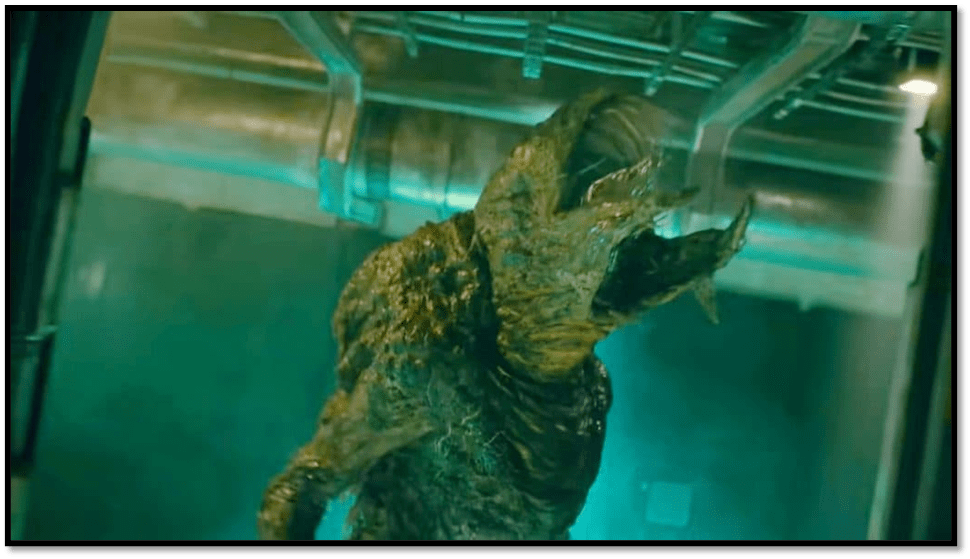
The Bogeyman is made of bogies
There is a precision of allegory in making the snot, urine, and faeces collection a function dealt with a ‘low’ and ‘base’ part of the space station. The babies are made by Nan-E to fear the low and base in the physical, moral and cognitive_emotional system and Nan-E will reach the climax of her moral function in her attempt to clean up the basement of the space-station. This will necessitate first the eradication of the Bogeyman using all the destructive forces of the mechanism of the station to do it. But if SBs need a Bogeyman to fear, they also need to come to terms with the fact that their fear of it is merely human function too, not unlike the disgust and fear of snot, urine and faeces production.
Thus, as Nan-E opens the ships anal doors to evacuate Bogeyman, the Doctor takes on the role of a systematic rational-emotive therapeutic (RET) counsellor and rescues Bogeyman, despite his own earlier fears of it. RET perspectives cause us to see that our fears are oft those we have over-learned of very ordinary and necessary human processes – of natural bodily functions for instance – and tend to encourage people receiving counselling to better cope with their fears by re-integrating to their better selves the objects that have become over-disgusting or over-fearsome to them, in their functional lives as human beings.
If we need a Bogeyman to objectify our fears, we will defeat those fears only by coming to terms with the fact that they are a projection from us. Hence, the Doctor saves the Bogeyman and learns empathy for that he once feared. He also show Nan-E a thing or two by getting the SBs to revolt against her in their demonstration of child-like empathy, even for a monster. As Nan-E tries to evacuate him into empty space in which he will disintegrate, the SBs force empathy for him on Nan-E too. They scream out to her,” You’re hurting him.” And she thinks again, and the Bogeyman is re-integrated into the space-station and SB lives as something necessary, kept in its place but not despised or made a victim of excess rage at otherness.
The less congealed bogies, together with other stinking SB excreta, which containing methane as the Doctor so doctorly mansplains, might, as it does in the shot below and with the power of a hugely amusing fart of propulsive power, shoot the space-station towards a putative new world elsewhere of SB power, and perhaps development – beyond the overbearing strictures of a nanny (Nan-E).
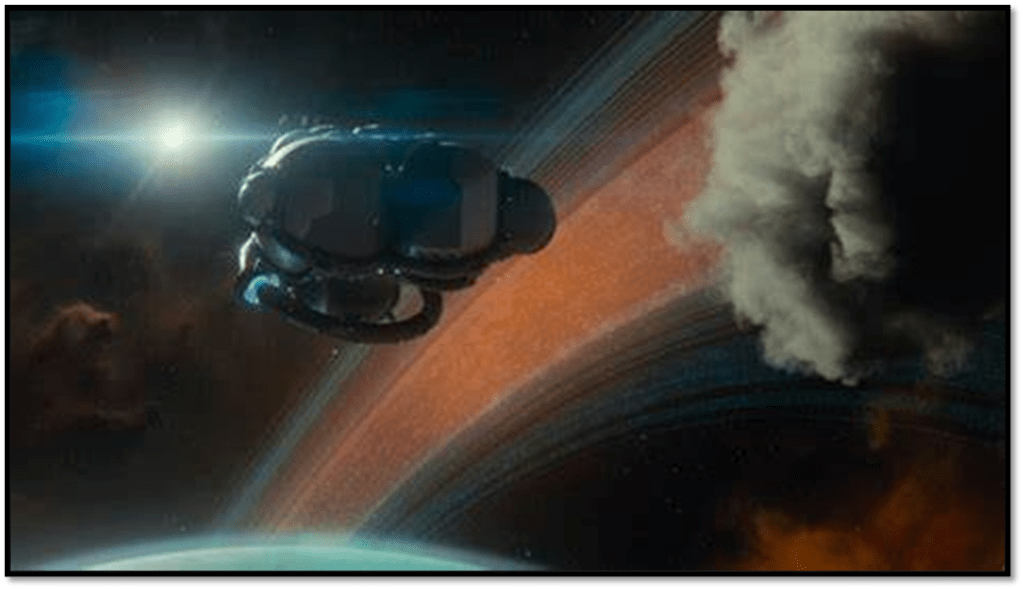
The SB space-station releases its pent-in smelly ‘fart-cloud’ of methane from its stored excretions to propel it onward to new developments.
The SB space-station and the SB genus may develop. It strikes me that if they don’t grow out of their mechanically propelled buggies, however, it’s unlikely they will survive on whatever is the natural terrain of a new planet. Still, the Daleks manage it somehow, and they are equally incapable of motion over rough terrain. Maybe, anyway, even the makers of Doctor Who do not want us to take the consequences of a story too far beyond the mechanics necessitated by an allegorical fairy-tale.

In the end, the SBs experience a ‘minor autopoesis’ and learn to live with a bit more autonomy, a lot less dependence on mere machinery, and some more realism about what it means to be embodied. If I could make ‘one small improvement’ in my life, it would be to become a more accepting SB, willing to bear what I cannot change and make the best use of what I felt to be the more negative issues (residues and excreta from a sloppy emotive past) in my life and re-frame them as, not problems to overcome, but potentials for moving on – however, the process of moving on might potentially look,as in the case of this space-station, smelly and disgusting. Lol.

Looking forward!
Lots of love
Steven (SB) xxxxxxxxx
 Steve_Bamlett_blog