


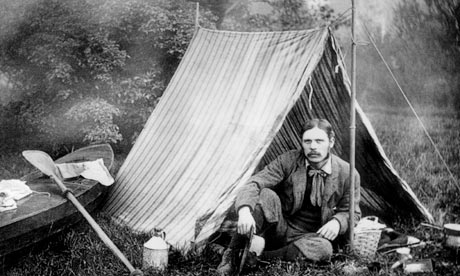
Thomas Hiram Holding, supposed to be the great populariser of the activity of camping, outside his camping tent.
Whether it has sufficient academic credence (by which is meant referencing to authoritative evidence) or not, the Wikipedia entry on CAMPING fits with my thoughts, memories and, possibly, biases, in understanding what camping as a term means in English-speaking cultures. This paragraph seems especially ‘right’:
Camping as a recreational activity became popular among elites in the early 20th century. With time, it grew in popularity among other socioeconomic classes. Modern campers frequent publicly owned natural resources such as national and state parks, wilderness areas, and commercial campgrounds. In few countries, including Sweden and Scotland, public camping is legal on privately held land as well. Camping is a key part of many youth organizations around the world, such as Scouting, which use it to teach both self-reliance and teamwork. School camping trips also have numerous benefits and can play an essential role in the personal growth and development of students.[1]
Being born into the British working class in the early 1950s meant that ‘camping’ was a middle-class activity, a bit like ‘scouting’ of which no-one on the council estate I was brought up attended, although middle-class peers at primary school saw it as a reward of years of being Cubs or Brownies, whose motivation was suspect. The British film Carry on Camping in 1969 is a kind of measure, and of course gross exaggeration of elements of British male working class thought about camping.
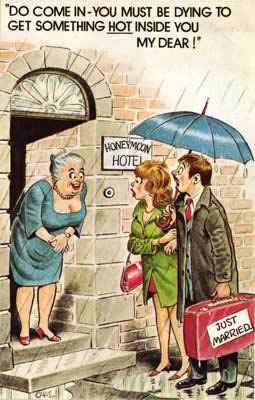
The film starts in a fleapit picture house where rather ugly and poorly dressed working class men are surprised by the refusal of younger, prettier, but definitely [presented as] ‘brainless’, girlfriends to accept a direct move to sexual activity withbtneidbunappealing selves – even in the ‘pictures’ where they feel they ought to expect it. The men, played by Sid James and Bernard Bresslaw, feel their minds changing as they watch a Pathé film-like documentary in the filmhouse showing people holidaying in a nudist camp. From then on, the mens’ interest peeks and the film becomes a constant chance to see women in the nude, for the gaze is the main vehicle of sexualised interest – linked of course to the language of sexualised double-meanings in language like that of Bamforth’s Holiday Postcards bought at Blackpool on working-class towns’ Wakes Weeks or on honeymoons.
With Carry On Camping, the promoters of the films had a publicity problem. Versions of the posters of the film play to different markets. The one below detoxifies the sexual content, possibly for an intended female and / or middle-class audience: ‘perfectly silly old-fashioned lowdown humour’ genuinely makes the sexual content and the display of bums, breasts and the hints of the phallus – in Charles Hawtrey’s tossed ‘bangers’ (sausages), for instance, in the cartoon-like picture next to the quotation, make it okay to watch humour that certainly involves things that are ‘lowdown’.
It all amounts to reference to, or even open discussions about, the genitals and bum as it is imagined the working class talk about these things. A ‘JOLLY GOOD TIME’ is itself a phrase, or was, that marked ‘naughty’ fun in the process of being made acceptable to the person who feels more refined than it. Of course, we get in the poster a cartoon version of the scene in which Barbara Windsor’s bra pops off exposing her breasts (though not in the film – that has to be imagined between the shots of before and after the event). It is all crude and ludicrous. It is the patriarchal working-class take on what their supposed betters were doing when they
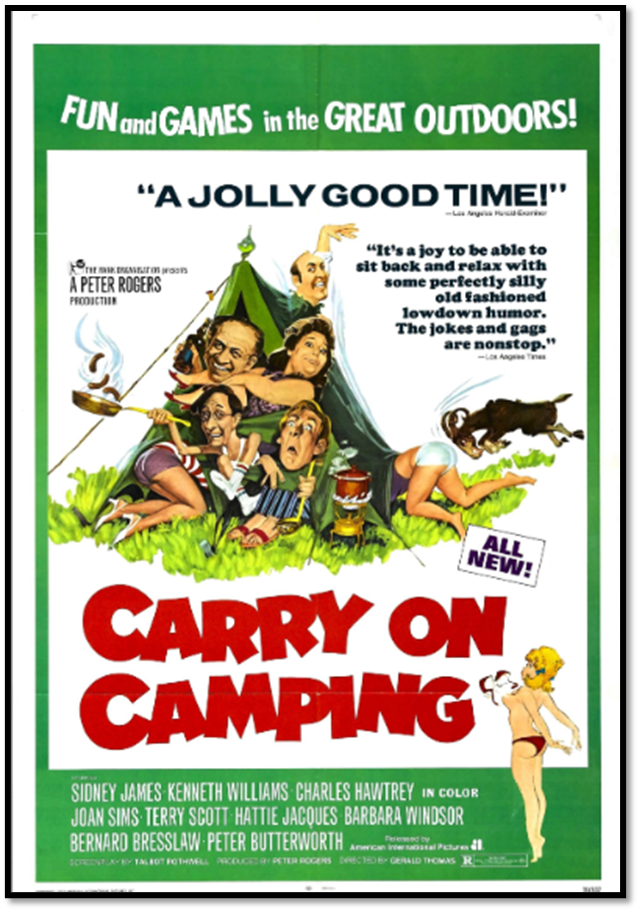
Compare it to the most popular poster which utilises every double-entendre to display its misogyny and sexualisation of women to the male gaze or reduction of them to objects, of which ‘sleeping bags’ must be crudest. Meanwhile the poster prioritises in both cartoons the pyramidal primacy of the sexual leers of Bresslaw and James, rather associating the known ‘camp’ of men known to be queer, though it might never be admitted – for they were suborned into a hopeless want of girls too, of Hawtrey and Kenneth Williams. Apart from Hattie Jacques turned into a joke about women who still ‘want it’ (don’t they all in this film) but are represented as too old or fat to get it and hence their turn, as the film’s ideology sees it, to posh prudery. At least until ….. their masks are ripped off. There is no release from the obvious fact that this film is about women getting the horn they are thought to want, even from a rampant goat rushing to their back end. It is all rather awful. Isn’t it?

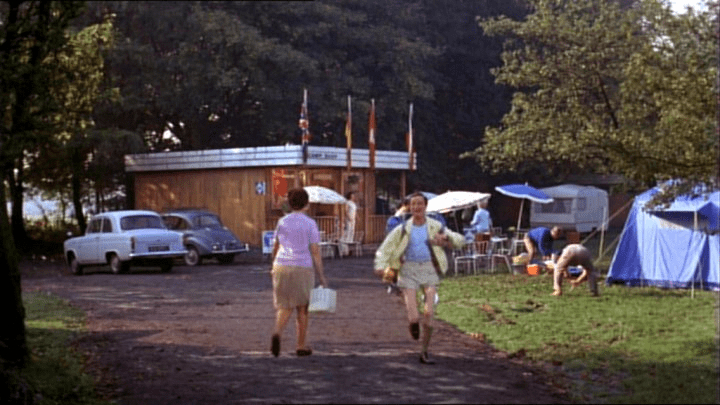
The camp site itself in the film, run by the horny, ugly, and avaricious Peter Butterworth, is basic. In no way snug in the manner working class homes were in the popular imagination, it appeals to middle-class preference for space. Peopled by eccentrics – here the over-prepared walker with his backpack (rare and rather silly in those days), the rest of the people in this shot are placed to look ridiculous. At that time this meant a concentration on exposed fat bums, and if bending-over, all the better.
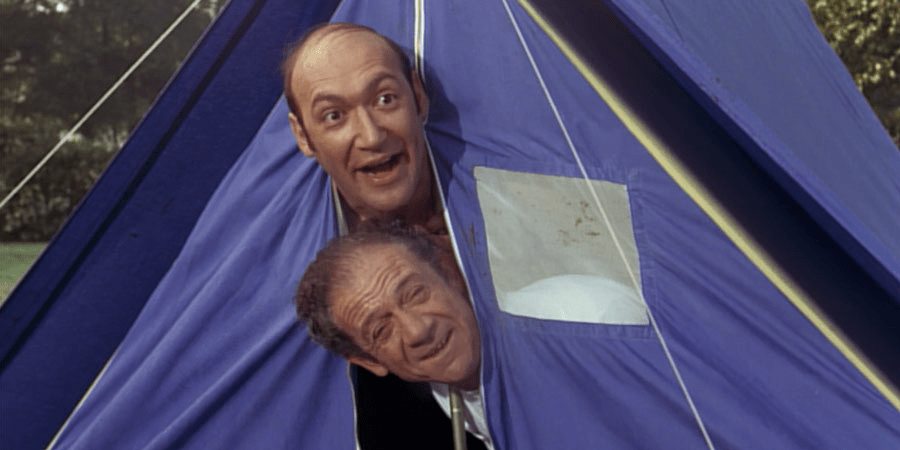
On these holidays, middle-class couples (as so often played by Peter Scott and Betty Marsden – her false hee-haw of a laugh placing her class and worth) like Peter and Harriet Potter (so perfect the middle-class name stereotype) are comfortable in donning khaki, or managing situations in a suit, but the focus of the viewes interest is in the stereotyped working-class men in dishevelled casuals and often or not in white underwear so brilliantly hammed up by Bresslaw and James (Bernie Lugg and Sid Boggle). Of course, their coarse surnames give their class status away, though each actor keeps his own first name in the ‘assumed role’. You were meant to think them acting as they really were, as with Barbara Windsor’s ‘Babs’, though she is not even given a surname,
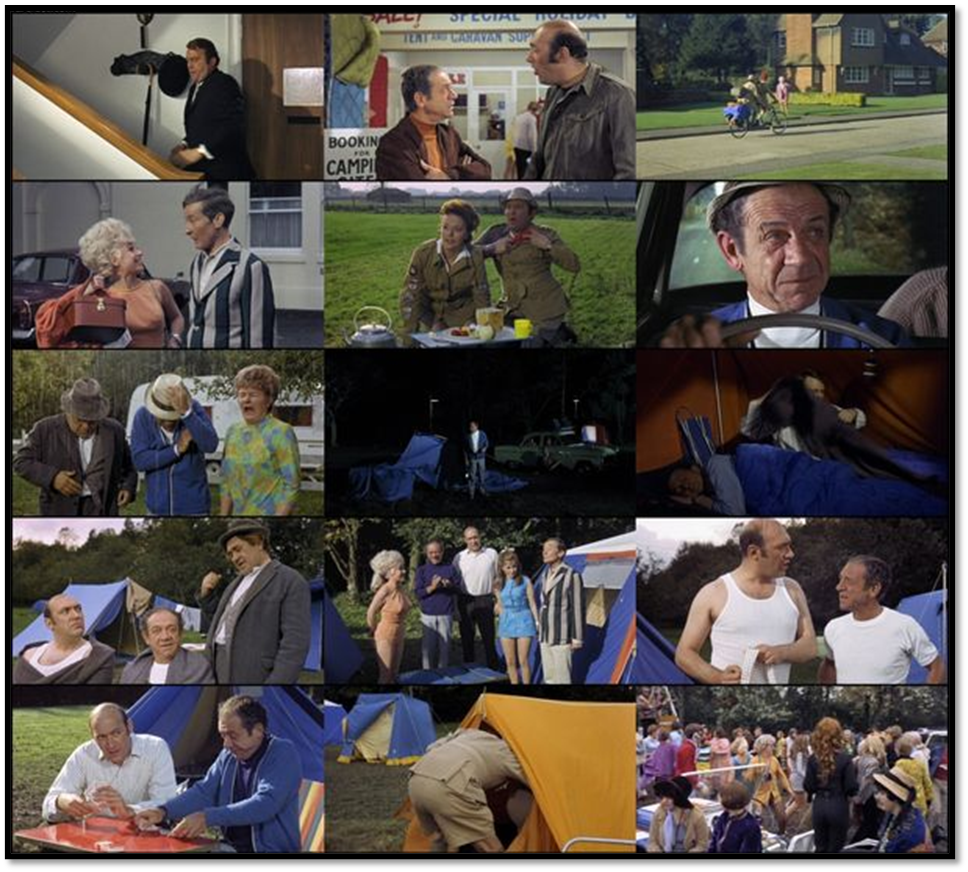
Working-class couples yet unmarried sit together in a supposedly eternal conflict of ‘one-thin-on-their-mind-only’ men and women fighting them off using a little bit of pretension to being better than their blokes, In the car journey to the camp, it all speaks out. Men grin, for they will ‘win’ in the end, the women play different kinds of nuanced austerity of manner – nuanced because the film never let’s you forget its ideology that all women actually want a man and the rougher and more sexually brutal the better. It is the fun and games, in fact, of rape ideology.

The role of men is to gaze in the hope of catching a sight of tits – and if Babs’ tits all the better.
The film has a lot of footage of attending the toilet. There you can laugh at the cover middle-class professionals have, like Hattie Jacques, in covering up that in toilets and showers nudity happens. To and from it she trads confidently over the mud and ‘dirt’ implied by nudity, though the young girls totter and titter, waving and giggling at men clearly on the make and not at all attractive. Jacques has sensible shoes, they ‘high heels’, or what passed for those then, and exposed legs – for legs were then as heavily sexualised in women (though not men as in the bingo call – LEGS ELEVEN – where everyone whistled on Blackpool front for no-one questione the sex/gender of those ‘legs’, as they laughed at TWO FAT LADIES 88.
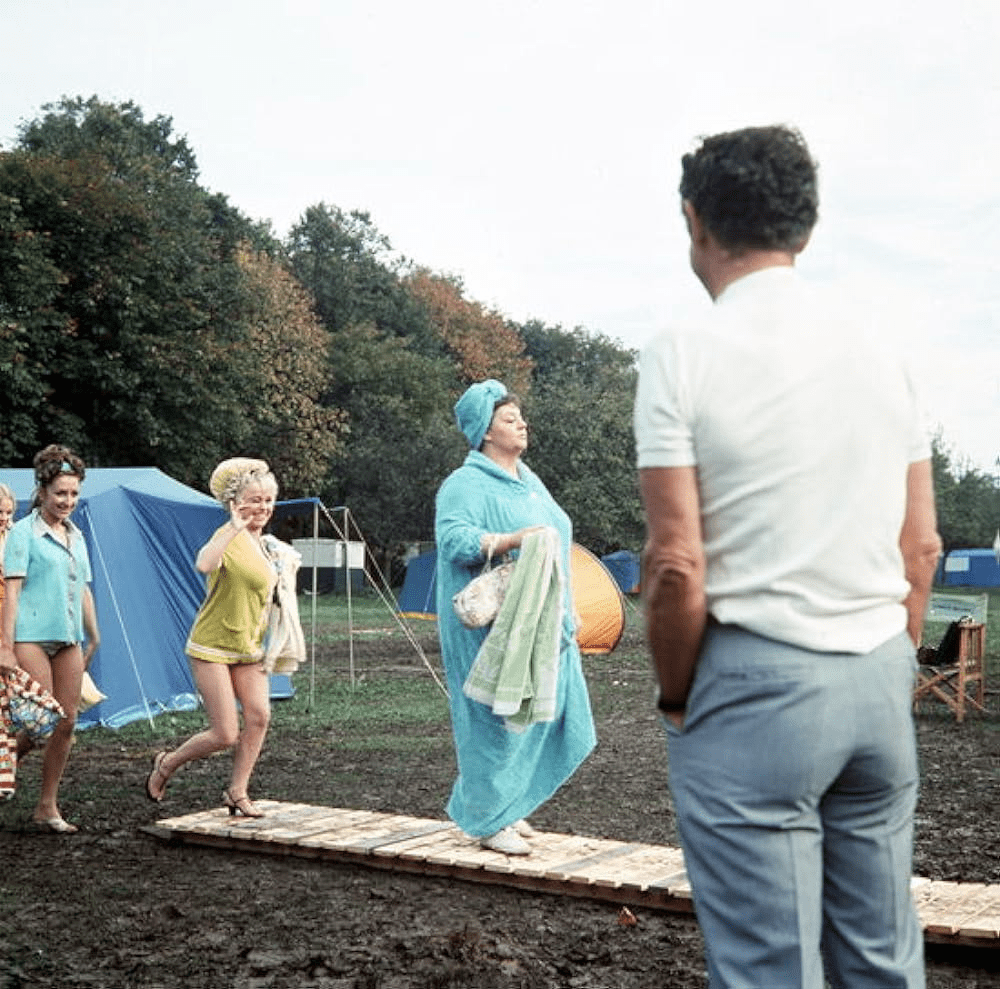
Every women wants fgo be gazed at in the picture above, though the young ones seem immune to the fear of being rolled in mud and dirt – in ‘lowdown humour’ as our first poster has it.
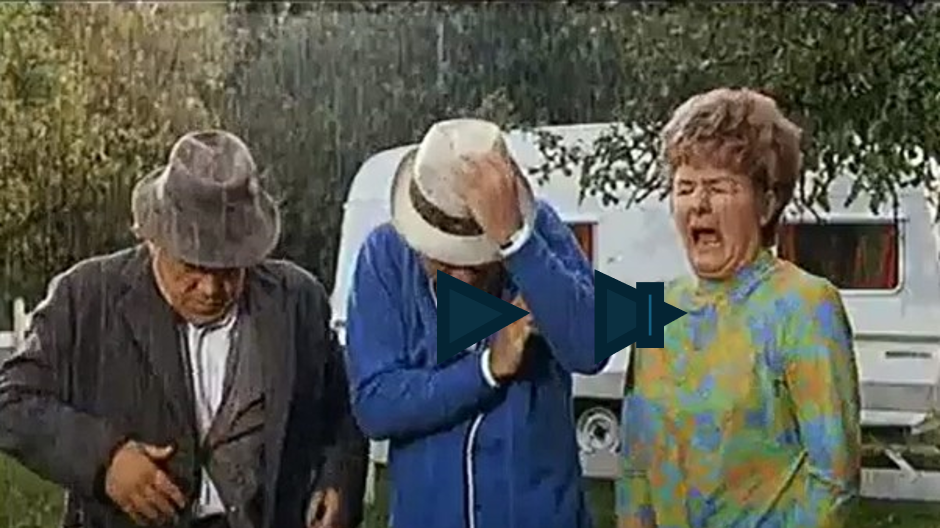
So this was the idea of camping, I was brought up with. Did we go camping , as a family. Never. And I think I have inherited a prejudice never to do so. Don’t it make ya weep. Even the sky weeps, but especially on girlfriends to whom you want to make a point that camping is not for the real guys and gals of the British working-class.
With love
Steven xxxxxxx
 Steve_Bamlett_blog