


If we are to discuss anything at all in our networked world of codes and symbols, where meanings lie in layers and sometimes in the knotted interconnections of things, subjects, objects and commentary thereon, is there any topic that can be excluded from the picture. In modernity, we are used to thinking of the world as so complex that each person must specialise themselves – as workers, thinkers, and even players. But that approach is not one that can address a complex world, only a world of subjects that are overwhelming in their multitude. It is quantity that overwhelms the desire to be ‘comprehensive’ in our comprehension, not quality. A world that believes that is the problem must specialise and imagine that its fanciful notion that their are discrete boundaries between topics in the world is a truth. When the poet Virginia Greenlaw approached the neuroscientist Colin Blakemore for answers about the neuroscience of how people can be said to see in the dark, he came up with many useful ideas but thought some of her questions unanswerable and as too ‘poetic’. She writes about it in a chapter called ‘Caves, sleep, absence of light’ in her book The vast Extent: on seeing and not seeing further [2024].
However, to my mind, the quality of the world, not its quantities of experiences – the description of what it is and can be made – is a matter of complexity. This leaves Greenlaw to paddle on the shores of all the topics and their interleaved currents, but paddle she does, sometimes diving into deeps. If we truly want to ‘know’ the world, can we exclude any topics that are thought not to be of interest to us?
In the Renaissance of learning in Italy some people thought there were no boundaries of exclusion between subjects and topics. Take Leon Battisti Albert, whom Wikipedia introduces thus:
Leon Battista Alberti (Italian: [leˈom batˈtista alˈbɛrti]; 14 February 1404 – 25 April 1472) was an Italian Renaissance humanist author, artist, architect, poet, priest, linguist, philosopher, and cryptographer; he epitomised the nature of those identified now as polymaths.
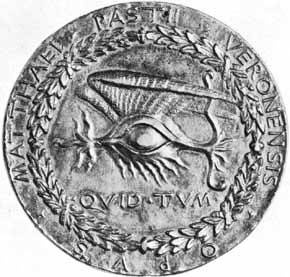
That word ‘polymath’ seems to make the man an exception, yet he I think that his colossal web of interests in the world reflected not him but the world. It is a world that only can be seen whole as God sees it, he thought, and man is modelled, his Neo-Platonism told him, after the aspirant fashion of God. He had a medal struck for himself which on its verso had a ‘winged eye’. A holiday website offers a straightforward rendering of its meaning:
Fascinated by the Egyptian alphabet, Alberti drew his personal emblem and gave a meaning to it, even though it’s not entirely clear today: the winged eye. The choice of the eye is not random; in fact, it is the most important part of the body used since ancient times to represent God, who can control and see everything.
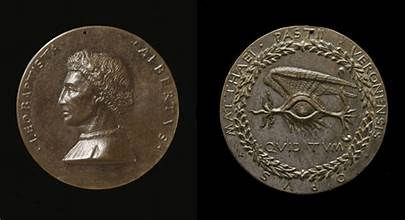
The ‘winged eye’ on the verso appears above but here below are both sides of the medal. The Culture Trip site rather undersells the fact that the meaning of this emblem is not clear today. In fact it is highly contested, especially in relation to the Latin motto the eye bear, ‘Quid Tum’.
I first came across this debate at University College London in Frank Kermode’s then innovative course on Renaissance literature where it was de rigueur to attend lectures by Frances Yates at the Warburg. Through her I read Edgar Wind’s Pagan Mysteries of the Renaissance and learned of the medal. His view of the phrase and emblem is summarised by Ingrid D. Rowland in The New York Times in a scholarly, and perhaps acerbic exchange of letters with another great specialist scholar, David Marsh, of the Renaissance period. Here is a long quotation in a screenshot:
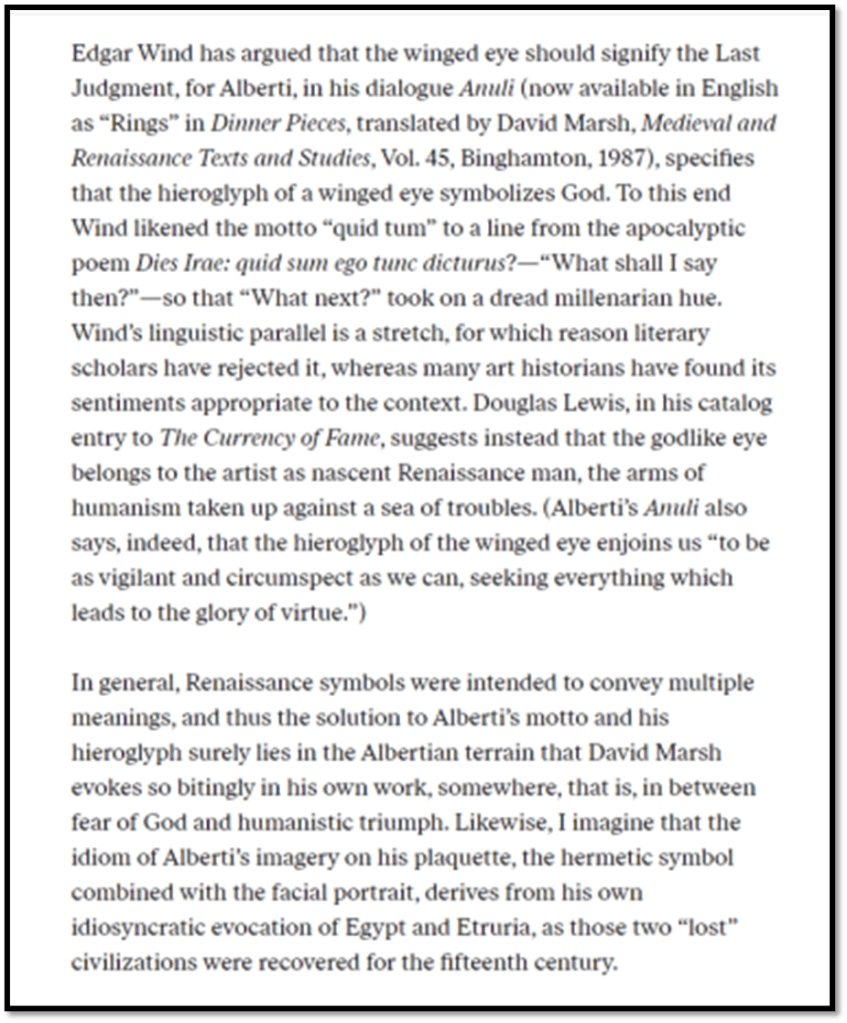
I hope my drift is clear. Despite the fact it takes a specialist like Rowland to tell us, one thing she actually does tell us is that ‘specialism’ is an inadequacy in the light of scholars and makers of things, like Alberti’s works of architecture and much else, where he insists we must live in the mode of ‘seeking everything that leads to the path of virtue’. Noet however that ‘virtue’ in the period was not moral or spiritual excellence alone but the power to do things, the meaning it had in Chaucer’s Prologue to the Canterbury Tales:
“Whan that Aprill with his shoures soote
The droghte of March hath perced to the roote,
And bathed every veyne in switch licour
Of which vertu engendred is the flour;
But Rowlands also rescues Wind’s appeal to the millenarian and apocalyptic meanings of ‘Quid Tum’: in brief a query of what happens once the world ends (‘What Then’). One answer is that then, God will see everything. But the layer above that in layered Renaissance meanings, is that it is for humans to aspire to see everything and know it. Without this aspiration indeed, can we either know the things we have the capacity to know or understand the fact that the world we inhabit is of uncertainties and unknowns remaining.
So why delimit the topics you like to discuss. Why create boundaries around them: I was revolving this ditty of mine in bed this morning.
Complete the sum.
Is work now done?
Quid tum! Quid tum!
Under the sun
Platonists hum
Quid tum! Quid tum!

Yet Cicero sung
the word-phrase Quid tum!
Meaning 'so what'. Done
To rouse Latin fun
No doubt, wit and  sun
lightens dark. Quid tum!

Quid tum! as the days add some
length to our sweet and sour  sum
Of time left, for music: rum,
bum and concertina, run
fast or what's then only a crumb
Of the whole loaf. So Quid tum!

Quid tum! Quid tum! Quid tum!Quid tum! Quid tum!
Keep on saying it, whilst the rivers run
on earth's warming last days. Exquisite sum
Of all we know. So what! Quid tum! Quid tum!
With all my love
Steven xxxxxx
In that doggerel verse, I try to mirror some layers of Quid Tum.
 Steve_Bamlett_blog
3 thoughts on “Quid tum. What next? So what?”