


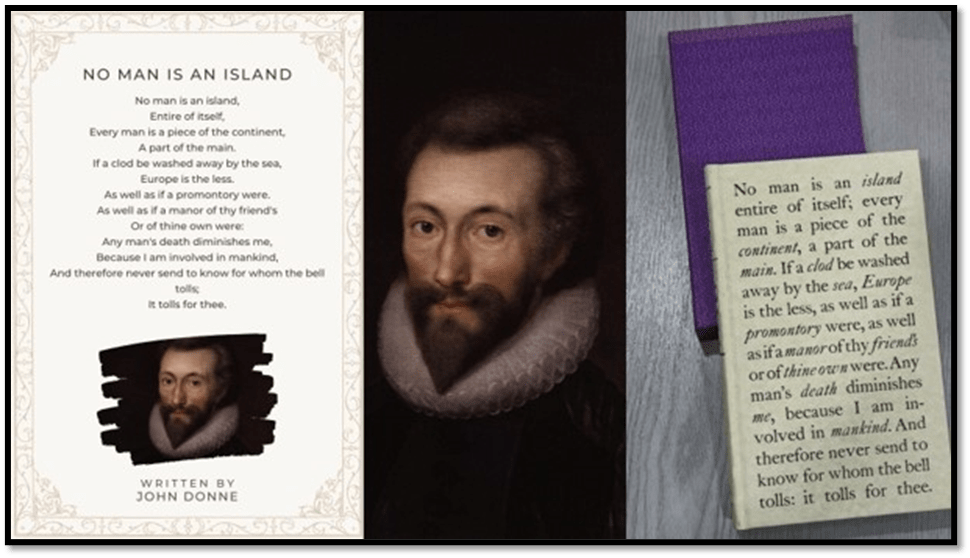
As a preacher of sermons, one almost thinks that John Donne was as alive to the need to generate memorable phrases that would outlive knowledge of his work as to teach the religious lessons of human and spiritual concern. Written in 1624, possibly in response to an illness that nearly killed him, the devotional piece that is so often misremembered as a poem, for poem it was not despite the pretence of the left part of my collage above, reminds ‘man’ that he is not unique except as he partakes of what is common and communal, ‘involved in mankind’. He was not to know that many works of art, novels in particular, would raid this passage for their titles: most portentously Ernest Hemingway in For Whom The Bell Tolls. Hemingway’s novel attempts to teach its American hero that his protestations of uniqueness must be tested in a human cause, the Spanish Civil War.
“No man is an island entire of itself; every man is a piece of the continent, a part of the main; if a clod be washed away by the sea, Europe is the less, as well as if a promontory were, as well as any manner of thy friends or of thine own were; any man’s death diminishes me, because I am involved in mankind. And therefore never send to know for whom the bell tolls; it tolls for thee.”
Both writers meant ‘man’ as a gendered item rather than person I think whatever the pretence otherwise of the word as a generic name for person. In both writers men test themselves, after all, on women (Donne in his ‘love’ poetry in particular)’, rather than embody them in their art as persons in their own right exploring an unknown world bigger than themselves. Milton’s Eve is created by Milton as a true character, with a point of view more robust and worth more than Milton’s Adam, God and the narrator of the poem ethically. However, Adam and God see her in the poem, and their view command authority they think as having a relationship to God and humanity merely as it is mediated by a man (her husband Adam), of whom, Adam says, in his despair on the Fall of Man, she is but a crooked part, a rib from the left or sinister side. Adam says this in Book 10 of Paradise Lost, continuing in his dismay that he is bound to ‘straight conjunction’ (oh! how I love that phrase that declares Adam would prefer not to be ‘straight’ in effect) with that other sex or never find love or perpetuity as a species as the interpenetrating queer angels do:
..... O why did God,
Creator wise, that peopl'd highest Heav'n
With Spirits Masculine, create at last [ 890 ]
This noveltie on Earth, this fair defect
Of Nature, and not fill the World at once
With Men as Angels without Feminine,
Or find some other way to generate
Mankind? this mischief had not then befall'n, [ 895 ]
And more that shall befall, innumerable
Disturbances on Earth through Femal snares,
And straight conjunction with this Sex: for either
He never shall find out fit Mate, but such
As some misfortune brings him, or mistake, [ 900 ]
Or whom he wishes most shall seldom gain
Through her perversness, but shall see her gaind
By a farr worse, or if she love, withheld
By Parents, or his happiest choice too late
Shall meet, alreadie linkt and Wedlock-bound [ 905 ]
To a fell Adversarie, his hate or shame:
Which infinite calamitie shall cause
To Humane life, and houshold peace confound.
John Milton ‘Paradise Lost’, Book X. Available at: https://milton.host.dartmouth.edu/reading_room/pl/book_10/text.shtml
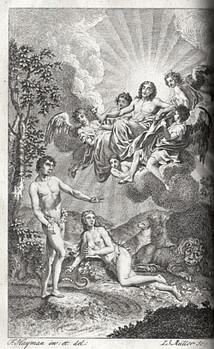
That Milton thought women a bloody nuisance, even predicting Delilah in his Samson Agonistes and his own ‘divorce’ here, is probably the case, but he was too much of an artist to create an Eve as supine as Adam and God would have preferred or that Eve as she is pictured above, just a degree above a snake. Hemingway and John Donne though thought themselves a perfect model of what man was and how he should be tested in pursuit either of sexual mastery or spiritual communion in the established rituals of the courtier and the Anglo-Catholic Church of Cardinal Laud.
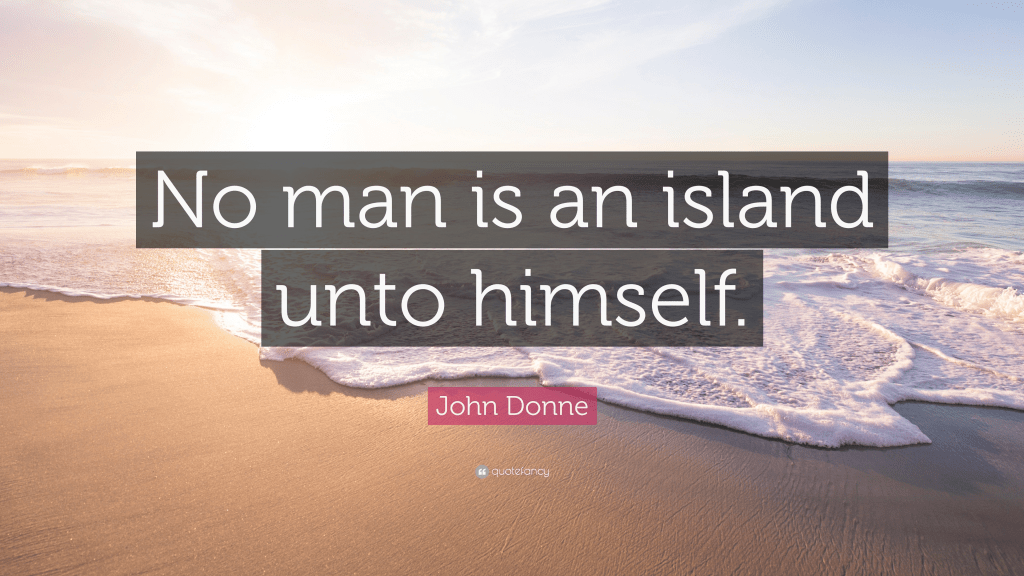
Donne, however, has a point about the wish that most persons have to be ‘unique’; to have a self ‘entire of itself’. By the way, it is interesting to note how and why this phrase is often remembered as being ‘entire to himself’ (as in the Quotefancy.com instance below) a real give away to those who believe HE can be a generic term for a person.
How much better is the quote the same meme company offers of the phrase as amended so amusingly by Robin Williams? No doubt Williams learned its wisdom from playing Mrs Doubtfire in drag:
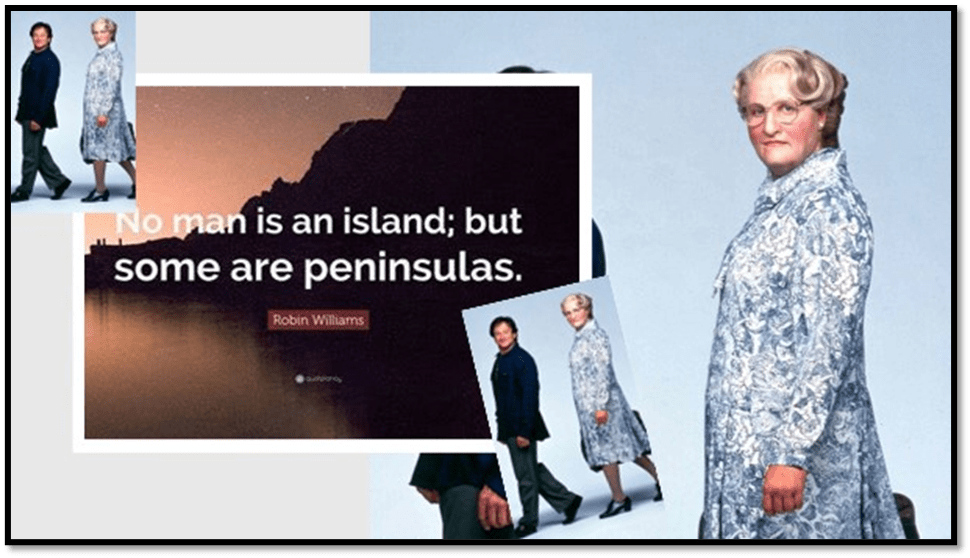
I suspect Robin Williams had Doubtfire gender-saviness here in mind. Men are obsessed with that peninsula, always over-rated that it is, the phallus. Moreover, in my experience men like not to be DETACHED exactly but somewhat semi-detached from others – always moaning about needing someone else whilst the next second narcissistically asserting they need no-one. Do we slso pretend to uniqueness whilst refusing to single ourselves out by decisions that show we actually DO think for ourselves rather than saying we do so whilst checking on our likely popularity ratings if we did so.
Donne is right. Men (I don’t except myself here in as far as I fail to really be non-binary) are too often ‘clods’,who think they are the whole continent, mistaking their earthiness for wholesomeness. For Donne, we are ‘involved‘. The word has an interesting etymology to which Donne, intellectually alive as always, was nearer. Here is the invaluable etymonline.com text:
late 14c., “envelop, surround; make cloudy or obscure,” from Old French involver and directly from Latin involvere “envelop, surround, overwhelm,” literally “roll into,” from in- “in” (from PIE root *en “in”) + volvere “to roll,” from PIE root *wel- (3) “to turn, revolve.” Mid-15c. as “concern oneself.” Sense of “take in, include” first recorded c. 1600.
That we are others or ‘rolled into’ others is important, as is the vagueness (cloudiness or obscurity) conceptually that also suggests the liminal nature of an experience of involvement. The point is that the concept ‘self’ has what psychologists call ‘fuzzy boundaries’, which is why I find all those awful counselling courses that insist on ‘preserving your boundaries’ so bizarre. If boundaries f the person were not porous, there would be no psychological phernomena like ‘projection’,’introjection’, or even identification. It is not only that a self declares connectivity to others, sometimes to an exclusive set of others but even that is oft an illusion that fosters all the worst forms of racism, heteronormativity, sex/gender dominance and so on, but that it is plastic connectivity – it shifts its connections on grounds both conscious and unconscious.
‘Being unique’ is itself a marker of a culture that believes conceptually in the primacy of the individual at the base of society, whilst enacting itself socially in quite other ways. Take those endless Robinsades promoted in the massive growth of bourgeois entrepreneurial identity in the eighteenth century and analysed by Marx in the Grundrisse. Defoe’s Robinson Crusoe is alone on an island and that fact allows him to pretend he is one (‘an island entire to itself’), though finding Man Friday allows him to re-enact the colonial and racist nature of eighteenth century mercantile capitalism as if it were his unique nature, and not a social construction of burgeoning colonial capitalism. He soon finds he cannot be ‘himself’ entirely with a parrot to mimic him and without building walls and defences to hold back others that he fears may intrude upon him, without fashioning clothes that betray a social nature rather than an individual one and using language that is not his entirely but always addresses another.
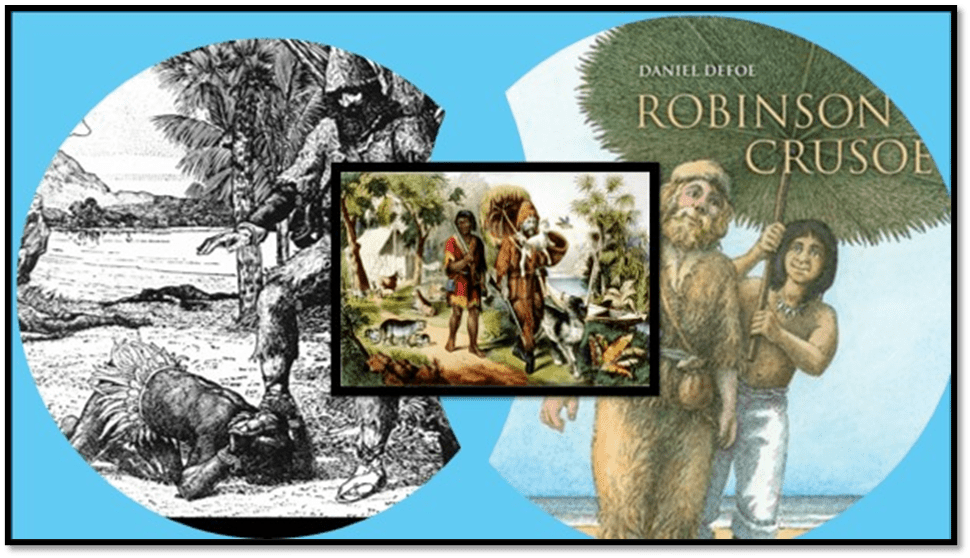
We like to think we are unique but to be so we would perhaps have to abandon other social categories that we exploit for the convenience and sometimes power they give to define us as a person who matters socially. Sometimes the power is that of an unjust hierarchy that defines class, patriarchal sex/gender relations, and most often race and nationality. It is often OTHERS that give us the ability to control and regulate not only others, as men might do women in marriage sometimes, a ‘boss’ command his workers whether he knows more of their task or not or groups ARMED or otherwise holding power over others hold sway over persons they define as other to them. Most often claiming uniqueness or ‘being oneself’ reinforces just how like everyone else one is.
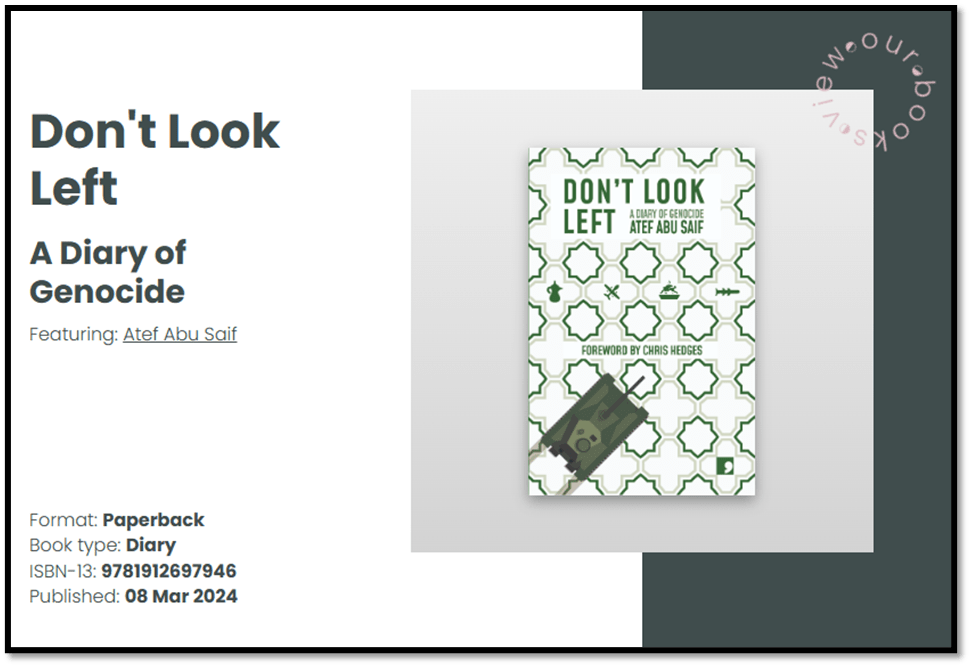
I am reading a wonderful but fearsome book currently by Atef Abu Saif called Don’t Look Left. I will blog in more detail later. It is a diary of Abu Saif’s life in Gaza during the first 85 days of the Israeli onslaught on it. Abu Saif is part of the Palestine Authority in the West Bank and ideologically opposed to Hamas, and more so to the militant wing that terrorised Israel and became the pretext of a war vastly out of proportion to the crime, even had it been a crime committed by Gazans as a whole, which it is not. But he reminds us that we in the West often decide on matters without knowledge of how other people’s lives are lived – of the event called the Nakba, which Westerners rarely hear, or speak, of but that included the islanding off of Palestinians in stateless conditions, in either (and the historical conditions cycled around since 1948) occupied and stateless portions of land and then in land surrounded by walls, munitions, armies and gunships off the coast, as in a prison. It might seem offensive in the light of this book to say to Atef: “No man is an island …any man’s death diminishes me, because I am involved in mankind. And therefore never send to know for whom the bell tolls; it tolls for thee.”
Why? Because we are complicit in islanding the West Bank and Gaza, in arming the only state in the area, and one opposed to Palestinian statehood currently, to ‘defend’ itself by ‘offensive’ arms we supply, and support its laws offering unequal access to land, housing, work and freedom of movement to Arabs. The bell that tolls for the current number of Palestinian dead would toll until silenced by wear. Atef talks about being a ‘displaced person’ by the war strategy in Gaza, the creation of a space where nowhere is safe or will remain so and the destruction of harra, a word in Standard Arabic that means neighbourhood, but in Atef’s writing grows to mean that which makes a self a self.
A harra doesn’t just consist of its buildings and streets, it’s made up of all the memories of all the people who have lived there, the people and the relations and the relations that have developed between them over time., it is not just where you were born, it’s a place whose story merges with your own.
Atef Abu Saif (2023: 93) ‘Don’t Look Left: A Diary of Genocide’ Comma Press.
But the death of so many diminishes me even if I do not know or understand their culture or circumstances. It does so even if I invoke the Holocaust or a terrorist action or pogrom against Jews to justify it as legitimate revenge or self-care. However, it does so also if I do not acknowledge that Jewish lives lost, however long ago or in the Hamas raid in lesser numbers, also diminishes me. Nevertheless, as an assault on the assembled refugees in Rafah promised safety if they went there, is in the offing, we remain particularly complicit in the ongoing death toll in Gaza, as we continue to face our apparent powerlessness in front of it and do nothing.
People say they are unique. They defend that view with evidence of their balanced adult and supposedly objective judgement and yet fear to speak out about Palestine because they fear the label Anti-Semite. We are not unique in such circumstances, and perhaps we even fail the test of humanity. Persons are made up of the circumstances and by networks of others who interact with them often with minimal help from our own petsonal agency. To really use that agency, would be to know that a ceasefire in Gaza must happen now; that it is not good enough to say food cannot be allowed entry into Gaza when arms so easily, and in massive volume, can so easily be. Thise latter are sent to the only armed participant state in the ‘war’ daily. And yet the pressure on Western governments for ceasefire is minimal, and the official major political opposition party in the UK is even complicit in avoiding it. Yet, on Twitter, people continue to berate the feckless Tory government as if change of government were enough in itself, though needed. On Twitter, of course, everyone feels they are unique.

Palestine refugees (British Mandate of Palestine – 1948). “Making their way from Galilee in October-November 1948” Available: https://upload.wikimedia.org/wikipedia/commons/f/f7/Palestinian_refugees_%28cropped%29.jpg
This issue matters. Why bother worrying about what makes you unique when you both refuse to individuate your judgement of bare facts, of which you prefer to remain ignorant, or to admit this is a problem and a major one in the ethics of one’s own life. But I, too, am complicit. So let’s leave on the same loving note. Imagine the destruction of your own ‘harra’ and see if you can stay with the wish to be unique as your main gosl in life. It is impossible!
With love
Steven xxxxxxx
 Steve_Bamlett_blog

One thought on “‘No-one is an island, entire to itself’, as John Donne might have preached, had he wished to touch the diversity of people.”