



If Judaeo-Christian thought gave us an obsession it is that of claiming a false integrity: the view that we are beings that can be summed up in one word – a thing that defines us. It has, in ways that monotheistic cultures must, made us prone to idealise the ONE. In truth this idealisation is always contradicted for as much as we believe that one thing exists that is sole and simply itself, we create a need for an OTHER that is everything that this ONE thing is NOT. In truth belief in unity always implies a binary: for GOOD to be a unity, there must be evil, for a SELF, there must be the OTHER, for light let there be dark, what is pure the unclean and so on through all the hierarchical binaries we can name – of which the most cloying is that of male and female, straight or gay – where a fundamental truth is set against what is considered its inversion and perversion. The most telling narrative of this appears in The Gospel of Mark, Chapter 5:
1 And they came over unto the other side of the sea, into the country of the Gadarenes. 2 And when he was come out of the ship, immediately there met him out of the tombs a man with an unclean spirit, 3 Who had his dwelling among the tombs; and no man could bind him, no, not with chains: 4 Because that he had been often bound with fetters and chains, and the chains had been plucked asunder by him, and the fetters broken in pieces: neither could any man tame him. 5 And always, night and day, he was in the mountains, and in the tombs, crying, and cutting himself with stones. 6 But when he saw Jesus afar off, he ran and worshipped him, 7 And cried with a loud voice, and said, What have I to do with thee, Jesus, thou Son of the most high God? I adjure thee by God, that thou torment me not. 8 For he said unto him, Come out of the man, thou unclean spirit. 9 And he asked him, What is thy name? And he answered, saying, My name is Legion: for we are many. 10
https://biblehub.com/kjv/mark/5.htm
A thing that refuses control by those who want things tied down (and chained up if it cannot be eradicated) refuses to give its name, or confuses the very unity of naming – insisting that there are many not ONE ways in which life has its being. The story of Rumpelstiltskin is of a kind with this:
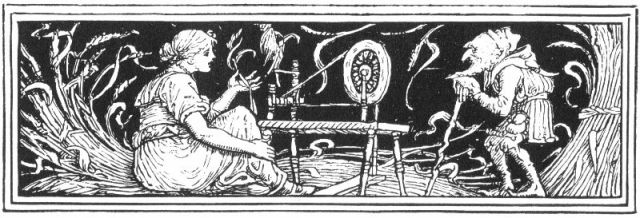
That which refuses a unified name and insists it is MANY, or LEGION must be controlled. Jesus reduces the ‘unclean man’ into the Gadarene swine, who then conveniently kill themselves.The man is tamed without chains because he has given up claims to being many things.
The Judaeo Christian tradition has thus tried to enchain the claim that the MANY have rights in its MONTHEISTIC battle against POLYTHEISM. It can do it in simple ways. The Early Christian Fathers used the doctrines of pagan Plato to invent that which it often called NEO-PLATONISM, an inheritance from a form of LATE-CLASSICAL monotheism that included many God’s. It is a belief-system that asserts that the MANY are in the final analysis actually ONE, but just seen as many by inadequate and overl finite mortal vision.
There are equivalents of this trend even in Hinduism, where a higher wisdom resolves all those wondrous incursions between the natural and supernatural and human that make up its pantheon are ultimately THINKABLE as mainly aspects of the ONE Godhead. But even they oft reduce back to fables of the one against the many- unity against duplicity. In Spenser’s The Faerie Queene, which is stuffed with Neoplatonic thought acting in politicsl service of the ideology of the one True monarch and representative of Catholic Imperial Protestantism (the true heir of the Eastern Church), Elizabeth I, who appears as UNA (One) in that poem. She is set against, and in mortal battle with, the evil Duessa (Two), the latter aided by magic in the form of Archimago (even Mary Queen of Scots is evoked by a layer of allegory in this ‘evil’) who is sometimes a beast with seven heads. That beast is from Revelations, of course – but also clearly, as Anglican Protestant allegorists liked to claim, represents the false Pope sat amongst the seven hills of Rome.
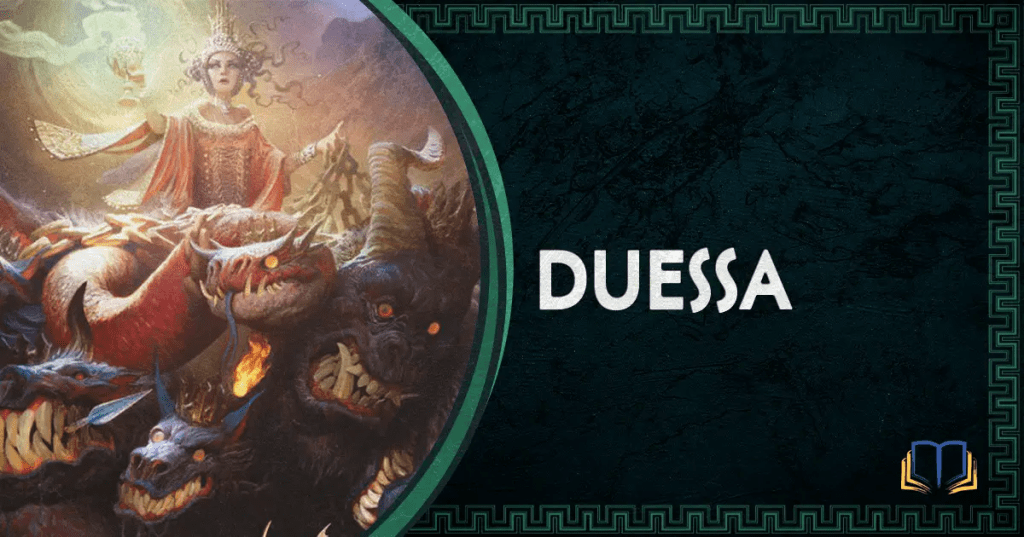
Duessa as the Scarlet Woman from Revelations (Una is the ‘woman clothed in the Sun’ from the same text)
Of course, we have to ask: Does any of this arcane mythology matter? I think we have to say yes because it underlies even the most liberal of ethical ideals. Take Arthur Miller, the dramatist and film writer (and one-time husband of Marilyn Monroe). Faced with Senator McCarthy and his Un-American Activities Committee, he resisted naming people who could then be hounded from their livelihoods as likely Communist infiltrators. His play The Crucible casts him (allegorically rather than in reality) in the character with the name John Proctor. It’s a powerful name for a guardian – maybe guarding very important values and the systems upholding them, of i tegrith and truth-telling. Asked to sign for his safety from being accused as a witch in the Salem trials, of which the play ostensibly deals, he defends his ‘name’ as the one principle of unity and integrity left to him. Asked to give that name to accusations of others, he refuses:

Because it is my name! Because I cannot have another in my life! Because I lie and sign myself to lies! Because I am not worth the dust on the feet of them that hang! How may I live without my name? I have given you my soul; leave me my name!
Proctor in The Crucible by Arthur Miller
It is the ONE thing I have that is mine, is my name. In essence, it proclaims that we have to know that one thing can be used to describe us – in this case, our guardianship of values of truth and integrity, a refusal of ‘lies’. Proctor knows his ‘soul’ is gone by his actions so far – but if that guarantor has gone there has to be the ONE THING NECESSARY, as Matthew Arnold defined it for Victorian England, that remains. For Arnold, that was ‘culture’.
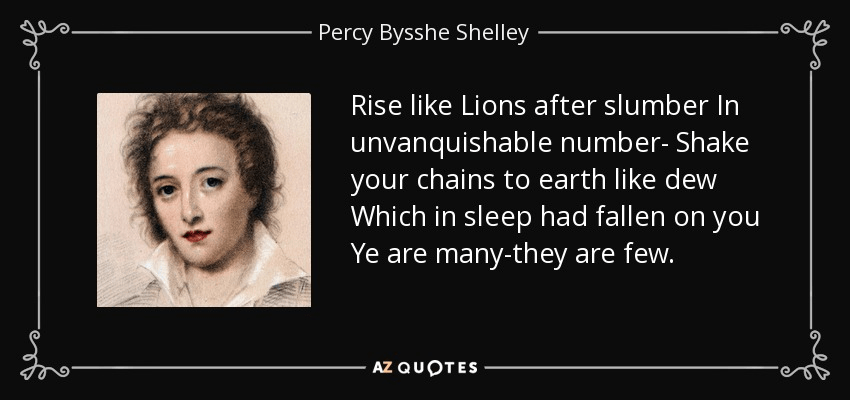
So to willingly accept that it is possible as this question presumes that I can name ‘one word that describes’ me, is to accept an important presumption that flies in the name of what I believe: that the diverse rights of the MANY matter more than those of any UNITARY SELF, that communal interest trumps self-interest, that multiplicity gives savour to life not dry reductive unity. In the work of Shelley, another Neo-Platonist mind, I think this applies to politics, too.
Thus, asked for ‘one word’ that describes you, stand up for your intersectional diversity and contradiction – the right to comprehend the complexity of a world made up of multiple determinations and readings of the truth, including of course your own agency. That will involve embracing those things too that you would rather not be or include in your legionary being (the devils of self-interest), but my belief is that if we don’t do that, we will never see their face for long enough to say: ‘you presume too much – other voices can and will represent me better when I act in the best way I can’.
To say ‘my name is LEGION’ is the stuff of horror genres these day, but I suspect that is itself itself a sign that we are pulled to acknowledge the fear that we are not so simple as we like to think life is or can be reduced to.
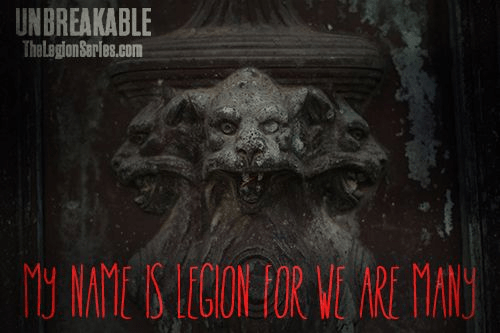
And to call for unity or pretend that reality can be reducible to single or even hegemonic causes, as science once tried to pretend but does no longer, is to go along with an illusion aimed at cheering us up – or giving the appearance of doing so. There is no one thing necessary, be it CULTURE in Matthew Arnold’s formulation or A HIGHER POWER in Alcoholics Anonymous (AA). Indeed, the best defence of the AA’s need for a HIgher Power is one I justvyestrday found in a novel I am reading to blog upon later: Martyr by the American-Iranian queer poet Kaveh Akbar wherein the protagonist’s mentor in AA, asked to define the Higher Power, says: ‘”Who cares?” Gabe answered. “To not-your-own-massive-fucking-ego. That’s the only part that matters”‘. [1]
The last quotation could, without (at least, in a public place) the expletives, have been said by Carl Jung, as the main theorist of the AA approach, for whom alcohol dependence was a form of narcissism. And Jung might have pointed proplecwhobqueried him to the many or the legion that in fact populated the unconscious in his rather airy-fairy formulations of the Unconscious, as a resource serving a Higher Power, that need not be ONE THING alone but can be controlled by refusing to deny one’s multiplicity. Multiplicity is a thing that the Ego– in Freud as Ich (I) as well as Jung – hates, so dependent is it on the principle of UNITY in its fight against the contradictoriness of the IT – ES – (ID).
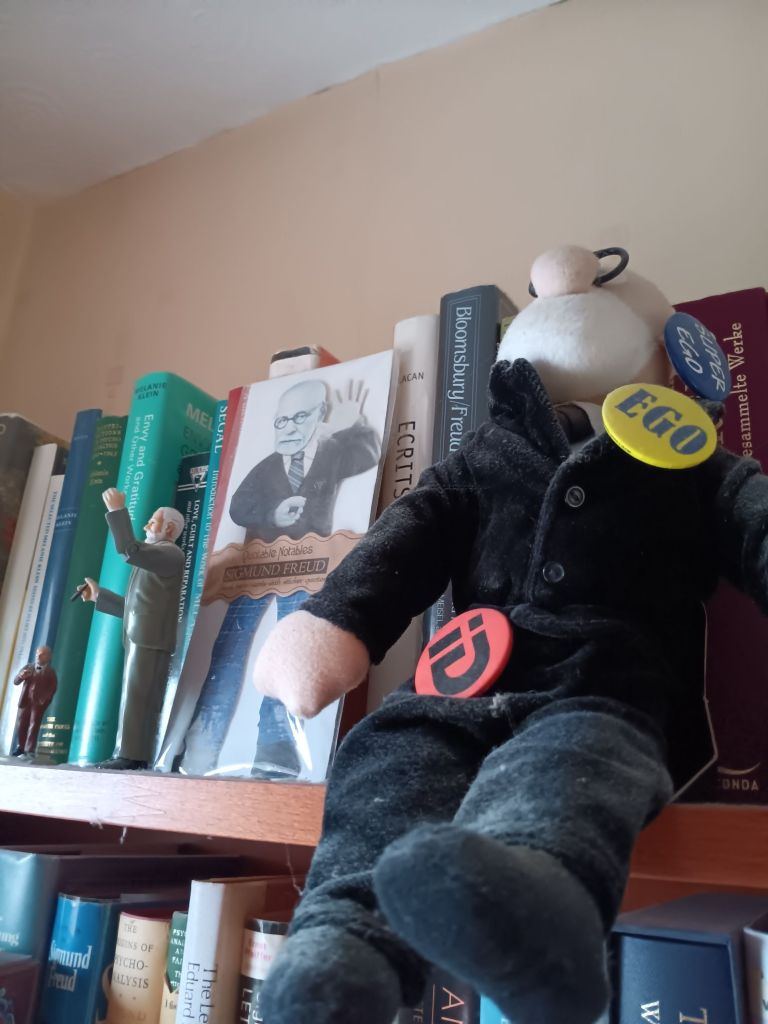
You shiver when you say it – so deep is the taboo – but let’s embrace the statement, ‘I am Legion’. I can not anyway find ‘ one word that describes’ me but LEGION, for I would prefer to be WE than I, for ‘we are MANY’. And the many does not represent giving oneself to the ‘unclean’, the fragmented or the anarchic but the finding of a way through to a life that does not depend on EXCLUSION to find value in itself. In The Masque of Anarchy, Shelley understood that it is Anarchy, in the form of an oppressive British so-called government (and Tory Castlereagh in particular) siding with Capitalism as the only allowable agent of change in the evil status quo, that caused Peterloos and other Massacres of the Innocents oppressed by that status quo and its one permissable change agent. There is, after all, an order winnable for the diverse many represented in the best ideals of community and the communal, where not only oneness or one person claims deity, political power, and regulation of behaviour (God’s, presidents or laws).
Last came Anarchy; he rode
On a white horse, splashed with blood;
He was pale even to the lips,
Like Death in the Apocalypse.And he wore a kingly crown;
Cited: https://socialistvoice.ie/2019/08/ye-are-many-they-are-few-percy-bysshe-shelley-and-the-struggle-against-tyranny/
And in his grasp a sceptre shone;
On his brow this mark I saw—
“I am God, and King, and Law!”
With love to you all in all your diversities,
Steven xxxxxxxxxxxx
______________________________________________________________
[1] Kaveh Akbar (2024: 28) Martyr London, Picador.
 Steve_Bamlett_blog