



‘Confidence ‘ is a word that must seem to have the most straightforward of etymologies, where notions of faith and trust derive straight from the Latin (and we are told Old French) to engineer the fact that it as about belief and trust. In brief, you can do things WITH (con-) FAITH (-fides) in another or in yourself, and think you KNOW that in all circumstances these persons will act in the way they tell you they will do, or otherwise indicate by their actions.
The Romans even made a God of FIDES, so important was that abstract thing to the conduct of Republican virtue in the life of an empire based on the integrity of authority to be what it says it is: whether in public or private situations. It is the cornerstone of that thing we call ‘integrity’, a refusal to act in a way that is contradictory or ambiguous about previously understood intentions. Yet, it is, as it were, that such cultures needed this term mainly because putting trust in people so often failed you, whether in the election of people fit to govern or to plight an enduring love or other loyalty.
It is hardly surprising that Fides appears on the reverse side of Roman coins, for they too require your trust that the value they say they bear will be sustained in the event, however long you keep them, for the moment they will be needed.
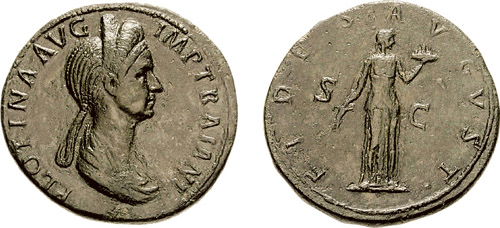
Pompeia Plotina coin, celebrating Fides on the reverse. By Classical Numismatic Group, Inc. http://www.cngcoins.com, CC BY-SA 3.0, https://commons.wikimedia.org/w/index.php?curid=5696753
Wikipedia makes the point about the basis of the importance of the ‘virtue’ of faith and trust in the ability of things and persons to live up to their stated verbal promises very well indeed:
Fides (Latin: Fidēs) was the goddess of trust, faithfulness, and good faith (bona fides) in ancient Roman religion.[1][2] She was one of the original virtues to be considered an actual religious divinity.[3] Fides is everything that is required for “honour and credibility, from fidelity in marriage, to contractual arrangements, and the obligation soldiers owed to Rome.”[4] Fides also means reliability, “reliability between two parties, which is always reciprocal.” and “bedrock of relations between people and their communities”,[5] and then it was turned into a Roman deity and from which we gain the English word, ‘fidelity‘.[6]
https://en.wikipedia.org/wiki/Fides_(deity)
The need for TRUST and FAITH in others seems to go hand-in-hand then with situations where doubt is as prominent in one’s belief system as faith, where one’s fears mirror one’s hopes. They do so because you believe that the presence or absence of that person or thing decides the nature and meaning of your consciousness of fulfiment or something like that.
The very useful etymology site etymonline.com though shares that the pressure of this ambivalence becomes even more evident as things we like to call ‘contractual’ signify more in our relationships of all kinds, sometimes based only in ‘good faith’. Socio-culturally they are so in societies which emphasise the absoluteness of the contractual or its equivalents, in social systems of exchanged values for instance that use the contractual as a means of regulating behaviour, whether in relationships, politics or commerce. Confidence becomes a thing as associated with the mechanisms of deceit as with ‘good faith’. It even infects relationships with oneself, to the point that the failure to commit and engage with the true sources of your combined feelings and thought are called by the existentialists, such as Sartre and Camus, ‘Mauvaise foi‘ or BAD FAITH.
confidence (n.)
c. 1400, “assurance or belief in the good will, veracity, etc. of another,” from Old French confidence or directly from Latin confidentia, from confidentem (nominative confidens) “firmly trusting, bold,” present participle of confidere “to have full trust or reliance,” from assimilated form of com, here perhaps an intensive prefix (see com-), + fidere “to trust” (from PIE root *bheidh- “to trust, confide, persuade”).
From mid-15c. as “reliance on one’s own powers, resources, or circumstances, self-assurance.” Meaning “certainty of a proposition or assertion, sureness with regard to a fact” is from 1550s. Meaning “a secret, a private communication” is from 1590s. The connection with swindling (see con (adj.)) dates to mid-19c. and comes from the notion of the false “trustworthiness” which is the key to the game.
https://www.etymonline.com/word/confidence
We are in the realm of the ‘confidence man’, or often too ‘woman’, a term applied rightly or wrongly to the deceitful who prey on our need to believe in others. The realms that covers included from the start a whole range of contexts: such as peddlers of religious truth (like Chaucer’s Pardoner whose love life Chaucer too suspects of perfidy.
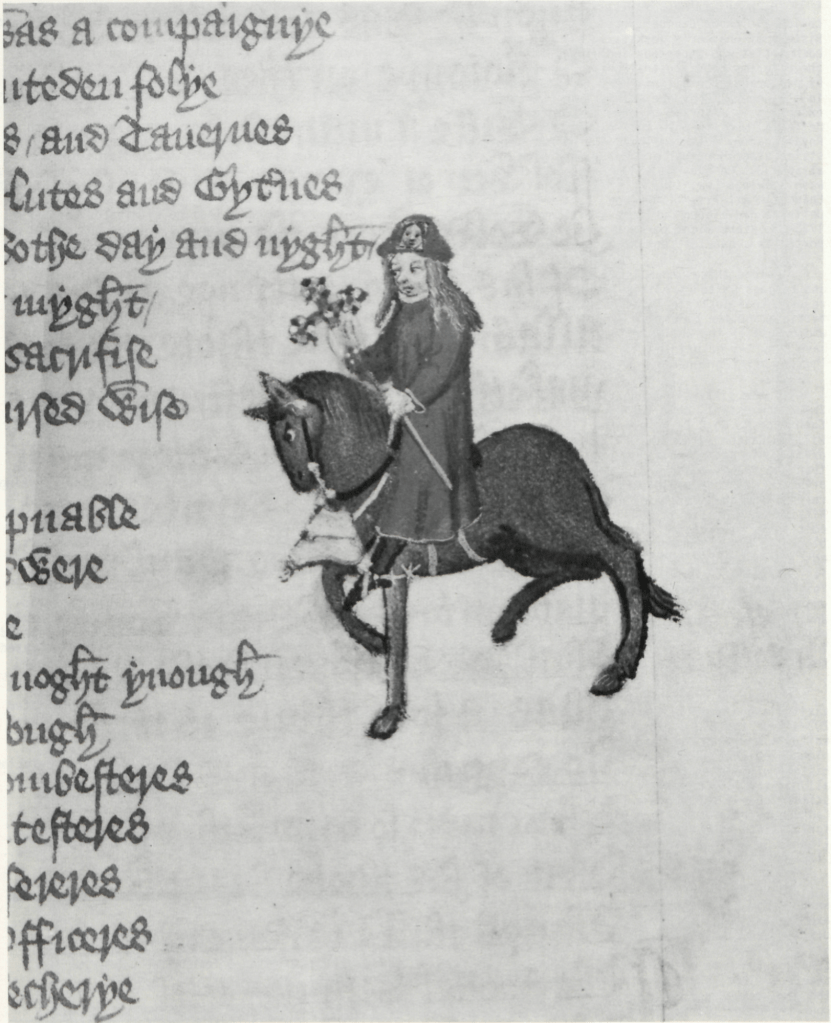
With him there rode a gentle Pardoner
Of Rouncival, his friend and his compeer
That straight was comèn from the court of Rome.
Full loud he sang "Come hither love to me."
This Summoner bore to him a stiff burdoun.       (ll. 669–674)
The stiff burdoun is the bass refrain of the song. But in addition, bourdon can also mean pilgrim’s staff. The implications of the Summoner bearing a stiff staff to the Pardoner while they sing a love duet are obvious.
https://literature.stackexchange.com/questions/3154/significance-of-the-pardoners-hair-style
Chaucer’s reflection of heteronormative integrity, whilst nothing like that quality as it is professed in contemporary life because Chaucer understands this relationship will seem richly individuating rather than socially negative, nevertheless prefers a lusty Wife of Bath to a Pardoner to whom the Summoner bears, and bares, his ‘stif bardoun”. Both are Catholic pretenders whom gave been too long in Rome and too implicated by foreign Popish falsity to be much good to the English sense, in the court of Edward III (having recovered from Edward II), that only in their country was there true integrity.
In the Renaissance, false lovers can allegorically also represent false beliefs. Hence Duessa in Spenser’s The Faerie Queene can be the ‘Whore of Babylon’, the ‘scarlet woman’ of Revelations, the falsity of the Catholic Church as post-English-Reformation Spenser saw it,and an everyday seductive femme fatale who betrays true love by enacting her opposite Una whilst being duplicitous,is the very symbol of everything integral, like the Elizabeth I also represented by her.
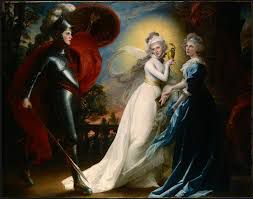
In the twentieth century a confidence man was a kind of false merchant or spy, when he wasn’t after the wealth of older women, and played a large part in the film noir genre of the mid-century, as did the Femme fatale, the confidence woman, more false and more deadly. For she is both more seductive than merely cunning in those age’s representations of her..


Do not expect it then to be simple to identify a person in one’s life with the most confidence, for the likelihood is they may have betrayed you or are still doing so. Adept at extreme protestations of both affection, need, and their own vulnerability, their confidence will be motivated entirely narcissistically and rarely test itself with a genuine or objective measurement of its efficacy. Such confidence merchants know the vulnerable and lacking-in-confidence will find in them the revelation of a truth they have searched for in vain in the past even when it doesn’t exist.
In fact I remember now I knew a man whose confidence in his own integrity veered between the most enormous self- doubt as if he did not really even trust himself and absolute bragadocchio.
His modus operandi (way of working) was to project his own bad feelings about himself into others around him such that it seemed they whom must be causing his distress. It was a distress he tried to hide under drink and faked self-belief that was merely a shade of the real thing, faith, for instance, in his ‘intelligence’, or even ‘dependability ‘. He liked being needed by others that he knew he did not want to need in return. Having abandoned his sister for her perfidy to him, and insanity, and constantly wishing her dead in wild statements of this case, he turned that characterisation to others when it suited. How controlled those behaviours were and are, none will ever know, least of all himself and now I am fairly sure I do not want to know.
Yet in the little I see of his public persona after I saw him no more, boastful confidence in self remains the key trait, although sometimes with its opposite. To have loved someone like this is hard. For you never stop loving them in your dreams, because they are that which you will ever lack, and have always lacked if you have fallen deeply. The point is to realise that you do not stop paying the price for the unwarranted trust evoked and betrayed, or for the insane jealousy provoked when the signals of ending are present under cover and yet constantly denied and peppered with surprising assertions of absolute devotion so that you disbelieve yourself not he.

Smug bragadocchio. Lol.
Confidence is a tool of social behaviour and social organisation the most needed when it is rare, which is when in truth it ought not to exist, for like certainty, it is likely to be a mirage. That is to say, it is needed by the overly needy because it rests on its alterities; those othernesses where belief disables perception and action. Reason alone won’t help here. What might help is a development of kindness to self and, if possible, self-love too. Honesty with others will help, too. For we can be confident in nothing but change and the will to face change head on and embrace it. And of course, proven people. My husband Geoff is one such for me.
With all my love,
Steven xxxxx.
 Steve_Bamlett_blog