


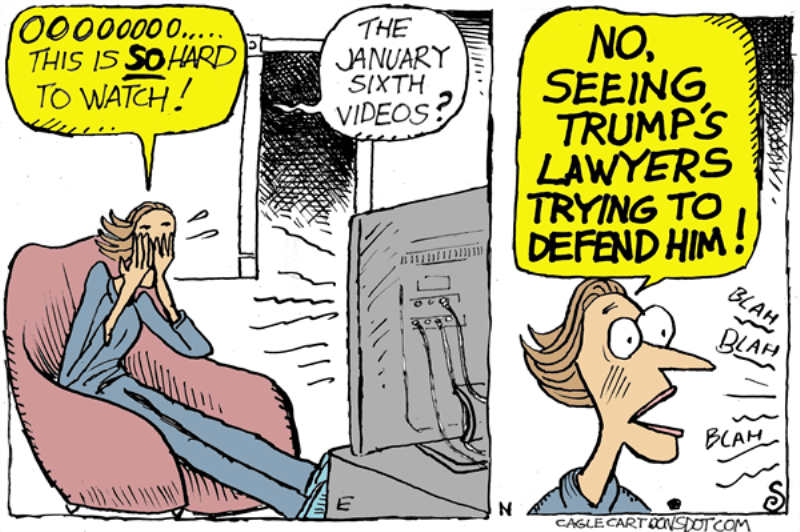
The study of leadership rather than an obsession with it is a vital task. It is the latter which produces what we too often call ‘leaders’ in contemporary life, who are, in brief, people who abuse relative power over others in order to assert a line of action whose success they alone are allowed to judge. Their success becomes a matter of debate despite evidence. In this state of affairs all evidence is thought to be suspicious, tarred as ‘fake news’ and is so often overlaid with purchasable power of persuasion and manipulation that it loses all force that it had even when evidence available in plain sight as in Donald Trump’s assumption of leadership of an attack on the central House of Government in Washington in order to avoid the consequences of having clearly lost an election, where even that evidence was overlaid by confident assertion supported by the interests of those served by right-wing governments like Trump’s. This attitude to over-weighing evidence by the spin of unjustifiable elaboration of interpretation is also Donald Trump’s practice in the courtroom facing charges of sexual plunder ‘(‘natural’ male leadership-in-sex behaviour as he sees it), or alleged malpractice in either business, relationships with international dictators or the conduct of government, as well as in public opinion and voter caucuses. Hence the vast sums of his apparently bottomless wealth that Donald Trump ‘invests’ in lawyers and spin doctors.
In Britain, since Thatcher (and Blair) leadership is a matter of the control of interpretation and strategic manipulation that only shows at its worst in the hands of highly incompetent driven persons such as the present Tory party throws up: Boris Johnson, Liz Truss and Rishi Sunak whose entire concept of leadership is based on manipulation, assertion and dependence on a skewed press and unquestioned set of institutions in the public and private sector, or crossing both, as in the notorious case of the Post Office and its relationship with Fujitsu.
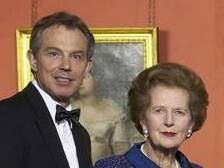
Together in 2022
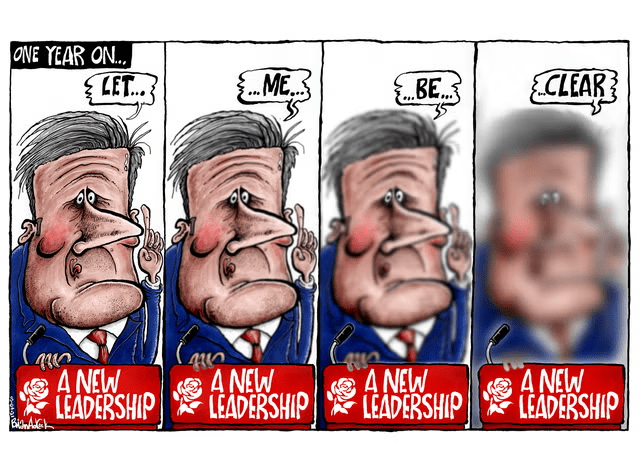
So commonplace is that view of leadership that Keir Starmer adopts it lock, stock and barrel learning, as one recent brilliant cartoon put it yesterday only the art of ‘standing still’ whilst opponents slog it out, except in the case of the already defeated – hence the fact of hanging his leadership credentials entirely on his own version of a Harrowing of Hell mythology, that consists of little more than the further and deeper humiliation to all lengths of possibility of Jeremy Corbyn.
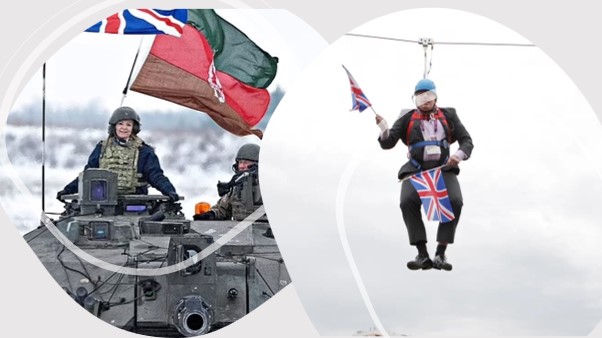
So much then for the obsession with unsubstantiated claims of being a true leader, often dressed up with ridiculous stunts in the case of Boris Johnson (that often misfired) or play with military imagery such as used by Truss sitting in tanks as if off to a victory in land war.
The study of leadership is a different thing and it used to be possible to discuss it in relation to the basic principle of ensuring leadership that is consonant with principled and progressive objectives AND the maintenance of positive human inter-relationship. I am told it still happens in business but I have my doubts whether it is pursued with anything I would recognise as probity depend on the fact that the goals of such leadership only apply to a group or corporate self-interest, only one step away from individualistic self-interest, and probably the latter’ corollary. I the 1950s it was not quite like that. Then the name of Wilfred Bion was used often. Take this discussion of his ‘leaderless group technique’ to study and determine leadership that not only works but is based on humane as well as psychological principle, though employed in war (for Bion’s ideas developed from war-time experiences of his own war trauma).
SINCE human behavior and personality involve constant interaction with other humans, assessment of an individual’s behavior and personality may profitably be made of the individual while he is a member of a group. This is especially true when one is interested in locating potential leaders. The leaderless group test probably is the best device for this purpose although no clear cut studies of the validity of the technique have been reported. For civilian purposes, the leaderless group discussion is the group test situation which has been used in the past and will be used most widely in the future.
The leaderless group discussion technique B.M. Bass (Personnel Psychology, 1950 - Wiley Online Library)
Take or leave the view that these methods were untested in 1950. in many ways they are ‘untestable’ because they not only determine who might be the better of several candidates for leadership – in this case applicants for ‘officer’ status in the British Army but also the generation of the criteria that make leaders effective, psychological comfortable in themselves and acceptable t others in that role. In progressive politics, such a person may still be needed. In 1946, Bion himself stressed that one function of his procedure was to test:
the way in which a man’s capacity for personal relationships stand up under the strain of his own and other men’s fear of failure and desires for personal success.
The leaderless group project, Wilfred R. Bion (Bulletin of the Menninger Clinic, 1946)
This displacement of self in the interests of a solution in the group is important. It is often called ‘leadership by consensus’ but that is not it at all, for people assume ‘consensus’ and forever interpret it differently (sometimes paradoxically in polarised ways), as in the myth of a ‘centrist’ political position. The important thing is that the role is actually about handling stress during change that seems to threaten individuals qua individuals. This is a fact of change of course, because individuality itself is a social construct, whose meaning and role in the networks that make up complex communities will inevitably be changed in the politics of the group. But its management is essential, as is the establishment of a view that all must be involved in the direction of change which may mean reconfiguration of the loci of political decision-making.
I do not even pretend to see answers to this issue although I think political thinking must have some new directions, multiple ones such as electoral reform might be a step in achieving the diversification of political voices and the interests that get voiced. There are still potentials in the unacknowledged brilliance of Gramsci here. But even more bizarre of me, I propose that there are still legs on the proposition of Percy Bysshe Shelley that ‘ poets are the unacknowledged legislators of the world. Note, for instance, the wisdom, for instance in one of our finest modern poets, to me probably the best, Andrew McMillan (and the fact that he is a queer, young and beautiful person influences me not at all).

In an article in yesterday’s The Guardian, he writes of his new novel coming out soon thus:
One of the things I try to wrestle with in my new novel is the question of who gets to tell the story of a place, and what story do we even mean? The characters – a drag queen trying to reshape understanding of the town’s past, a former miner still grappling with how to carry what was lost into the future, a security guard at the Alhambra shopping centre, a sex worker, a call centre employee trying to make ends meet, academics bringing an outsider perspective as they work on a community ethnography and history project, a young poet with armfuls of tattoos who may or may not be me – all wrestle with that idea.
Towards the end, in their final section of Fieldnotes, the academics in the novel write: “We are certain that the story a place tells of itself should be more important than the story which is told about it”, before going on to complicate their own assertion by wondering “which story the town might tell of itself do we really mean … anybody carving out small chunks of story from the wall of sound and noise and memory is doing so selectively, and a small nugget of something larger should never be taken to be the thing itself”. …
Andrew Macmillan (2024:45) ‘The view from here’ in ‘The Guardian’ (Weekend) 43 – 45 Available online at: https://www.theguardian.com/books/2024/jan/27/beyond-cliche-and-condescension-we-need-new-stories-about-the-north
Herein is wisdom. There is no pretence that the story of a group of people unknown to each other except as part of a ‘place’ is easy to represent. nor can an assumption that a ‘soviet’ might be the answer for localised direction of governance. It would not, nor was not in Russia when power still came top-down from the Russian understanding of Marx’s vague term, ‘ the dictatorship of the proletariat’. Rather, a story must have the bricolage of numerous stories underneath it, from the miner that time seems to have passed by, a drag queen, several progressive academics and a tattooed queer poet, who, as McMillan says, may or may not be himself.
I haven’t read this book yet but have it ordered for publication day and have booked seats for hubby and self when Andrew appears at a bookshop in Whitley Bay this month to get it signed. But this article already implies all that I need for this blog. That is that knowing the meaning and direction of any place, and all places need a difference of treatment respecting their populations, also needs to respect non-tradition based groups, or, at least groups not thought of in the stereotypes of that place as ‘native’ to be represented and enabled if a voice and empowered to implement the otherwise disregarded needs of that group.
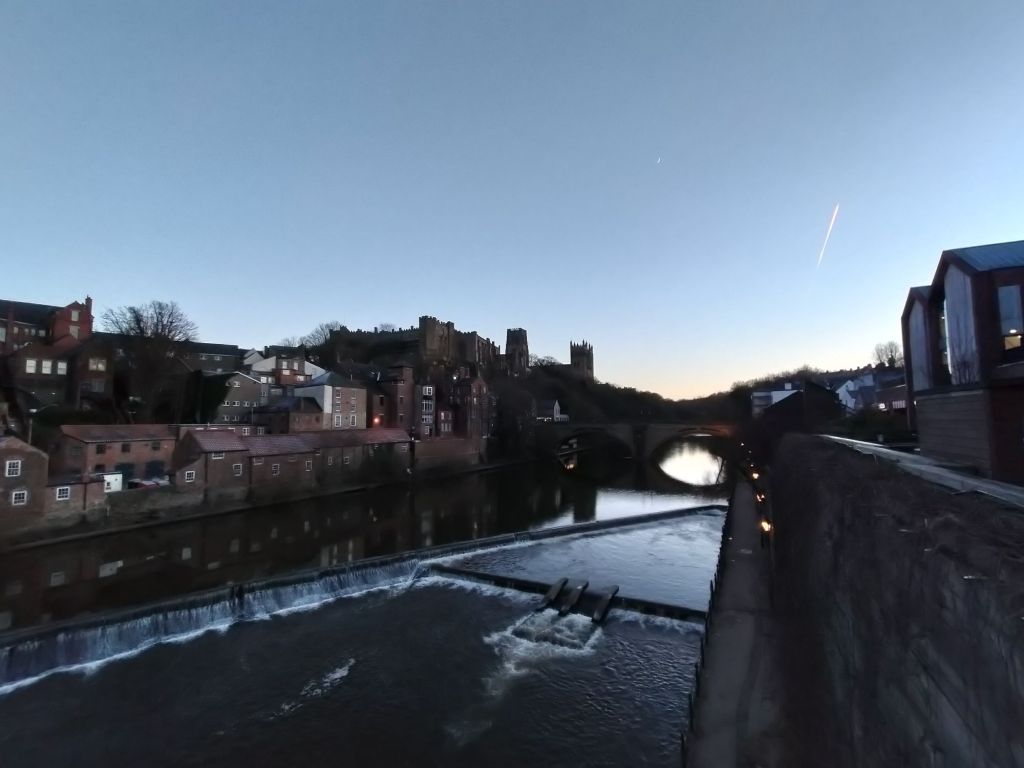
In the article too McMillan praises writers already on a page containing similar multiple perspectives on the local and he mentions another favourite of my own, Benjamin Myers (we will more than one for he invokes Nzelu too). Recently I blogged on how Myers has made representations of my local city, Durham, that though they start with the city’s heart in the myths of St. Cuthbert, moves on to show a city of variegated interests and perspectives that still needs the myth of Cuthbert’s human significance to be alive in it. Read that blog at this link.
Well, so much for leadership. I was never a good leader myself and my understanding of Bion explains why! The truth is I quail at fear of failing, especially failing others. But one wishes that the Liz Trusses of this world had some suchlike humility too. I doubt that humility is coming our way anytime soon.
With love
Steven xxxxx
 Steve_Bamlett_blog