What is your mission?
Each day he used the same route to work and each evening the same route in reverse back to his home. Each evening, he sat exhausted in front of the TV, and registered very little from its surface. One day, his employer decided that the business needed revamping, and found a way through the corporate lawyers to make all his workforce redundant, whilst allowing them to reapply for their own jobs.
Hector glanced over the letter telling him this without quite understanding. He couldn’t see a better way of doing his work yet the interview letter said he must write a mission statement that set targets and goals as well as aspirations, and that he must append to it a plan of how some of the goals might be met within one year, and others show progress to attainment using objective measures or sub-goals toward completion. None of it meant much to Hector.
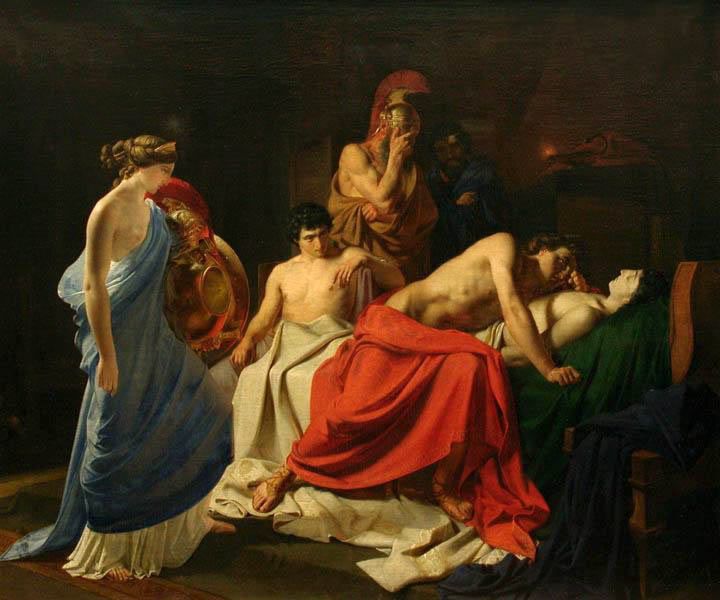
A mission was a thing believers had. He knew that because, as a boy, he had dreamed that he might be a missionary and spread the Word of the God whose undoubted existence then to him seemed to give all the meaning he wanted to life, and some hope. But he was young then and that God had died or was, as someone said, paring his nails till the old creation wound down into chaos, insignificance and self-willed Apocalypse. No person or belief took God’s vacant place, though Hector sometimes dreamt of reading about Achilles and Patroclus in love in the Greek text he kept from his college studies.
Somehow a mission to increase footfall in the shop selling leather goods he managed seemed nonsensical. The more websites he tapped on, the more confused he got in trying to sort out what the difference might be in expressing a particular ‘mission’ that would increase the number of handbags swinging from hands free to hold them, and what might be a specific goal in realising his mission. Instead he thought of the number of animal carcasses his increased sales would require to be sourced. As he thought the abstract numbers in his mind began to bleed and his imagination was a wide space stained with uneven flows of fluid reds and denser purple.
The colours solidified into gleaming viscera and the spill of blood thickened into a darkness like that of the black pudding his mother used to force him to eat. There was nothing of the moralist about Hector, or so he often thought. The world was what it was and its cruelties reflected the realities of an animal that had got above itself in the belief that what it thought or did could change the basics of our nature. And yet wasn’t the mission, that he couldn’t come up with, another way of up-scaling the ability of humans to prove their value in further massacre of the bred for dead cattle he imagined hemmed into a narrow lane on the way to slaughter.
Hector cried. His arms seemed weak – even too weak to hold the flimsy letter he was reading. His arms would once, a thought crossed His mind, had carried the body of Patroclus to be anointed by his lover, Achilles. But that was all a story. And besides, Hector laughed to himself for the last time, ‘it was me that killed Patroclus’, he thought. His head seemed to roll from his shoulders held back by still resistant muscle in his neck from entirely detaching itself and float down the river of thickening blood he still imagined.
And so the first day of Hector’s dissolution began. He didn’t go into work that day, didn’t telephone to alert anyone, didn’t even care about Helen, his assistant who had probably received a similar letter and needed him as she often said she did to ‘get her mind sorted’. Who will weep for Helen, whose face had launched a thousand placid cows into a channel leading only to a stun gun and the knife.
And day followed day and letters piled behind the door, many no doubt from his employers fretting about how they should follow a protocol for his non-response that might exonerate them in any later suicide enquiry. Hector rarely moved but to go to the toilet occasionally. Few people ever visited him, less and less as the days went on even glanced at the window on passing, faces that he had convinced himself he knew.
Hector’s body was found many months later, following an alert about the ‘stink’ from his flat by a worried neighbour. The neighbour didn’t know Hector’s name; had barely registered him but to nod as each departed their flat at the same time each morning. It only struck Hector’s neighbour now that he hadn’t seen Hector for what must be very many months. They found a note eventually buried in a sketch pad with doodles and shopping lists ages old. He said:’Since I have no mission, I must have no hope’. Many thought that was sad – for a moment.
But, after all, no-one was to blame they thought but Hector, before the short process of forgetting him entirely set in. He was always so earnest and so kind to the kids. Who would have thought that he could think and feel like that. It’s insane!
Hector’s father, who lived in Paris, couldn’t get to the funeral. Hector would have understood, Priam thought. He always was a troubled boy.
And they all went back to their lives keeping their mission unrevealed, for , after all, missions were for missionaries, like revolution was for revolutionaries.
———————————————————–
Love to you and love to Hector ❤️
Steven xxxx
 Steve_Bamlett_blog