



Rhetorical questions are those which ask you to assume a lot of meaning before you answer them. ‘Where can you reduce clutter in your life?’ First of all I must assume I accept a common definition of clutter. Yet there is no definition of this word that is culture-free and value-free. It assumes notions of the management of space for instance that change over time and across cultures. It was once, for instance, novel to assume as Charles-Édouard Jeanneret (better known as Le Corbusier or Corbu) proposed that a ‘home’ was a ‘ machine for living in’. But now technocratic views of space are commonplace and shored round with justifications from considerations of social, personal and mental hygiene. We take it for granted that spaces need to be ‘managed’.
However, we need to remember, as we look at these assumptions, that Hygeia was a goddess of health, not of the identification of dirt or pollutants. Of course those notions were not such different things in Ancient Greece for dirt and pollution were clearly accepted as symbolic concepts (as constructions of behaviour such as incest and regicide) then. That is clear from any reading of The Oresteia. But anthropological interpretation, as most notably in the example of Mary Douglas’ book, Purity and Danger: An Analysis of Concepts of Pollution and Taboo, is not usually assumed in notions of health today, although its traces are, as with all things, probably deeply implicit in our technocracies. In Douglas’ analysis ‘dirt’ or ‘mess’ are always things associated with our fears of a moral and psychic pollution and things ‘out of place’ (hence Hygeia’s symbolic and theologically charged snake that ‘clutters’ her frontage in the statue below).
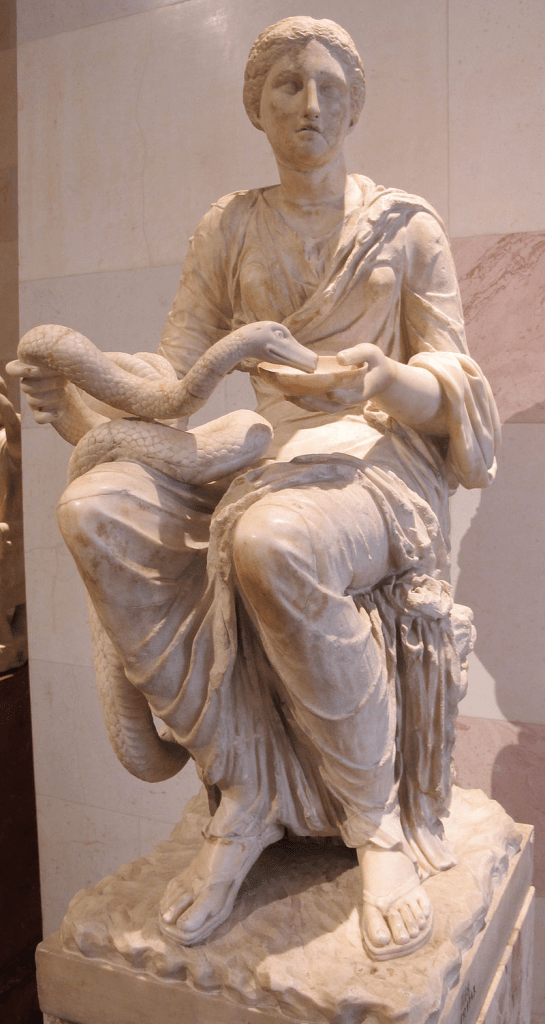
Hygeia, Greek goddess of health, Roman copy of 3rd Century BCE Greek statue. Photograh by I, Sailko, CC BY-SA 3.0, https://commons.wikimedia.org/w/index.php?curid=16480848
Ideas of home building and their exterior and interior furnishing change of course. Corbu’s notion (derived from original Bauhaus concepts) of what a democratic, sane and clean modernity of lifestyle and thinking was changed too from its origins, especially with regard to notions of decoration and ornamentation.
Corbu also had radical ideas when it came to architectural ornamentation, rejecting decorative traditions as outdated in the Machine Age. Critiquing the 1925 Exposition of Decorative Arts in Paris, he wrote: “The religion of beautiful materials is in its final death agony…. The almost hysterical onrush in recent years toward this quasi-orgy of decor is only the last spasm of a death already predictable.”
For full text see: https://99percentinvisible.org/article/machines-living-le-cobusiers-pivotal-five-points-architecture/
The definition of clutter implied in our question is clearly implicated in these cultural shifts. Lots of assumptions get made in it about what it means to live a satisfactory life, that are the product of changes to the political as well as the psycho-cultural tool (a tool replete with mirroring – reflexive and reflective – facilities) that is the mind. Popular mental health sites get into the act too; as in this infographic from the site Very Well Mind.
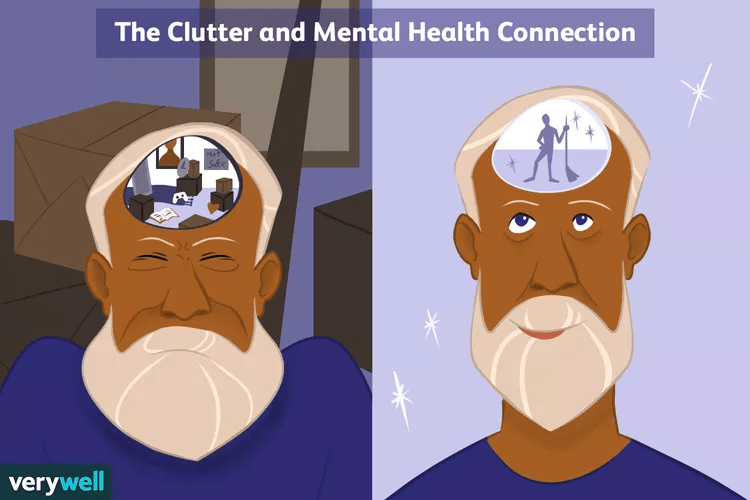
Illustration from: https://www.verywellmind.com/decluttering-our-house-to-cleanse-our-minds-5101511
Poor Stevie on the left in the collage above, as the viewer sees it of course (it’s always on the left– a sinister connection in every sense – see the definitions of ‘sinister’ at the link on the word) is in trouble. He is working inside his mind and out in an environmentally, physical and mental mess – his desk, office walls, his work style are all cluttered. Time is wasted and cluttered too – note the clock near to his head. Compare him to Stevie on the right, who has a dextrous broom; and we all know what a ‘new broom’ does, especially a dextral one.
And, if the word ‘life’ has fulsome associations, so does clutter. Even in blander definitions, like the one at the link, it carries with it notions of disorder and impeded efficiency. It is technocratic to the full. In popular mental health discourse, moreover, this view of things is backed up by studies. Cited studies, we are told, supported the notion that people, especially older people, need to sort themselves out and live in the present not in their accumulated memories in order to be healthy and ‘happy’ (I balk at the assumptions in that last word).
One study found that clutter, particularly among older adults, decreased overall life satisfaction. Other research has found that helping older adults find ways to tidy up and declutter could help them feel more accomplished and in control.[1]
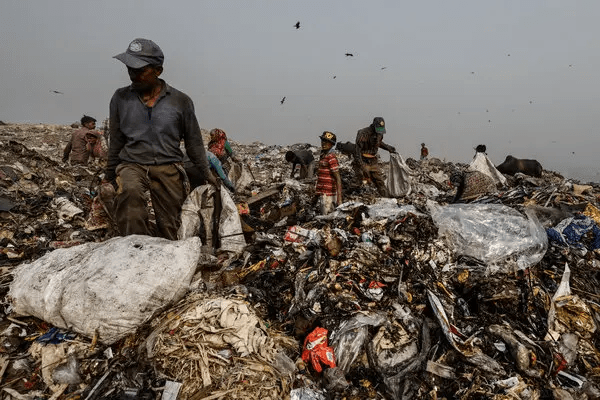
Be accomplished and be in control. We are in the world of what is known as care and self ‘management’, an area of discipline and control that Foucault, at the end of his short life, felt to be the key discourse of an oppressive ideology of culture. Nothing is good but that which can be managed in this technocratic world – nothing can be good that does not employ a ‘manager’, and proliferate extraneous expertise on nearly every aspect of ‘life’ and personal, social and environmental living. Yet it is an ideology only. It survives because our economies find unseen spaces (and among unseen and marginalised peoples) in which to dump ‘waste’, which it it is the purpose of continual economic growth in capitalism to increase.(2) Sometimes this ideology increases to a crescendo, as on the webpage blog at this link.
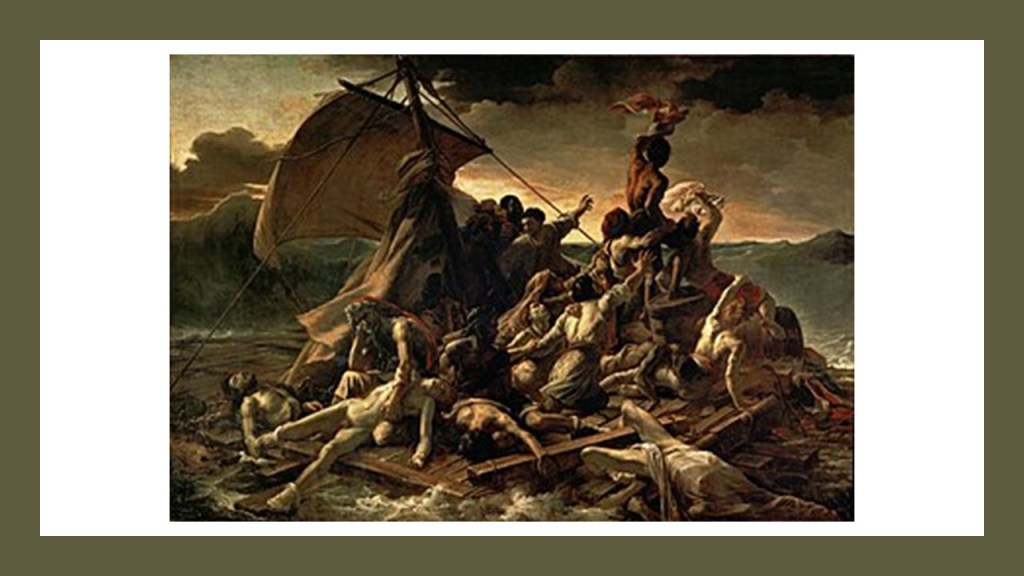
In a blog I am writing now (but it may take some time – so cluttered is my mind with toom many ideas and too much to say – LOL) I cite an Observer article by Tom de Freston where before a fire wipes out the whole content of years of work in his studio. Tom is the subject of that blog together with his work on Jean-Louis André Théodore Géricault’s The Wreck of the Medusa and he says therein: ‘The studio was overstuffed, no pause or resting place for the eye anywhere. It was, in hindsight, a self-portrait of a restless mind’.(3)
It is in another word, ‘clutter’ I suppose, and it caused a fire because he did not clear up his environment enough before working on his artwork with a blow torch. However, because one identifies a ‘restless’ mind in Tom de Freston, or Géricault, – and its dangers – does not mean that we create a plan of management that applies to everyone and everything. It cannot apply to art, for instance, which would be pushed into meaningless confusion by the application of this rule.
To apply the rule, of course, would not mean just the abandonment of the ornate and enfolded like Rococo and Baroque art, as Deleuze describes it, but any art that says ‘too much’ because there is ‘too much’ to say and the complicated world is ‘always with us’, like The Raft of Medusa or Michelangelo’s Sistine Chapel ceiling.
And speaking of art, let’s take that great artwork wherein an old and once great man who is forced to declutter, King Lear, loses his reason. Originally asked to cut the number of knights allowed in his retinue as a retired King from 100 to 50, eventually his youngest daughter, Regan, says (King Lear Act IV, Scene 2, 303) he doesn’t really NEED any retinue – louche soldiers get in the way after all, clutter things up: “What need one?”, she says. To which Lear replies:
O, reason not the need! Our basest beggars
Are in the poorest thing superfluous.
Allow not nature more than nature needs,
Man’s life is cheap as beast’s. Thou art a lady;
If only to go warm were gorgeous,
Why, nature needs not what thou gorgeous wear’st,
Which scarcely keeps thee warm. But, for true
need—
You heavens, give me that patience, patience I need!
You see me here, you gods, a poor old man
As full of grief as age, wretched in both.
If it be you that stirs these daughters’ hearts
Against their father, fool me not so much
To bear it tamely. Touch me with noble anger,
And let not women’s weapons, water drops,
Stain my man’s cheeks.—No, you unnatural hags,
I will have such revenges on you both
That all the world shall—I will do such things—
What they are yet I know not, but they shall be
The terrors of the Earth! You think I’ll weep.
No, I’ll not weep.
I have full cause of weeping, but this heart
Storm and tempest.
Shall break into a hundred thousand flaws
Or ere I’ll weep.—O Fool, I shall go mad!
(King Lear Act IV, Scene 2, 304- 327) See https://www.folger.edu/explore/shakespeares-works/king-lear/read/

Foolish, fond, old man though Lear be, his depth of misogyny at this point rivals his lack of knowledge of ‘our basest beggars’ (something he will learn in the coming tempest in his sojourn with Poor Tom in a wattle hut on a heath), his cry ‘Reason not the NEED’ is apposite. For in truth the life of humanity can be made as ‘cheap’ as that of ‘beasts’, as the Holocaust concentration camps showed. You only need a thorough ideology of social pollution and a way of managing it (Hitler’s was set out in Mein Kampf) and the ‘triumph of the will’ to apply that ideology. People will follow behind you with reasons to back you up – social, psychological and cultural hygiene, eugenics, and the rest. It is a point the neglected playwright C.P. Taylor makes in his play Good (see my blog on seeing the streaming of this play by the National Theatre with David Tennant in it here). That Lear goes mad and suffers is not because he is a clutterer, though he is, but because history has found him redundant – and by history I mean the onward march of self-interest that almost wins out in this play, and indeed already had in Jacobean England. Shakespeare even pointedly blamed the now dead Queen Elizabeth for this state of affairs in the ship of fools that was the nation (or as near as a censored theatre would allow):
EDGAR Look where he stands and glares!—Want’st
(King Lear Act III, Scene 6, 25 – 30) See https://www.folger.edu/explore/shakespeares-works/king-lear/read/
thou eyes at trial, madam?
⌜Sings.⌝ Come o’er the ⌜burn,⌝ Bessy, to me—
FOOL ⌜sings⌝
Her boat hath a leak,
And she must not speak
Why she dares not come over to thee.
There is no doubt I have an untidy mind. But I had rather keep it and the risks it entails than be ruled by people who think a ‘tidy’ world trumps all other complex considerations.
With all my love
Steven xxxxxxx
[1] But note that even this website says ‘one study’ to justify that claim (referring to: Ferrari JR, Roster CA. Delaying disposing: Examining the relationship between procrastination and clutter across generations. Curr Psychol 2018;37:426–431. doi:10.1007/s12144-017-9679-4).
[2] See for instance that novel of genius Satin Island by Tom McCarthy (based on the New York waste dump called Staten Island).
[3] Tom de Freston (2022) ‘Ten years of my art was lost in a fire I accidentally started – but I made better work from the ashes’ im The Observer (Sun 6 Mar 2022 11.00 GMT) Available at: https://www.theguardian.com/lifeandstyle/2022/mar/06/ten-years-of-my-art-was-lost-in-a-fire-i-started-accidentally-but-i-made-better-work-from-the-ashes
 Steve_Bamlett_blog
4 thoughts on “The fallacy of ‘allow not nature more than nature needs’. The danger of reductionism and a blunt Occam’s razor.”